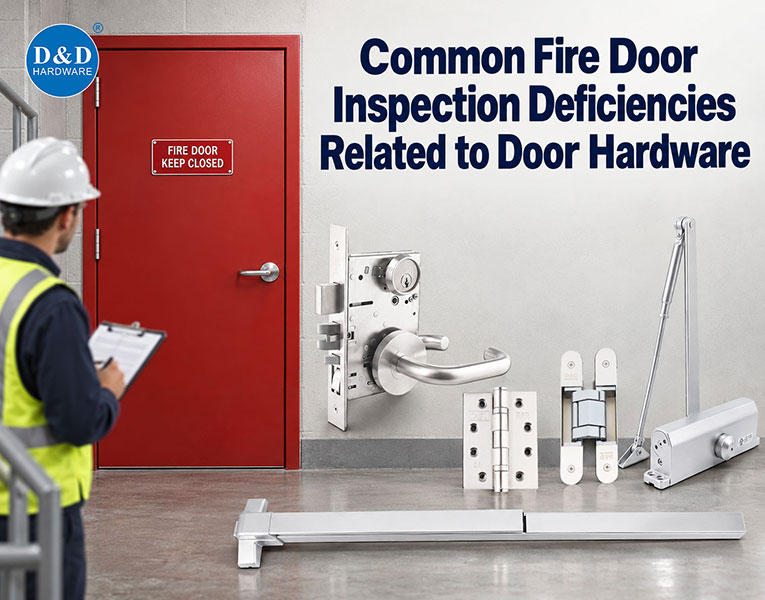
Why Hardware, Not the Door Leaf, Fails Inspections
Under NFPA 80's periodic inspection requirements, hardware deficiencies rank among the most frequently cited findings on fire-rated openings. The door leaf usually keeps its rating for decades; what fails is the hardware attached to it—the closer that lost its spring tension, the hinge swapped during a routine repair, the latch that no longer reaches the strike.
Most cost little to fix if found before inspection day. The ones that surface during the inspection tend to be the ones nobody checked. Here are the failures inspectors report most often, and how to verify each against certification records.

1. Missing or Unreadable Identification
The most common deficiency, and the easiest to prevent. Hardware on a fire-rated opening must carry legible identification so the inspector can match the installed product to a certified listing. Over time, labels get painted over, worn smooth, or buried under hardware the painter never removed. An inspector resolving a marking against UL Product iQ needs legible model information to work with—verify it before they arrive. If a marking is obscured, verify the product by model number against the manufacturer's certification records; an undocumented product is treated as non-compliant, no matter how well it performs.
When a component fails this check, the correction path runs through the certification documentation: the model number resolves to a UL file number showing the exact product categories and applications covered. A deficiency report that cites this record—and shows the replacement matching it—closes the loop in one pass. Specifying "equivalent" hardware without this check is how deficiencies recur at the next inspection.
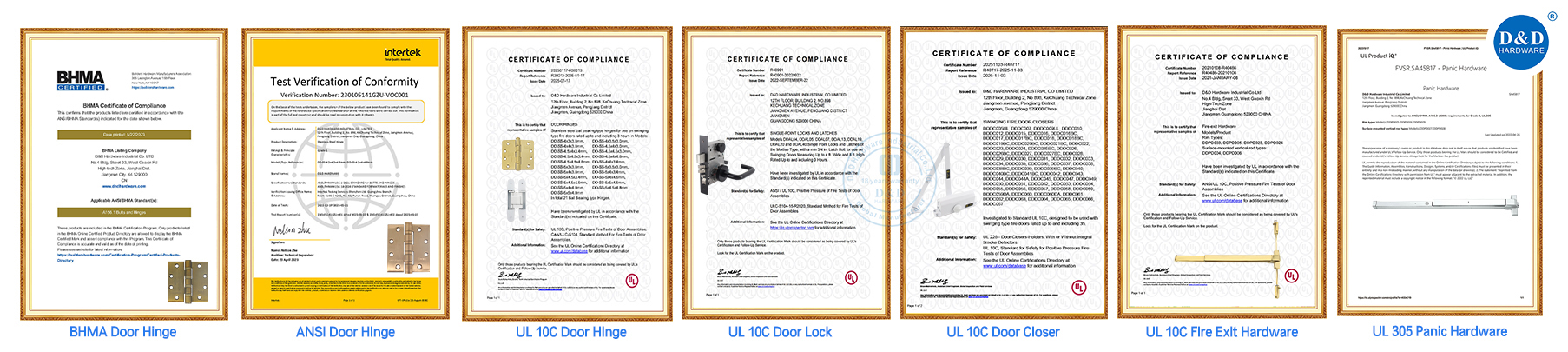
D&D UL Series Fire Rated Door Hardware:
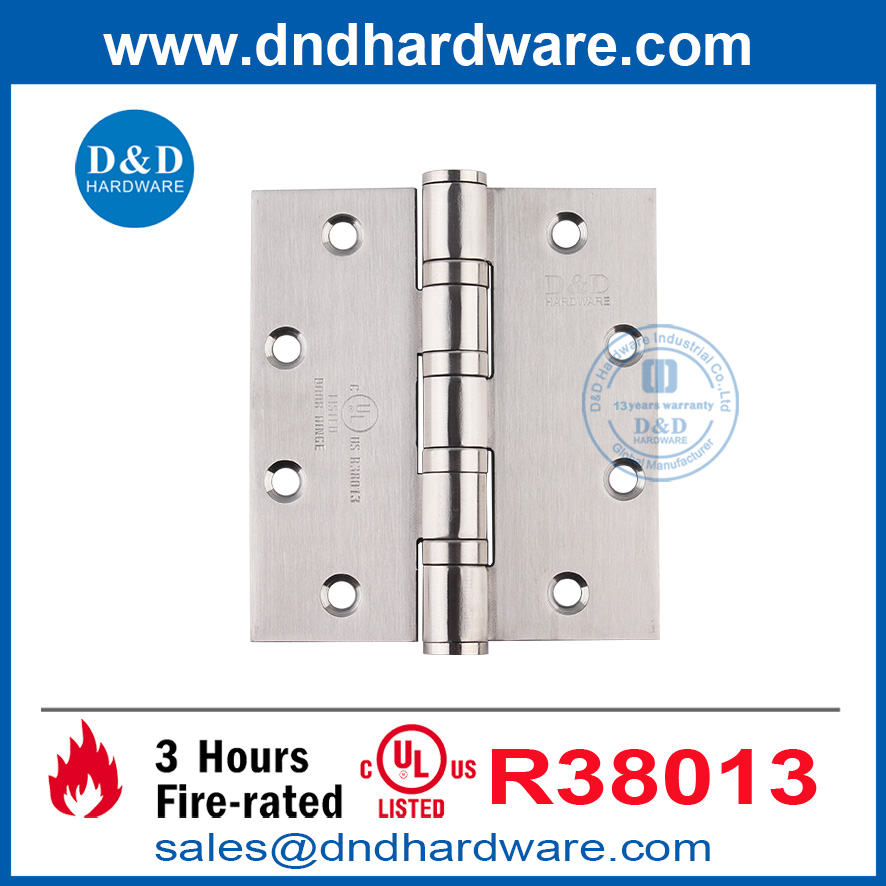
✔️ Door Hinge-UL/cUL UL 10C Fire Rated 3 Hours, File No.R38013 & ANSI/BHMA Grade1&Grade 2
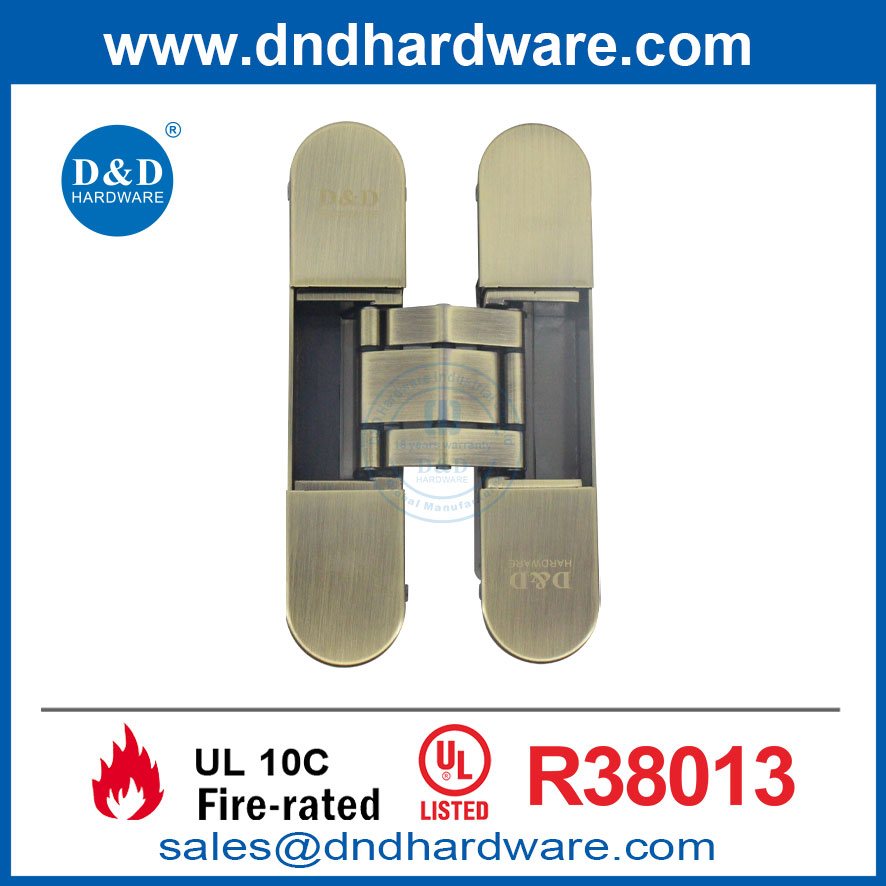
✔️ Concealed Hinge-UL 10C Fire Rated, File No.R38013
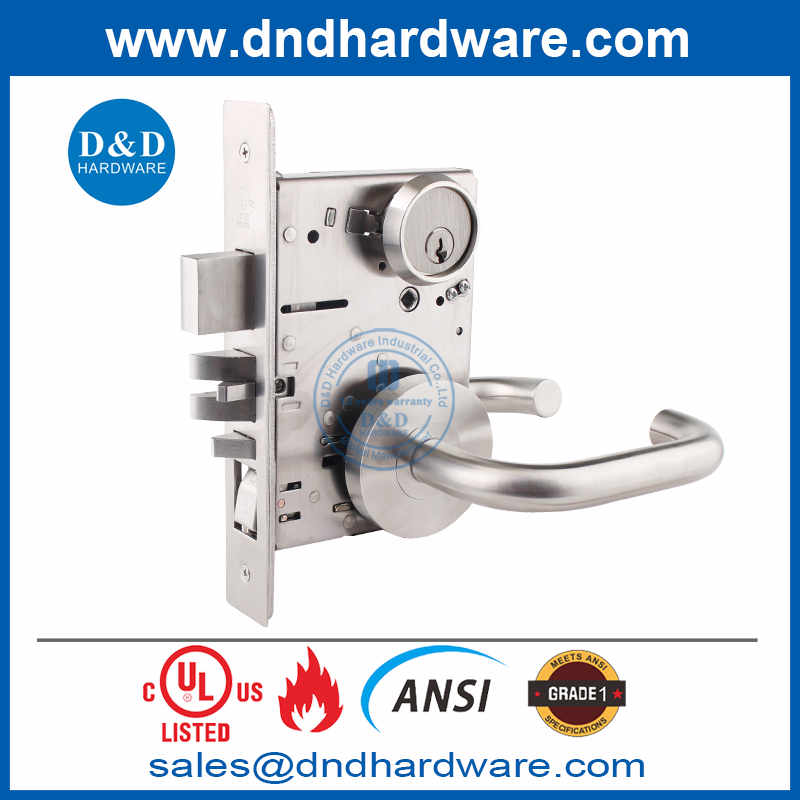
✔️ Door Lock-UL 10C Fire Rated 3 Hours,File No.R40901
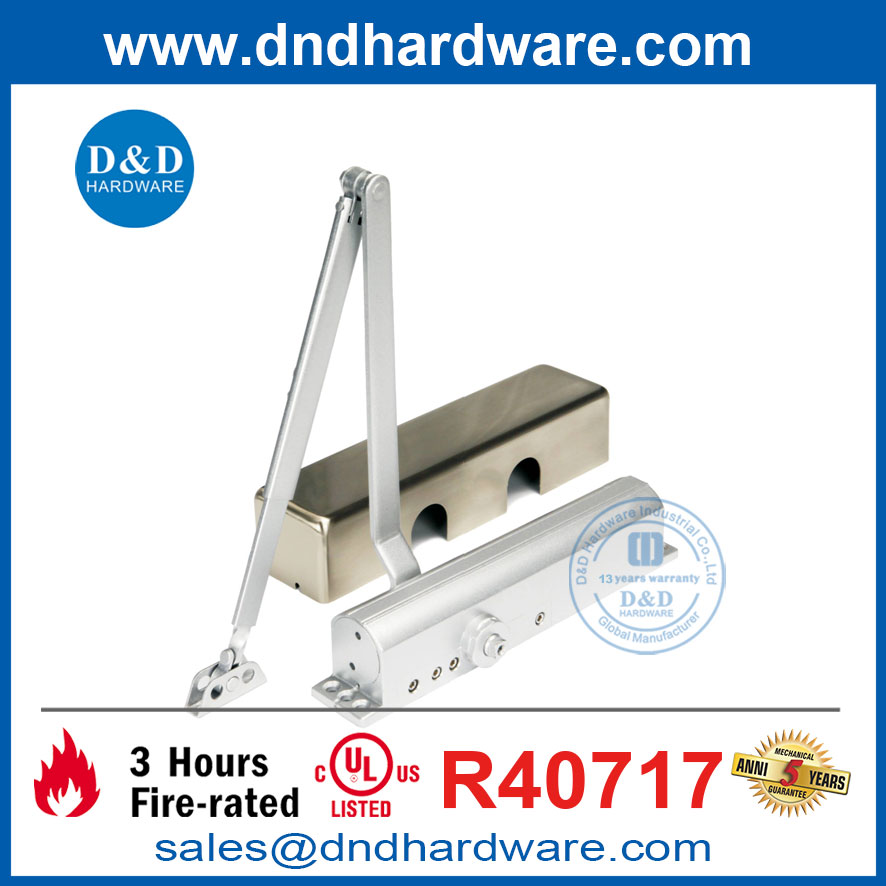
✔️ Door Closer-UL 10C Fire Rated 3 Hours, File No.R40717
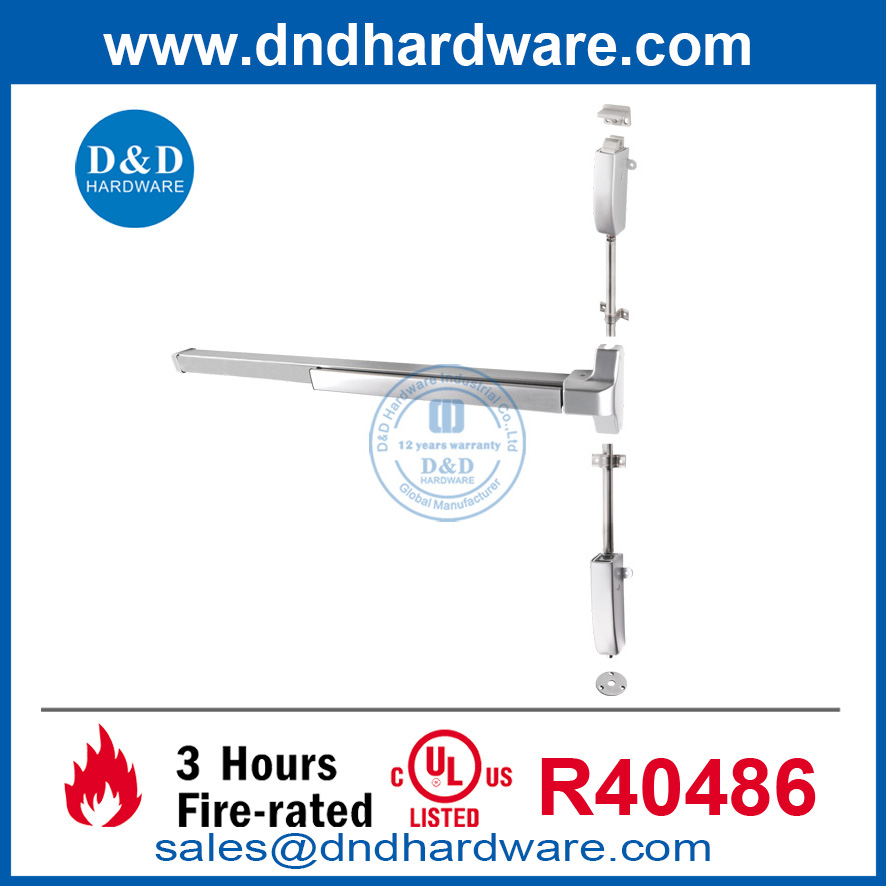
✔️ Fire Exit Hardware- UL 10C Fire Rated 3 Hours, File No.R40486
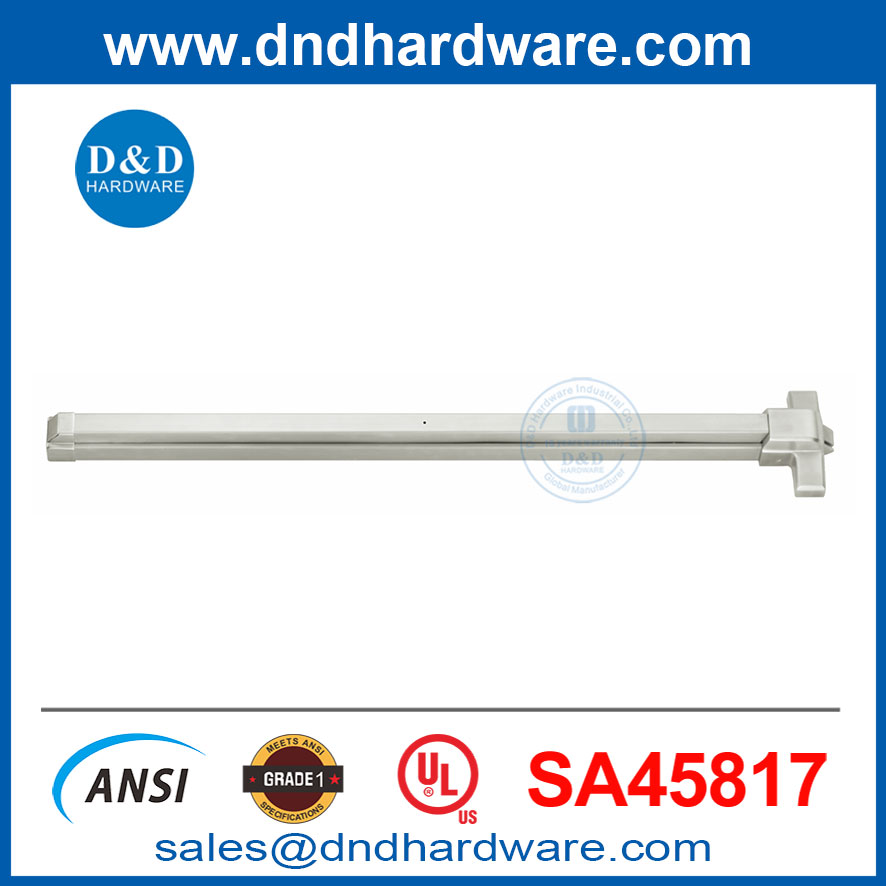
✔️ Panic Hardware-UL305, File No.SA45817
2. Non-Rated Replacement Parts
Fire doors stay in service for thirty, sometimes fifty years. Hardware does not. Closers leak, hinges wear, exit devices get damaged—and the technician replacing them thinks about function, not fire rating.
A standard closer installed where a fire-rated closer belongs is a deficiency even if it works perfectly. The same applies to hinges, mortise locks, flush bolts, and coordinators. Every replacement should be verified against the original door schedule and its UL listing, not pulled from the nearest stock shelf. D&D's UL 10C hinges, closers, and fire exit hardware list their file numbers on each product page for exactly this verification.

3. The Door Won't Close and Latch
A fire door that doesn't latch is a failed door, regardless of what's on the label. Inspectors test it every time: release the door from a few inches open and watch. Typical culprits: closers with insufficient spring power, doors rubbing the frame, loose hinges pulling the leaf out of alignment, shifted strike plates. A wedged-open door signals a closer never adjusted for actual traffic. No certification record substitutes for this check.
4. Closers That Can't Complete the Cycle
Because the closer controls the closing action, it draws close attention: closers that leak, sit loose on the frame, are adjusted so the door never reaches the latch, or carry unapproved hold-open devices all get flagged.
Even a UL listed closer fails if it can't finish the cycle. Adjustment takes minutes; a failed inspection and reinspection fee don't.
5. Hinge Problems
Three loose hinges fail a door faster than almost anything else. Inspectors look for screws that won't tighten, worn bearings letting the leaf sag, missing fasteners, and—frequently—non-rated replacements.
Hinge count matters too: removing a hinge and plugging the mortise changes the assembly's tested configuration. Every hinge should be present, secure, and matched to the door's weight and construction.
6. Wrong Exit Hardware for the Opening
Panic hardware and fire exit hardware are not interchangeable. A fire-rated opening needs hardware certified to UL 10C—with positive latching and fire-test compliance that panic hardware certified only to UL 305 doesn't provide.
The mistake usually happens at replacement: a panic device ordered because it's cheaper or in stock, installed on a stairwell door where UL 10C fire exit hardware belongs. Cross-check the device against the opening's requirements before ordering, not after the red tag.
7. Unauthorized Field Modifications
Drilled holes, cut-down devices, swapped internal springs, relocated closer arms—field modifications move a certified product outside its evaluated configuration. Inspectors have seen every one of them.
Some modifications are permitted by the manufacturer's instructions; most are not. If the change isn't in the installation instructions, ask the manufacturer first. An altered product is, for inspection purposes, an unlisted one.
8. Installation Outside the Certified Scope
Correct hardware, wrong application: a listed closer mounted on the wrong side of the frame, a latch with the wrong throw for the frame depth, a device installed on a configuration it was never evaluated for. Verify mounting arrangement, door material, and opening configuration against the product's certification scope before installation—not against what worked on the last job.

9. Latching Hardware That Doesn't Engage
The latch and strike take daily abuse, and problems creep in gradually: a latchbolt that won't project fully, a strike loosened by thousands of cycles, misalignment from a settled door. At inspection, a latch that doesn't engage means a failed assembly. Cycle the lockset and watch—fix misalignment during routine maintenance, not during the inspection window.
10. Missing Documentation
Not every deficiency is physical. When certification can't be verified from markings or records, the inspector must treat it as unestablished. Hardware schedules, UL file numbers, and product data exist for a reason: keep them, update them when hardware is replaced, and have them at inspection.
Pre-Inspection Walkthrough Checklist
Item | What to Verify |
Labels & markings | Present, legible, unpainted |
Certification match | Installed model matches UL listing |
Hinges | All present, secure, correctly rated |
Closer | Full closing cycle, latches door |
Lock & latch | Engages strike fully and holds |
Exit device | Correct type for the opening |
Fasteners | Complete and tight |
Modifications | None beyond manufacturer instructions |
Operation | Door closes and latches unassisted |
Documentation | Schedules, file numbers, records on hand |
A preparation aid—not a substitute for NFPA 80 or the authority having jurisdiction.
Catching Deficiencies Before the Inspector Does
None of these ten are exotic, and most are cheap to fix early. What makes them expensive is timing: a hinge replacement takes an hour; a failed report and reinspection scramble takes weeks.
Verify the installed product and its UL listing before every replacement, walk each opening before a scheduled inspection, and keep certification records findable. The doors that pass reliably aren't the ones with the most expensive hardware—they're the ones somebody checked last month.

FAQ
What fire door hardware deficiency appears most often?
Missing or illegible identification markings, followed by non-rated replacements installed over the door's service life.
Does individually listed hardware make the assembly compliant?
Not necessarily. Hardware is one link in the assembly; the door, frame, glazing, and installation carry their own requirements, covered in our fire rated door assembly compliance article.
How do you verify a correction against certification records?
Match the replacement's model number to its UL file number in UL Product iQ, confirm the application falls within the certified scope, and attach the record to the inspection documentation.
Contact: David Jian
Mob: 0086-139 2903 7292
Email: David@dndhardware.com, sales@dndhardware.com,
Contact: Jobby Zhang
Mob: 0086-137 2599 9617
Email: jobby@dndhardware.com
D&D HARDWARE INDUSTRIAL CO.,LTD
ADD:12th Floor, Building 2, No.898, KeChuang Technical Zone, Jiangmen Avenue, Pengjiang District, Jiangmen City, Guangdong, China (Postcode:529000)
https://www.dndhardware.com
Tel: +86-750-3856396
Fax: +86-750-3856395


 English