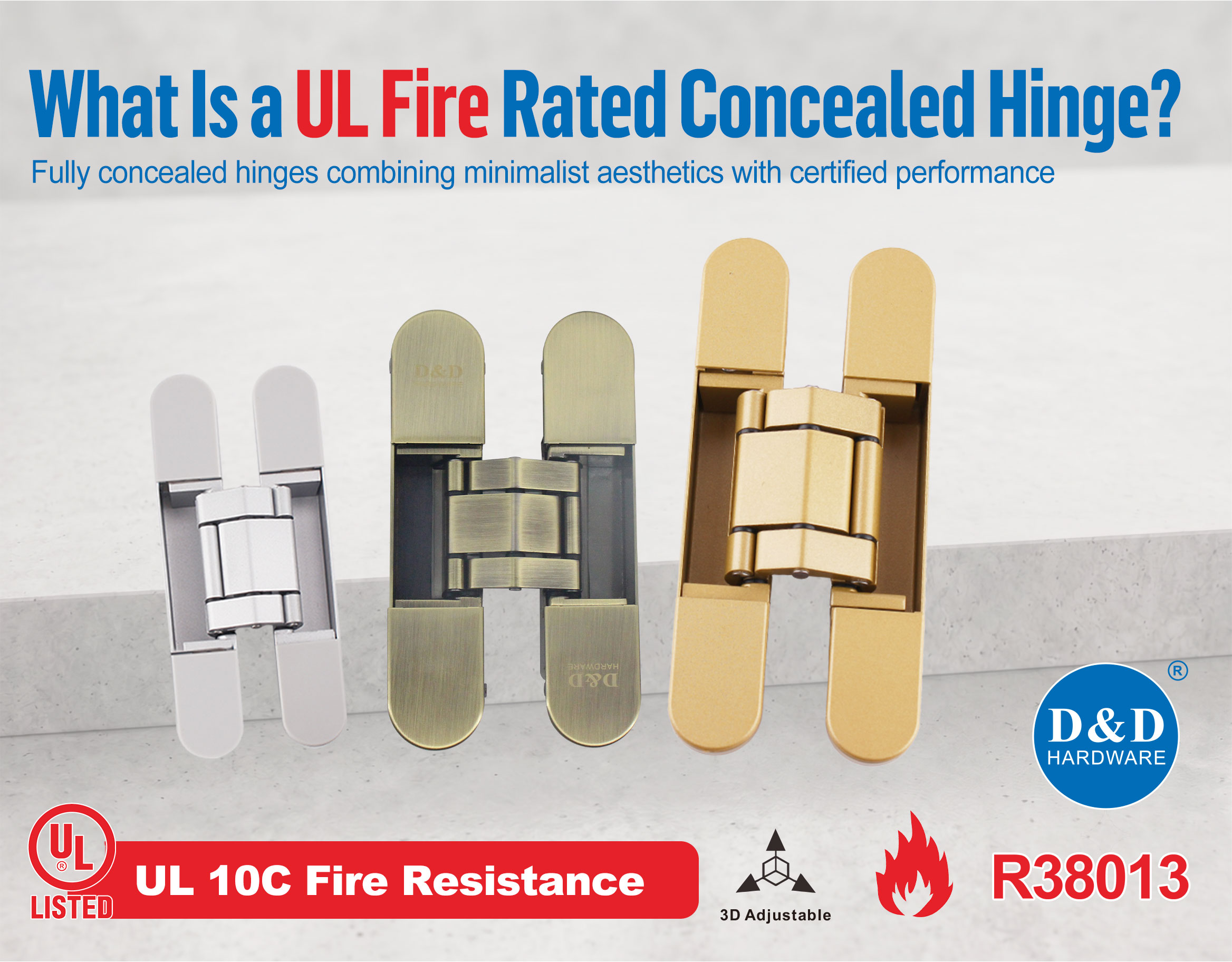
A UL-listed concealed hinge is a concealed door hinge that has been independently tested by Underwriters Laboratories and certified for use on fire-rated door assemblies under UL 10C, the positive-pressure fire test standard used across North America. Only hinges that pass this testing and appear in UL's certification directory can legally be installed on a fire door opening — a standard concealed hinge, no matter how well made, cannot be substituted.
That single distinction — tested and listed versus simply well-manufactured — is the one architects, contractors, and code officials check first, and it's the focus of this guide.
Key Points at a Glance
●A UL-listed concealed hinge is certified under UL 10C as part of a complete fire door assembly, not tested in isolation.
●Fire rating is voided if a non-listed hinge is substituted, even on an otherwise fully compliant door.
●Certification is verified through a UL File Number, checked against UL's Online Certifications Directory.
●Compatibility with door weight, thickness, and the rest of the hardware set is a separate requirement from certification itself.

Why Concealed Hinges Matter to Fire Door Performance
Concealed hinges are hidden inside the door leaf and frame when the door is closed, which is exactly why their role in fire performance gets overlooked. They're often treated as a purely cosmetic upgrade — a way to avoid visible barrel hinges on a high-end lobby door.
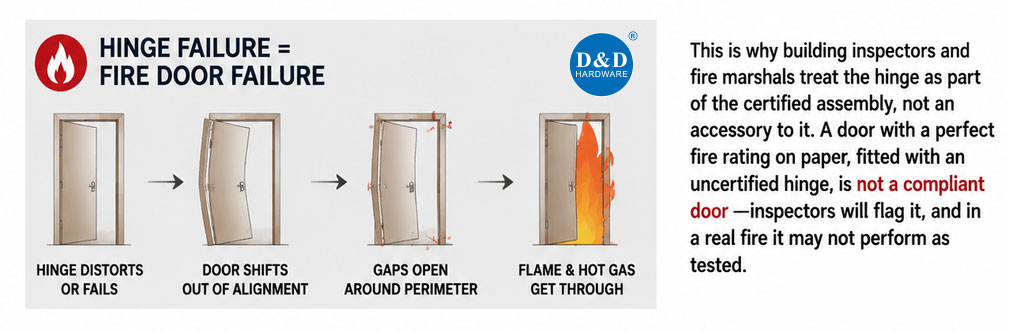
In a fire door assembly, though, the hinge is a structural load path. It carries the full weight of the door leaf and keeps that leaf aligned in the frame while the assembly is exposed to fire. If a hinge distorts, binds, or fails under heat, the consequences cascade quickly:
●The door leaf shifts out of alignment with the frame
●Latching hardware can no longer engage properly
●Gaps open around the perimeter, letting flame and hot gas through
● The assembly's rated fire-resistance is compromised, regardless of how the door slab itself performs
What UL 10C Actually Tests
UL 10C is the standard most fire door assemblies in the U.S. and Canada are rated against. It largely superseded earlier neutral-pressure test methods because it more closely reflects real fire conditions, where hot gases build up positive pressure above the neutral plane and push against — and through — any weak point in the assembly.
During a UL 10C test, the complete assembly is evaluated together: door leaf, frame, hinges, locking hardware, and closer. The assembly is exposed to a standardized time-temperature curve for the duration matching its intended rating (commonly 20, 45, 60, or 90 minutes, up to 3 hours for some applications), and assemblies rated 60 minutes or higher must also survive a hose stream test immediately after fire exposure to demonstrate structural integrity isn't just heat-resistant but impact-resistant.
Because the hinge stays under load for that entire duration, it has to keep the door leaf seated and functional from ignition through hose stream — not just avoid melting. A hinge that carries a UL 10C Fire Rated listing has been evaluated as part of an assembly that met all of that, not tested on its own in a lab and extrapolated.
Fire doors intended for smoke control applications may also require a UL 1784 smoke and draft control listing — a separate certification worth confirming during specification if the opening has a dual rating requirement.
Standard Concealed Hinge vs. UL-Listed Concealed Hinge
| Standard Concealed Hinge | UL-Listed Concealed Hinge |
Primary design goal | Aesthetics, smooth operation | Fire performance + aesthetics + operation |
Testing | Mechanical / durability only | UL 10C fire assembly testing |
Fire door use | Not permitted | Permitted, within listing scope |
Documentation | General spec sheet | UL File Number, listed in UL directory |
Verification | Manufacturer claim only | Independently verifiable third-party record |
What to Look for When Specifying a Fire-Rated Concealed Hinge
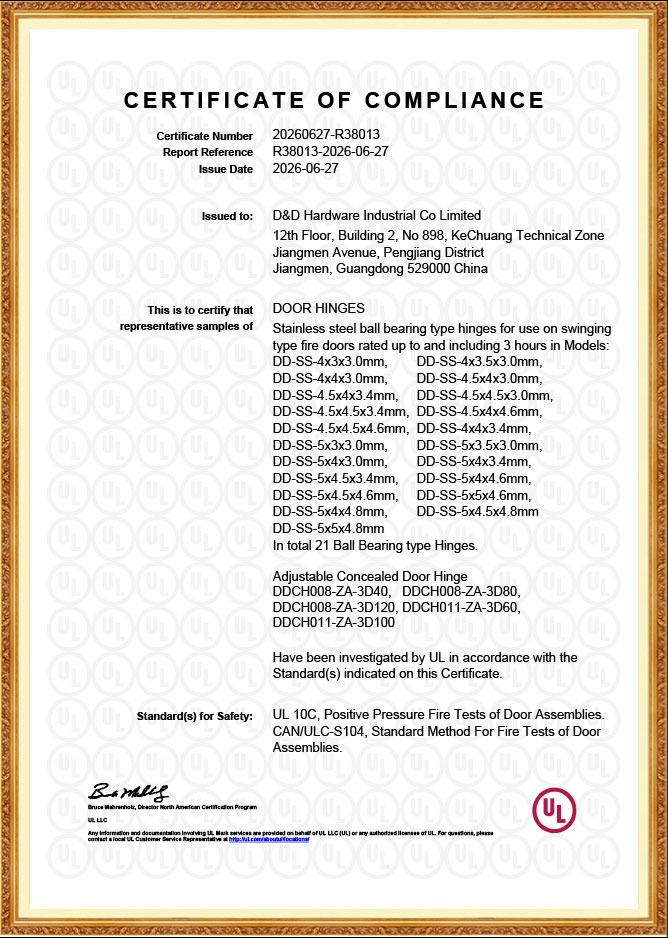
Certification on file, not just on the label. The hinge should carry a specific UL File Number that can be looked up independently — not a general claim of "fire rated" with nothing behind it. D&D Hardware's concealed hinge, for example, is certified to UL 10C Fire Rated under UL File No. R38013, and that listing can be checked directly in UL's directory rather than taken on faith.
Load capacity matched to the door. Commercial fire doors run heavier than typical interior doors — solid-core wood, steel, or composite cores add up fast. A hinge undersized for that weight will sag or bind long before it's ever tested by fire, and misalignment from years of overload is itself a compliance risk at the next inspection.
Consistent operation over the door's service life. A fire door only works if it closes and latches every single time, including after years of daily cycling. Excess play in the hinge translates directly into gaps and misalignment — the same failure modes fire testing is designed to catch.
Compatibility with the rest of the opening. Certification applies to a tested assembly, not to individual parts in isolation. A listed hinge still needs to be compatible with door thickness, frame construction, opening angle, and the other certified hardware on that same opening — locks, closers, panic hardware, and any intumescent components.
Where UL-Listed Concealed Hinges Get Specified
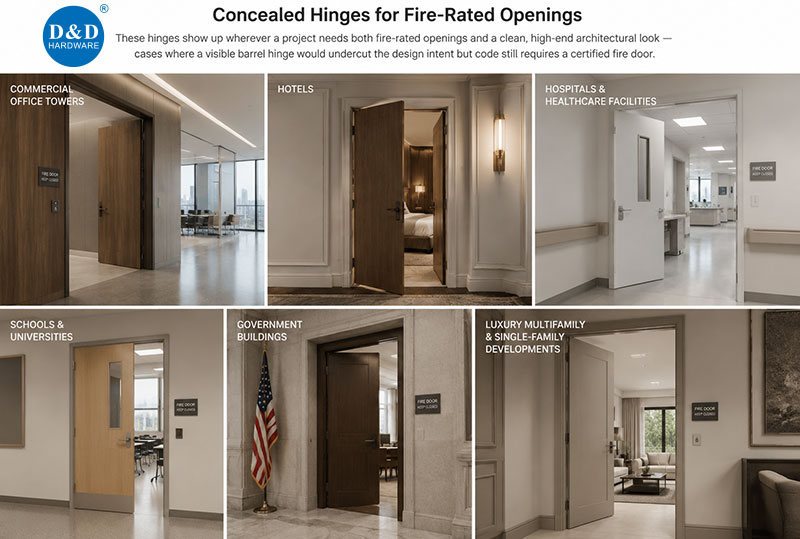
These hinges show up wherever a project needs both fire-rated openings and a clean, high-end architectural look — cases where a visible barrel hinge would undercut the design intent but code still requires a certified fire door. That covers commercial office towers, hotels, hospitals and healthcare facilities, schools and universities, government buildings, and luxury multifamily or single-family developments with rated openings.
How to Verify a UL-Listed Concealed Hinge Before Specifying It
1.Get the UL File Number and check it against UL's Online Certifications Directory. Don't stop at a marketing claim — confirm the exact hinge model and manufacturer match the directory listing.
2.Pull the technical data sheet. It should state the fire rating, the applicable UL standard, any installation limitations, and which door types the listing covers.
3.Confirm physical compatibility. Door thickness, weight, frame type, and swing angle all need to fall within what the hinge is rated for — a listing doesn't automatically mean fit.
4.Check assembly-level compatibility. Confirm the hinge works within a tested assembly alongside the specified locks, closers, panic hardware, and frame — not just that each component is separately certified.

Common Misconceptions
“Any concealed hinge can go on a fire door if it's well made.” Build quality isn't certification. Only hinges tested and listed for fire-rated use are permitted on a fire door opening, regardless of how well-engineered an uncertified alternative might be.
“UL certification is about the door slab — hardware is secondary.” The rating covers the full assembly. A door slab tested and rated on its own says nothing about how it performs with different hardware; hinges, locks, and closers are all part of what gets tested and listed together.
“Concealed hinges are a purely cosmetic choice.” Appearance is one reason to specify them, but on a fire-rated opening they're carrying structural and life-safety requirements first — the clean look is a secondary benefit, not the qualifying factor.
The Bottom Line
A UL-listed concealed hinge isn't a hidden design detail — it's a load-bearing, code-required component of the fire door assembly it's installed in. Swapping a certified hinge for an uncertified one, even one that looks and feels identical, voids the fire rating of the entire opening.
For projects specifying fire-rated openings, that makes the UL File Number the detail worth checking first. D&D Hardware's UL 10C Fire Rated Concealed Hinge (UL File No. R38013) is documented in UL's directory for exactly this use case, giving architects, contractors, and code officials a verifiable record rather than a manufacturer's claim to take on faith.

Frequently Asked Questions
Can a concealed hinge be used on a fire-rated door?
Yes, but only if it's specifically tested and listed for fire-rated assemblies — a UL-listed concealed hinge certified under UL 10C, for example. A standard concealed hinge without that listing cannot legally be installed on a fire door.
What actually separates a standard concealed hinge from a UL-listed one?
A standard hinge is engineered and tested for mechanical performance and appearance only. A UL-listed hinge has additionally been evaluated as part of a complete fire door assembly under UL 10C, meaning it's proven to hold up under fire exposure and hose stream testing, not just daily use.
How do I confirm a concealed hinge is actually UL listed, and not just marketed that way?
Ask the manufacturer for the specific UL File Number, then look that number up directly in UL's Online Certifications Directory. If the file number, manufacturer, and product don't match what's in the directory, the claim isn't verifiable.
Why does UL 10C specifically matter, versus older fire test methods?
UL 10C tests under positive pressure, which reflects how hot gases actually behave in a real fire — pushing outward through any weak point in the assembly. Earlier neutral-pressure methods didn't capture that dynamic as accurately, which is why UL 10C became the standard most fire door assemblies are now rated against.
If I replace a certified hinge with a different one later, does that affect the door's fire rating?
Yes. The fire rating applies to the tested assembly as a whole. Replacing a listed hinge with a non-listed product — even for a repair — can void the rating on that opening, which is why maintenance teams should always replace like-for-like with another listed hinge.
Contact us Now:
Contact: David Jian
Mob:0086-139 2903 7292
Email: David@dndhardware.com, sales@dndhardware.com,
Contact: Jobby Zhang
Mob:0086-137 2599 9617
Email: jobby@dndhardware.com
D&D HARDWARE INDUSTRIAL CO.,LTD
ADD:12th Floor, Building 2, No.898, KeChuang Technical Zone, Jiangmen Avenue, Pengjiang District, Jiangmen City, Guangdong, China (Postcode:529000)
https://www.dndhardware.com
Tel: +86-750-3856396
Fax: +86-750-3856395
 English