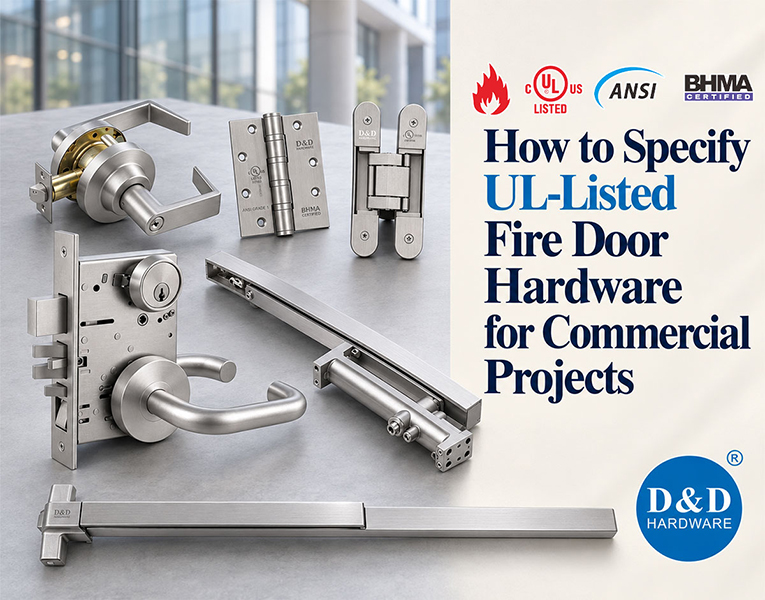
A hardware specification that says only “UL Listed, three-hour fire rated” leaves important decisions unresolved. It does not identify the permitted door application, the required locking function or the documents needed to verify the supplied model.
To specify UL Listed Fire Rated Commercial Door Hardware, connect every hardware set to a defined opening and require evidence that the selected components suit that opening. The specification states the requirements; the submittal demonstrates how the proposed products meet them.
This guide addresses technical specifications and project submittals for commercial swinging fire doors under U.S. code frameworks. Other jurisdictions require confirmation of locally accepted standards and approval procedures.

1 Establish the Opening Requirements First
Start with the project’s adopted building code, local amendments and approved fire strategy. Identify the required door fire protection rating, occupancy, egress function and any smoke control or accessibility requirements.
The wall’s rating alone is insufficient to select hardware. The opening’s location and applicable code provisions determine its required protection. SDI 118 explains this relationship and distinguishes fire protection requirements from smoke and draft control requirements.
Give each opening a door number. Record its construction, dimensions, thickness, handing and single- or paired-leaf arrangement. Establish these details before assigning a hardware set, particularly where paired doors require coordinated closing or specific latching arrangements.
2 Write Requirements That Can Be Checked
Specify the applicable fire door application, performance criteria and installation conditions. Avoid treating a manufacturer’s entire catalog as certified because one product has a UL file number.
For each scheduled item, identify:
· Product type, exact model and operating function.
· Applicable certification and required rating coverage.
· Dimensions, quantity, finish and relevant performance grade.
· Mounting arrangement, fasteners, reinforcement and associated accessories.
A fire rated mortise lock specification should identify its function and compatible strike. A fire door closer requires a defined mounting arrangement and appropriate operating characteristics. For UL Listed door hinges, establish the approved size, quantity and fixing method.
These details let reviewers compare the submitted product with the requirement instead of interpreting a general claim of suitability.

3 Separate Fire Performance from Other Certifications
UL 10C addresses positive-pressure fire testing of door assemblies. UL 305 addresses panic hardware. Where an exit device is used on a fire door, specify fire exit hardware with the applicable UL 10C and UL 305 coverage and correct product designation.
ANSI/BHMA grades address separate hardware performance criteria. A hinge’s durability grade does not replace evidence of suitability for a rated opening.
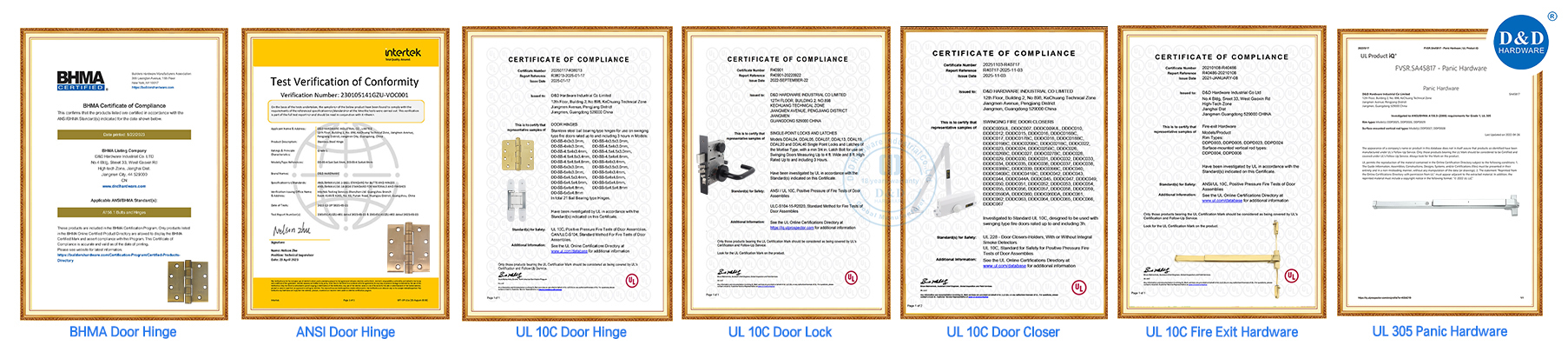
D&D Hardware provides the following series-level references. Match them to current certification records for the exact models proposed in the submittal.
| Door Hardware | Hardware category | D&D certification and performance references |
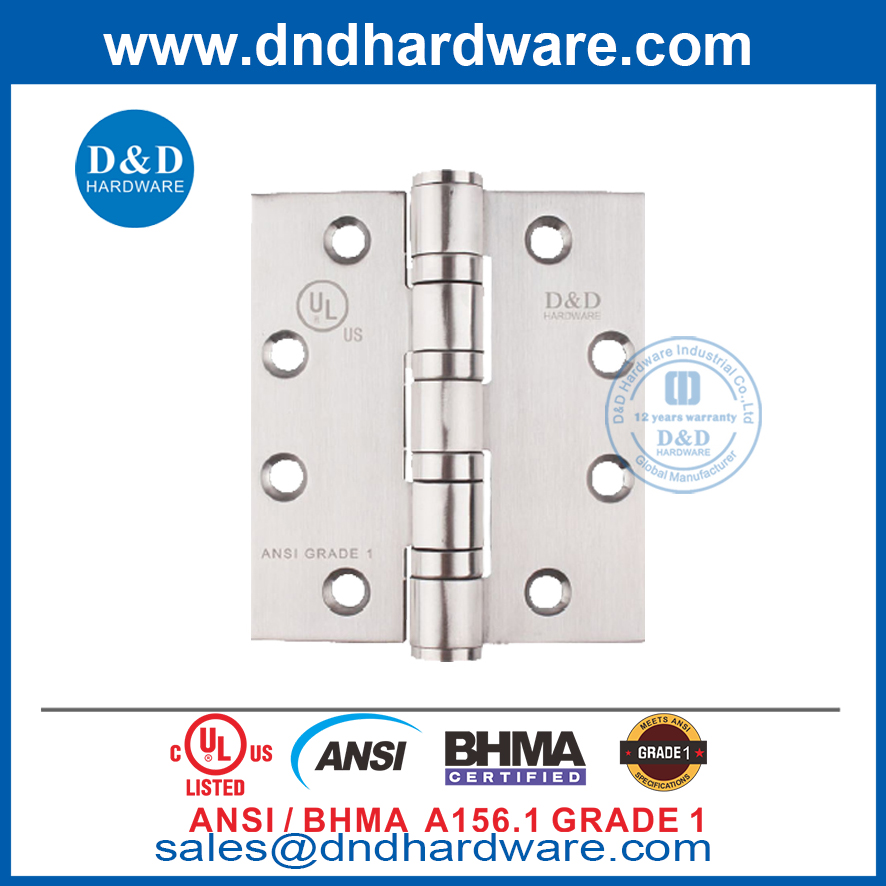 | Door hinge | UL/cUL UL 10C Fire Rated 3 Hours; R38013. ANSI/BHMA Grade 1: 2,500,000 cycles; Grade 2: 1,500,000 cycles. |
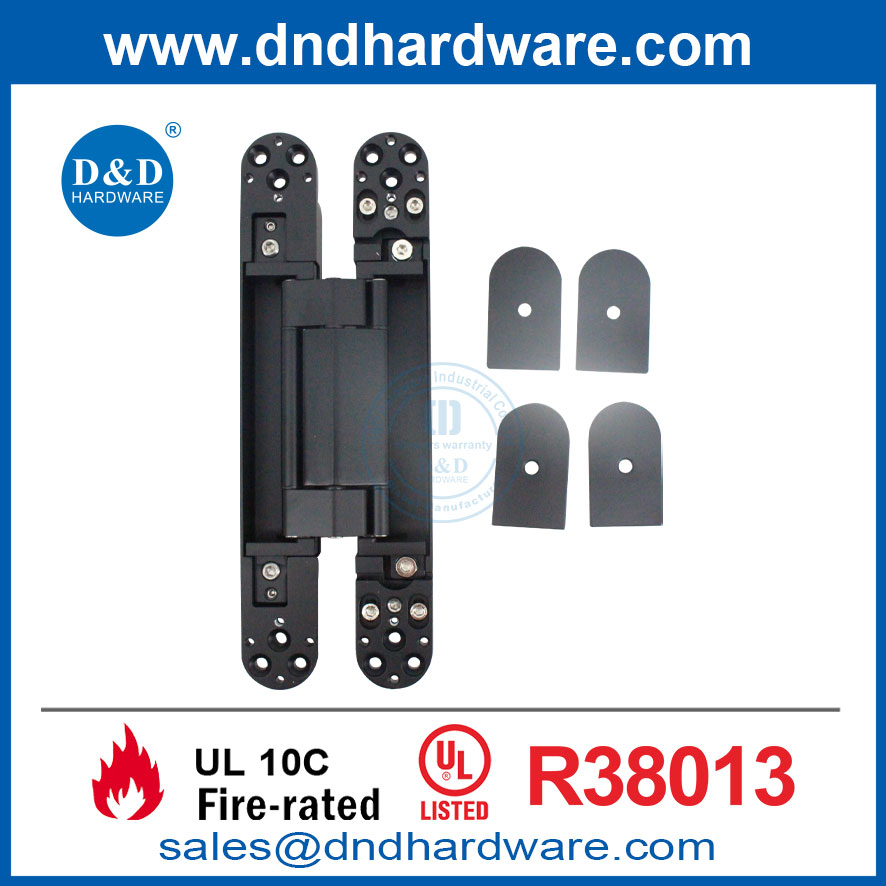 | Concealed hinge | UL 10C Fire Rated; R38013. Confirm model-specific application. |
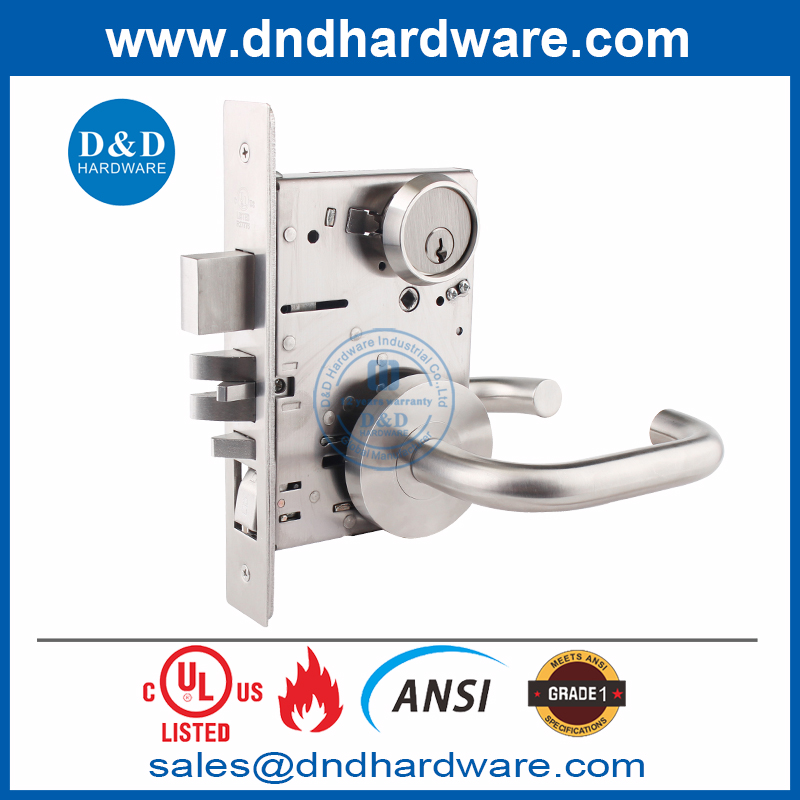 | Door lock | UL 10C Fire Rated 3 Hours; R40901. |
 | Door closer | UL 10C Fire Rated 3 Hours; R40717. |
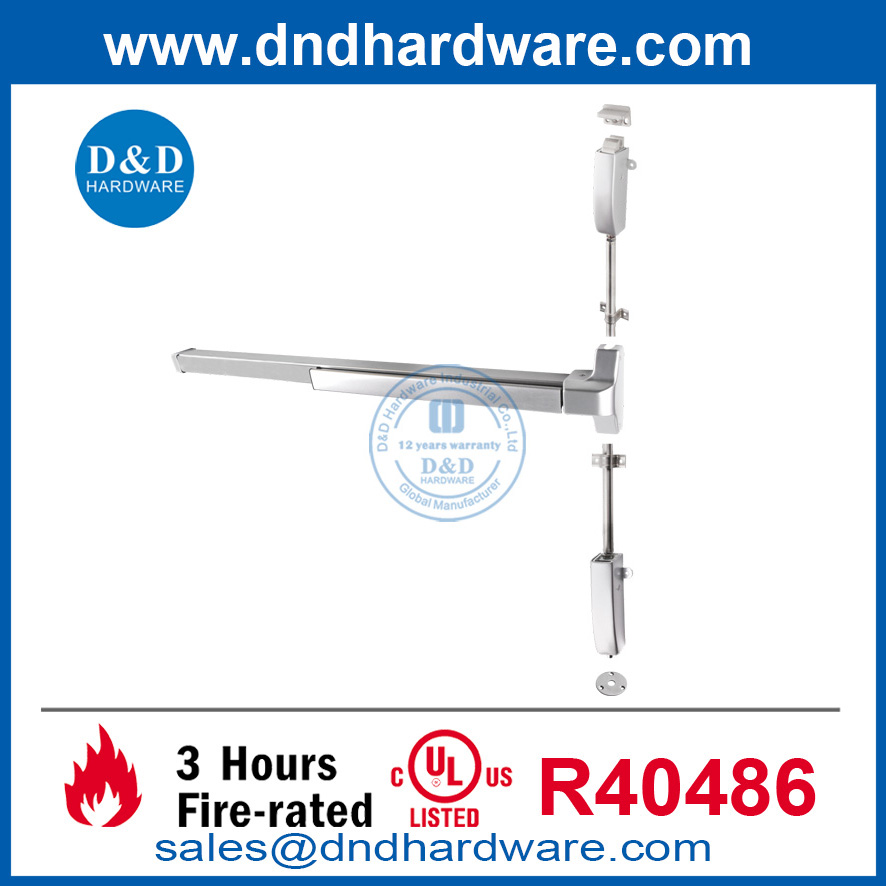 | Fire Exit Hardware | UL 10C Fire Rated 3 Hours; R40486. |
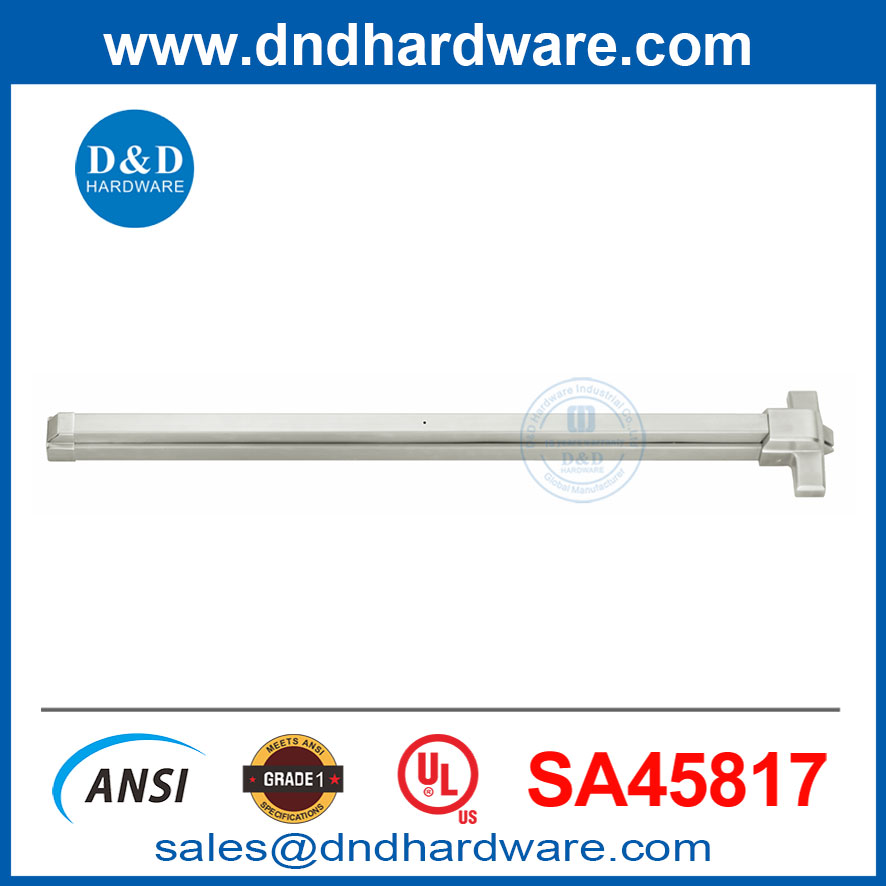 | Panic hardware | UL 305; SA45817. |
Do not assign a three-hour rating to the concealed hinge range from the shared file number. Confirm the selected model’s permitted application. Likewise, the UL 305 panic hardware reference alone does not establish fire door suitability; verify the proposed fire exit device’s applicable certifications.
4 Coordinate the Hardware with the Door and Frame
Individually certified products do not automatically form an acceptable assembly. Check whether the door and frame permit the proposed hardware application and preparations.
The Steel Door Institute notes that labeled hardware can be used across door brands when the door is properly listed for that application. A door listed for a single-point lock is not automatically approved for fire exit hardware.
Resolve templates and reinforcement before fabrication. Concealed hinges require pockets in the door and frame; locks require defined mortises and strikes; closers need suitable fixing locations. Identify any required seals and ensure accessories do not obstruct closing or latching.
A coordinated drawing should show the intended arrangement clearly enough for the door manufacturer and installer to prepare the same opening.

5 Assemble a Traceable Project Submittal
Organize the submission by hardware set and door number. Provide marked product data showing the exact selections rather than an unmarked catalog containing several alternatives.
A practical submittal package includes:
· Door-to-hardware-set schedule with quantities and functions.
· Model-specific certification records and relevant listing limitations.
· Technical data, installation instructions and preparation templates.
· Coordinated drawings and a clearly identified deviations list.
Use UL Product iQ or the relevant certification directory to verify the proposed models. SDI identifies certification listings as a resource for checking hardware suitable for fire-rated assemblies.
A file number should lead the reviewer to supporting evidence. It should not require them to guess which model, option or application the supplier intends.
6 Define Review and Acceptance Conditions
Include a requirement that substitutions receive the project’s prescribed review before supply or installation. Require revised evidence whenever a change affects the function, certification scope, preparations or accessories.
Suggested specification wording: “Provide hardware suitable for each scheduled fire door application, supported by applicable listing documentation. Submit exact models, functions, templates and installation instructions. Identify deviations and obtain required acceptance before fabrication.”
This is drafting guidance; adapt it to the contract and jurisdiction. Project submittal acceptance does not expand a product’s certification scope.
Finally, distinguish document review from installed acceptance. UL’s guidance requires installation in accordance with applicable standards and manufacturer instructions. Verify closing, latching, alignment and egress operation, and retain the final hardware schedule and inspection records for maintenance.

FAQ
Is a UL certificate enough for project approval?
Usually it is only part of the evidence. Reviewers also need the selected model, permitted application, technical data and coordination with the scheduled opening.
Should all commercial fire doors receive three hour hardware?
Specify hardware suitable for each opening’s required rating and listing conditions. A higher stated hardware rating does not upgrade the complete assembly.
Must the hardware and door come from the same manufacturer?
Not necessarily. Compatibility with the door’s listed application matters; using one brand does not remove the need for verification.
Can UL 305 panic hardware be specified for a rated exit door?
A UL 305-only designation is insufficient. Specify the appropriate fire exit hardware and verify its applicable fire and panic certifications.
What should be submitted for concealed hinges?
Provide the exact model, applicable certification, permitted door construction, load and dimensional data, quantity, fixing details and preparation drawings.
For the broader certification framework, consult D&D Hardware’s UL Listed Fire Rated Commercial Door Hardware resource center. Preparing a project submittal? Send D&D your door schedule, required ratings and proposed hardware sets to request model-specific certification and technical documentation.
Contact us Now:
Contact: David Jian
Mob:0086-139 2903 7292
Email: David@dndhardware.com, sales@dndhardware.com,
Contact: Jobby Zhang
Mob:0086-137 2599 9617
Email: jobby@dndhardware.com
D&D HARDWARE INDUSTRIAL CO.,LTD
ADD:12th Floor, Building 2, No.898, KeChuang Technical Zone, Jiangmen Avenue, Pengjiang District, Jiangmen City, Guangdong, China (Postcode:529000)
https://www.dndhardware.com
Tel: +86-750-3856396
Fax: +86-750-3856395


 English