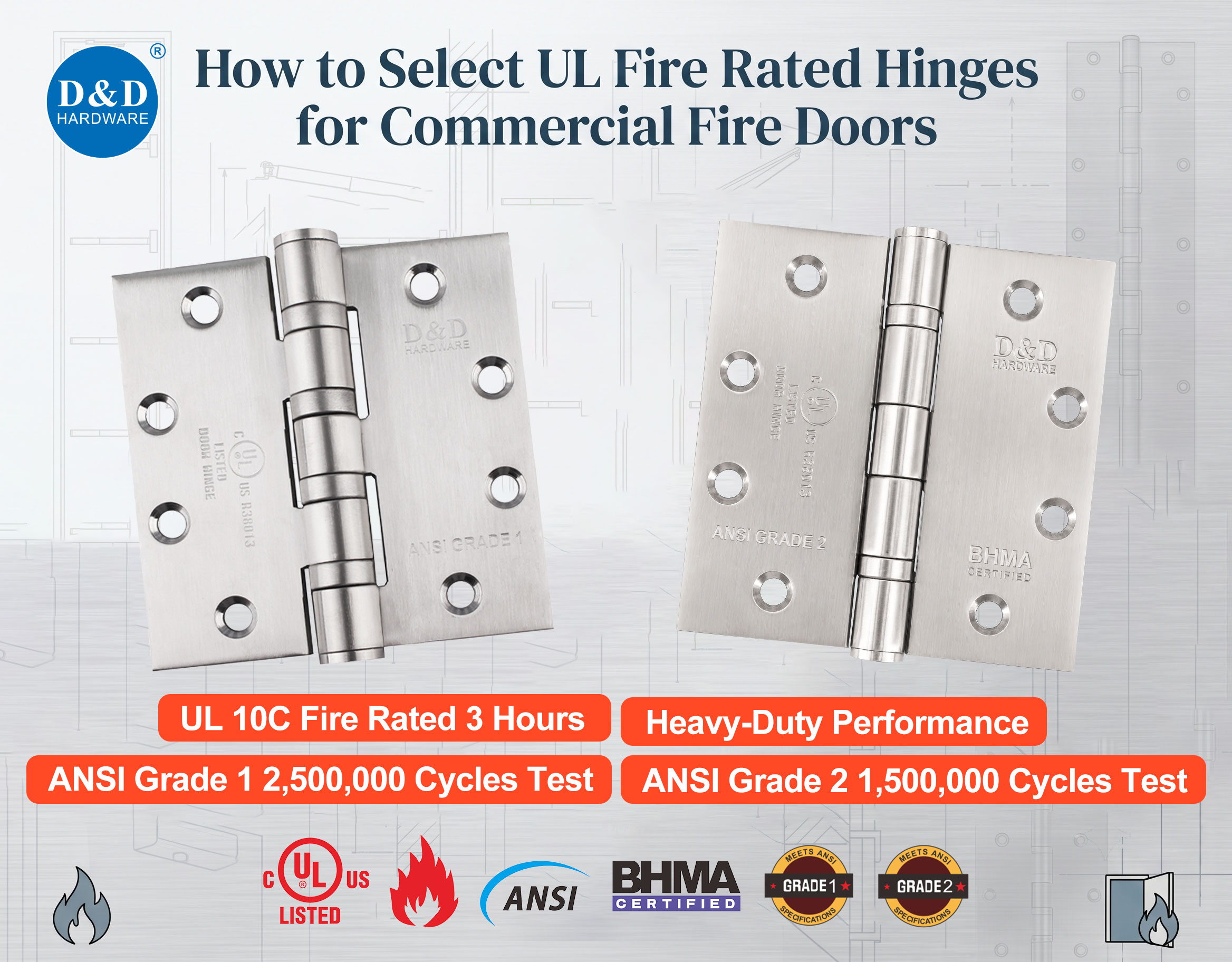
Selecting hinges for a commercial fire door involves more than matching the hinge size to the door. Hinges are essential load-bearing components that influence door alignment, closing, latching and the long-term performance of the complete fire door assembly. An incorrectly selected hinge can cause the door to sag, create excessive clearances or prevent the latch from engaging correctly.
A UL-listed hinge must therefore be selected as part of the complete fire door assembly—not as an isolated component. Project teams should verify the hinge certification, covered model, door construction, fire rating, dimensions, weight, usage frequency and installation conditions before approval.
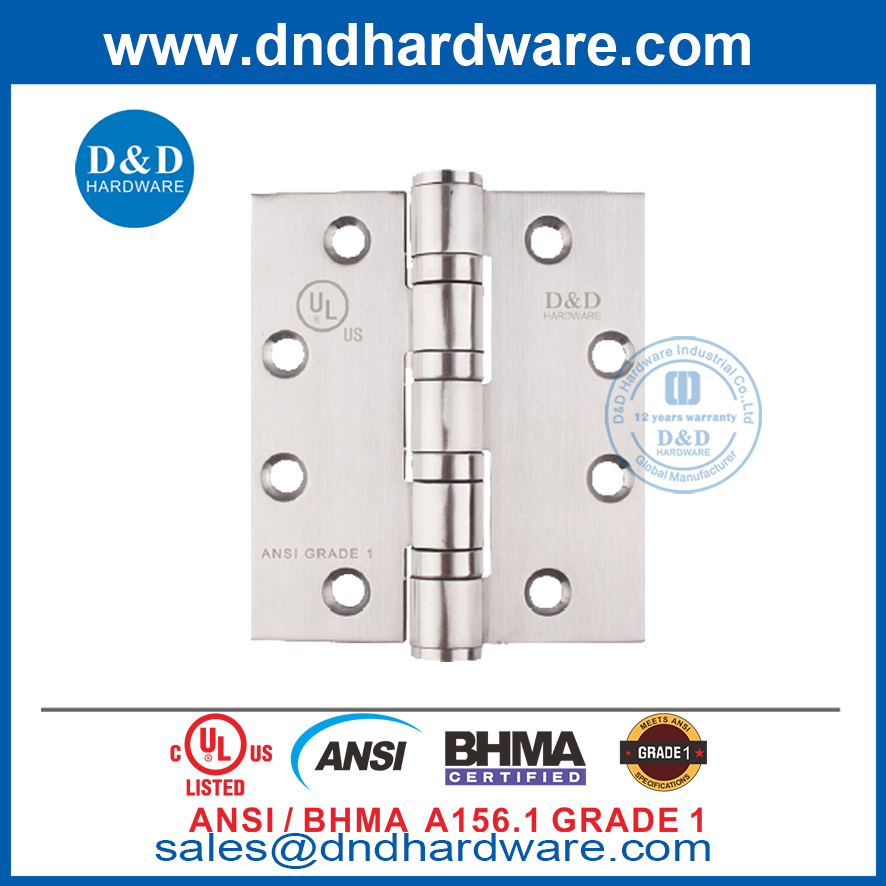
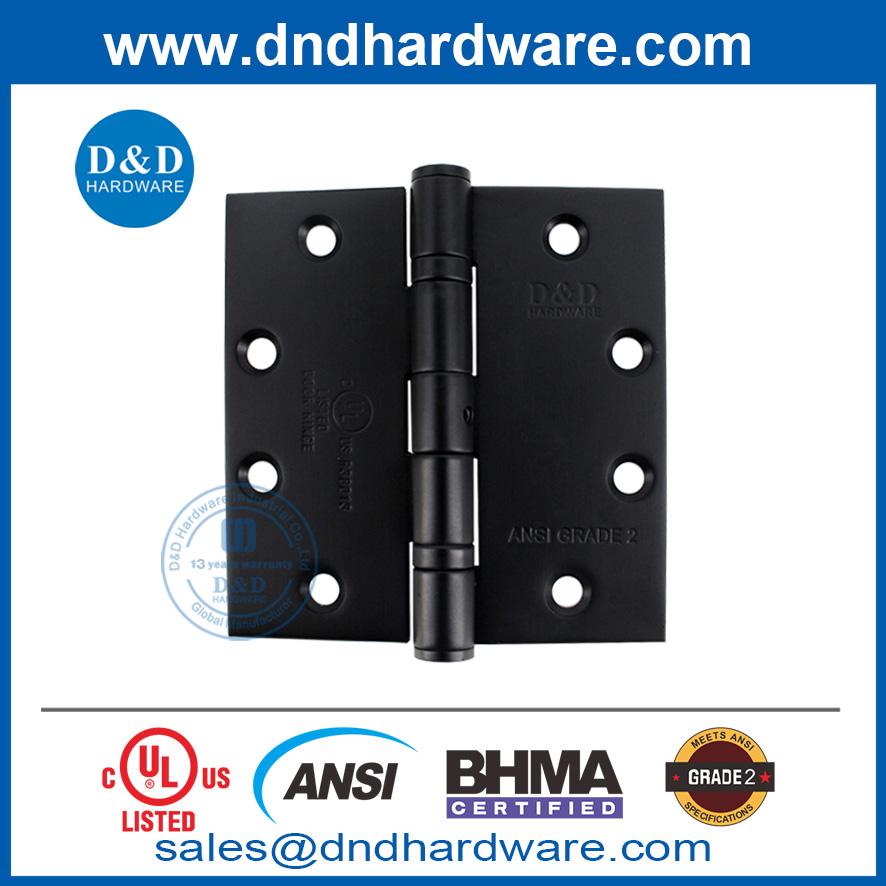
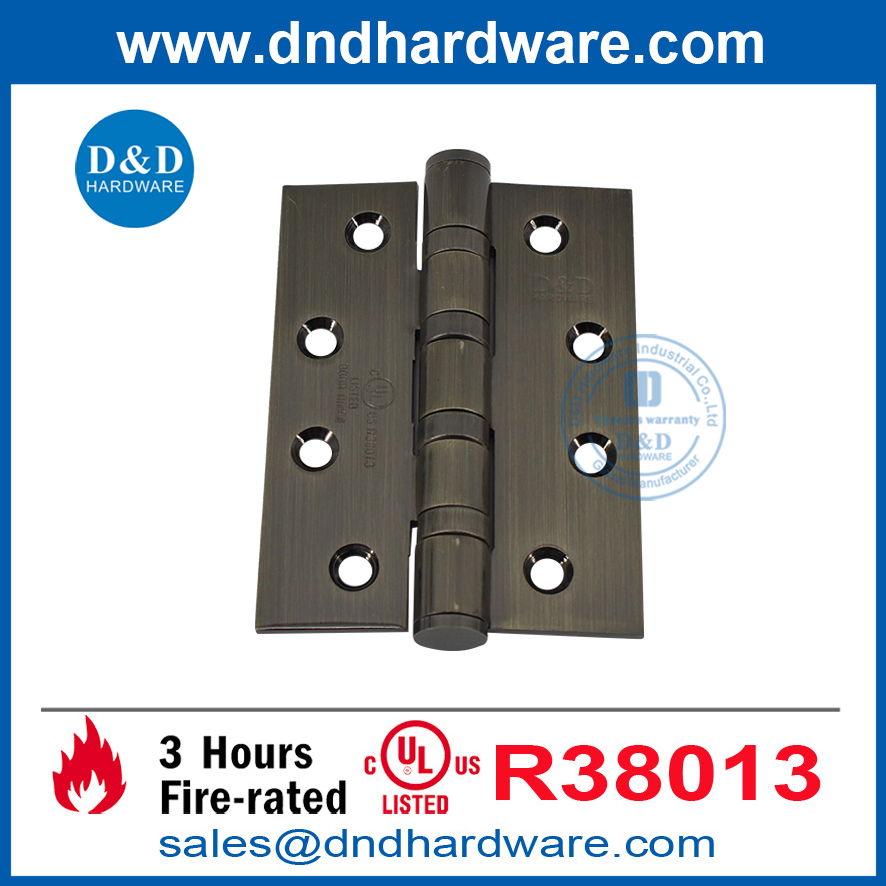
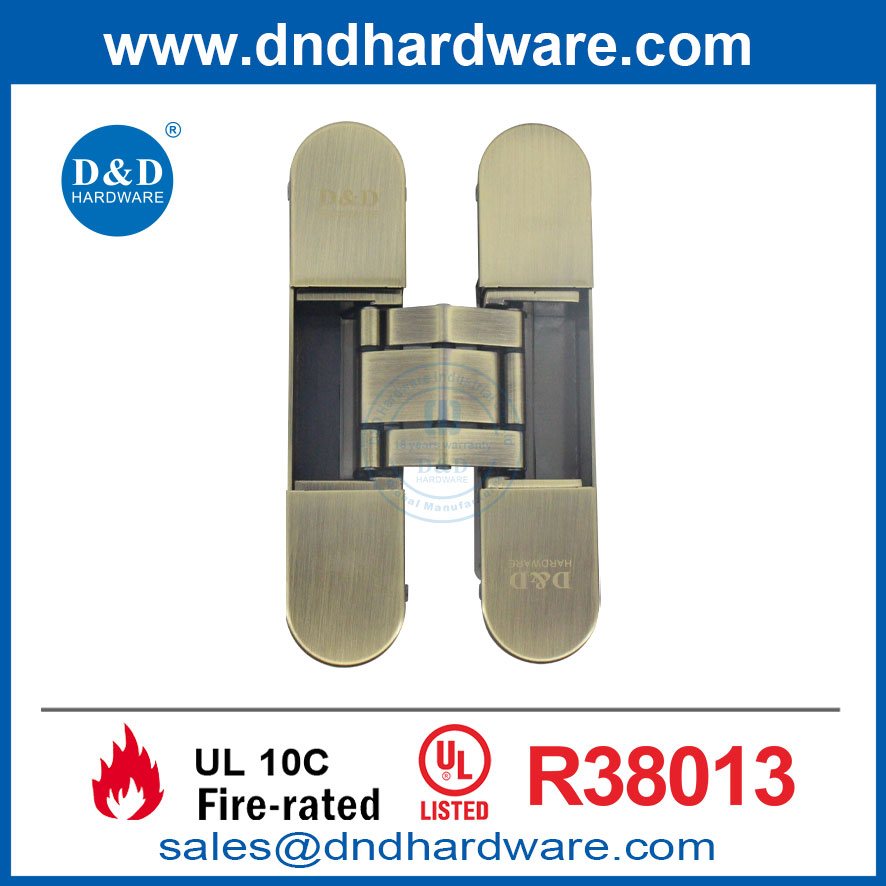
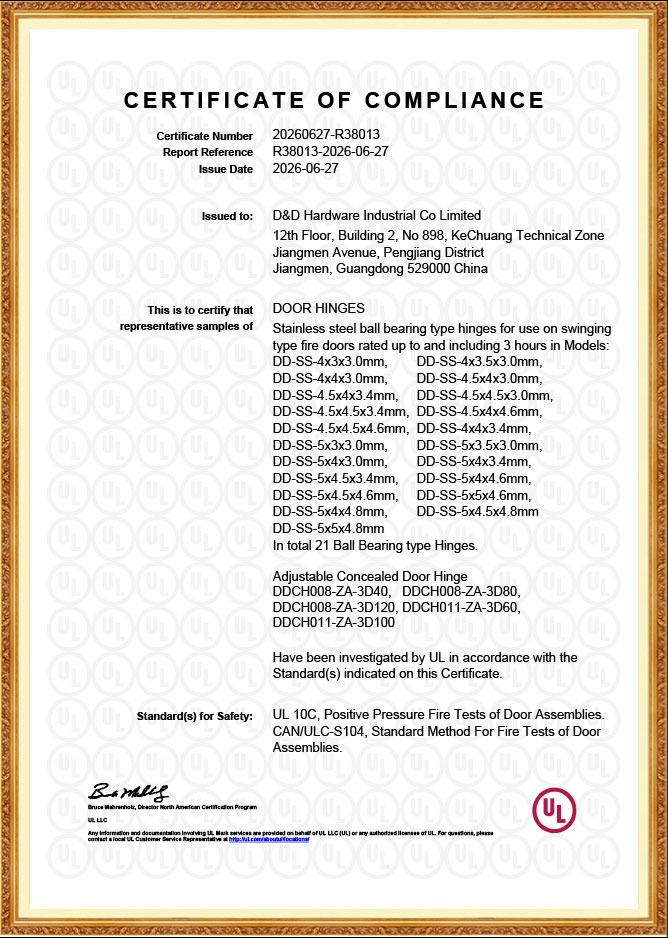
D&D supports commercial fire door projects with UL-listed hinge options under UL File No. R38013. The documented product range covers 21 butt-hinge sizes and five concealed-hinge sizes, providing multiple configurations for metal, wooden and fire-rated commercial doors.

1. Confirm the Fire Door Assembly Requirements
Begin by reviewing the requirements of the complete opening. Important information includes:
•Required fire rating
•Door and frame material
•Door leaf dimensions and weight
•Single- or double-leaf configuration
•Opening direction
•Expected usage frequency
•Environmental exposure
•Applicable building codes and project specifications
A hinge described as suitable for fire doors does not automatically match every fire-rated opening. The selected model must fall within the documented certification scope and be compatible with the door manufacturer's construction and installation requirements.
The fire rating of one hardware component also does not determine the rating of the complete assembly. A hinge listed for use in a three-hour assembly does not make an unapproved door system three-hour fire rated.
2. Verify the UL Listing Before Comparing Specifications
Certification verification should take place before comparing materials, finishes or prices. Buyers, contractors and specifiers should confirm:
The manufacturer's name and UL file number.
The exact hinge model or size included in the certification scope.
The permitted door type, installation method and application conditions.
Any limitations relating to dimensions, materials or fire ratings.
Consistency between the certification reference, drawings, product label and delivered model.
“Tested to UL 10C” should not automatically be treated as equivalent to a current UL Listing for the exact product being supplied. Certification applies to defined products and conditions, so model-level verification is necessary.
D&D UL-Listed Door Hinge Certification Reference
Verification item | D&D information |
Brand | D&D Hardware |
Product category | Butt hinges and concealed hinges |
UL file number | R38013 |
| Fire Resistance | UL 10C Fire Rated 3 Hours |
Butt-hinge coverage | 21 sizes covered |
Concealed-hinge coverage | 5 sizes covered |
Typical applications | Metal, wooden and fire-rated commercial doors |
Available support | Certification references, drawings, specifications and installation information |
The specific D&D model, dimensions, installation method and intended application should always be checked against the documented UL scope.
3. Confirm Door and Frame Compatibility
The hinge must match both the door leaf and frame preparation. Review the hinge type, leaf dimensions, thickness, fixing positions, screw pattern and mortising requirements.
Using a hinge with an incompatible template can lead to field drilling, cutting or other unauthorized modifications. Such changes may affect door alignment and could create compliance concerns for the complete fire door assembly.
The selected hinge must also work with other hardware, including the door closer, mortise lock or exit device. A door closer may generate additional operating forces, while the lock or exit device depends on accurate alignment to achieve positive latching.
4. Calculate Door Size, Weight and Hinge Quantity
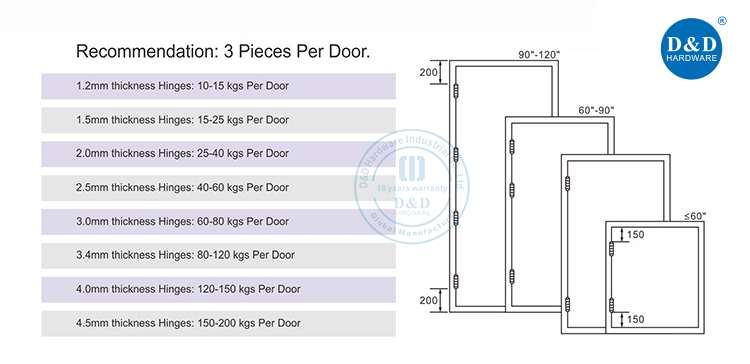
Door height and weight are central selection factors. Heavy steel doors, oversized wooden doors and doors fitted with glass, protective plates or access-control equipment may require larger hinges, additional hinges or higher-capacity bearing constructions.
Avoid using one universal formula for every project. The appropriate hinge quantity depends on:
•Door height and width
•Total door weight
•Door material and construction
•Hinge dimensions and load capacity
•Usage frequency
•Additional installed hardware
•Manufacturer and project requirements
The final arrangement should follow the door manufacturer's instructions, certification conditions and approved hardware schedule.
5. Select the Appropriate Bearing Construction
Commercial fire doors usually operate more frequently and carry greater loads than typical residential doors. Bearing construction affects operating resistance, wear and service life.
Ball-bearing hinges are commonly considered for heavy or high-frequency commercial openings because they reduce friction and provide smoother movement. However, they are not automatically required for every fire door. The correct construction depends on door weight, usage intensity, applicable specifications and the hinge manufacturer's documented performance.
For entrances, stairwells, corridors and other high-traffic openings, durability should be evaluated carefully to reduce sagging, binding and maintenance requirements.

6. Select the Material and Finish
Hinge material should be chosen according to the operating environment as well as the appearance of the door.
Stainless steel is frequently specified for commercial projects because of its strength and corrosion resistance. Grade 304 stainless steel is suitable for many internal and general commercial environments, while Grade 316 may be preferred for coastal, humid, chemical or highly corrosive conditions.
The finish must also be compatible with the project's architectural requirements. However, a decorative finish should not be used as a substitute for an appropriate base material or verified corrosion performance.
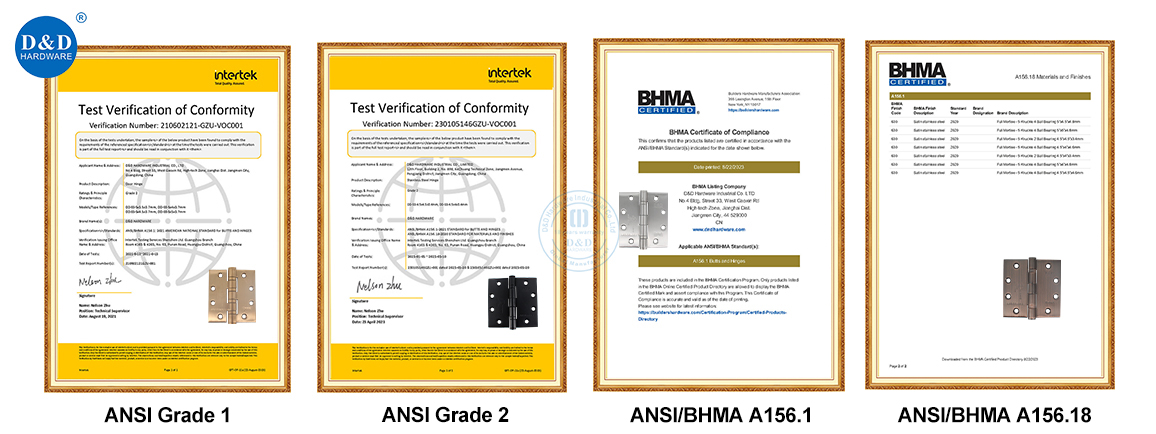
7. Understand UL and ANSI/BHMA Requirements
UL certification and ANSI/BHMA performance classifications address different aspects of hinge selection.
UL-related certification helps establish whether a product is eligible for use under defined fire door conditions. ANSI/BHMA requirements are generally used to evaluate characteristics such as durability, structural performance and commercial service level.
These requirements are complementary rather than interchangeable:
•Passing a durability test does not automatically qualify a hinge for fire door use.
•A UL-listed hinge must still be evaluated for load, traffic and operating conditions.
•An ANSI/BHMA performance grade should not be presented as evidence of a UL Listing.
•Both fire-door compatibility and mechanical performance should be reviewed during specification.
8. Check Complete Assembly Compatibility
Hinge performance affects more than the movement of the door. Poor selection or installation can prevent the fire door from closing and latching correctly.
Project teams should evaluate compatibility with:
•Door leaf and frame preparation
•Door closer force and adjustment
•Lock or exit-device alignment
•Permitted door clearances
•Approved fasteners and fixing methods
•Intumescent materials where required
•Manufacturer installation instructions
A sagging or misaligned door may rub against the frame or floor, close too slowly, remain partially open or fail to latch. These conditions can compromise the intended operation of the complete fire door assembly.
9. Prepare the Technical Submittal
Before ordering or installation, prepare a clear technical submittal containing:
Manufacturer and product model
•UL file number and certification reference
•Hinge type, size and material
•Bearing construction
•Finish
•Door and frame application
•Fire-rating compatibility
•Product drawing and template
•Fastener information
•Installation instructions
The model shown in the submitted documents should match the product delivered to the project. Unapproved substitutions should be reviewed before installation, even when the replacement hinge appears dimensionally similar.

D&D UL-Listed Hinge Options for Commercial Fire Doors
D&D offers UL-listed hinge solutions under UL File No. R38013, covering 21 butt-hinge sizes and five concealed-hinge sizes. This range gives project teams options for different door dimensions, constructions, loads and architectural requirements.
D&D can provide model-specific certification references, technical drawings, dimensions, material information and installation documentation for project specification and submittal review. Where applicable, performance information can also support evaluation of durability and commercial service conditions.
Frequently Asked Questions
Are D&D door hinges UL listed?
D&D provides UL-listed hinge models under UL File No. R38013. The documented range covers 21 butt-hinge sizes and five concealed-hinge sizes. The exact model and application should be verified against the current certification scope.
Does a UL-listed hinge make the entire door fire rated?
No. The hinge is only one component of the fire door assembly. The door, frame, glazing, lock, closer, exit hardware, seals and installation must satisfy the applicable assembly requirements.
Can a fire door hinge be replaced with a different model?
Replacement may be possible, but dimensional similarity alone is insufficient. The new hinge should be checked for certification scope, load capacity, template compatibility, fixing method and suitability for the existing assembly.
Selecting UL fire rated hinges requires a certification-first approach. Confirm the assembly requirements, verify the exact listed model and UL file number, calculate the door load, evaluate durability and check compatibility with the door, frame and other hardware.
With traceable coverage under UL File No. R38013 and documentation support for covered models, D&D helps project teams select and submit commercial fire door hinges based on verifiable certification evidence and actual opening conditions.
Contact us Now:
Contact: David Jian
Mob:0086-139 2903 7292
Email: David@dndhardware.com, sales@dndhardware.com,
Contact: Jobby Zhang
Mob:0086-137 2599 9617
Email: jobby@dndhardware.com
D&D HARDWARE INDUSTRIAL CO.,LTD
ADD:12th Floor, Building 2, No.898, KeChuang Technical Zone, Jiangmen Avenue, Pengjiang District, Jiangmen City, Guangdong, China (Postcode:529000)
https://www.dndhardware.com
Tel: +86-750-3856396
Fax: +86-750-3856395
 English