A UL Listed Fire Rated Commercial Door Hardware Selection Guide
For a commercial fire door, the closer is not simply a convenience device. It must return the door to the closed position so the opening can perform as intended when fire protection is needed. That makes the choice between a surface closer and a concealed closer a matter of listing, assembly compatibility, installation and maintenance—not appearance alone.
This guide compares Surface Door Closers for Fire Doors with Concealed Door Closers for Commercial Fire Doors and explains how to verify a UL Listed Fire Rated Door Closer within a complete UL Listed Fire Rated Commercial Door Hardware package.

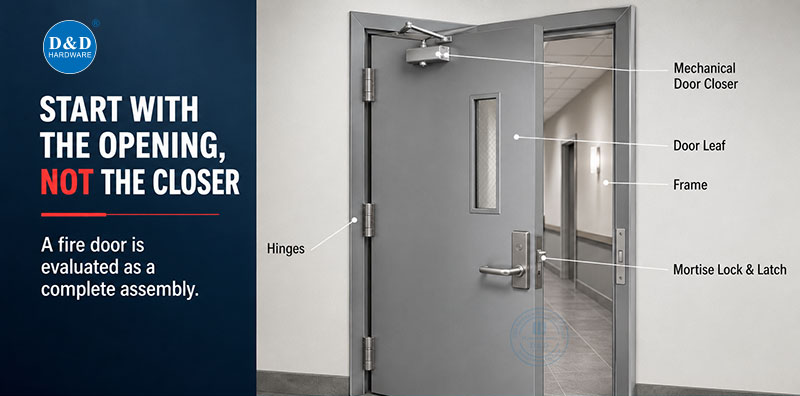
Start With the Opening, Not the Closer
A fire door is evaluated as an assembly. The door leaf, frame, hinges, lock or fire exit hardware, closer and other installed components must work together. A UL mark on one device does not automatically approve every combination or installation.
UL 10C is the positive-pressure fire test standard for door assemblies. In project language, “UL 10C fire rated” identifies the fire-test basis associated with the listed opening and the conditions covered by the certification. It should not be treated as a substitute for checking the product listing, the door and frame labels, the installation instructions and the approved assembly configuration.
The International Building Code requires fire doors to be self- or automatic-closing in the applicable circumstances. NFPA 80 addresses the installation, inspection, testing and maintenance of fire doors and other opening protectives. The practical requirement is straightforward: after the door is opened, the closing system must bring it back to the closed position and the latching hardware must secure it as required by the assembly.
This assembly-based approach is the foundation of sound Commercial Fire Door Hardware Selection.
What “UL Listed Fire Rated Door Closer” Should Mean in a Specification
A UL Listed Fire Rated Door Closer should be identifiable in the certification record and used within the limitations of that record. Before approving a submittal, confirm:
·The manufacturer and exact model appear under the relevant UL file.
·The fire rating is suitable for the specified opening.
·The installation arrangement is covered, including surface or concealed mounting.
·The closer is compatible with the door material, frame preparation, size, weight and swing.
·Installation follows the listed product instructions and the fire door manufacturer's preparation requirements.
·The complete opening can close and latch without field modifications that could affect its rating.
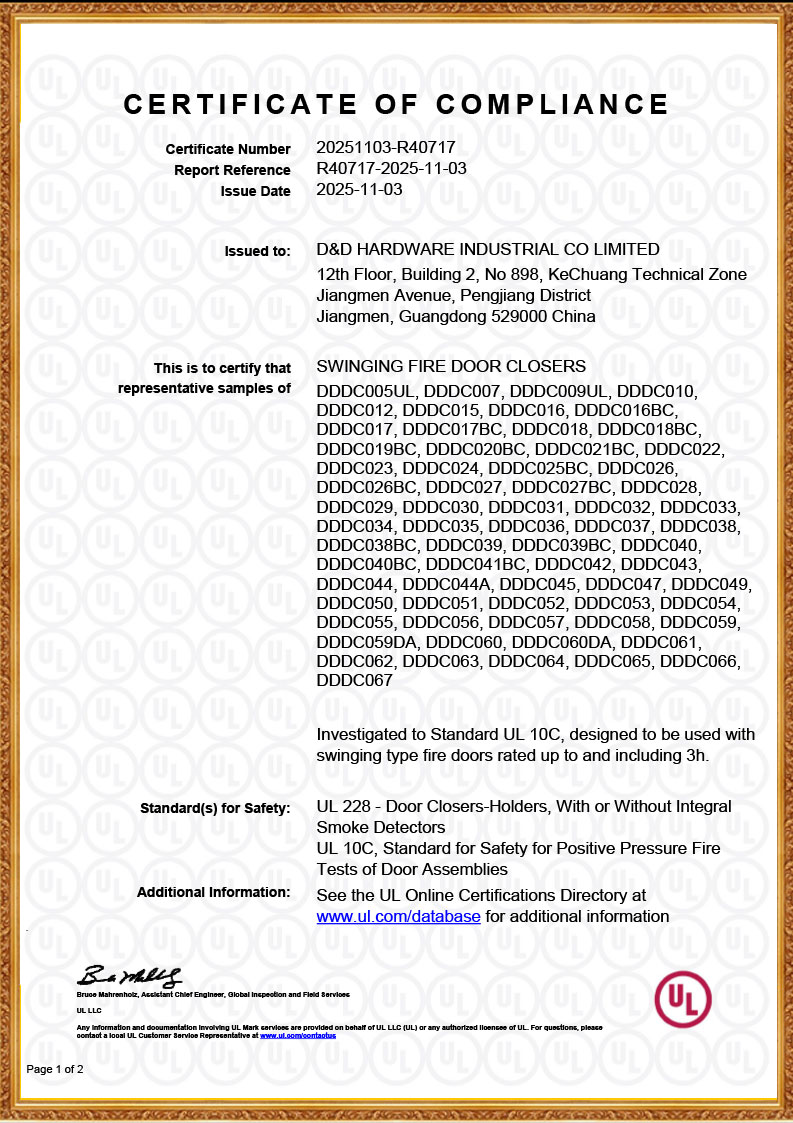
D&D Hardware's UL door closer range is identified under UL File R40717, with 67 models listed for applications fire rated up to 3 hours under UL 10C, subject to the conditions of the listing and the applicable fire door assembly. Buyers and specifiers should verify the selected model—not only the product family name—against the current certification information and project submittal.
Surface Door Closers for Fire Doors
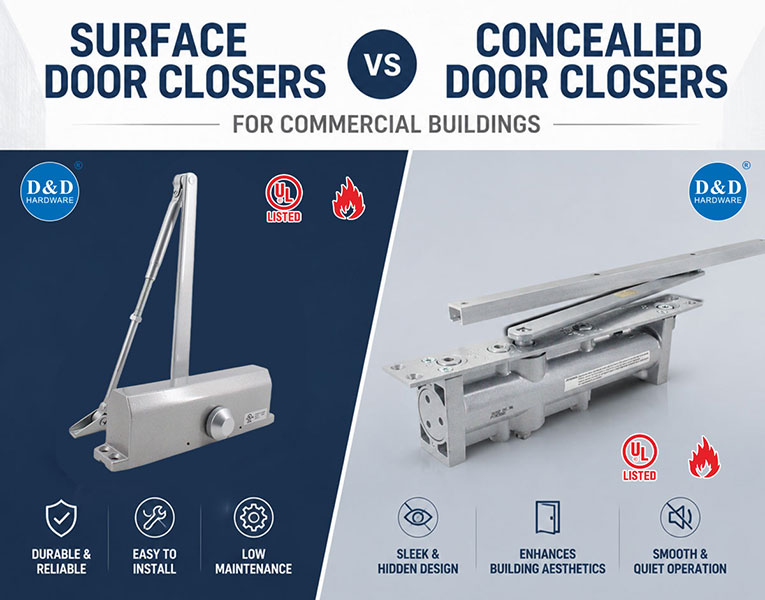
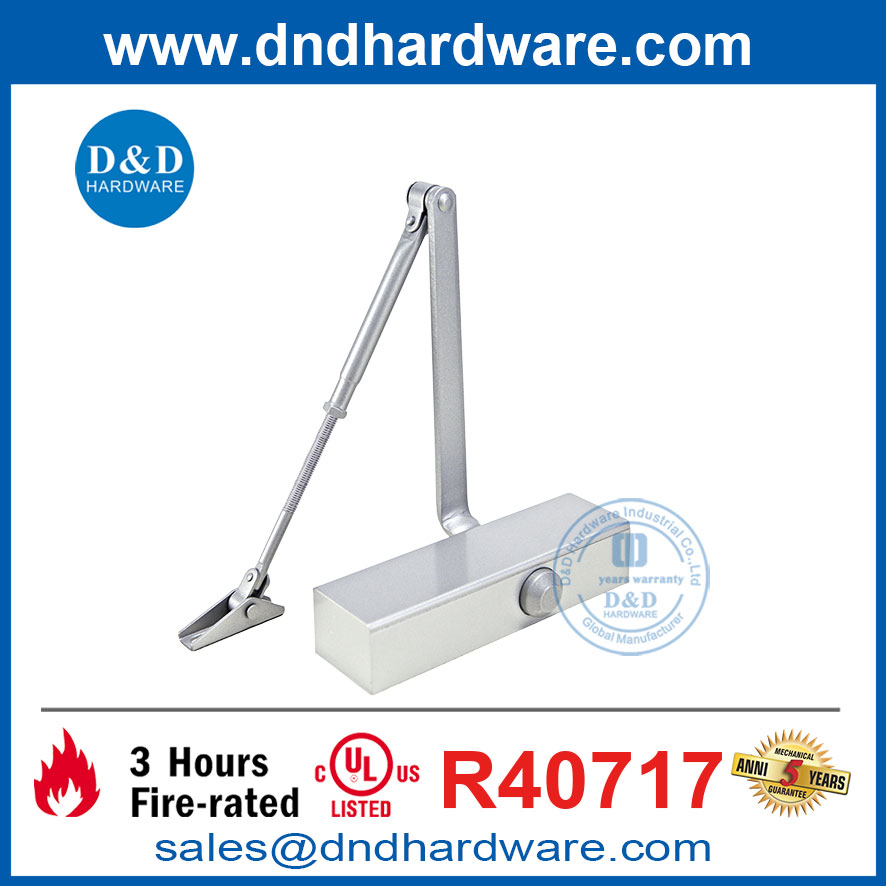
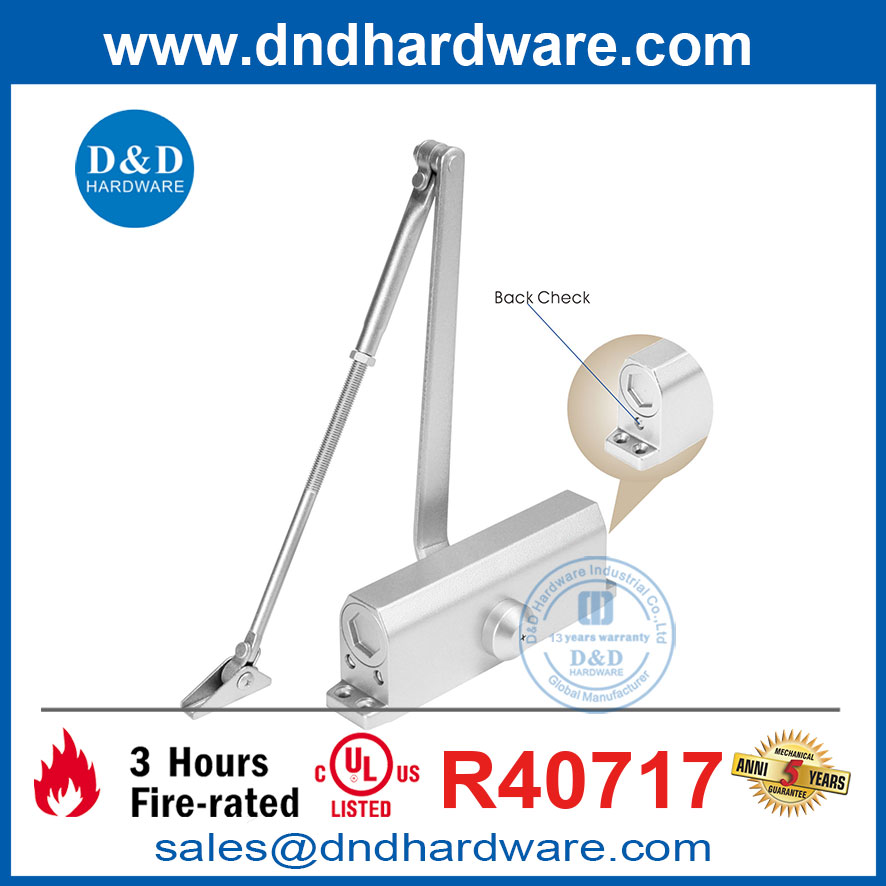
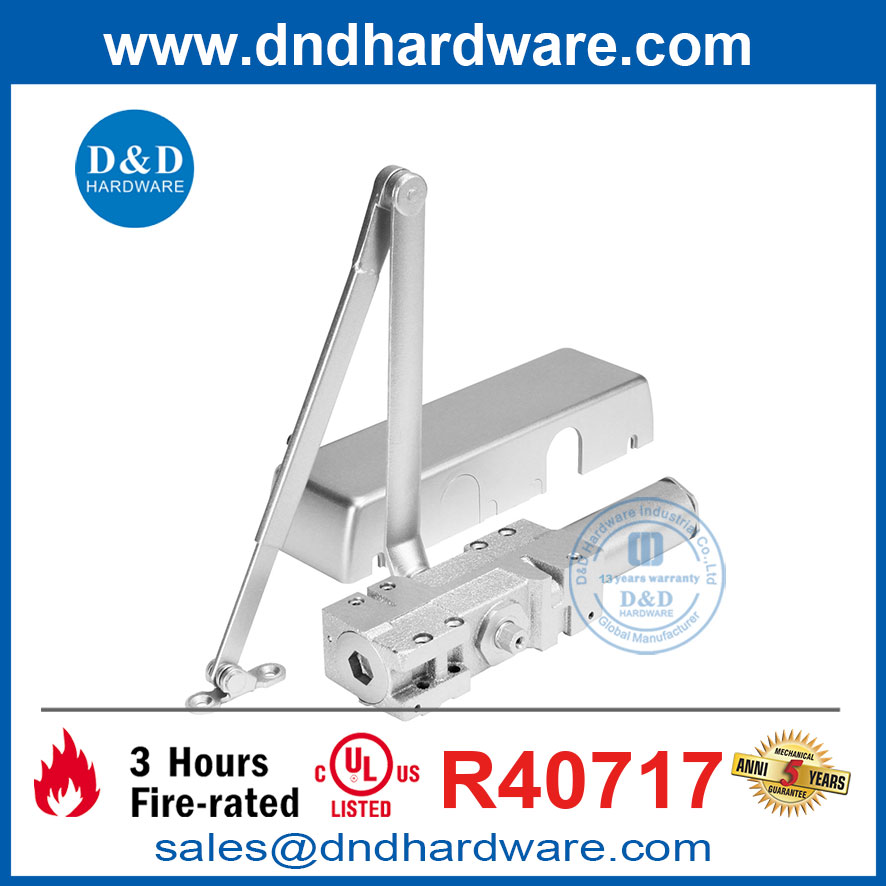
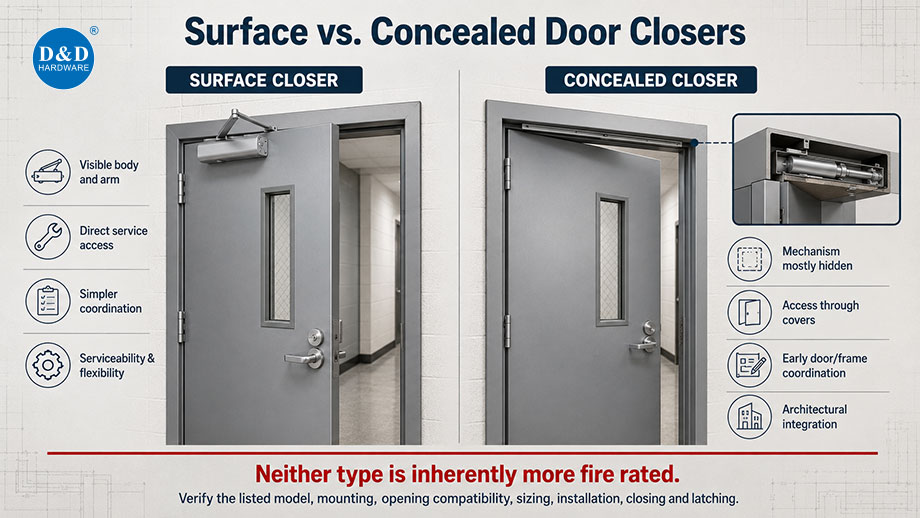
A surface closer is mounted on the face of the door or frame, with the arm and closer body accessible after installation. It remains the most common configuration for commercial openings because it is familiar to installers, adaptable to many door conditions and easy to inspect.
Where surface closers are a strong fit
Surface Door Closers for Fire Doors are commonly selected for schools, hospitals, offices, hotels, public buildings, service corridors and industrial facilities. They are especially practical where openings experience frequent use or the maintenance team needs direct access to adjustment valves, fasteners and arms.
Main advantages
·Accessible inspection and adjustment. The body and arm can be checked without opening a concealed cavity.
·Installation flexibility. Depending on the listed model and instructions, regular-arm, top-jamb or parallel-arm arrangements may be available.
·Practical maintenance. Leakage, loose fasteners, arm condition and closing performance are easier to observe.
·Broad project use. Listed models are available for many metal and wood fire door conditions.
Points that require specification control
Visible hardware may not suit every architectural interior. Mounting configuration also matters: a closer listed in one arrangement should not be assumed acceptable in every alternative arrangement. Door width, weight, opening force, wind or stack pressure, arm geometry and required options must be reviewed before the power size is selected.
Concealed Door Closers for Commercial Fire Doors
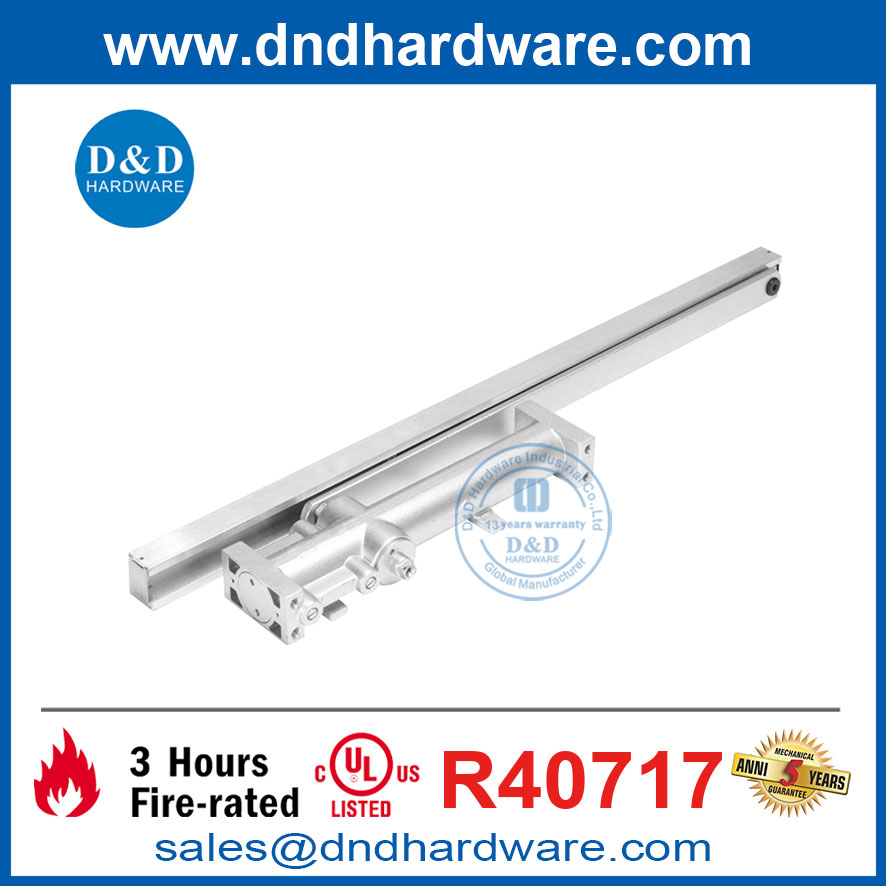
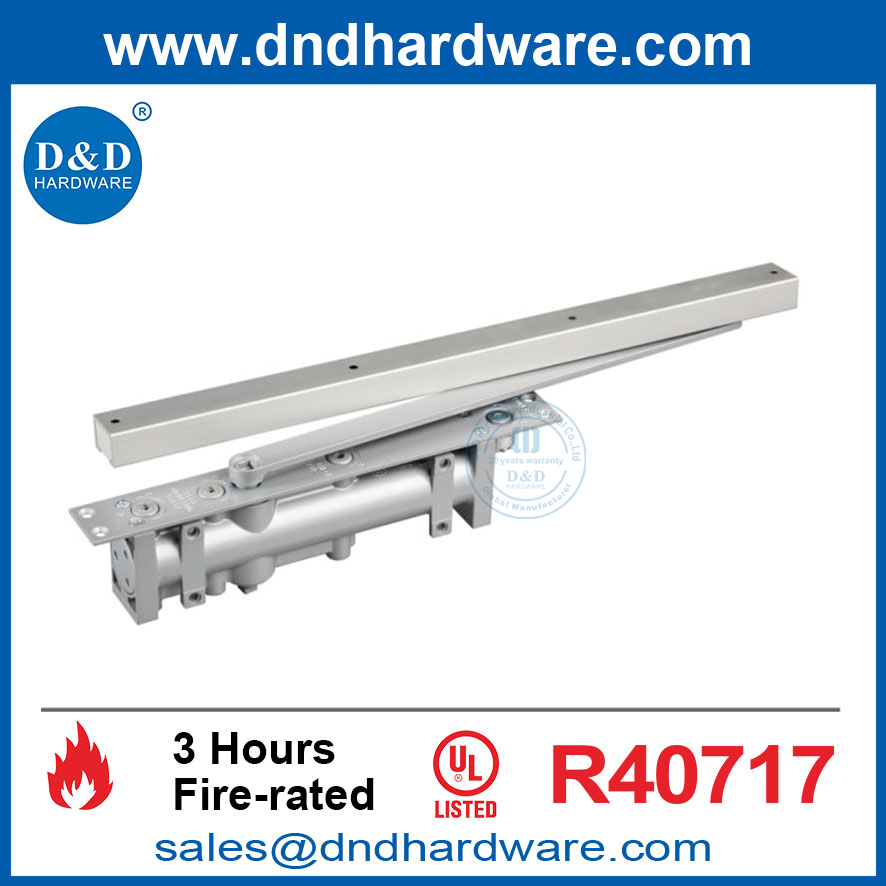
A concealed closer places most or all of the mechanism within the door, frame or another prepared location. This reduces visible hardware and can support a clean architectural line. It also introduces closer coordination between the closer manufacturer, door manufacturer, frame supplier and installer.
Where concealed closers are a strong fit
Concealed Door Closers for Commercial Fire Doors may suit premium hotels, executive offices, public interiors and other design-led projects where exposed hardware is undesirable. They are appropriate only when the exact closer, preparation and installation arrangement are covered for the rated opening.
Main advantages
·Architectural integration. Most of the closing mechanism is hidden.
·Reduced exposure. The body is less accessible to casual contact or unauthorized adjustment.
·Coordinated appearance. The solution can align with minimalist door and frame detailing.
Points that require specification control
Concealed preparation removes material from the door or frame and may affect the fire door construction if it is not factory-prepared or otherwise permitted by the listing. Installation tolerances are tighter, access for service is more limited, and replacement must match the approved preparation. “Concealed” is not a single universal mounting condition: overhead concealed and other concealed arrangements must be reviewed separately.
For these reasons, do not substitute a concealed closer for a surface model solely because both carry a UL mark. Confirm the exact model, mounting position, door and frame preparation, installation instructions and assembly eligibility before approval.
Surface vs. Concealed: Technical Comparison
Selection factor | Surface closer | Concealed closer |
Visual profile | Body and arm are visible | Most of the mechanism is hidden |
Fire-door verification | Confirm exact listed model and mounting arrangement | Confirm exact listed model, concealed preparation and assembly compatibility |
Installation coordination | Usually simpler; preparation remains model-specific | Requires early coordination with door and frame construction |
Inspection and adjustment | Direct access | Access may require covers or partial disassembly |
Replacement planning | Generally more straightforward | Replacement must suit the existing approved preparation |
Typical priority | Serviceability, flexibility and high-use operation | Architectural integration with verified fire-rating conditions |
Best decision rule | Use when access and maintainability lead | Use when design integration justifies added coordination |
Neither type is inherently “more fire rated.” The correct choice is the configuration that is listed, compatible with the complete opening, correctly sized, properly installed and capable of closing and latching the door under actual site conditions.
UL 10C Fire Rated Door Closer: What to Verify
When a schedule calls for a UL 10C Fire Rated Door Closer, the procurement team should request enough information to connect the product to the rated opening. Use the following verification sequence.
1. Confirm the opening rating
Identify the rating required by the approved door schedule and wall/opening design. Do not select a closer rating in isolation or assume that a “3-hour closer” increases the rating of a lower-rated door assembly.
2. Verify the certification record
Match the manufacturer, UL file number and exact model. For D&D Hardware, the relevant door closer file is R40717. Verify that the proposed model is included and review the current listing conditions.
3. Check the installation arrangement
Confirm whether the project requires surface, overhead concealed or another configuration. Review the approved mounting position, arm type, fasteners, templates and door/frame preparation. The installation method shown in the listing and instructions takes precedence over a generic product description.
4. Size the closer for the real door
Review door width, weight, material, frequency of use, opening angle, seals, latch resistance and environmental loads. A closer that is too weak may not close and latch the opening. Excessive power can create accessibility and usability problems. The authority having jurisdiction and applicable accessibility requirements must also be considered.
5. Review functions and options
Closing speed, latch speed, backcheck, delayed action and hold-open functions are not interchangeable. A mechanical hold-open condition is generally not appropriate for a fire door. Where an automatic-closing or releasing arrangement is permitted, it must be an approved system that releases under the required fire alarm or detection condition. Verify every option as part of the submitted model.
6. Coordinate the complete hardware set
The closer must work with the hinges, lock or fire exit hardware, seals, coordinator and other components. On pairs of doors, closing sequence and positive latching may depend on correctly coordinated hardware. This is why a closer should be selected within the broader UL Listed Fire Rated Commercial Door Hardware schedule.

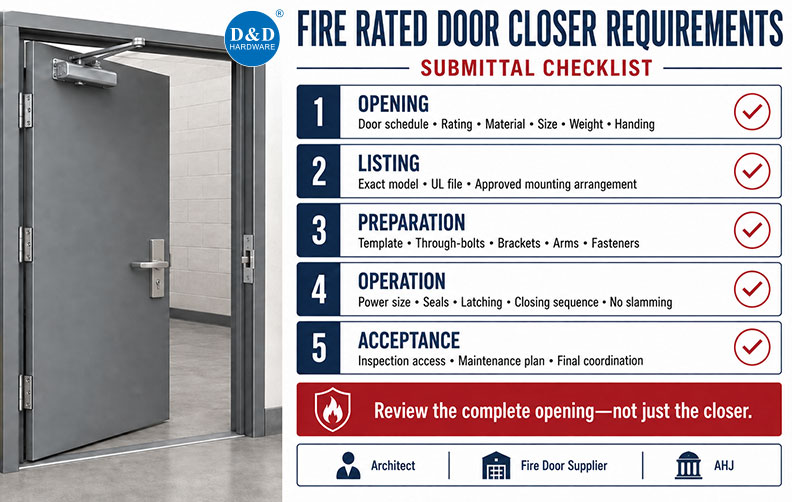
Fire Rated Door Closer Requirements: Submittal Checklist
Use this checklist before purchasing or approving a closer:
·Approved door schedule and required fire rating are available.
·Door and frame material, dimensions, weight and handing are confirmed.
·Exact closer manufacturer, model and UL file are stated.
·The proposed surface or concealed mounting arrangement is covered.
·Door and frame preparation matches the listed instructions.
·Power size and operating functions match the opening conditions.
·The closer can overcome seals and latch resistance without slamming.
·Hold-open or delayed-action features, if proposed, are specifically permitted.
·All through-bolts, brackets, arms and fasteners follow the approved template.
·The complete opening closes in the correct sequence and latches after installation.
·Inspection, adjustment and replacement access are included in the maintenance plan.
·Final acceptance is coordinated with the architect, fire door supplier and authority having jurisdiction.
These Fire Rated Door Closer Requirements help procurement teams move from a catalog-level selection to an opening-level compliance review.
Which Type Should You Specify?
Choose a surface closer when service access, installation flexibility and high-use maintenance are the leading priorities. Choose a concealed closer when architectural integration is important and the project team can verify the concealed preparation early.
In both cases, the first filter is certification and assembly compatibility. The second is operational performance. Appearance comes after those two decisions.
For a multi-opening project, avoid approving one closer by description alone and applying it to every door. Exterior doors, interior corridor doors, pairs, wide leaves and high-traffic openings may require different models or power sizes. A controlled hardware schedule is more reliable than a blanket substitution.
D&D Hardware UL Door Closer Range
D&D Hardware supplies UL Fire Rated Commercial Door Hardware for metal and wood fire door projects. Its UL door closer range includes surface and concealed options under UL File R40717, with 67 listed models and ratings up to 3 hours under UL 10C, subject to the individual model and assembly conditions.
For specification support, provide the door schedule, door and frame details, required mounting arrangement, opening conditions and project standard. D&D’s technical team can help identify a candidate model and prepare certification information for review. Final selection and acceptance should remain aligned with the approved opening, current listing information and the authority having jurisdiction.

Frequently Asked Questions
What is the difference between a surface and concealed door closer?
A surface closer is fixed to the face of the door or frame and remains accessible for inspection. A concealed closer is installed within a prepared door or frame location for a cleaner appearance. On a fire door, the exact model and installation arrangement must be permitted for the rated assembly.
Are concealed door closers suitable for commercial fire doors?
Yes, when the specific concealed closer and its preparation are listed or otherwise permitted for the fire door assembly. A concealed installation should never be assumed acceptable simply because a related surface model is UL Listed.
Does UL 10C apply only to the door closer?
No. UL 10C is a positive-pressure fire test standard for door assemblies. A closer described as UL 10C fire rated must be evaluated through its listing and used within the conditions established for the rated opening.
What should be checked under UL File R40717?
Confirm that the D&D manufacturer information and exact proposed closer model appear in the current certification record. Then check the rating, mounting configuration, instructions and any limitations relevant to the door assembly.
Which closer is better for a high-traffic fire door?
A surface closer is often preferred because it is accessible for inspection and adjustment, but traffic level alone does not determine compliance. The closer must also be correctly sized, listed for the application and capable of closing and latching the door under real operating conditions.
Can a 3-hour UL Listed closer make any door a 3-hour fire door?
No. The rating belongs to the tested and listed opening configuration. A listed closer does not upgrade an unlisted door, frame or incompatible assembly.
Contact us Now:
Contact: David Jian
Mob:0086-139 2903 7292
Email: David@dndhardware.com, sales@dndhardware.com,
Contact: Jobby Zhang
Mob:0086-137 2599 9617
Email: jobby@dndhardware.com
D&D HARDWARE INDUSTRIAL CO.,LTD
ADD:12th Floor, Building 2, No.898, KeChuang Technical Zone, Jiangmen Avenue, Pengjiang District, Jiangmen City, Guangdong, China (Postcode:529000)
https://www.dndhardware.com
Tel: +86-750-3856396
Fax: +86-750-3856395


 English