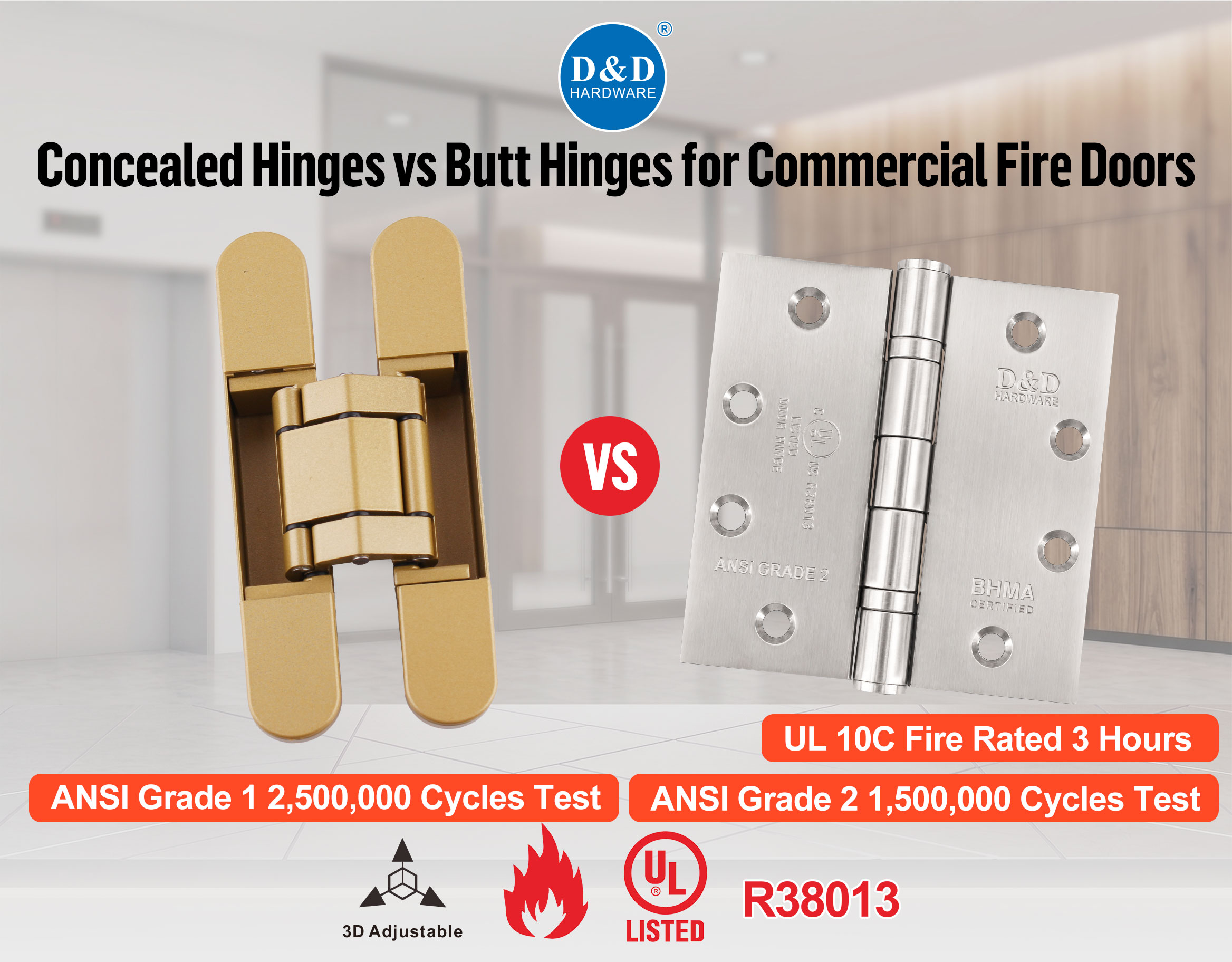
A Certification-Based Comparison
Hinge selection on a fire-rated opening is not a cosmetic decision. It is a compliance decision. Once a hinge is installed on a listed fire door assembly, it becomes one of the tested components that determines whether the assembly holds its rating — and whether it passes inspection.
Architects tend to favor concealed hinges because they disappear into the door line. Contractors and facility teams often default to butt hinges because the parts are standardized, stocked, and familiar to any door shop. Both positions are defensible. Neither is complete on its own, because appearance and installation convenience are not the variables that determine fire performance.
This comparison looks at concealed hinges and butt hinges through the lens actually used by code officials and specifiers: UL listing, cycle testing, load capacity, and assembly compatibility.
Why the Hinge Is Part of the Fire Rating, Not Separate From It
A fire door is tested and listed as a complete assembly — leaf, frame, hinges, latching hardware, closer, and glazing (if any) tested together, typically to UL 10C and NFPA 252 for temperature rise and, where required, positive pressure performance. The rating on the door label applies to that tested configuration, not to the leaf and frame in isolation.
If a hinge deforms, releases, or allows the leaf to sag out of the frame during fire exposure, the assembly can lose its seal at the perimeter long before the rated duration elapses. That is why AHJs and third-party inspectors check hinge listings during commissioning and periodic fire door inspections under NFPA 80 — not because the hinge itself burns, but because it is load-bearing hardware on a life-safety assembly.
The practical takeaway for specifiers: concealed vs. butt is a secondary question. The first question is always whether the specific hinge model is listed for use on the specific door/frame combination being installed.

Concealed Hinges: How They Work and What They're Rated For
A concealed hinge sits inside the door leaf and frame rather than on the face of either. When the door closes, no hinge barrel or leaf is visible from either side — the door reads as a single unbroken plane.
Most commercial concealed hinge systems use a linkage or pivot mechanism recessed into mortises cut into the door edge and frame rabbet, rather than the surface-mounted knuckle-and-pin design of a butt hinge. Many models also include three-way or multi-axis adjustment, which lets installers correct reveal and alignment after the door is hung — useful on fire doors, where clearance tolerances at the head and jamb are tighter than on standard interior doors.
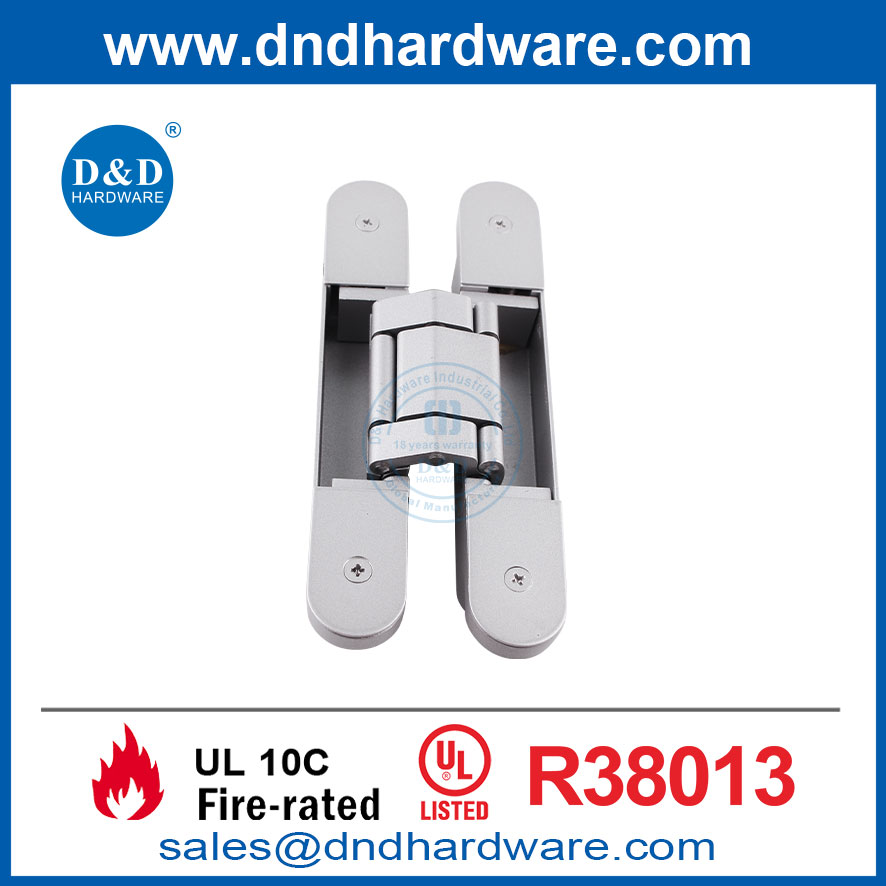
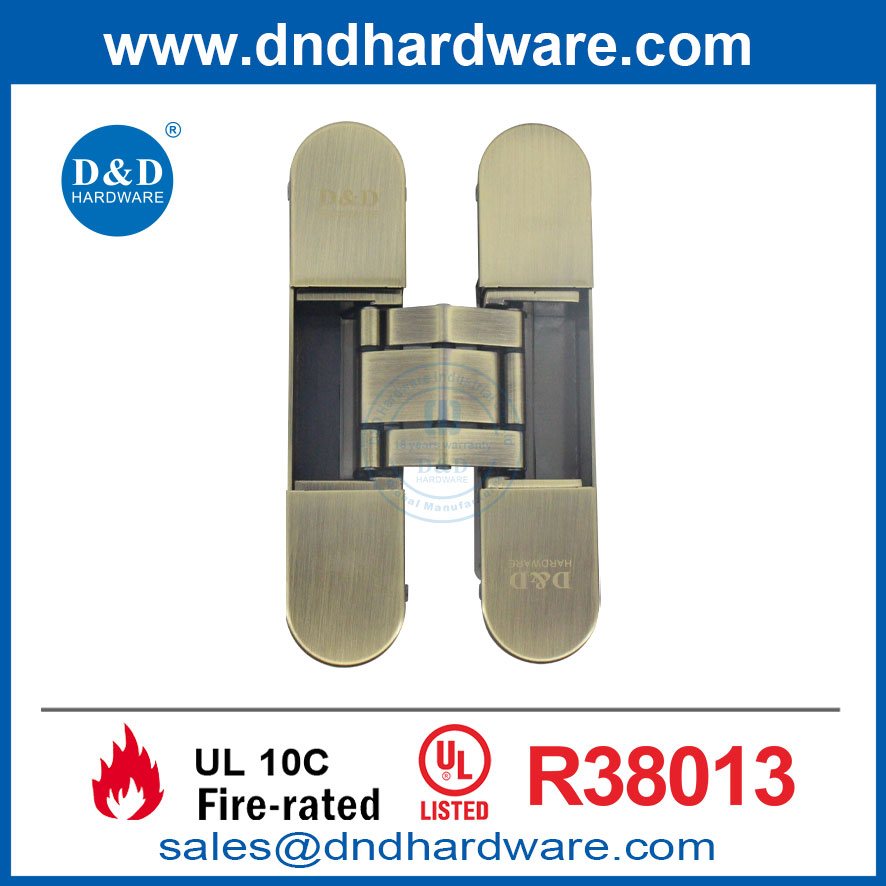
D&D Hardware's commercial concealed hinge is listed as:
•UL 10C Fire Rated
•UL File No. R38013
That listing covers use within approved fire door assembly configurations — the specific door construction, frame type, and size limits documented under the file. It does not automatically extend to every door/frame pairing, which is a distinction worth flagging to contractors during submittal review.
Butt Hinges: The Baseline Hardware for Commercial Openings
The butt hinge is the default hinge type in commercial construction: two leaves joined by a pin, mortised into the edge of the door and the face of the frame. The design has changed little in decades, which is precisely why it remains the easiest hinge to source, replace, and service in the field.
For fire-rated openings, the certification requirement is the same as for any other hinge type — a butt hinge has to carry its own UL listing to be used on a rated assembly. Being a "standard" hinge does not exempt it from testing.
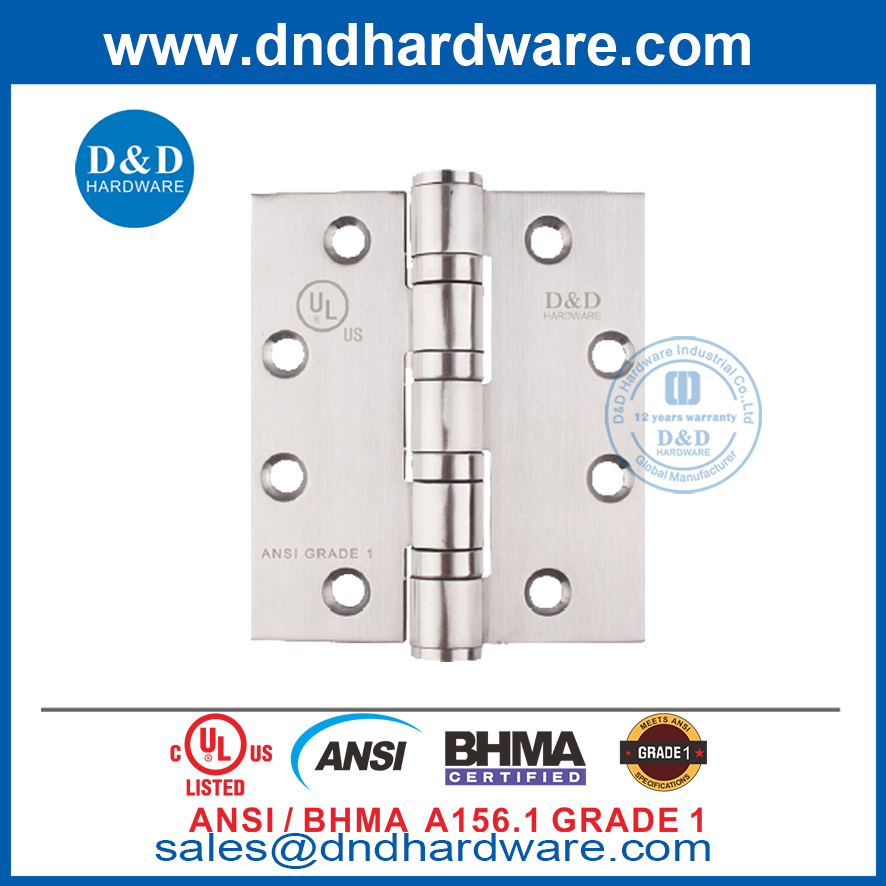
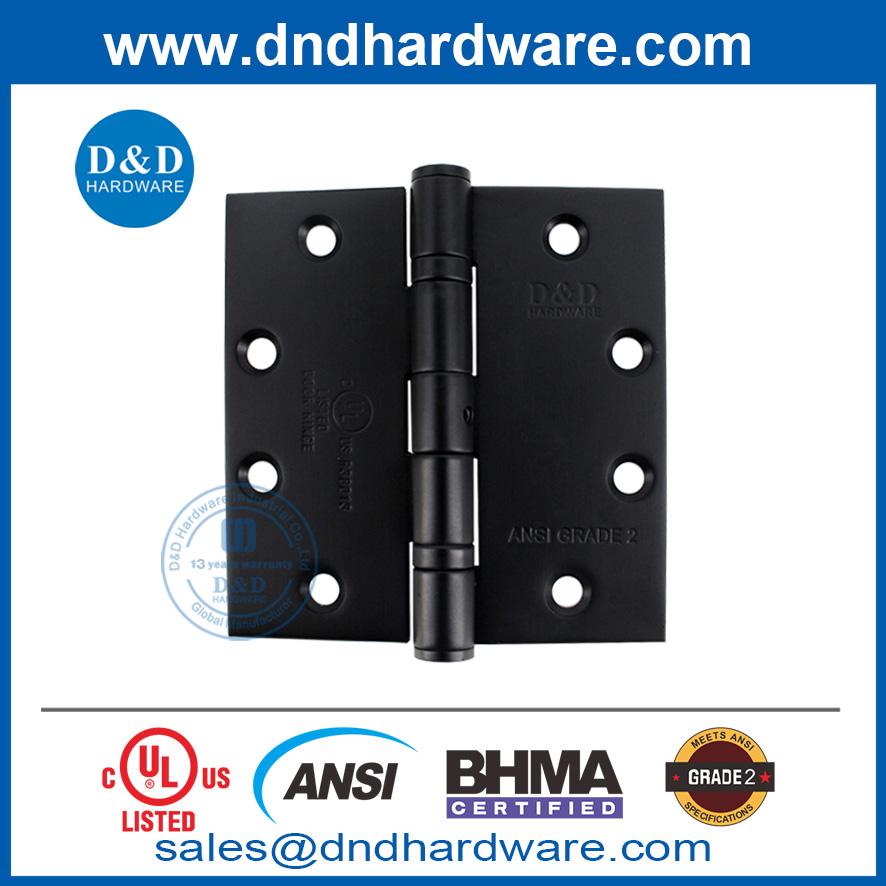
D&D Hardware's commercial butt hinge carries:
•UL/cUL 10C Fire Rated — 3 Hours
•UL File No. R38013
•ANSI/BHMA Grade 1 — 2,500,000 cycles
•ANSI/BHMA Grade 2 — 1,500,000 cycles
The ANSI/BHMA grading (per A156.1) is a cycle-life classification, not a fire rating. Grade 1 hinges are tested and certified for the highest commercial duty cycle, which is the relevant spec for high-traffic openings — stairwells, corridor doors, hospital units — where the door may open several hundred times a day.

Concealed vs. Butt Hinge: Side-by-Side
Criterion | Concealed Hinge | Butt Hinge |
Fire listing | UL 10C (model-dependent) | UL/cUL 10C — up to 3 hours (model-dependent) |
Cycle / durability rating | Manufacturer-specific; verify per model | ANSI/BHMA Grade 1 (2.5M cycles) / Grade 2 (1.5M cycles) |
Visible when closed | No | Yes |
Installation | Mortise-intensive, tighter tolerances | Standard mortise, widely understood |
Field replacement | May require partial disassembly | Straightforward, parts widely stocked |
Typical use case | Design-forward interiors, hidden hardware | High-cycle, heavy-duty commercial openings |
Neither column is "better" in the abstract. A certified concealed hinge and a certified butt hinge both satisfy UL 10C requirements when installed per the listing — the table exists to show where they diverge, not to rank them.
Load Capacity and Structural Performance
Commercial fire doors routinely weigh more than standard interior doors, especially where composite or steel cores are used to meet the fire rating. That extra weight is carried entirely by the hinge set, which is why load rating deserves the same scrutiny as fire rating.
Butt hinges have the longer track record on oversized and high-frequency doors — hospitals, schools, and industrial facilities have specified them for this reason for decades. Concealed hinges are available in heavy-duty configurations too, but load capacity varies significantly by manufacturer and mechanism design. The safe approach is to compare published load ratings for the specific model under consideration rather than assuming either category is inherently stronger. Door weight, leaf size, and hinge quantity per opening should all factor into that comparison.

Installation: What Actually Differs in the Field
Butt hinges
Use a mortise pattern that most door shops can cut, template, or order pre-machined without special tooling. Replacement is a routine field task, and parts availability is rarely a bottleneck.
Concealed hinges
Require precision machining in both the door edge and the frame rabbet, and the tolerances matter more on a fire door because the perimeter gap is part of what the assembly was tested with. Installers who are not already familiar with the specific hinge system should expect a learning curve on the first few units. Once set, the adjustability built into most concealed systems makes long-term alignment easier to maintain than it is on some multi-hinge butt installations.
Maintenance and Facility Management
Exposed butt hinges are easy to inspect visually during routine fire door inspections (an NFPA 80 requirement for most commercial buildings) — a technician can check for wear, sag, or missing screws without opening up the door. Concealed hinges are shielded from impact and tampering, which reduces vandalism and accidental damage in high-traffic public areas, but a major repair may require pulling the door off its mortises rather than a simple hinge-pin swap.
Facility teams with in-house maintenance staff and frequent self-inspection programs often lean toward butt hinges for this reason. Buildings prioritizing appearance and willing to schedule qualified service technicians for hinge work tend to accept the added maintenance complexity of concealed systems.
Where Appearance Actually Drives the Decision
Concealed hinges earn their spec in projects where an unbroken door line is part of the design intent — hospitality, executive office space, luxury multifamily, and healthcare interiors built around a contemporary aesthetic. Butt hinges remain the default everywhere durability, high cycle counts, and simple servicing outweigh the visual argument — the majority of institutional and industrial fire-rated openings.

Selection Framework
Choose a concealed hinge when… | Choose a butt hinge when… |
A clean, hardware-free door face is a design requirement | Maximum cycle life and proven durability are the priority |
The frame and door system are detailed to accommodate recessed hardware | The opening sees high daily traffic |
The specific model carries UL 10C listing for the assembly in question | ANSI/BHMA Grade 1 or 2 performance is specified |
— | Installation speed and field familiarity matter |
Certification is the constant in both columns. Neither hinge type should be specified — or approved — without confirming the listing applies to the exact door, frame, and size combination on the project.
Common Misconceptions, Corrected
"Concealed hinges are just decorative — not real fire door hardware."
Incorrect. A properly listed concealed hinge is tested hardware with a UL 10C rating, not an aesthetic accessory. The mechanism is different from a butt hinge; the certification standard is not.
"Any butt hinge works on a fire door."
Incorrect. Only butt hinges independently listed under UL 10C (or the applicable standard) for fire door use are acceptable. A non-rated butt hinge invalidates the assembly regardless of how the rest of the door is specified.
"A fire-rated door label means the whole opening is compliant."
Incorrect. The label reflects the tested assembly as a whole — hinges, latching hardware, closer, and frame included. Swapping in a non-listed hinge after the fact breaks that compliance chain even if the door leaf itself retains its label.

Concealed and butt hinges solve different problems well. Concealed hinges deliver a hidden, design-forward hardware line and are available in UL 10C-listed configurations for fire-rated openings. Butt hinges deliver decades of field-proven durability, straightforward installation, and — when Grade 1 or Grade 2 rated — cycle performance suited to heavy commercial traffic.
The decision should be driven by the project's fire rating requirements, door weight, traffic volume, and maintenance model — not by hinge style alone. D&D Hardware's UL 10C Fire Rated Concealed Hinge (UL File No. R38013) and UL/cUL 10C Fire Rated Butt Hinge — 3 Hours (UL File No. R38013, ANSI/BHMA Grade 1 & Grade 2) are both documented for use in approved fire-rated door assemblies, giving specifiers a certified option in either category.
FAQ
Which hinge is better for commercial fire doors — concealed or butt?
Neither is universally better. The right choice depends on the door's fire rating, weight, expected duty cycle, and the project's design and maintenance requirements — not on hinge style alone.
Can concealed hinges be used on fire-rated doors?
Yes, provided the specific model is tested and listed under the applicable standard (UL 10C in North America) as part of a compliant fire door assembly.
Are butt hinges stronger than concealed hinges?
Not inherently. Load capacity depends on the individual hinge's design and published rating, not on whether it's concealed or exposed. Compare model-specific load data rather than assuming by category.
Why does UL certification matter for door hinges?
UL listing confirms the hinge was tested as part of a fire-rated assembly and meets the performance requirements for that rating — without it, the hinge (and potentially the whole opening) is non-compliant regardless of build quality.
What does ANSI/BHMA Grade 1 mean for a butt hinge?
It's a durability classification under ANSI/BHMA A156.1, indicating the hinge has passed cycle testing to 2,500,000 operations — the standard benchmark for high-traffic commercial openings.
Do concealed hinges need more maintenance than butt hinges?
Not more, but different. Concealed hinges are less exposed to impact and tampering day-to-day, but major service work may require partial door disassembly rather than a simple field swap.
Contact us Now:
Contact: David Jian
Mob:0086-139 2903 7292
Email: David@dndhardware.com, sales@dndhardware.com,
Contact: Jobby Zhang
Mob:0086-137 2599 9617
Email: jobby@dndhardware.com
D&D HARDWARE INDUSTRIAL CO.,LTD
ADD:12th Floor, Building 2, No.898, KeChuang Technical Zone, Jiangmen Avenue, Pengjiang District, Jiangmen City, Guangdong, China (Postcode:529000)
https://www.dndhardware.com
Tel: +86-750-3856396
Fax: +86-750-3856395


 English