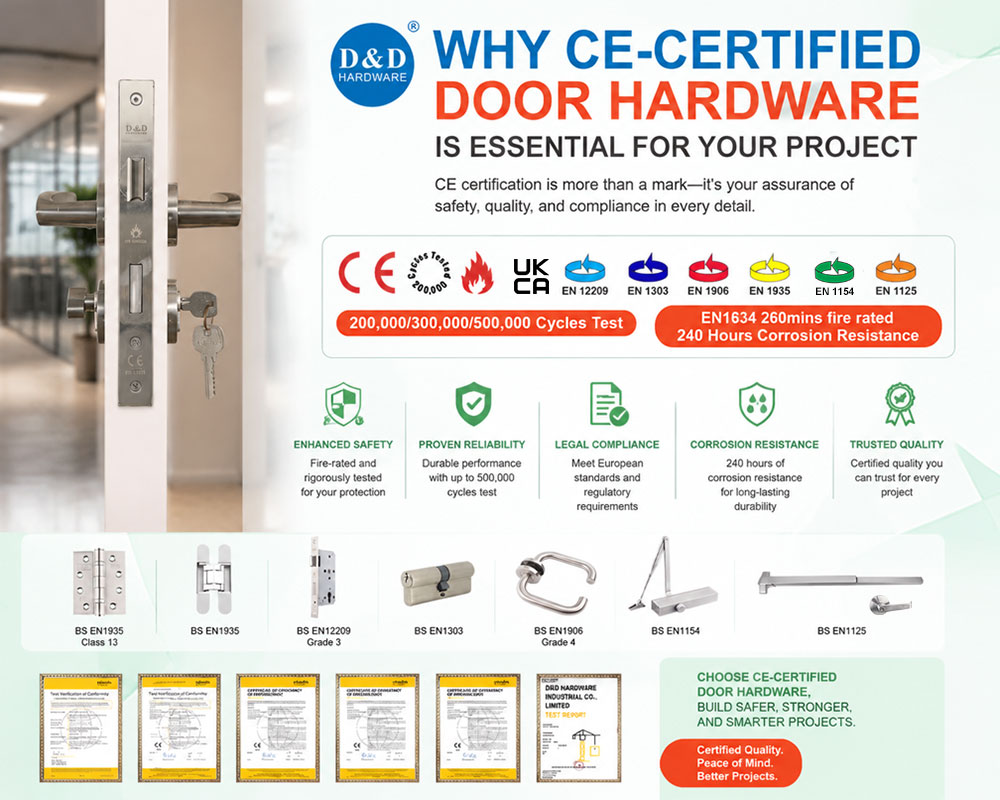
You need CE certification for your door hardware to follow strict rules and keep your project safe. If you do not follow the rules, you could lose fire ratings. Insurance might not pay for damage. You could break building codes. You might even get in trouble with the law. The Grenfell Tower Fire showed that not following rules can cause big problems. CE certification shows your hardware is safe and follows the law. It helps you feel calm and sure. D&D Hardware is a trusted CE door hardware manufacturer. CE certification keeps your project safe, legal, and working well. Building inspectors want you to follow the rules. CE certification helps you avoid expensive mistakes.
Key Takeaways
CE certification shows your door hardware is safe and legal. It helps protect your project from possible dangers. Using CE-certified hardware helps you avoid big mistakes and legal trouble. It keeps your building following the rules. CE certification makes things safer in emergencies. It makes sure doors work right and everyone can use them, even people with disabilities. Picking a trusted company like D&D Hardware means you get good, certified products. This helps your project do well. Always look for the CE mark on door hardware. This proves it meets safety rules and laws.

What Is CE Certification?
CE Certification Explained
You can find the CE marking on many things in Europe. This mark means the product is safe and works well. For door hardware, CE certification means it follows European Union laws. These laws help keep people and buildings safe. The table below shows what CE marking and construction product mean:
Term | Definition |
CE Marking | Shows the product follows EU rules and laws. This can include door hardware under the Construction Products Regulation. |
Construction Product | Any product or kit made and sold to be used in buildings. It affects how well the building works and meets basic needs for construction. |
You need CE certification for door hardware to show your project follows the law. This is important for all types of buildings.
Standards and Testing for Door Hardware
You must use harmonised standards when picking door hardware. These standards make sure products are safe and strong. The main harmonised standards for door hardware are:
EN Standard | Description |
EN 1935 | Single-axis hinges and 3D adjustable concealed hinges. It covers how much weight they hold, how long they last, safety, and rust resistance. |
EN 12209 | Mechanically operated locks. It tells you about security, how long they last, and how well they work. |
EN 1154 | Controlled door closing devices for commercial and fire-rated doors. |
EN 1125 | Panic exit devices needed for public buildings. |
EN 1906 | Door handles and knobs. It explains how strong, safe, and long-lasting they are. |
EN 1303 | Lock cylinders. It covers how long they last, how safe they are, and how well they work. |
EN 1634 | Fire resistance and smoke control tests for door assemblies and hardware. |
EN 1670 | Corrosion resistance class for hardware in different places. |
You must use harmonised standards for testing and checking. These steps help you prove your product is safe and get the right certifications.
Why CE Certification Matters
You need CE certification to make sure your door hardware is safe and legal. The process has a few steps:
Decide what type of product you have and what standard to use
Test how well the product works
Get all the paperwork ready
Make a statement that your product is safe and add the CE marking
You also need to find the right rules, check your product, and keep records to show you follow the law. Harmonised standards help you with each step.
CE certification keeps people safe in public buildings. It makes sure you follow EU safety rules. You lower risks by using products that pass strict standards. When you see the CE marking, you know the maker promises the product is safe and healthy. This helps you feel calm and keeps you out of trouble with the law.
Tip: Always look for the CE marking on door hardware. This helps you meet all the rules for your project.
Benefits of CE Door Hardware
Safety and Compliance
You want your building to be safe for everyone. CE certification helps you reach this goal. When you pick CE-certified fire door hardware, you know it passed tough tests. These tests check if the hardware is strong and can handle heat. They also make sure it works right in emergencies. CE certification helps your doors follow ADA rules. This means people with disabilities can use the doors safely.
Look at the table below. It shows how CE-certified fire door hardware works better in emergencies:
Feature | Standard Door Hardware | Fire Exit Hardware |
Operation | Needs grasping, twisting, or keys. | Opens with one push right away. |
Crowd Safety | Can trap people if crowded. | Opens by itself when pushed (Panic Bar). |
Heat Resistance | May bend or melt and jam the door. | Tested to handle high heat and not fail. |
Latch Mechanism | Often uses deadbolts for safety. | Locks itself to keep fire and smoke in. |
Compliance | Good for privacy or safety. | Needed for emergency exits. |
Using CE-certified fire door hardware saves lives. You also avoid trouble with inspectors. CE certification proves your hardware follows the rules. Your project stays safe and legal.
Note: CE certification is more than a mark. It means your fire door hardware meets all safety and quality standards.
Risk Reduction and Liability Protection
You lower risks by using CE-certified fire door hardware. CE certification means your hardware is checked for safety and strength. You make accidents and injuries less likely. You also protect yourself from legal problems. If something bad happens, you can show your hardware follows the rules.
ADA compliance is important for lowering risks. You must use hardware that helps everyone get out safely. CE certification helps you follow ADA rules. You avoid lawsuits and fines. You also make your building safer for all people.
Here are some ways CE-certified fire door hardware helps you:
Doors do not jam during fires.
Exits are easy for everyone to use.
You keep your insurance by following the rules.
You show inspectors your project is safe.
You build trust with your clients and users. They know you care about their safety.
Market Access and Project Success
CE certification lets you sell in more places. Many countries need CE-certified fire door hardware for new buildings. You follow the rules in Europe and other areas. You also show your hardware fits many building styles.
See the table below. It lists the top three benefits of using CE-certified door hardware in commercial buildings:
Benefit | Description |
Compliance | Follows European and world building rules. |
Durability | Made to last in busy places. |
Suitability | Works in many types of buildings. |
You get more clients and projects. You meet ADA and accessibility needs. You also make your reputation better. CE certification shows you care about safety and quality.
Tip: Always pick CE-certified fire door hardware for your project. You keep everyone safe and happy in your building.

Choosing a CE Door Hardware Manufacturer
Why D&D Hardware?
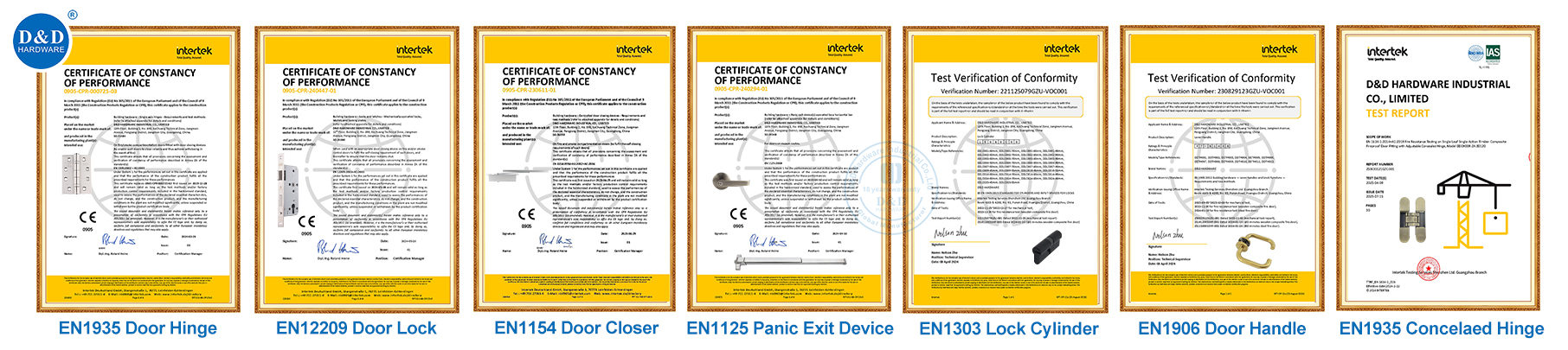
You want a ce door hardware manufacturer you can trust. D&D Hardware has many certifications like CE marking, UL, ANSI/BHMA, and ISO 9001. These show their products are safe and work well. You can count on their fire door hardware for important projects. D&D Hardware has been in the business for over 18 years. They help customers all over the world. Their experience helps you get good results.
When picking a ce door hardware manufacturer, check for clear CE and fire labels. Make sure they have real DoP documents and good supplier credentials. You need to see real marks on every piece of fire door hardware. The table below tells you what to look for and why it matters:
What to Check | Why It Matters |
Clear CE and fire labels | Shows the door hardware passed real safety tests |
Valid DoP document | Proves the product meets the right standards |
Supplier’s credentials | Helps you avoid risky or fake door hardware |
Label quality and placement | Real marks are clear and in the right spot |
You also want a ce door hardware manufacturer with strong production, many years in business, and helpful customer service. D&D Hardware answers your questions fast and helps you from start to finish.
Product Range and Custom Solutions
You need a ce door hardware manufacturer with many fire door hardware choices. D&D Hardware sells locks, hinges, handles, exit devices, and access control systems. Their products come in different finishes and setups. You can ask for custom solutions if you have special needs. D&D Hardware tests locks and closers together to keep standards high for secure projects.
You get many benefits when you choose D&D Hardware. Their fire door hardware is EN 1906 certified for strength and EN 1634 fire-rated for up to 260 minutes. Products do not rust and work well in busy places. D&D Hardware gives you good quality and fair prices. You get everything you need from one ce door hardware manufacturer, so buying is easy and quick.
Tip: Pick a ce door hardware manufacturer with certifications, quality checks, and custom options. This helps you follow the rules and keep your project safe.
CE Certification vs Other Standards
CE vs UL, ANSI, and BHMA
You might wonder how CE certification is different from UL, ANSI, and BHMA. CE certification is the law in the European Union. You need outside testing, a Declaration of Performance, and Factory Production Control papers. These steps make sure your fire door hardware is safe. UL certification is not required, but it helps people trust your products in North America. UL checks if hardware works during a fire and gives a fire rating. ANSI and BHMA follow local rules and test how well hardware works. These do not always need as much paperwork as CE certification.
Here is a table that shows how EN 1634-1 (for CE certification) and UL 10C (for UL certification) are different:
Aspect | EN 1634-1 | UL 10C |
Pressure | Neutral | Positive |
Temperature curve | ISO 834 | ASTM E84-based |
Flame passage | Limited | Strict |
Hardware function | Indirect | Critical |
Door gap behavior | Monitored | Highly critical |
EN 1634-1 checks if the fire door hardware stays strong and the latch works. UL 10C looks at how far the latch sticks out and how the door does in heat. ANSI and BHMA look at how well hardware works, but CE certification needs more papers and testing. Both CE certification and ANSI/BHMA check the locking mechanism.
Note: CE certification is a must in the EU, but UL, ANSI, and BHMA matter in North America and other places.
When CE Certification Is Required
You must use CE certification for fire door hardware in Europe. If you skip it, you might fail fire checks and not get project approval. CE certification is needed when you want to:
Keep the door strong in a fire
Control smoke and keep it in one area
Follow building and fire rules
Pass fire checks or get approval to use the building
Avoid legal and insurance trouble after a fire
CE certification keeps your project on track and away from legal problems. It also proves your fire door hardware is very safe. ANSI/BHMA is important in the US, but only CE certification works for Europe. You need to know what your project needs before you pick hardware.
Tip: Always check your local rules and project needs before you pick fire door hardware. CE certification is not just a mark—it proves your hardware is safe and follows the rules.

Common Misconceptions
CE Certification Scope
Some people think ce certification is for just one kind of door hardware. But it actually covers many different products. Each product has its own EN standard and rules to follow. The table below shows how ce certification works for different hardware types:
Product Type | Relevant EN Standard | Key Requirements |
Door handles and knobs | EN 1906 | Strength, corrosion resistance, safety, cyclic testing |
Locks and bolts | EN 12209 | Strength, fire resistance, burglar resistance, durability |
Door closers | EN 1154 | Control performance, durability, fire door requirements |
Single-axis hinge | EN 1935 | Load-bearing, durability, corrosion resistance |
You have to check what each product needs. Ce certification is not the same for every item. You must use the right standard for your hardware.
Is CE Only for Europe?
Some people think ce certification is only important in Europe. That is not true. Many places outside Europe also accept ce certification as a sign of safety. You can find ce certification in projects in the Middle East, Asia, and Africa. Some areas even need it for public buildings and fire doors. Ce certification helps you meet world standards and lets you work in more places.
Tip: Ce certification makes your project look good everywhere, not just in Europe.
Cost vs Value
You might think ce certification costs too much. Certified hinges can be 20% to 40% more expensive than others. You pay more at first, but you save money later. Ce certification stops early problems and lowers repair costs. You do not have to fix or replace things as often. Over time, ce certification gives you more value for your money.
Many things change the price:
The material you pick changes the cost.
More fire resistance means a higher price.
Certification and standards make products more reliable.
Size, design, and special features can raise the price.
Prices can be different in each region.
Ce certification helps you save money in the long run. It keeps your project safe and protects your budget.
You keep your project safe when you pick CE-certified door hardware. You follow safety rules and make your building secure. D&D Hardware gives you good products and helpful support. Here is how D&D Hardware helps your project:
Feature | Description |
Safety Compliance | Checked to world standards for safety and performance |
Durability | 10-year warranty for strong and lasting quality |
Expert Support | Technical help for easy project management |
You can ask D&D Hardware for certified solutions. You get special designs, technical help, and support that lasts:
Service | What You Get | Why It Matters |
Project Consultation | Expert advice | Saves time and stops mistakes |
Certification Guidance | Info about CE and UL standards | Meets safety rules |
Tip: Pick CE-certified door hardware for peace of mind and to follow the rules.
FAQ
What does CE certification mean for door hardware?
CE certification shows your door hardware meets strict safety and quality rules. You can trust that the product works well and keeps your building safe.
Do I need CE-certified hardware for every project?
You need CE-certified hardware for projects in Europe and many other places. It helps you follow building codes and pass inspections. Always check your local rules.
How can I tell if my door hardware is CE-certified?
Look for the CE mark on the product or packaging. You can also ask for a Declaration of Performance (DoP) from your supplier. This proves the hardware meets standards.
Does CE-certified hardware cost more?
You might pay more for CE-certified hardware. You save money over time because the hardware lasts longer and helps you avoid repairs or legal trouble.
Contact us Now:
Contact: David Jian
Mob:0086-139 2903 7292
Email: David@dndhardware.com, sales@dndhardware.com,
Contact: Jobby Zhang
Mob:0086-137 2599 9617
Email: jobby@dndhardware.com
D&D HARDWARE INDUSTRIAL CO.,LTD
ADD:12th Floor, Building 2, No.898, KeChuang Technical Zone, Jiangmen Avenue, Pengjiang District, Jiangmen City, Guangdong, China (Postcode:529000)
https://www.dndhardware.com
Tel: +86-750-3856396
Fax: +86-750-3856395
 English