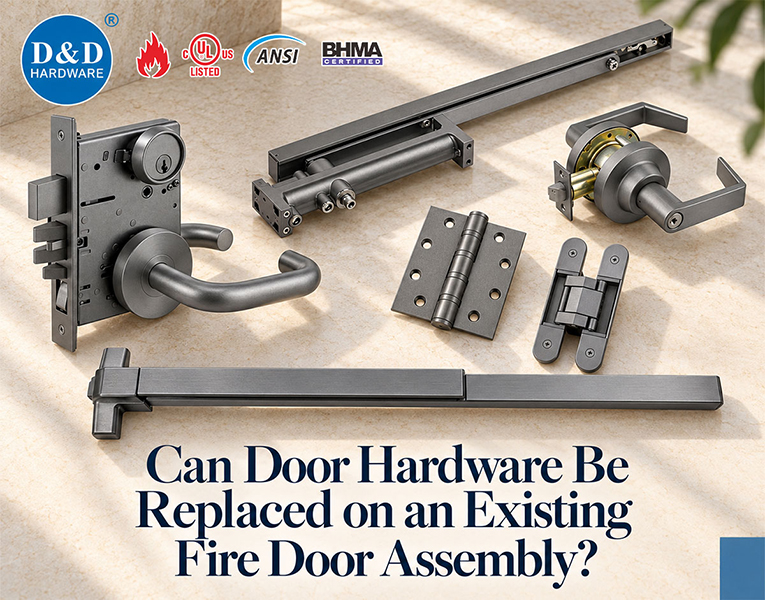
Yes, door hardware can be replaced on an existing fire door assembly, provided the replacement is suitable for the opening and the work follows applicable listing conditions, installation instructions and adopted code requirements. A product that fits the existing holes is not necessarily an acceptable replacement.
The key distinction is between replacing compatible hardware within permitted preparations and modifying the certified construction. Changing a worn closer may be relatively straightforward. Converting a mortise lock opening to an exit device, or cutting pockets for concealed hinges, requires closer review.
For building owners, contractors and door manufacturers, the objective is to restore service while preserving the opening’s documented fire protection and egress functions.

1 Identify the Existing Assembly Before Selecting Hardware
Begin with the door and frame labels, original hardware schedule and available installation records. Establish the opening’s required rating, door construction and approved hardware application.
Do not assume that a visible fire label permits every type of replacement hardware. The Steel Door Institute explains that labeled hardware can be used across fire door brands only when the door is properly listed and labeled for that hardware application. A door approved for a single-point lock is not automatically suitable for fire exit hardware.
Record the existing:
· Door and frame manufacturer and certification marks.
· Fire protection rating and any special label information.
· Hardware models, functions and fixing arrangements.
· Cutouts, reinforcement, damage and previous alterations.
If labels are missing or unreadable, resolve the identification issue before treating the assembly as verified. Installing new UL Listed Fire Rated Commercial Door Hardware does not restore missing certification evidence for the door or frame.
2 Separate Compatible Replacement from Field Modification
A replacement using an appropriate existing preparation generally presents fewer complications than a change requiring new cutouts. Nevertheless, “like-for-like” should describe the relevant function and approved application, not simply appearance.
Compare the proposed product’s template, fasteners, reinforcement requirements and operating function with the existing arrangement. Even hardware from the same manufacturer can require different preparations.
NFPA 80 provides allowances for job-site preparations and procedures for field modifications. For work outside those allowances, consult the door or frame manufacturer and the listing agency before making changes. Written authorization may permit some modifications without a field visit; others may require evaluation or additional action.
For example, replacing a surface-mounted closer does not automatically authorize enlarging its fixing holes. Likewise, changing a butt hinge to a concealed hinge involves more than selecting another certified product: the new mortises must be acceptable for the door and frame.

3 Check Each Replacement Against Its Certification Scope
A UL file number helps identify certification records, but it should not be treated as blanket approval for every model or installation.
Review the exact replacement model, permitted door application, rating limitations, accessories and installation instructions. For locks, include the strike and trim. For closers, check the mounting arrangement. For hinges, verify dimensions, quantity and fixing details.
D&D Hardware’s supplied UL series information provides the following starting references:
Product
| Hardware category | Stated certification and performance information |
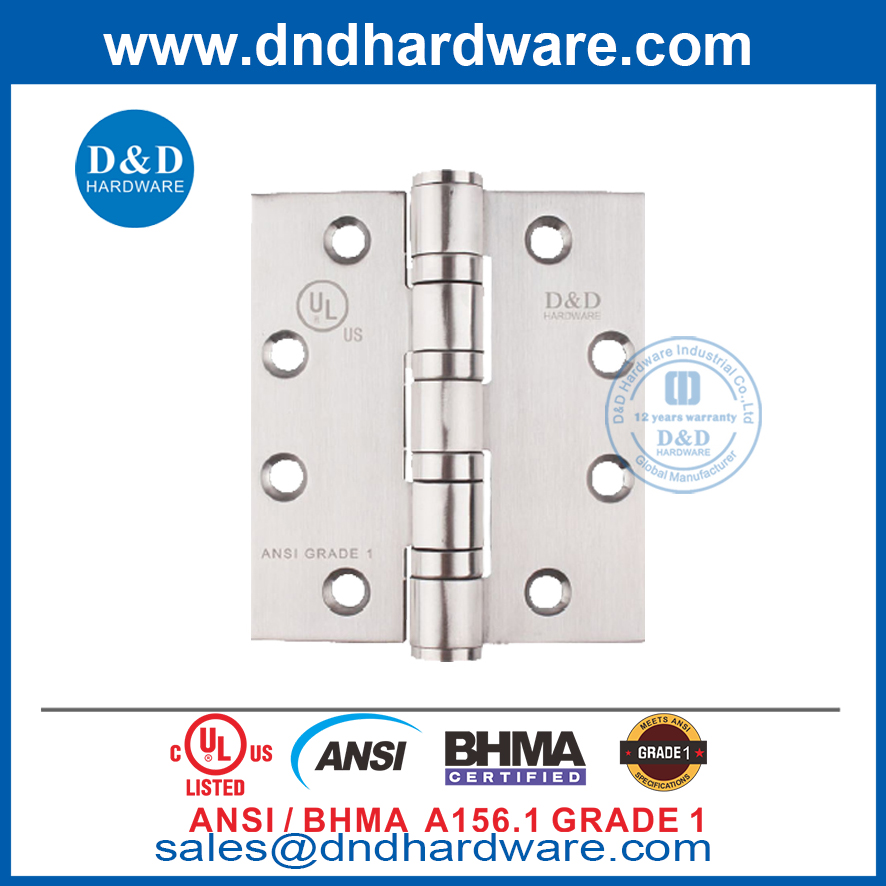 | Door hinge | UL/cUL UL 10C, three-hour fire-rated coverage; R38013; ANSI/BHMA Grade 1, 2,500,000 cycles, and Grade 2, 1,500,000 cycles |
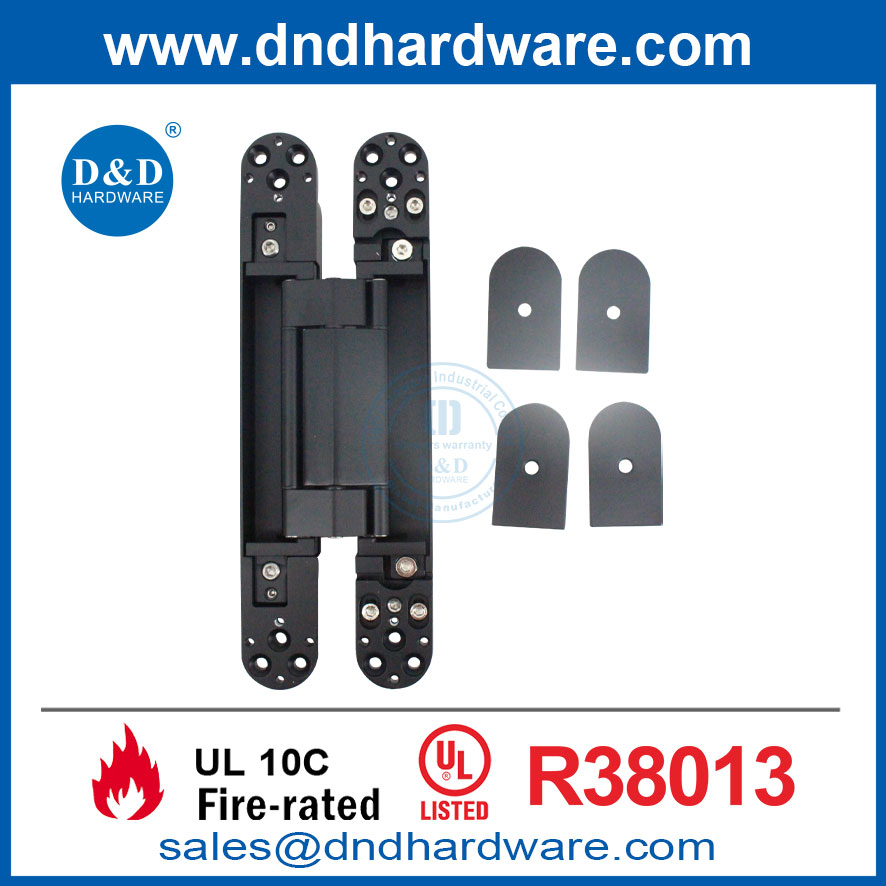 | Concealed hinge | UL 10C fire-rated coverage; R38013; confirm the selected model’s rating |
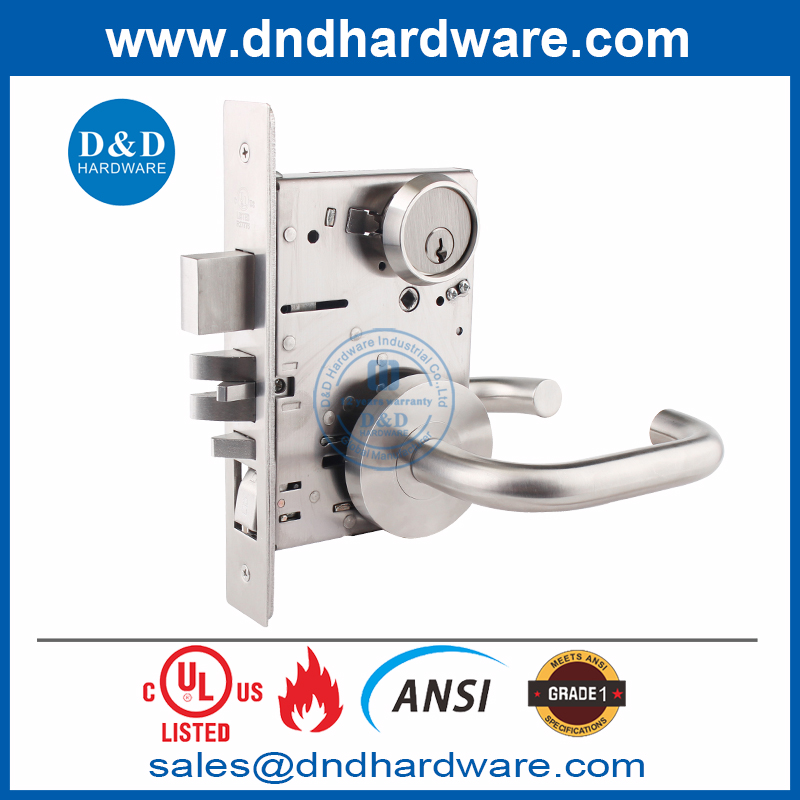 | Door lock | UL 10C, three-hour fire-rated coverage; R40901 |
 | Door closer | UL 10C, three-hour fire-rated coverage; R40717 |
 | Fire exit hardware | UL 10C, three-hour fire-rated coverage; R40486 |
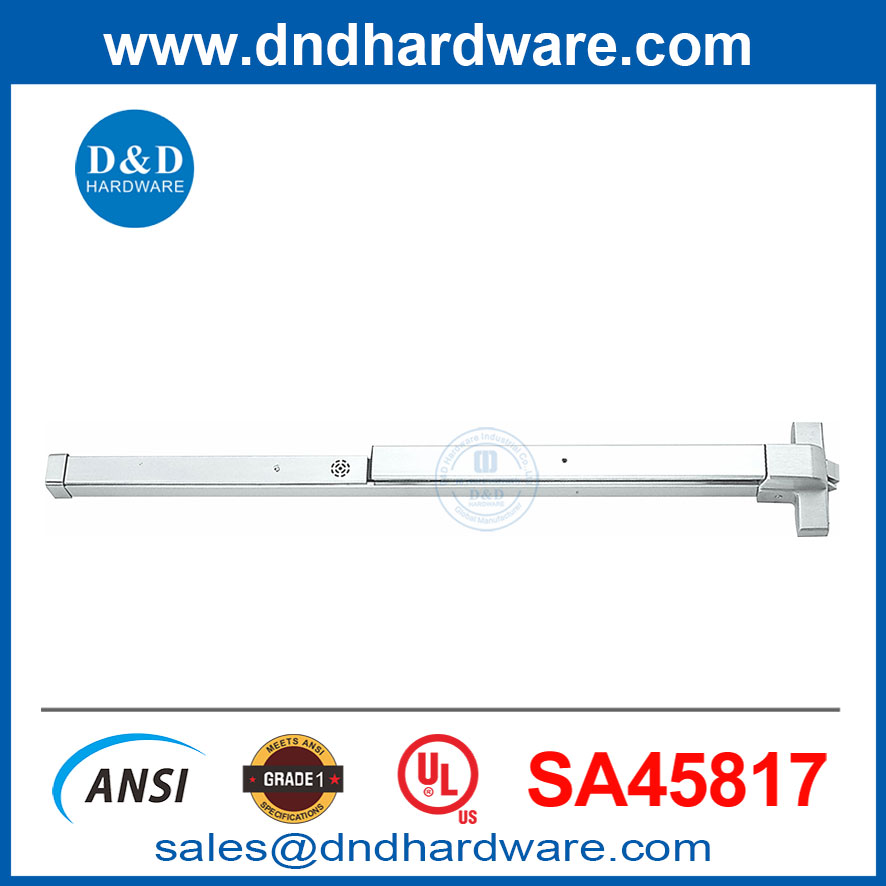 | Panic hardware | UL 305; SA45817 |
Use current model-specific records to confirm suitability. ANSI/BHMA hinge performance grades address separate criteria and do not replace fire certification. Similarly, three-hour hardware does not increase the rating of the existing assembly.
4 Treat Exit Device Replacement as a Separate Compliance Check
A replacement exit device must preserve both the required emergency release function and the fire door application.
UL distinguishes panic hardware, evaluated to UL 305, from fire exit hardware, evaluated to UL 305 and UL 10C. A panic-only device is intended for non-rated exit doors. Fire-rated openings require the appropriate fire exit hardware designation.
Consequently, D&D’s UL 305 panic hardware reference, SA45817, should not by itself be used to establish fire door suitability. For a proposed fire exit hardware model, obtain documentation confirming both applicable standards and the permitted configuration.
Also check the existing door’s approval for that exit-device application. A conversion from a mortise lock to a rim or vertical-rod device can introduce new preparations, strikes and fixing requirements.

5 Repair Unused Holes Through an Accepted Method
Removing hardware may leave exposed fixing holes or larger openings. Covering them with a plate does not, by itself, demonstrate an acceptable repair.
The Steel Door Institute’s explanation of NFPA 80 distinguishes unused fastener holes from other openings. Depending on the applicable requirements, accepted fastener-hole repairs include steel fasteners, matching material or material specifically listed for that repair. Other openings require review under field modification procedures.
Identify the hole type and door construction before selecting a repair method. Do not assume that general-purpose filler or a repair suitable for steel doors is appropriate for a wood fire door.
6 Inspect the Completed Work and Retain Records
After replacement, assess the entire opening. Confirm alignment, secure attachment, acceptable clearances, unobstructed operation and effective closing and latching.
A functional check alone cannot establish that an unauthorized modification is acceptable. Intertek notes that an opening can operate while no longer matching its listed construction.
Keep the replacement model, certification documentation, installation instructions, repair details and any written authorization with the opening’s records.
Where certification questions remain, distinguish inspection from field evaluation. UL explains that routine inspection identifies deficiencies; it does not certify modifications. Field evaluation addresses eligible altered or unlabeled assemblies, subject to the evaluation outcome.

FAQ
Can a different hardware brand be used?
Potentially, yes. Brand matching alone does not determine acceptance. The replacement must suit the door’s listed hardware application and installation conditions.
Does every replacement require field evaluation?
No. Compatible replacement within permitted conditions may not require it. Changes outside permitted preparations need review before work proceeds.
Can a three hour UL Listed lock upgrade a 90 minute door?
No. The lock’s coverage does not upgrade the door, frame or completed assembly.
Can ordinary UL 305 panic hardware replace fire exit hardware?
No. A UL 305-only designation is insufficient for fire door use. Verify fire exit hardware certification and compatibility.
Does replacing hardware automatically invalidate the fire label?
No. Proper replacement can preserve compliance. Unapproved alterations can create certification concerns that require further assessment.
Planning a fire door hardware replacement? Contact D&D Hardware with the existing labels, opening details and hardware photographs to request model-specific certification and installation information.
Contact us Now:
Contact: David Jian
Mob:0086-139 2903 7292
Email: David@dndhardware.com, sales@dndhardware.com,
Contact: Jobby Zhang
Mob:0086-137 2599 9617
Email: jobby@dndhardware.com
D&D HARDWARE INDUSTRIAL CO.,LTD
ADD:12th Floor, Building 2, No.898, KeChuang Technical Zone, Jiangmen Avenue, Pengjiang District, Jiangmen City, Guangdong, China (Postcode:529000)
https://www.dndhardware.com
Tel: +86-750-3856396
Fax: +86-750-3856395

 English