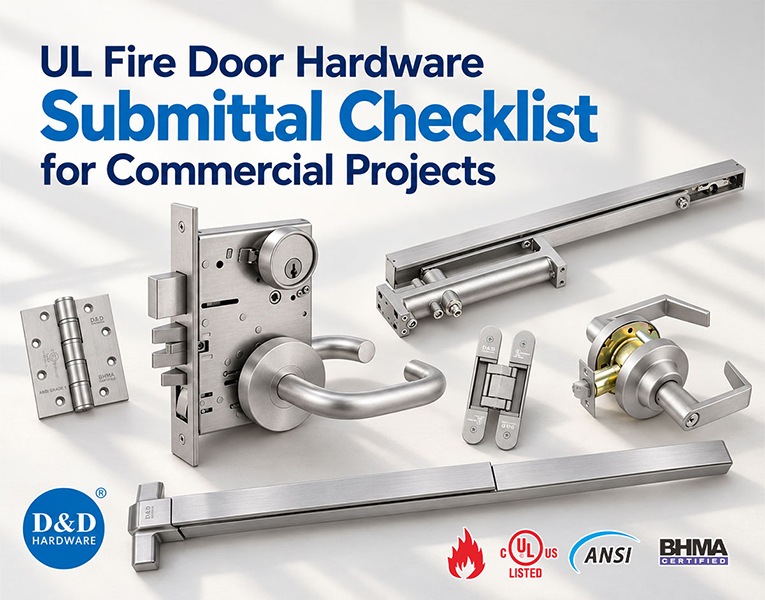
A fire door hardware submission can contain every product brochure and still leave the reviewer unable to accept it. The missing item is often the connection between the proposed model, its certification and the opening where it will be installed.
A complete UL fire door hardware submittal should let a reviewer trace that connection without guessing. Each rated door needs an identifiable hardware set, applicable certification evidence, coordinated preparation details and a clear record of exceptions.
This final article in D&D Hardware’s UL Listed Fire Rated Commercial Door Hardware series brings those checks together. Use it before submission and again when responding to review comments. It addresses commercial swinging fire doors under U.S. code frameworks; the adopted code, contract and local authority determine project-specific requirements.

1 Run the Completeness Check Before Technical Review
Begin with document control. Confirm the project name, submission number, revision and issue date. Identify the door schedule and specification revisions used to prepare the package.
A revised lock selection is easy to miss when the product sheet changes but the hardware schedule does not. Include a short revision note explaining which door numbers or hardware sets changed and where the supporting evidence appears.
The following is a recommended review tool, not a substitute for the project specification or a code-prescribed universal form.
Review item | Evidence to locate in the submission |
Opening basis | Door numbers, required ratings and applicable project requirements. |
Hardware schedule | Exact models, functions, quantities and hardware-set assignments. |
Certification | Applicable records identifying the selected products and limitations. |
Coordination | Templates, fixings, reinforcement and related accessories. |
Exceptions | Declared deviations, review responses and revision references. |
Treat an unresolved item as an action requiring evidence or clarification. A blank box should not silently become an assumption during fabrication.

2 Check What the Certification Actually Supports
For each item requiring certification, match the exact model and relevant options to the applicable record. A supplier’s file number is useful only when the reviewer can connect it to the proposed product.
UL’s application guide distinguishes hardware categories and requires appropriate installation under applicable standards and manufacturer instructions. It also distinguishes fire exit hardware from panic hardware intended for non-rated exits.
D&D Hardware provides these series-level references for identifying the relevant documentation:
| Hardware category | D&D certification and performance references |
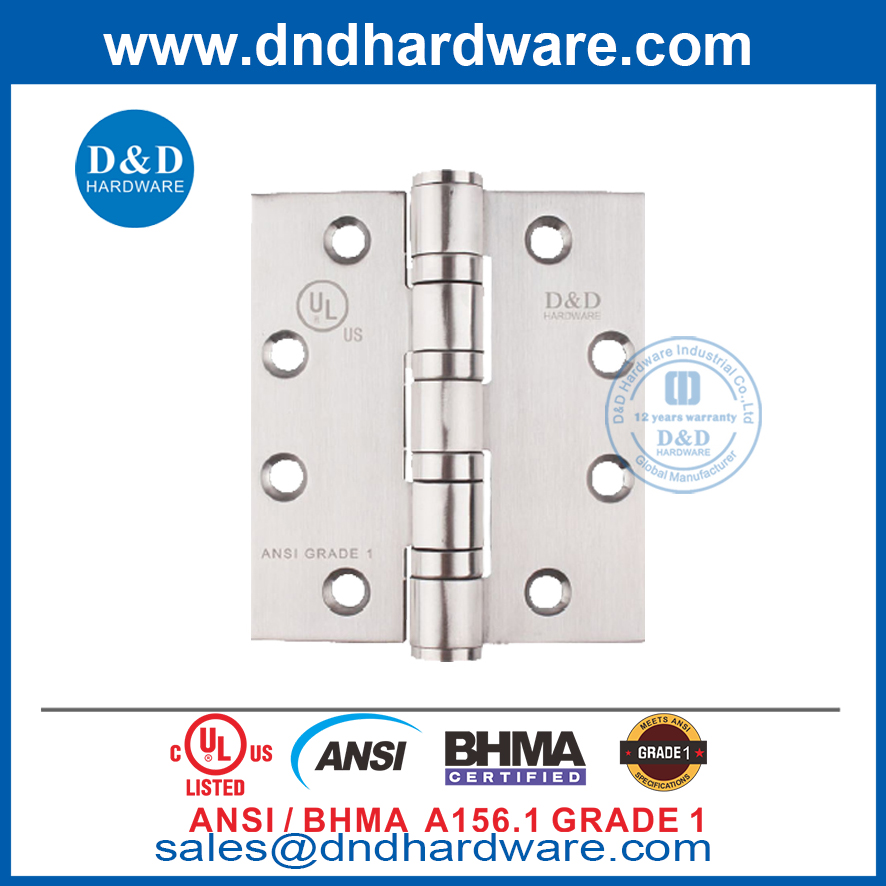 | Door hinge | UL/cUL UL 10C Fire Rated 3 Hours; R38013. ANSI/BHMA Grade 1: 2,500,000 cycles; Grade 2: 1,500,000 cycles. |
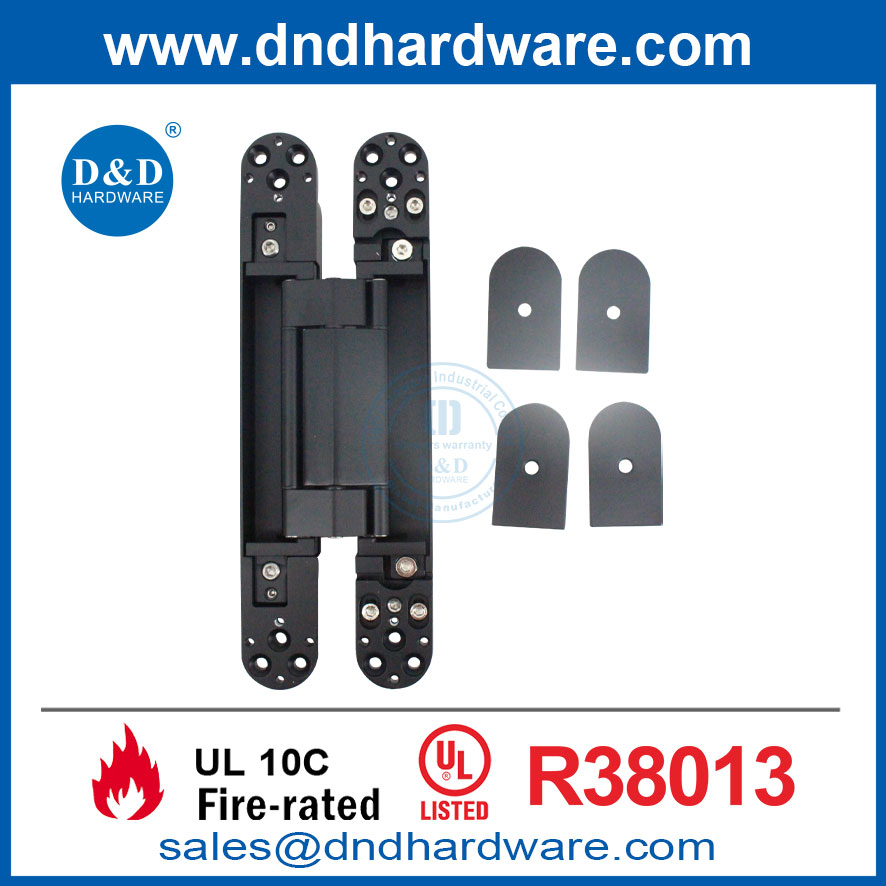 | Concealed hinge | UL 10C Fire Rated; R38013. Confirm model-specific application. |
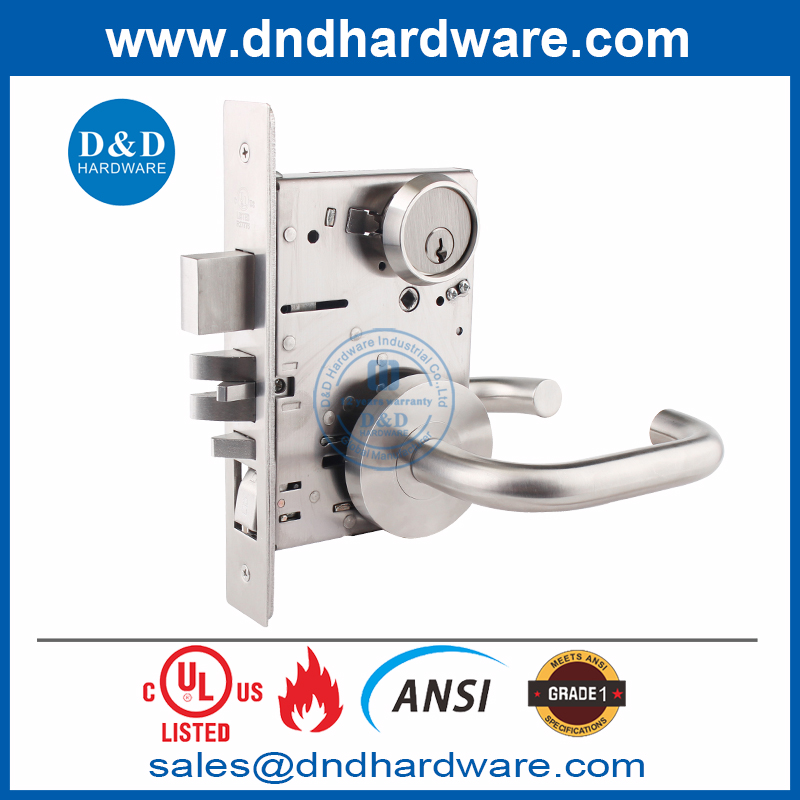 | Door lock | UL 10C Fire Rated 3 Hours; R40901. |
 | Door closer | UL 10C Fire Rated 3 Hours; R40717. |
 | Fire Exit Hardware | UL 10C Fire Rated 3 Hours; R40486. |
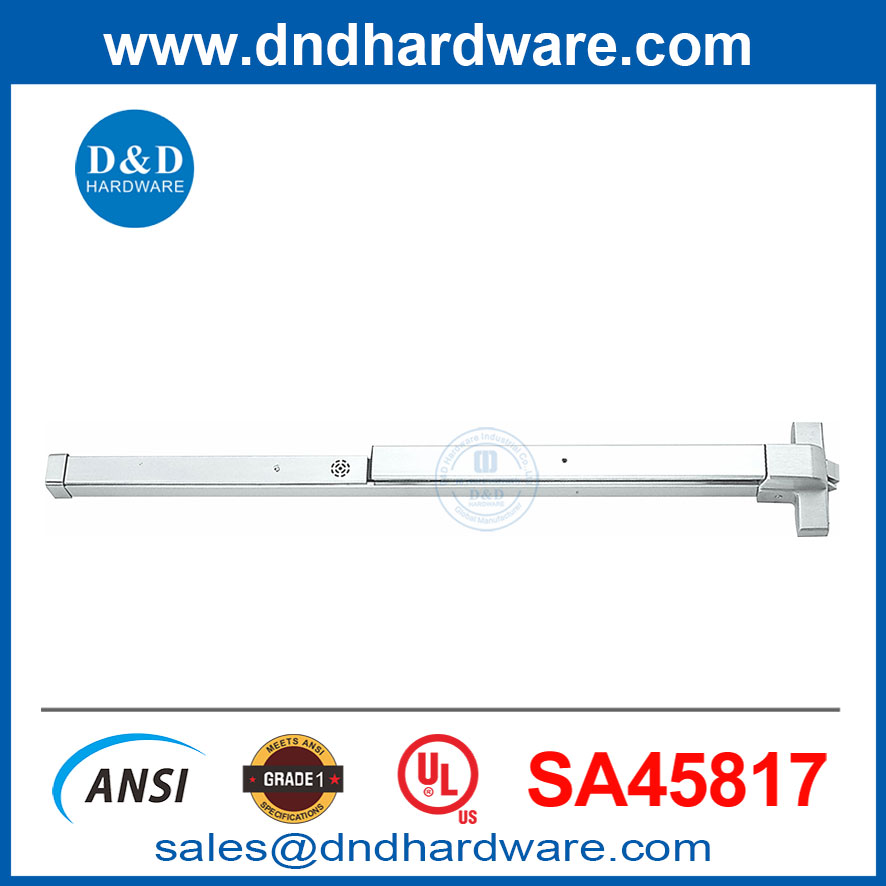 | Panic hardware | UL 305; SA45817. |
These references do not establish that every model suits every opening. Confirm the selected product’s permitted use and limitations. Do not infer a three-hour concealed hinge rating from R38013 or treat ANSI/BHMA hinge cycle performance as fire certification.
For a proposed fire exit device, verify the applicable UL 10C and UL 305 coverage for that device. The separate SA45817 panic hardware reference alone does not demonstrate suitability for a fire door.
3 Look for Contradictions Across Documents
Review the package horizontally, comparing the same opening across the schedule, product data and drawings.
For example, a schedule may identify a steel door while the submitted preparation detail describes another construction. A fire rated mortise lock may be paired with an unspecified strike. A closer may appear with different mounting arrangements on the product sheet and elevation.
Ask for correction where the documents disagree. An installer should not have to decide which version the reviewer intended to accept.
SDI 118 identifies certification listings as a resource for checking hardware suitable for rated assemblies and addresses hardware arrangements for paired doors. [2] For pairs, ensure the submission explains the active and inactive leaves, latching arrangement and closing sequence where relevant. A generic “double-door set” description leaves too much unresolved.

4 Return Specific Comments That Can Be Closed
Review comments work best when they identify the missing evidence and affected opening. “Provide UL documents” is less useful than a request naming the model, hardware set and unresolved application.
Examples of focused comments include:
· “Set 04: identify the submitted lock’s function and compatible strike.”
· “Door D-112: reconcile the closer mounting detail with the schedule.”
· “Set 07: provide the selected exit device’s fire exit hardware evidence.”
· “Concealed hinge: submit the applicable door preparation and fixing details.”
Keep the response beside the original comment and identify the revised document. Where a deviation changes preparations or certification assumptions, obtain the required review before releasing fabrication.
Distinguish a commercial substitution request from a technical compliance finding. A lower price or shorter lead time provides no evidence that an alternative fits the listed application.
5 Carry the Accepted Information Through Delivery
A reviewed submittal is a reference for checking what arrives on site. Compare delivered model identifiers, functions and accessories with the accepted schedule before installation.
Retain installation instructions, applicable certification records and written decisions with the final hardware register. Record later changes by door number so maintenance staff can identify what was actually installed.
Document acceptance does not establish that installation is correct. Closing, latching, alignment and egress operation still require verification under the applicable requirements. UL distinguishes routine inspection from field evaluation of eligible modified assemblies; an inspection report does not itself certify an unsupported alteration. [3]
The file is ready for handover when the installed hardware, final schedule and supporting records agree, and outstanding deficiencies have been addressed through the required process.

FAQ
Is this checklist an official UL approval form?
No. It is a practical submission review aid. UL certification records, adopted codes, manufacturer instructions and project requirements remain the governing references.
Does every hardware item need the same certificate?
No. Certification categories and requirements differ. Identify the evidence applicable to each product and opening rather than requesting one generic certificate for the whole set.
Is an unmarked catalog acceptable product data?
It leaves the selection ambiguous. Mark the exact model, function, size and options proposed so the reviewer can assess them.
Can a submittal be accepted with unresolved deviations?
Follow the project’s review procedure. Clearly identify unresolved deviations and their consequences; do not assume conditional review permits fabrication of affected items.
What should remain after the project is completed?
Keep the final door and hardware schedule, relevant certification evidence, installation and maintenance instructions, accepted changes and required inspection records.
Need to close a certification gap in your submission? Send D&D Hardware the affected door numbers, hardware sets and review comments to request relevant model-specific documentation. For the underlying standards and assembly requirements, return to the UL Listed Fire Rated Commercial Door Hardware topic series.
Contact us Now:
Contact: David Jian
Mob:0086-139 2903 7292
Email: David@dndhardware.com, sales@dndhardware.com,
Contact: Jobby Zhang
Mob:0086-137 2599 9617
Email: jobby@dndhardware.com
D&D HARDWARE INDUSTRIAL CO.,LTD
ADD:12th Floor, Building 2, No.898, KeChuang Technical Zone, Jiangmen Avenue, Pengjiang District, Jiangmen City, Guangdong, China (Postcode:529000)
https://www.dndhardware.com
Tel: +86-750-3856396
Fax: +86-750-3856395


 English