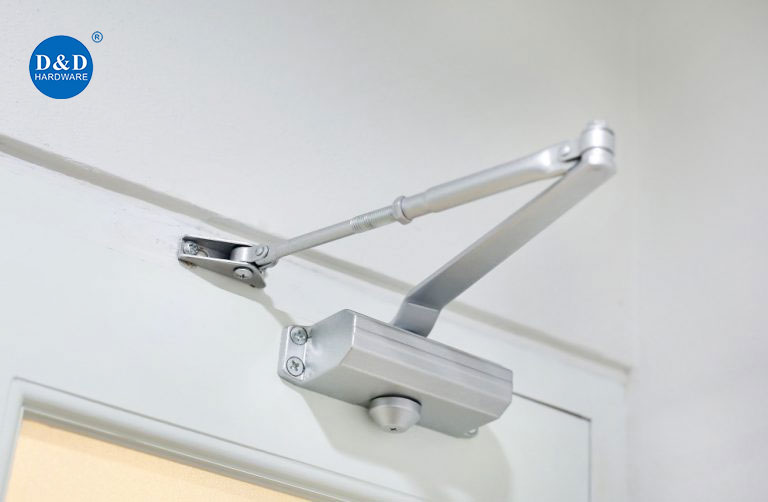
You need the correct door closer size for your door to ensure safety and smooth operation. Choosing the right size depends on your door’s width and weight, aswell as whether it’s for commercial or residential use. It’s important to consider regulations such as ADA opening force requirements and ANSI/BHMA durability standards, and to check for UL fire ratings. D&D Hardware offers products that comply with these standards. This guide covers the key factors you need to know. Use the Door Closer Size and Measurement Guide to select the perfect door closer for your needs.
Key Takeaways
Picking the right door closer size keeps your door safe and working well.
Think about your door’s width, weight, and how often you use it when you choose a closer.
Follow safety rules like ADA and fire safety so you do not break the law.
Look at the door closer size chart to find the best size for your door.
D&D Hardware sells products that are certified and meet world safety rules.
Measure your door carefully so you do not pick the wrong closer size.
Adjustable door closers work well in busy places, but fixed closers are good for doors that are not used much.
Ask D&D Hardware’s support team for help if you need advice on picking or putting in a door closer.

Door Closer Size and Measurement Guide
What Is Door Closer Size?
You may wonder what door closer size means when you start looking for a new door closer. Door closer size refers to the strength of the spring inside the device. This spring strength controls how easily the door closes and latches. The BS EN 1154 standard explains that controlled door closing devices, like door closers, use a coding system to show their performance. The code includes details about how much weight the door can handle, how many times it can open and close, and how well it resists corrosion and fire. You will also find electrically powered hold-open devices in some buildings, but most doors use mechanical closers. When you use the door closer size and measurement guide, you can match the right spring strength to your door’s needs.
Why Door Closer Size Matters
Choosing the correct door closer size is important for safety and performance. If you pick a closer that is too small, your door may not latch properly. This can be dangerous, especially for fire-rated doors. If you choose a closer that is too strong, the door may be hard to open. This can make it difficult for people with disabilities and may break ADA rules. You need to consider the door’s width, weight, and how often people use it. The door closer size and measurement guide helps you avoid these problems.
Tip: Always check the door closer size and measurement guide before buying a door closer. This helps you meet safety codes and keeps your building safe.
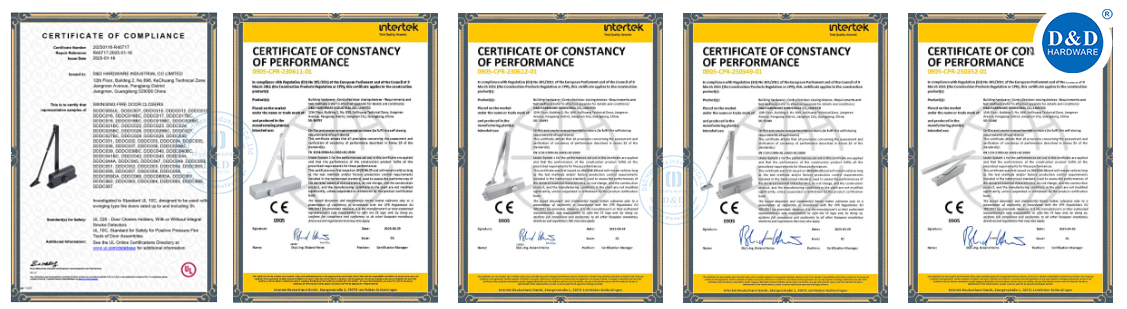
D&D Hardware makes it easy for you to choose the right door closer. Their products meet international standards like UL, CE, and ANSI. These certifications show that the door closers are safe and reliable. CE certification is important in Europe, while UL is needed in North America. When you use D&D Hardware, you know your door closer will work well and last a long time.
Overview of Door Closer Sizes
You will see different door closer sizes for different doors. The size you need depends on how wide and heavy your door is, and how many times people use it each day. Here is a simple way to understand door closer size and measurement guide:
The spring strength in the door closer decides how well the door closes.
Doors in busy places, like schools or hospitals, need strong closers. These are called Grade 1 closers and can handle over 100 cycles a day.
Doors in homes or offices with less traffic may use Grade 2 closers.
If you use the wrong size, your door may not close right or may be hard to open.
The door closer size and measurement guide helps you pick the best closer for your door’s width, weight, and use.
D&D Hardware offers many types of door closers. You can find closers for metal, wood, and fire-rated doors. Their products are tested to meet BS EN 1154:1997 and other standards. You can trust D&D Hardware to provide door closers that work well in any setting. When you follow the door closer size and measurement guide, you make sure your doors are safe, easy to use, and last longer.
Door Closer Size Chart Explained
How to Read a Door Closer Size Chart
You can use a door closer size chart to find the right commercial door closer for your building. The chart helps you match the spring strength to your door’s width and weight. This makes sure your door closes smoothly and safely. Here is how you can read the chart:
Look at your door’s width and weight.
Find the matching size on the door closer size chart.
Check if the size meets safety standards like ADA and fire safety.
Choose a commercial door closer that fits your needs.
Understanding the chart helps you avoid problems with doors that are too hard to open or do not close properly. D&D Hardware offers certified products that make this process simple.
Common Door Closer Size Ratings
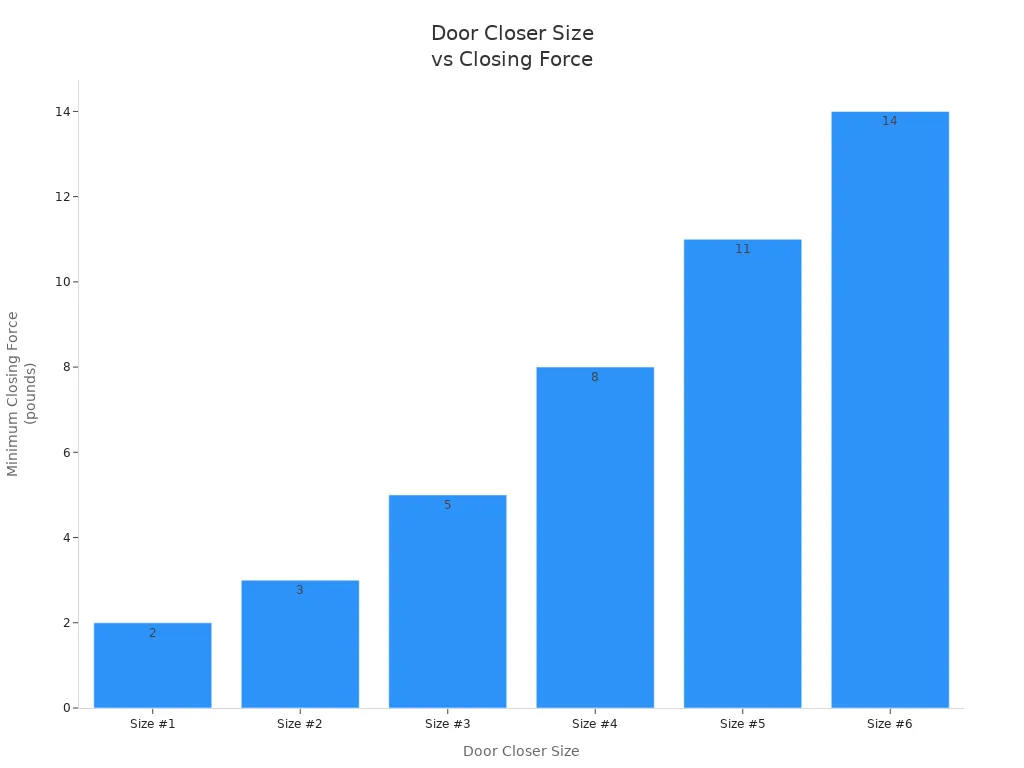
You will see different ratings on the door closer size chart. Each rating shows the minimum closing force needed for a door. Use the table below to compare the most common ratings for commercial door closer models:
Size | Minimum Closing Force | Typical Door Application |
#1 | 2 pounds | Interior doors up to 32" wide |
#2 | 3 pounds | Interior doors 33" to 36" wide |
#3 | 5 pounds | Interior doors 37" to 42" wide, exterior doors up to 33" wide |
#4 | 8 pounds | Interior doors 43" to 48" wide, exterior doors 34" to 36" wide |
#5 | 11 pounds | Interior doors over 48" wide, exterior doors 37" to 42" wide |
#6 | 14 pounds | Heavy exterior doors 43" to 48" wide |
When you use the door closer size chart, you can see which commercial door closer works best for your door. For example, Size 1 is good for small interior doors, while Size 6 is made for heavy exterior doors.
EN1154 and International Standards
You need to make sure your commercial door closer meets international standards. The EN1154 standard sets rules for safety, durability, and fire safety. D&D Hardware’s products follow these standards, so you can trust their quality. Here is what EN1154 covers:
Key Requirement | Description |
Safety | Makes sure door closers prevent accidents. |
Durability | Tests for long-lasting use. |
Operational Criteria | Sets rules for closing speed and force adjustment. |
Fire Safety Compliance | Ensures doors close automatically in emergencies. |
When you choose a commercial door closer from D&D Hardware, you get products that meet EN1154 and other standards like UL and CE. This keeps your building safe and helps you follow local rules. Always use the door closer size chart to pick the right closer for your door and make sure it meets these important standards.
Door Measurement StepsMeasuring Door Width and Height
You need to measure your door before you choose a door closer. Start by using a tape measure. Place one end at the edge of the door and stretch it to the opposite side. Write down the width in inches or millimeters. Next, measure the height from the bottom to the top of the door. Record this number. Most commercial doors are wider and taller than residential doors. Accurate measurements help you select the right door closer size. If you measure incorrectly, you may pick a closer that does not work well.
Tip: Always measure both width and height. Some doors look standard but have custom sizes.
Determining Door Weight
You must know your door’s weight to match it with the correct door closer. Heavier doors need stronger closers. If you have the manufacturer’s specifications, check the label for the weight. If not, estimate by considering the material. Solid wood doors weigh more than hollow metal or aluminum doors. Glass doors often have special hardware and may need a different approach. For a rough estimate, use a bathroom scale. Remove the door from its hinges and place it on the scale. Write down the weight. If you cannot remove the door, ask a professional for help.
Note: D&D Hardware offers technical support if you find it hard to measure door weight. Their team can guide you through the process or recommend the best solution for your door type.
Assessing Door Usage and Location
You should think about how and where your door will be used. This step helps you choose a door closer that fits your needs. Consider these factors:
Size and weight of the door
Location of the door (interior or exterior)
How often people open and close the door
Type of door (wood, metal, glass)
Mounting location (top jamb, parallel arm, regular arm)
Traffic volume and frequency
Door swing direction
Wind or building pressure conditions
Backswing requirements
Affordability
Doors in busy places, like schools or hospitals, need strong closers. Exterior doors face wind and pressure, so they need durable hardware. Interior doors in homes or offices may use lighter closers. The mounting location affects how the closer works. High-traffic areas require closers that last longer and operate smoothly.
If you have a complex door setup, you can contact D&D Hardware’s technical support. Their experts help you measure and select the right closer. You get advice for special doors, like fire-rated or handicap-accessible models. This support ensures your door closer fits your door and meets safety standards.
Tip: Write down all your measurements and usage details. Share them with D&D Hardware’s team for the best product recommendation.
Matching Door Closer Size to Your Door
Using the Size Chart for Selection
You can use your door’s measurements to find the correct door closer. Start by checking the width and weight of your door. Then, look at the size chart below. This chart matches door width and weight to the right closer size. You can see which size fits your door best.
Size | Max Door Width (Interior) | Max Door Width (Exterior) | Max Door Weight (lbs/kg) | Typical Applications |
1 | up to 30" | up to 26" | ~44 lbs / 20 kg | Light interior doors, closets |
2 | up to 34" | up to 30" | ~88 lbs / 40 kg | Small offices, light residential |
3 | up to 40" | up to 34" | ~132 lbs / 60 kg | Standard interior office/classroom, minimum size for fire-rated doors |
4 | up to 44" | up to 38" | ~176 lbs / 80 kg | Commercial entries, heavier interior or exterior doors |
5 | up to 50" | up to 44" | ~220 lbs / 100 kg | Large doors, high-traffic entrances, heavy commercial use |
6 | up to 56" | up to 50" | ~264 lbs / 120 kg | Extra-heavy institutional doors, wide exterior entrances |
7 | up to 60 - 63" (specialty only) | up to 56 - 58" (specialty only) | ~350 lbs / 160 kg | Specialty oversize or industrial doors (less common) |
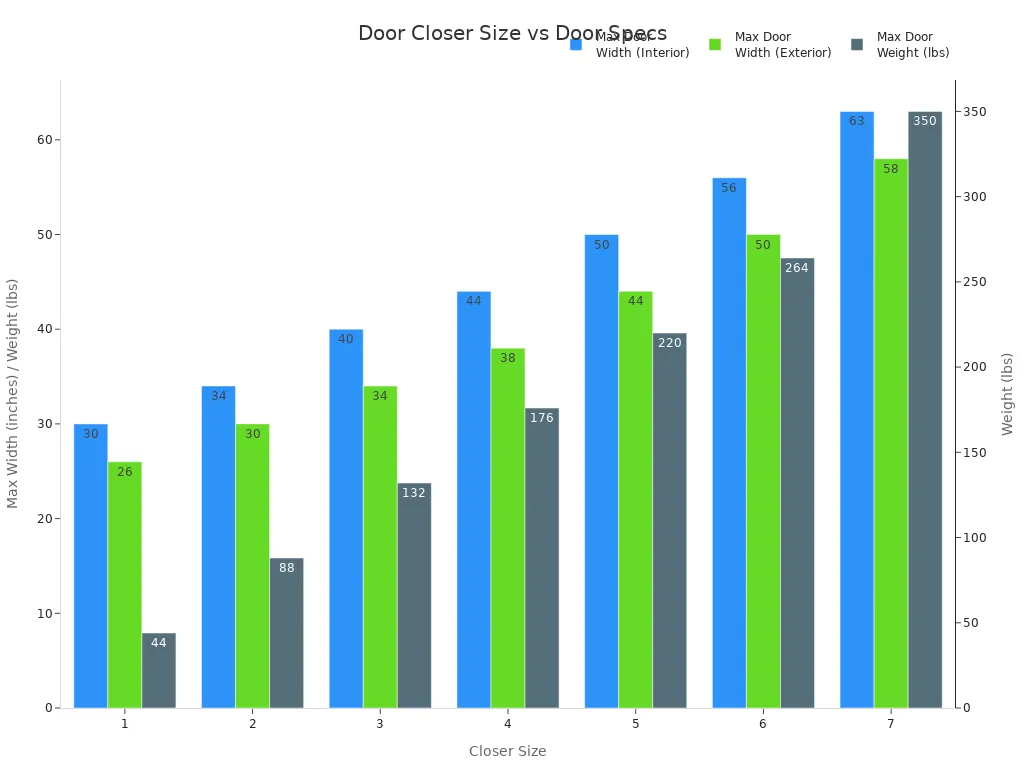
To select the right closer, match your door’s width and weight to the chart. For example, if your door is 36 inches wide and weighs 100 pounds, you should choose a size 3 closer. If your door is heavier or wider, move up to the next size. This method helps you pick the correct door closer for safety and smooth operation.
Tip: Always choose a closer size that meets or exceeds your door’s measurements. This ensures reliable closing and long-lasting performance.
Adjusting for Special Door Types
Some doors need special attention when you select a closer. Fire-rated and exterior doors have extra requirements. You must follow these rules to keep your building safe and meet local codes.
Fire doors need certified closers. These closers make sure the door closes and latches every time. This is important for safety during a fire.
Always use at least a size 3 closer for fire doors. This size gives enough force to close and latch the door in an emergency.
Exterior doors face wind and pressure. Choose a closer size based on the door’s weight and width. Heavy exterior doors often need size 5 or 6 closers.
Surface-mounted closers come in different spring sizes. Use the chart to find the right size for your door type.
For accessibility, select a closer that meets ADA requirements. This helps everyone open and close the door easily.
If you have a special door, like a glass or oversized door, you may need a specialty closer. You can contact D&D Hardware’s technical team for advice on these doors.
Note: Always check for certifications like UL, CE, or EN1154 when choosing a closer for fire or exterior doors.
D&D Hardware Solutions for All Products
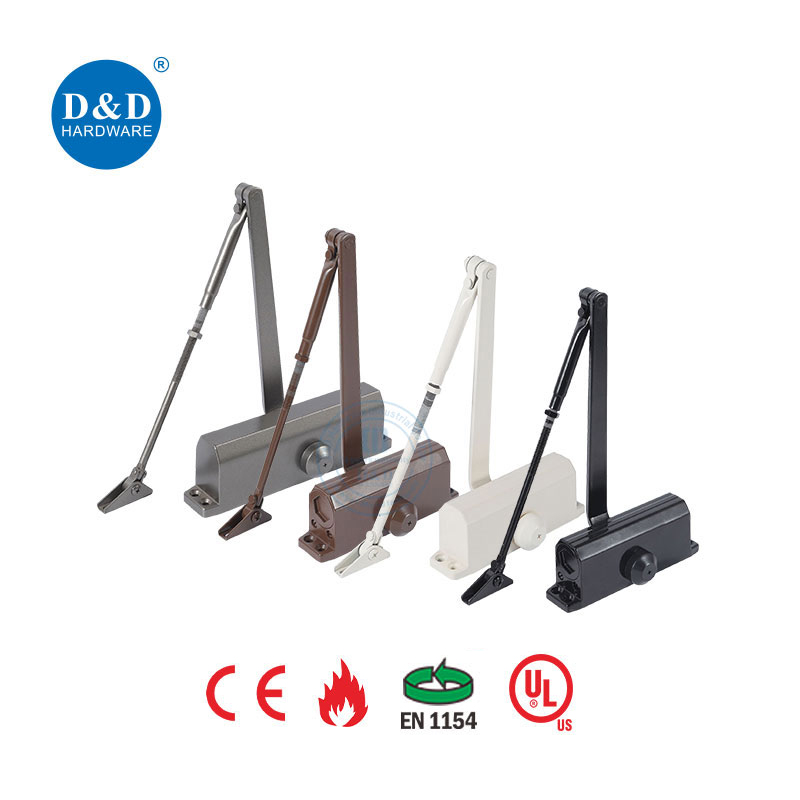
D&D Hardware offers a wide range of door closers for every need. You can find both adjustable and fixed models. These products work for metal, wood, and fire-rated doors. Each closer meets strict international standards for safety and durability.
Type of Door Closer | Features | Applications |
Fire Rated | CE Marked to BS EN 1154, EN 1634 tested, 120-180 minutes fire rated | Commercial & Residential |
Non-Fire Rated | Various power sizes (EN1-2, EN2-3, EN3-4, EN4-6) | Different door widths/weights |
You can choose a fire-rated closer for doors that need extra protection. These closers have been tested for up to 120 minutes of fire resistance. For other doors, you can select from a range of power sizes. Adjustable closers let you change the closing force to fit your door. Fixed closers come in set sizes for simple applications.
D&D Hardware’s products are certified to UL, CE, and ANSI standards. You get reliable performance and peace of mind. If you need help, D&D Hardware’s support team can guide you to the best solution for your project.
Tip: Write down your door’s measurements and needs. Share them with D&D Hardware’s experts for a custom recommendation.

Fixed vs Adjustable Door Closers
When you pick a door closer, you should know about fixed and adjustable models. Each type works better in certain places. Learning about these choices helps you find the best one for your building.
Fixed Door Closer Features
Fixed door closers have one spring strength. You cannot change how hard they close after you put them in. These closers are good for doors that do not need changes and get used the same way every day. You often see them in homes or small offices with few people.
Here is a table that shows what fixed door closers can do:
Feature | Description | Why You Need It |
Opening & Closing Force | Adjustable force for closing the door, ranging from 2 lbs to 14 lbs. | Customizes the force needed for different users, ensuring ease of use for all. |
Backcheck | Cushions the door to prevent slamming into walls. | Protects walls from damage in high-traffic areas or careless openings. |
Delayed Action | Adds a delay before the door starts closing. | Allows slower users or groups to pass through without the door closing immediately. |
Closing Speed | Controls the speed of the door closing. | Faster closing reduces temperature leaks; slower closing allows more time for users to enter/exit. |
Latching Speed | Adjusts the speed just before the door fully closes. | Ensures the door latches securely to prevent it from being left ajar. |
You can use fixed door closers for inside doors, closets, or rooms where the door size and weight stay the same. These closers work well for simple needs.
Adjustable Door Closer Features
Adjustable door closers let you change how hard and fast the door closes. You can set them for your door’s weight and how busy the area is. This makes them great for places like schools, hospitals, and big buildings.
Here is a table that explains what adjustable door closers can do:
Feature | Description |
Sweep speed | Controls door closing speed from fully open to about 10 degrees |
Latch speed | Controls the final 10 degrees of closing to ensure proper latching |
Backcheck | Provides resistance when opening to prevent damage from aggressive opening |
Delayed action | Holds door open temporarily before beginning to close |
You can use adjustable models for many kinds of doors, like fire-rated and outside doors. These closers help you follow safety rules and make doors easier for everyone.
Choosing the Right Type for Your Needs
You should think about where your door is and how people use it. The best choice depends on the door’s size, weight, and how many people use it each day. Here is a table to help you pick:
Traffic Frequency | Recommended Grade | Environmental Considerations |
High traffic (100+ cycles/day) | Grade 1 | Robust construction, easy maintenance |
Moderate traffic (25-100 cycles/day) | Grade 1 or 2 | Depends on specific application |
Low traffic (less than 25 cycles/day) | Grade 2 | Generally sufficient for low usage |
Exterior applications | N/A | Consistent performance across temperature ranges |
Coastal environments | N/A | Corrosion-resistant materials (e.g., 316 stainless steel) |
Clean rooms/healthcare | N/A | Smooth-body closers to minimize dust collection |
High humidity areas | N/A | Proper finishing to prevent corrosion |
High-abuse settings | N/A | Vandal-resistant models with tamper-proof covers |
If your door gets used a lot or is fire-rated, you should pick adjustable door closers. These last longer and give you more control. For a bedroom or closet, fixed door closers are usually fine.
D&D Hardware sells both fixed and adjustable door closers. You can find the right one for metal, wood, or fire-rated doors. Their products meet world standards and work in many places. If you need help, D&D Hardware’s team can help you choose the best door closer for your project.
Tip: Write down your door’s size, weight, and how often people use it. Share this with D&D Hardware to get the best advice.
Compliance: ADA and Fire Safety
ADA Door Closer Requirements
Doors should be easy for everyone to use. ADA rules say doors must not be hard to open. You can only use up to 5 pounds of force to open any door. Doors also need to close slowly so people have enough time to walk through. These rules help people with disabilities move safely.
Here is a simple table that shows the main ADA requirements for door closers:
Requirement | Value |
Maximum opening force | 5 pounds for all types of doors |
Closing speed | 5 seconds minimum from 90 degrees to 12 degrees from latch |
If your door needs more than 5 pounds to open, it does not follow ADA rules. The door should close slowly, not too fast. Always check these things when you put in or adjust a door closer.
Tip: Use a small scale or force gauge to test your door. If it takes more than 5 pounds to open, you should adjust the closer or pick another model.
Fire-Rated Door Closer Standards
Fire safety rules protect people and buildings during emergencies. You must use special hardware for fire-rated doors. These rules make sure doors close and latch every time, even if there is a fire.
Here is a table showing important fire safety standards for door hardware:
Hardware Item | Standard Code |
Door closer | BS EN1154 |
Door hinge | BS EN1935 |
Door coordinator | BS EN1158 |
Mortise lock | BS EN12209 |
| Lock cylinder | BS EN1303 |
| Door handle | BS EN1906 |
Panic exit device | BS EN1125 |
Emergency exit device | BS EN179 |
Always use a Size 3 or bigger closer for fire doors. The closer must be UL-listed and follow NFPA 80 rules. Manual hold-open features are not allowed unless they connect to a fire alarm. These steps keep doors closed during a fire and stop smoke and flames from spreading.
Note: Fire-rated doors need certified hardware. Look for UL, CE, or EN markings before you buy or install.
D&D Hardware Compliance Solutions
You want hardware that follows all safety and accessibility rules. D&D Hardware makes door closers that help you meet ADA and fire safety standards. Here are some ways D&D Hardware helps you stay compliant:
D&D Hardware’s door closers make sure inside doors need no more than 5 pounds to open.
Outside doors usually have a limit of 8.5 pounds, which D&D Hardware models can meet.
Fire doors use at least a Size 3 closer for safe closing and latching.
All fire-rated closers from D&D Hardware are UL-listed and meet NFPA 80 rules.
Manual hold-open features are only allowed if they connect to a fire alarm.
You can trust D&D Hardware to give you products that pass tough tests and meet world codes. Their certified solutions help you make safe, easy-to-use spaces for everyone.
Tip: If you have questions about rules, ask D&D Hardware’s support team. They can help you pick the right hardware for your project.
Common Mistakes in Door Closer Sizing
You should try not to make mistakes when picking a door closer. These mistakes can make your building unsafe or cost you extra money. Knowing about these problems helps you choose better for your doors.
Choosing the Wrong Size
Many people pick the wrong door closer size. Sometimes, the closer is too weak for a heavy door. Other times, it is too strong for a light door. This can make the door slam or not close right. If the closer is too small for a big door, it might leak fluid. The fluid can stain and ruin the door. You could also break the closer and need to fix or replace it.
Some common sizing mistakes are:
Using a closer that does not fit the door’s width or weight
Setting the spring tension wrong
Not tightening all the mounting screws
Adjusting backcheck or delayed action the wrong way
Letting the closer arm hit other door hardware
Tip: Always measure your door’s width and weight first. Use the size chart to pick the right closer for your door.
Ignoring Compliance
Not following rules can cause big trouble for you. If you ignore ADA or fire safety standards, you could get fined or sued. Not following rules can also hurt your business’s reputation. It can make your building hard for people with disabilities to use. You want your doors to be safe and easy for everyone.
Not following rules can lead to fines or lawsuits.
It can make people think badly of your business.
It makes things harder for people with disabilities.
Note: Always look for UL, CE, and ADA certifications when you buy a door closer. D&D Hardware has products that meet these standards.
Installation Errors
Even if you pick the right closer, you can make mistakes when installing it. You need to put the closer in the right spot and use the right screws. Things like humidity or temperature can also change how the closer works.
Here is a table with common installation mistakes and ways to fix them:
Installation Error | Description | Solution |
Wrong Mounting Position | Can make the door work badly or wear out fast. | Use clear guides and adjustable brackets for the right spot. |
Not Matching Door and Frame Materials | Different materials need special screws and ways to mount. | Make sure you use the right screws for each material. |
Environmental Problems | Changes in temperature or humidity can hurt performance. | Pick materials that resist rust and can handle weather changes. |
️ Tip: If you are not sure how to install, ask D&D Hardware’s support team. Their experts can help you with sizing, rules, and installation.
If you learn about these mistakes and avoid them, your doors will be safe and work well. D&D Hardware’s support team can help you pick the right size and install your door closer the right way.

Quick Reference and Practical Examples
Door Closer Size Quick Reference Chart
You can use a quick reference chart to choose the right door closer size for your project. This chart shows the most common door types and the recommended closer sizes. You only need to match your door type to the chart. This makes selection fast and easy.
Door Type | Recommended Closer Size |
Light interior door | Size 1–2 |
Standard office/classroom | Size 3 |
Exterior entry door | Size 4–5 |
Oversized/industrial door | Size 6 |
Storm/security door | Pneumatic or dual closers |
Tip: Always check your door’s width and weight before you choose a closer. D&D Hardware offers a full range of sizes to fit every door.
Example: Residential Door Closer Sizing
Let’s look at a real example for a home. You have a bedroom door that is 32 inches wide and made of hollow wood. This door is light and does not get much use. You want a closer that is easy to open and closes the door gently.
Door Location | Door Width | Door Weight | Recommended Closer Size | D&D Hardware Solution |
Bedroom | 32" | ~44 lbs | Size 1–2 | D&D Adjustable Spring Closer |
Bathroom | 28" | ~40 lbs | Size 1 | D&D Hydraulic Door Closer |
Kitchen Entry | 34" | ~50 lbs | Size 2 | D&D Standard Door Closer |
You can pick a Size 1 or Size 2 closer for these doors. D&D Hardware’s adjustable spring or hydraulic models work well for bedrooms, bathrooms, and kitchens. These closers are easy to install and help keep doors quiet and safe.
Note: For storm or security doors, you may need a pneumatic or dual closer. D&D Hardware has options for these doors too.
Example: Commercial Door Closer Sizing
Now, imagine you need a closer for a busy office entrance. This door is 42 inches wide, made of metal, and used all day by staff and visitors. You want a closer that is strong, reliable, and meets safety rules.
Surface-mounted closers work well for most office and classroom doors. You can install them easily.
Concealed closers fit inside the door or frame. They give a clean look for glass or aluminum doors.
Overhead concealed closers hide in the header. These are good for glass storefronts.
Floor-spring closers support heavy or pivot doors. You see these in lobbies and large entries.
Hydraulic or pneumatic closers let you adjust the closing speed for busy areas.
Always check that your closer meets ANSI/BHMA A156.4, is UL Listed for fire-rated doors, and follows ADA rules for accessibility.
D&D Hardware offers all these types. You can find a closer that fits your door, meets safety standards, and lasts a long time.
️ If you need help, D&D Hardware’s support team can guide you to the best closer for your building.
You can find the right door closer size by measuring your door. Check how much your door weighs. Use a quick chart to help you pick. Always pick certified door closers for these reasons:
Certified closers follow safety rules and work well.
They help you meet building codes and keep people safe.
Picking the right closer protects fire doors and helps people get out safely.
If you need help, D&D Hardware’s team can help you. Look at the chart and choose certified closers so you feel safe.
FAQ
How do you measure your door for a closer?
You measure the width and height with a tape measure. You check the weight using a scale or manufacturer’s specs. Write down these numbers before you choose a door closer.
What size door closer do you need for a fire-rated door?
You need at least a Size 3 door closer for fire-rated doors. Always check for UL or CE certification. This keeps your building safe and meets fire codes.
Can you adjust the closing speed of your door closer?
Most adjustable door closers let you change the closing speed. You turn a screw on the closer to make the door close faster or slower. Always follow the instructions.
What is the difference between fixed and adjustable door closers?
Fixed door closers have one set strength. Adjustable door closers let you change the closing force and speed. Adjustable models work better for busy places.
Do D&D Hardware door closers meet ADA requirements?
Yes, D&D Hardware door closers meet ADA standards. You can open doors with less than 5 pounds of force. This helps everyone use the door easily.
How do you know if your door closer is installed correctly?
Check that the closer sits flat and the arm moves smoothly. The door should close fully and latch without slamming. If you see problems, ask D&D Hardware for help.
What certifications should you look for in a door closer?
Look for UL, CE, and ANSI marks. These show the door closer meets safety and quality standards. Certified closers work better and last longer.
Who can help you choose the right door closer?
You can contact D&D Hardware’s support team. They help you pick the best closer for your door size, weight, and use. You get expert advice for every project.
Contact us Now:
Contact: David Jian
Mob:0086-139 2903 7292
Email: David@dndhardware.com, sales@dndhardware.com,
Contact: Jobby Zhang
Mob:0086-137 2599 9617
Email: jobby@dndhardware.com
D&D HARDWARE INDUSTRIAL CO.,LTD
ADD:12th Floor, Building 2, No.898, KeChuang Technical Zone, Jiangmen Avenue, Pengjiang District, Jiangmen City, Guangdong, China (Postcode:529000)
https://www.dndhardware.com
Tel: +86-750-3856396
Fax: +86-750-3856395


 English