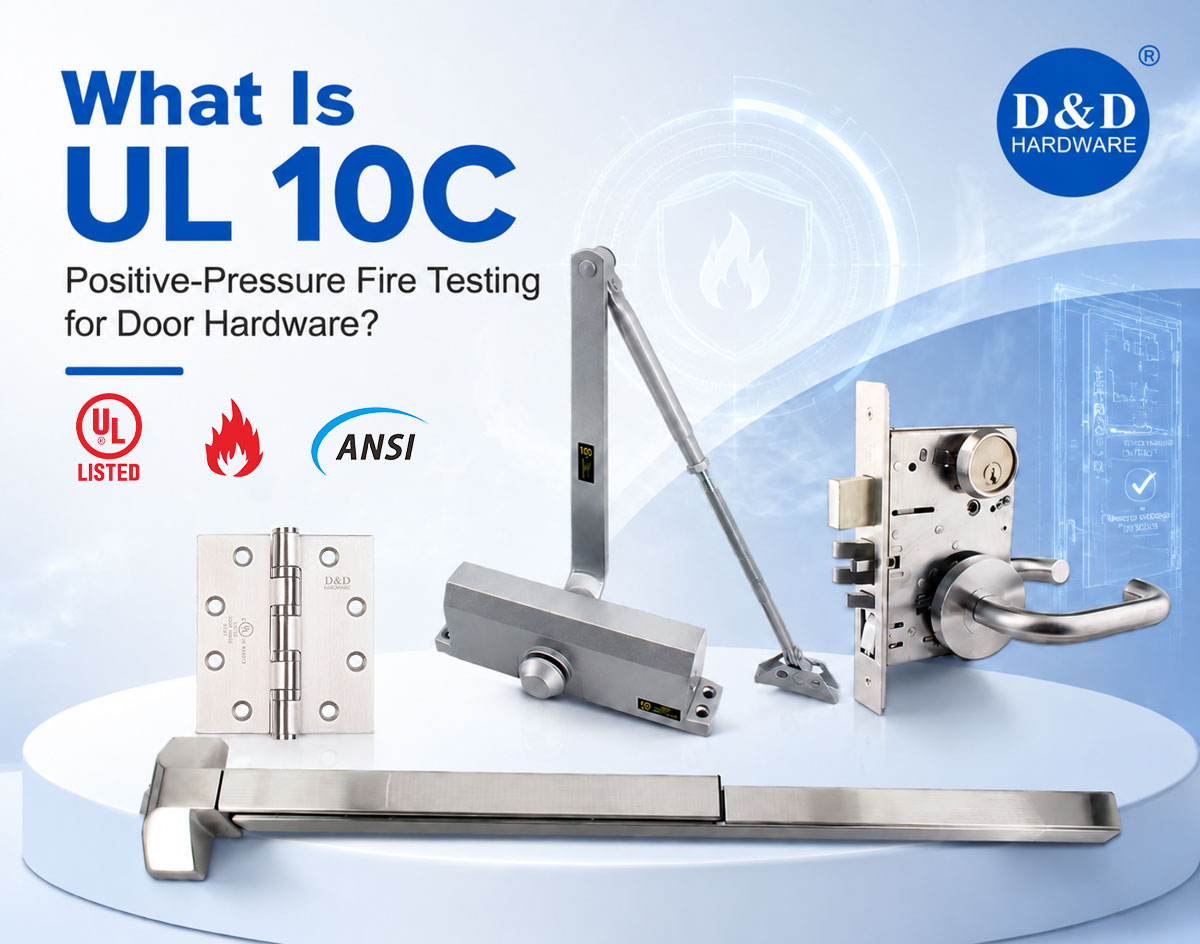
A fire-rated door is expected to do more than remain standing during a fire. It must stay closed, resist the passage of flames and hot gases, and keep its essential hardware functioning for the required period. UL 10C provides a recognized method for evaluating that performance under positive-pressure fire conditions.
For architects, door manufacturers, contractors, distributors, and hardware buyers, the important point is straightforward: UL 10C does not treat a hinge, lock, closer, or exit device as an isolated decorative component. These products influence how the complete fire door assembly performs when exposed to heat, pressure, and mechanical stress.

What Is UL 10C?
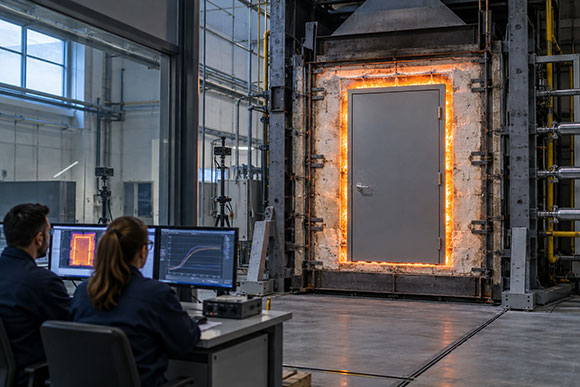
UL 10C is the Standard for Positive Pressure Fire Tests of Door Assemblies. It is used to evaluate fire door assemblies under controlled furnace conditions that reproduce the temperature development and pressure behavior expected during a building fire. Some building-code applications require side-hinged or pivoted fire door assemblies to be tested in accordance with UL 10C or another referenced fire-test standard.
The term "door assembly" is important. A fire door opening normally includes more than the door leaf:
• Door and frame
• Hinges or pivots
• Lock or latch
• Door closer
• Fire exit hardware, where required
• Glazing and glazing materials, if present
• Seals, fasteners and other approved accessories
The test evaluates how these elements work together. A door leaf may have suitable fire-resistant construction, but the opening can still lose its integrity if the hinges distort, the latch disengages, or the closer fails to keep the door in its intended position.
What Does "Positive Pressure" Mean?
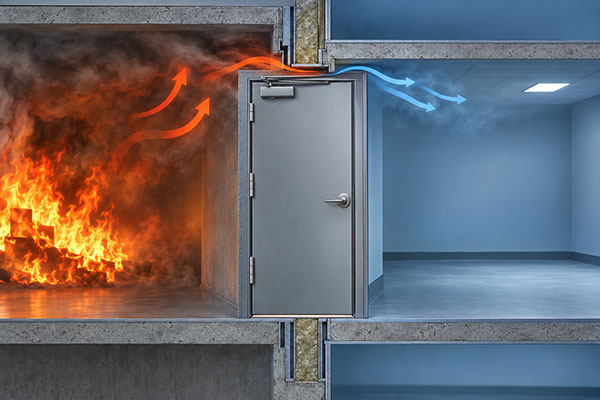
During a building fire, heated gases expand and rise. This can create pressure inside the fire compartment that is higher than the pressure on the unexposed side of the door.
Under positive-pressure conditions, hot gases are pushed toward and through available openings. Gaps at the top and sides of a door, hardware preparations, joints, and clearances can therefore become paths for flame and hot-gas leakage.
In a UL 10C test, the furnace pressure is controlled so that part of the test assembly is exposed to positive pressure. This makes the test different from a purely neutral- or negative-pressure condition in which furnace gases are not driven through upper door clearances in the same way.
For door hardware, this matters because heated gas and flame can reach vulnerable areas around:
• Hinge cutouts and fasteners
• Lock cases and latch preparations
• Exit-device mounting points
• Door-edge clearances
• Closer or coordinator preparations
• Glazing and accessory openings
Positive-pressure testing therefore gives specifiers a more representative way to assess whether the assembly can maintain its fire-protection function under demanding fire conditions.
How Does a UL 10C Fire Test Work?
A representative door assembly is installed in a test frame and positioned in front of a furnace. The assembly must reflect the construction, hardware preparation, mounting method, and configuration that the certification is intended to cover.
1. Installation of the Test Assembly
The door, frame, hardware, fasteners, seals, and permitted accessories are installed according to the proposed construction. Details such as door material, leaf size, hardware location, clearances, and mounting method are controlled because they can affect the result.
2. Furnace Exposure
The fire-exposed side of the assembly is subjected to a prescribed time-temperature curve. Furnace temperature increases as the test continues, creating progressively more severe thermal conditions.
Depending on the intended rating, the exposure may continue for 20, 45, 60, 90, 180 minutes, or another applicable period.
3. Pressure Control
The furnace is operated to establish the required pressure conditions across the opening. Above the neutral-pressure plane, furnace pressure is higher than the pressure on the unexposed side. Hot gases are consequently driven against gaps and joints in the upper portion of the door assembly.
4. Observation of Assembly Performance
During the exposure, the laboratory observes the assembly for conditions such as:
• Sustained flaming on the unexposed side
• Openings through the assembly
• Door-leaf distortion
• Failure of hinges or supporting hardware
• Latch disengagement
• Separation of components
• Loss of the door's protective position
5. Hose-Stream Evaluation Where Applicable
Fire door testing may also involve a hose-stream test after fire exposure. This subjects the heated assembly to water impact and cooling shock. The evaluation helps determine whether the assembly remains sufficiently intact after thermal exposure.
Applicable code provisions can affect whether a hose-stream test is required for a particular opening and rating, so the project specification and adopted code must always be checked.

Why Door Hardware Matters in Positive-Pressure Testing
Door hardware affects both movement and retention. It allows the door to open during normal use, but it must also help the door close, latch, and remain supported during a fire.
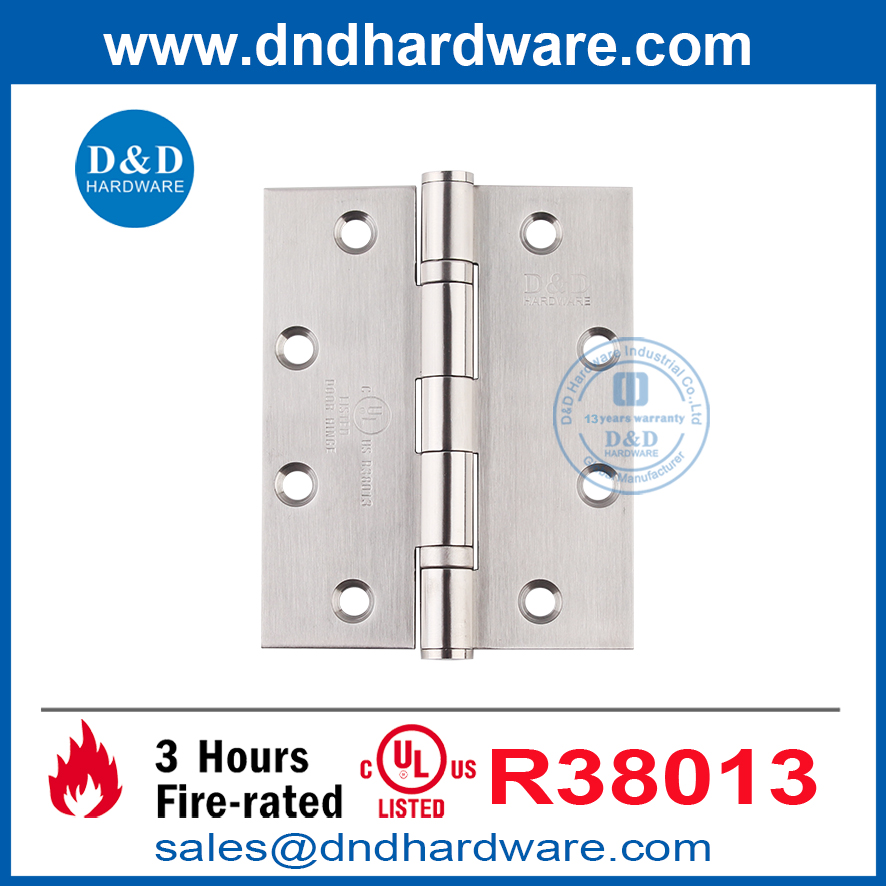
Hinges Must Continue Supporting the Door
As the door and frame heat up, the materials may expand, deform, or lose strength. Hinges must keep the leaf aligned closely enough for the door to remain within the frame and for the latch to engage.
Hinge selection must consider the tested or certified application, including door material, dimensions, weight, hinge size, quantity, fasteners, and installation method. Replacing a specified hinge with a visually similar model does not automatically preserve the fire rating.
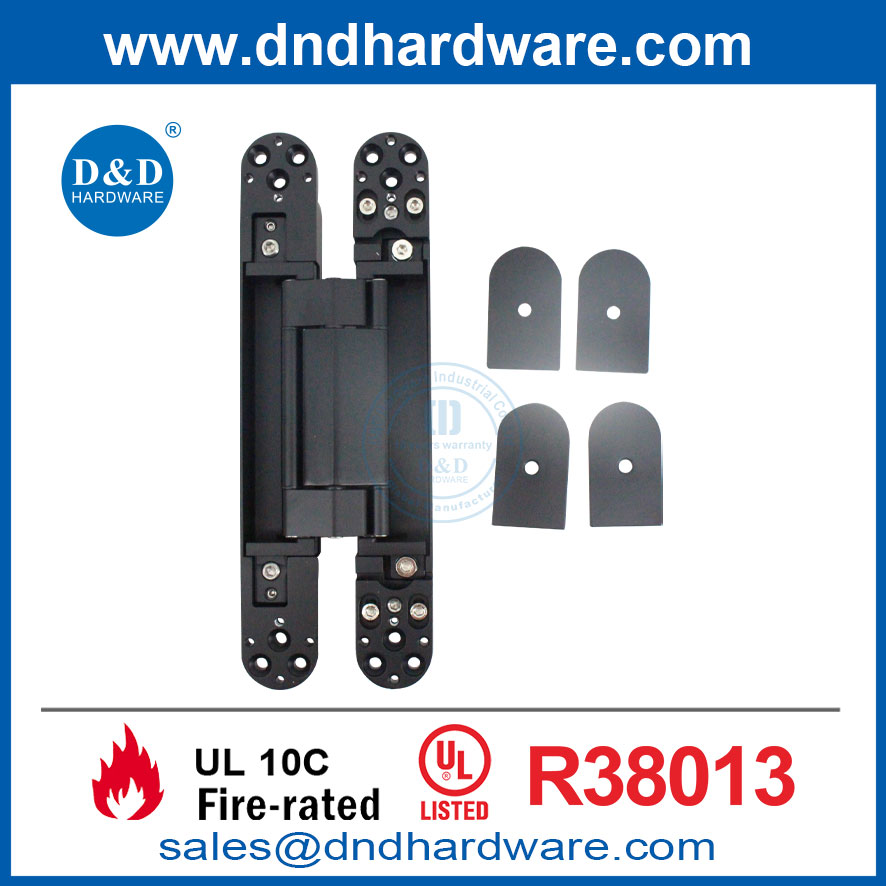
Concealed Hinges Require Controlled Preparation
A concealed hinge is installed within recesses in the door and frame. These preparations remove material and can influence the behavior of the opening under fire exposure.
For this reason, concealed hinges intended for fire-rated doors should have certification coverage appropriate to the proposed door construction and installation. The installer must also follow the specified routing dimensions, fastener requirements, and adjustment instructions.
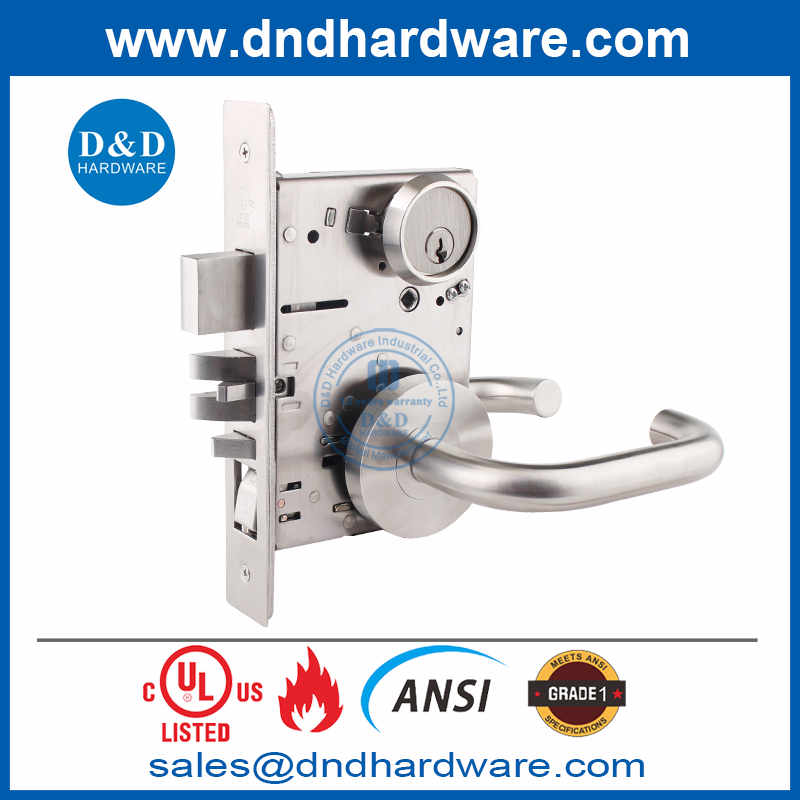
Locks and Latches Help Retain the Door
A fire door generally depends on positive latching to remain closed when exposed to fire pressure and distortion. The lock or latch must engage correctly before the fire occurs and continue retaining the leaf during the rated period.
The certification of a mortise lock should be checked together with its function, door type, preparation, strike, fasteners, and permitted accessories. A three-hour rating is not a universal statement that the lock can be installed in every three-hour door configuration.
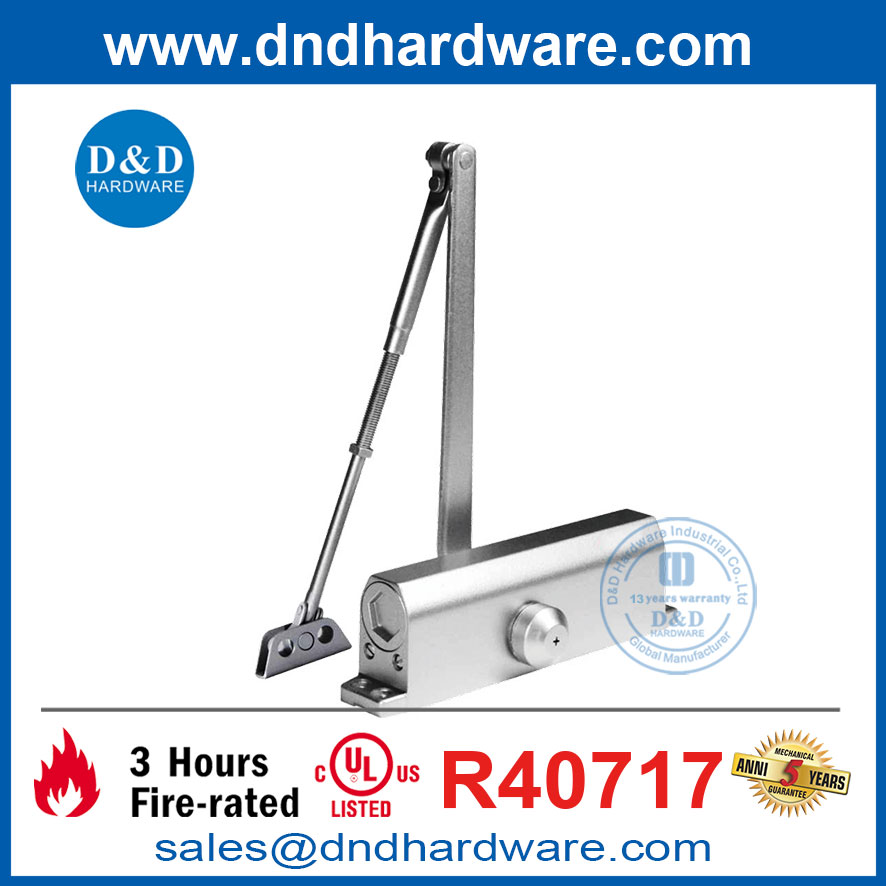
Door Closers Restore the Protective Position
An open fire door cannot protect an opening as intended. A door closer brings the leaf back to the closed position after normal use so that the latch can engage.
Closer selection must take account of door size, weight, opening force, mounting arrangement, environmental conditions, and the approved fire door application. Installation and adjustment are equally important: insufficient closing force, incorrect arm geometry, or excessive latch resistance may prevent reliable closing.
Fire Exit Hardware Combines Egress and Fire-Door Functions
Fire exit hardware allows occupants to release an egress door while also providing the latching function needed for a fire-rated opening. It must not include mechanical dogging that can hold the latch retracted on a fire door.
Fire exit hardware and panic hardware are related, but the terms are not interchangeable. Panic hardware is evaluated for safe release and operating performance under standards such as UL 305. When an exit device is used on a fire-rated opening, it needs the appropriate fire exit hardware certification for that application.
UL 10C vs UL 10B
UL 10B and UL 10C are both fire-test standards for door assemblies, but their pressure conditions differ.
UL 10B is commonly associated with neutral- or negative-pressure test conditions near the upper part of the door assembly. UL 10C establishes positive-pressure exposure over a larger portion of the opening, driving hot gases toward clearances and joints.
This distinction can affect the required door-edge construction, seals, glazing systems, and hardware preparations. Buyers should therefore avoid assuming that evidence to one standard automatically satisfies a specification calling for the other.
The adopted building code, project specification, authority having jurisdiction, and certified door design determine what is acceptable.
D&D UL-Certified Commercial Door Hardware
D&D supplies multiple hardware categories for commercial fire door projects. Current certification coverage includes:
Product Category | Certification Information |
Door hinges | UL/cUL UL 10C fire rated for up to 3 hours, File No. R38013; ANSI/BHMA Grade 1 and Grade 2 |
Concealed hinges | UL 10C fire rated, File No. R38013 |
Mortise locks | UL 10C fire rated for up to 3 hours, File No. R40901 |
Door closers | UL 10C fire rated for up to 3 hours, File No. R40717 |
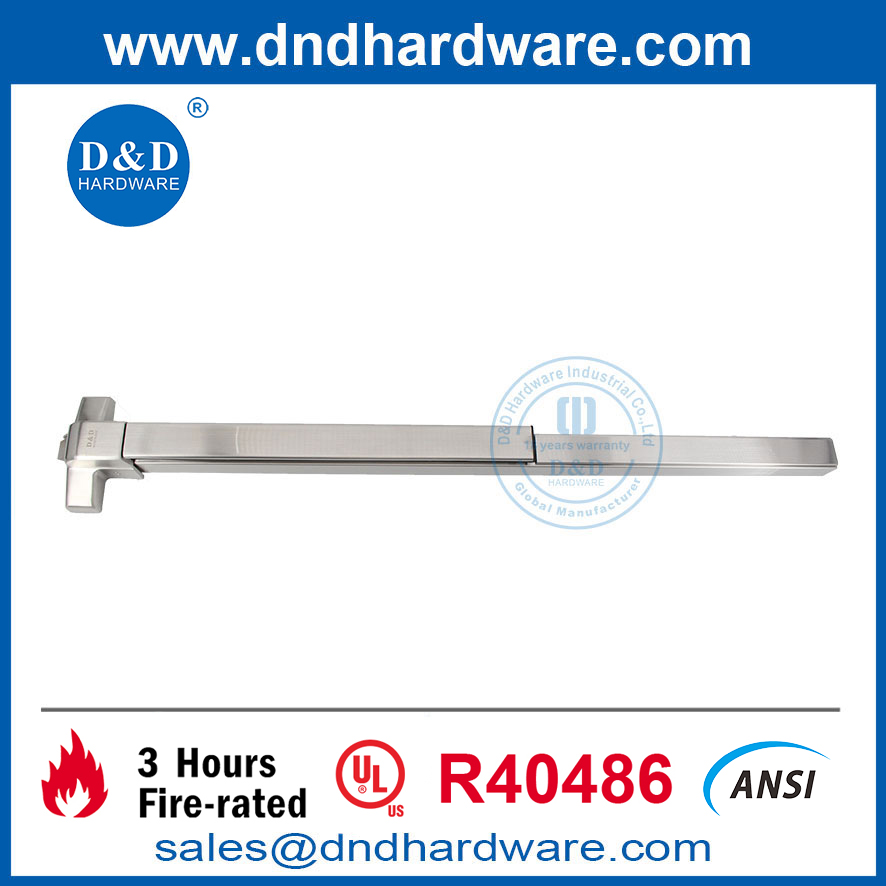
Fire exit hardware | UL 10C fire rated for up to 3 hours, File No. R40486 |
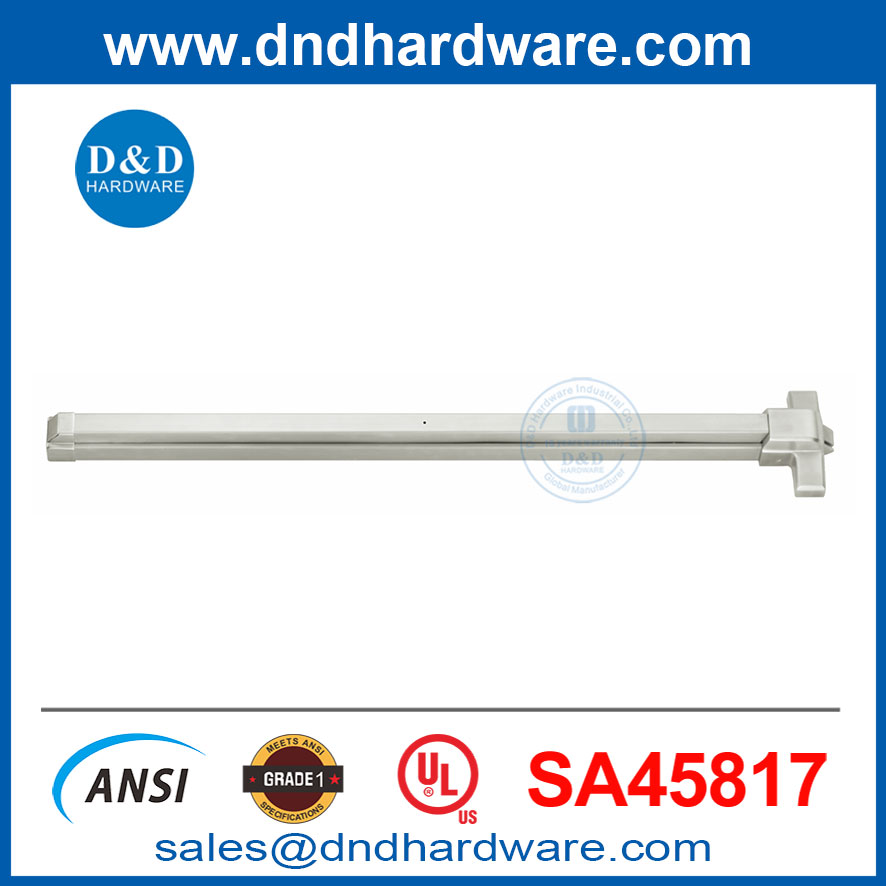
Panic hardware | UL 305, File No. SA45817 |
These certifications allow project teams to evaluate coordinated hardware categories from one manufacturer. However, the file number and general rating are only the beginning of product verification. The exact model, size, function, mounting method, door construction, and certification limitations must still correspond with the proposed application.
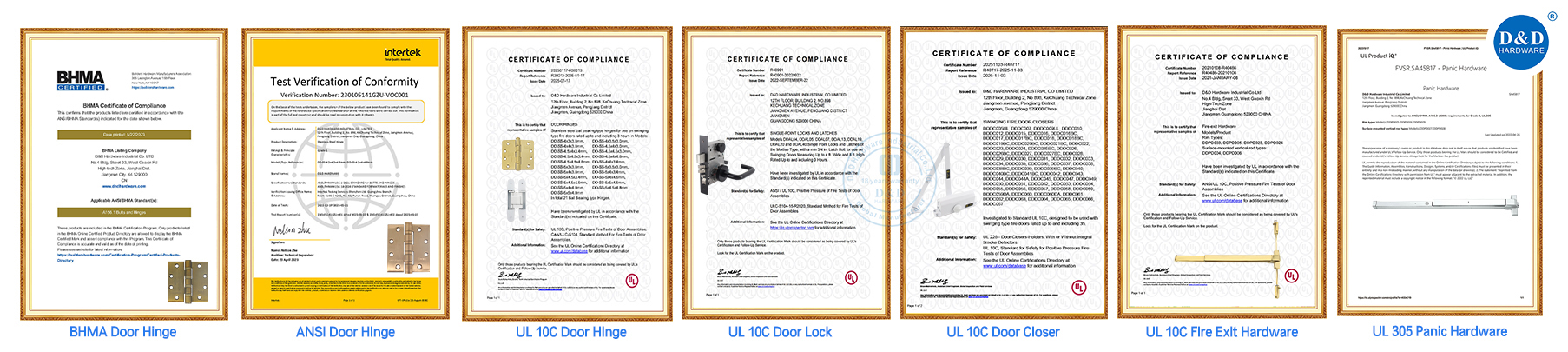
In particular, D&D panic hardware certified to UL 305 should not automatically be described as UL 10C fire exit hardware. For fire-rated openings, the correct product category and applicable listing must be selected.
What Buyers Should Verify Before Ordering
A specification that simply says "UL fire-rated hardware" leaves too much room for error. Before releasing an order, the buyer should confirm:
1. The fire rating required for the opening
2. The fire-test standard stated in the project documents
3. Door and frame materials and construction
4. Door dimensions, thickness, weight, and swing direction
5. Hardware model, function, size, and finish
6. Certification file number and listing coverage
7. Permitted installation and mounting method
8. Compatibility between the hinge, lock, closer, and exit device
9. Required labels, certificates, drawings, and submittal documents
10. Approval requirements of the authority having jurisdiction
This verification is especially important when a project combines products from different sources. Every component may appear suitable on its own, yet the combination may fall outside the tested or certified door assembly.

Does UL 10C Certification Apply to the Entire Project Door?
Not automatically.
UL 10C certification for an individual hardware product does not certify every door on which that product is installed. Final compliance depends on the complete opening, including the door, frame, hardware, glazing, seals, installation, labeling, project specification, and applicable code.
A practical procurement sequence is:
Door and frame construction -> required fire rating -> applicable standard -> compatible listed hardware -> approved submittal -> controlled installation
This sequence reduces the risk of selecting hardware based only on appearance, dimensions, or a general "fire-rated" claim.
Frequently Asked Questions
Is UL 10C a durability test?
No. UL 10C evaluates fire performance under positive-pressure conditions. Operational durability may be covered by separate standards, such as applicable ANSI/BHMA requirements.
Does a three-hour UL 10C rating mean the product suits every fire door?
No. The rating applies within the conditions and limitations of the certification. The exact model and door application must be verified.
Is UL 305 the same as UL 10C?
No. UL 305 addresses panic hardware performance, while UL 10C covers positive-pressure fire testing of door assemblies. A fire-rated exit application requires hardware with the appropriate fire exit certification.
Can standard hinges be installed on a UL 10C fire door?
Only when the hinges are permitted by the certified door assembly and meet the applicable specification. Similar dimensions or materials do not prove suitability.
Who gives final approval for the installed opening?
Acceptance ultimately depends on the applicable code, project requirements, inspection process, and authority having jurisdiction.
UL 10C positive-pressure testing evaluates whether a fire door assembly can resist fire exposure while hot gases are being driven against its clearances, joints, and hardware preparations. It is not simply a certificate attached to an individual product.
For commercial projects, reliable compliance begins with the complete opening. Hinges must support the leaf, locks and fire exit hardware must retain it, and the closer must return it to the closed and latched position. Selecting UL-certified hardware with traceable file numbers is essential, but those products must also be coordinated with the door assembly in which they will be used.
D&D's UL-certified hinges, concealed hinges, mortise locks, door closers, and fire exit hardware provide a coordinated starting point for UL fire-rated commercial door projects, supported by clearly identified certification files and application-based hardware selection.
Contact us Now:
Contact: David Jian
Mob:0086-139 2903 7292
Email: David@dndhardware.com, sales@dndhardware.com,
Contact: Jobby Zhang
Mob:0086-137 2599 9617
Email: jobby@dndhardware.com
D&D HARDWARE INDUSTRIAL CO.,LTD
ADD:12th Floor, Building 2, No.898, KeChuang Technical Zone, Jiangmen Avenue, Pengjiang District, Jiangmen City, Guangdong, China (Postcode:529000)
https://www.dndhardware.com
Tel: +86-750-3856396
Fax: +86-750-3856395
 English