UL Fire Rated Commercial Door Hardware — Technical Guide
Two standard numbers appear on almost every commercial hardware submittal we review, and buyers often treat them as alternatives. That reading is wrong, and it is a common reason hardware packages get returned.
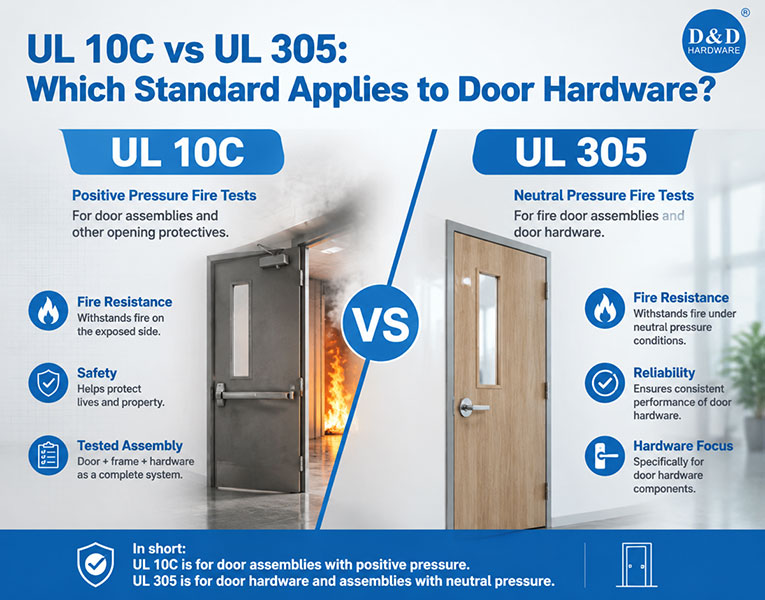
UL 10C is a fire test method. It evaluates a complete swinging door assembly (leaf, frame, hinges, latch, closer, seals) in a furnace under positive pressure. UL 305 is a product performance standard for panic hardware: does the releasing device unlatch when people push on it, after cycling and after adverse exposure.
They answer different questions. Will this opening hold back fire? belongs to UL 10C. Will this door release under panic load? belongs to UL 305. One product needs both: an exit device on a fire rated door.

Which Standard Covers Which Hardware?
The mapping below is the short answer.
Hardware category | UL 10C | UL 305 | Durability standard |
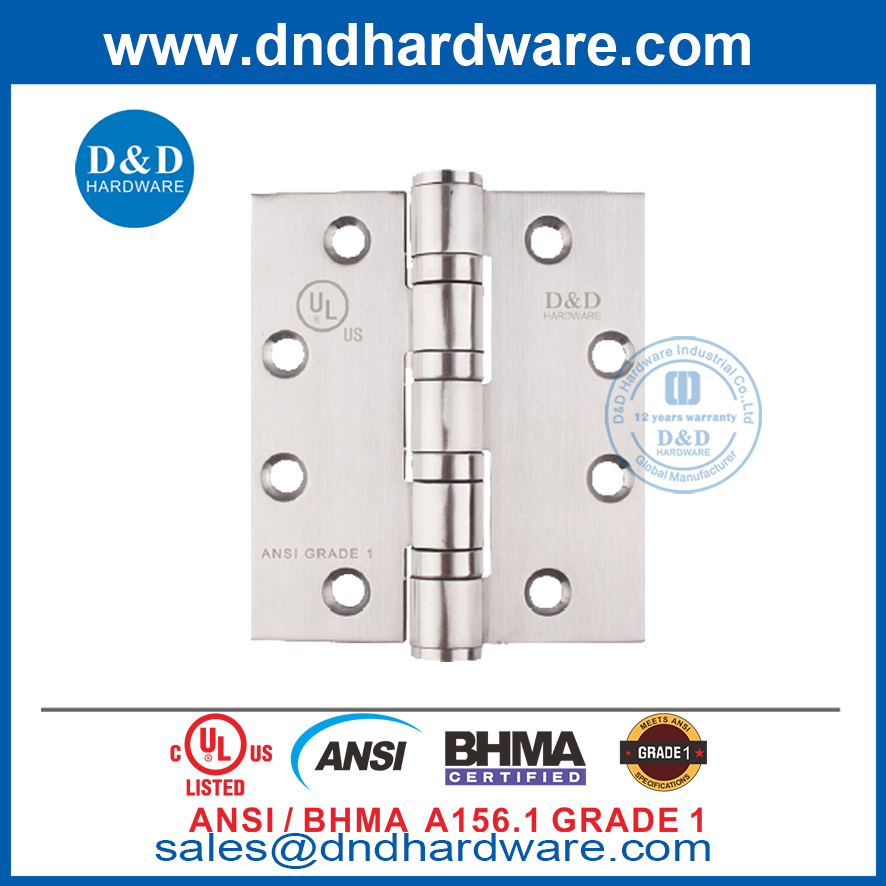
Butt hinge, continuous hinge (rated opening) | Required, tested as part of the assembly | Not applicable | ANSI/BHMA A156.1 |
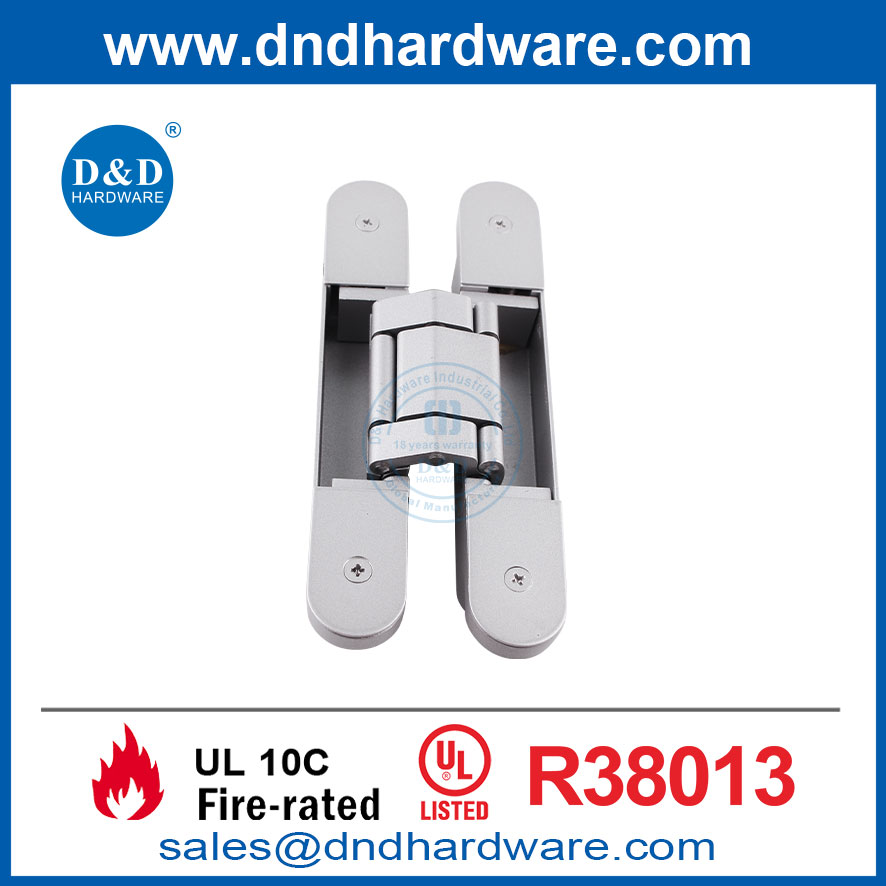
Concealed hinge (rated opening) | Required, preparation must match the certified design | Not applicable | ANSI/BHMA A156.1 |
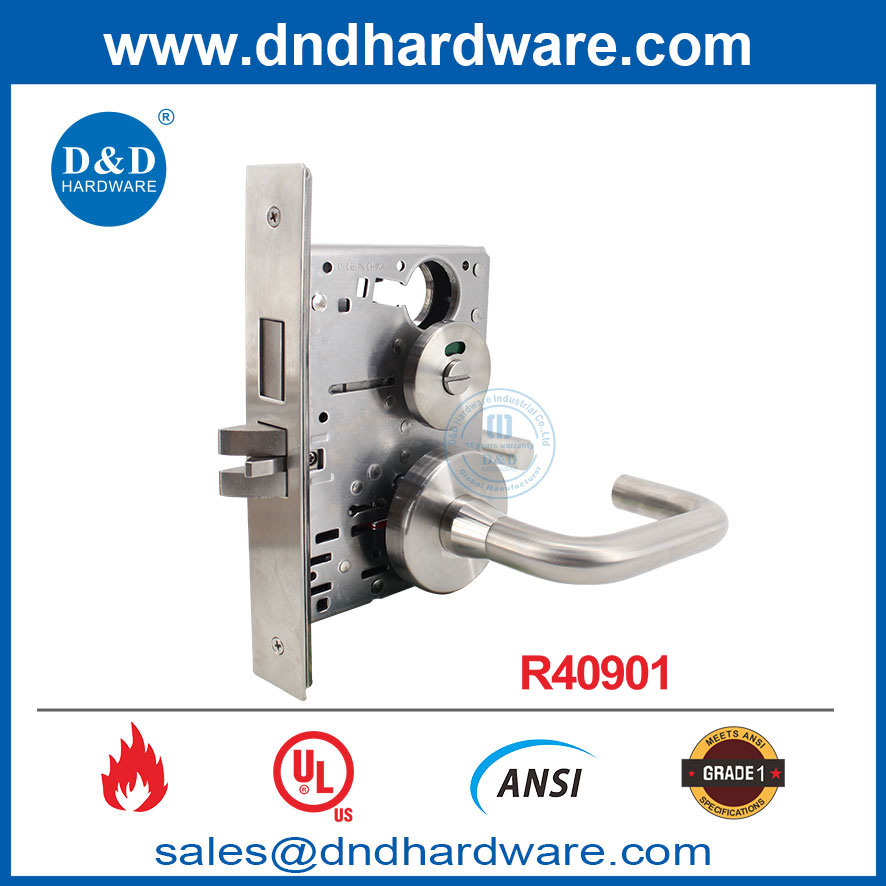
Mortise or cylindrical lock, latch | Required | Not applicable | A156.13 / A156.2 |
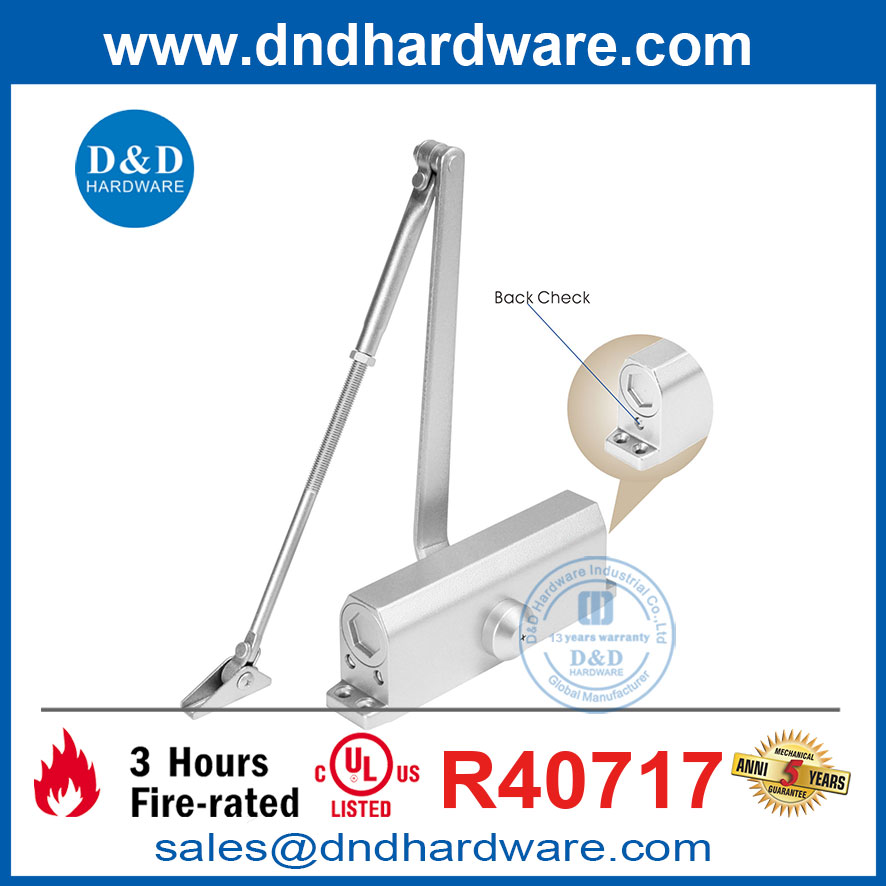
Door closer | Required | Not applicable | ANSI/BHMA A156.4 |
Fire exit hardware (rated opening) | Required | Required | ANSI/BHMA A156.3 |
Panic hardware (non-rated egress door) | Not applicable | Required | ANSI/BHMA A156.3 |
Coordinator, flush bolt, seals | Within the assembly test | Not applicable | Varies |
Note what never appears: UL 10C alone on an exit device for a rated door, or UL 305 alone on a hinge. Listing only one of them for fire exit hardware is incomplete.
What UL 10C Actually Tests
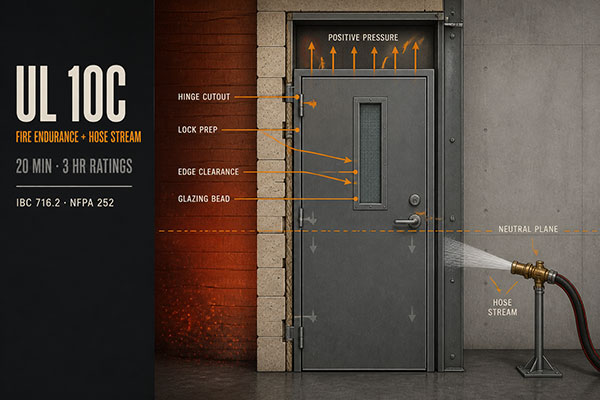
Scope clause 1.1 covers swinging door assemblies, including frames with lights and panels. The test has two parts: fire endurance exposure to a standard time-temperature curve, then a hose stream impact. Ratings run from 20 minutes to 3 hours.
What separates UL 10C from the older UL 10B method is pressure. Above the neutral plane, hot gas is driven against every gap in the upper half of the opening: hinge cutouts, lock preparations, closer fixings, door edge clearances, glazing beads. That is where assemblies fail. Our UL 10C positive pressure testing guide covers the procedure in detail.
Two code points matter. IBC Section 716.2 requires fire door assemblies to be tested to NFPA 252 or UL 10C; the methods are harmonised, so either is normally accepted. Certain 20 minute assemblies may be tested without the hose stream.
UL 10C is not a durability test. Cycling performance falls under ANSI/BHMA, so a product can be A156.1 Grade 1 and carry no fire listing.
What UL 305 Actually Tests
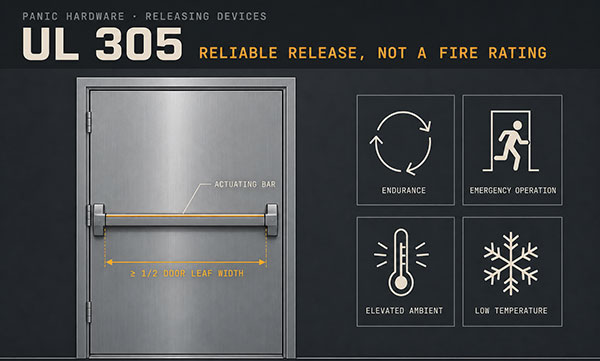
UL 305 covers releasing devices operated by an actuating bar, crossbar, push pad or paddle on outward swinging doors, with four critical test areas: endurance, emergency operation, elevated ambient exposure and low temperature impact. Bar type devices must span at least half the door leaf width, and egress provisions cap unlatching force at 15 lbf (67 N).
UL 305 establishes reliable release, not a fire protection rating. Our UL 305 requirements guide covers the four test areas in full.
The Code Language That Settles It
IBC Section 1010.2.9 (2021 edition; earlier editions place it in Section 1010.1) states it plainly:
Panic hardware shall be listed in accordance with UL 305. Fire exit hardware shall be listed in accordance with UL 10C and UL 305.
The word doing the work is and. On a rated opening with a panic egress requirement, both listings are mandatory.
Three further requirements come from NFPA 80. Fire doors must be self closing or automatic closing, and positively latched. Mechanical dogging is prohibited on fire exit hardware, since a held-back latch defeats positive latching; only a listed electrical latch retraction is acceptable. Where an exit device is fitted to a fire door, the label must read Fire Door to be Equipped with Fire Exit Hardware. See our NFPA 80 label requirements guide.
Panic hardware is triggered by occupancy and load, not by fire rating: assembly and educational occupancies at 50 occupants or more, and high hazard occupancies at any load (IBC Section 1010.2, NFPA 101 Chapter 7).

Four Questions That Resolve Any Door Schedule Line
Is the opening rated?
1. Check the door schedule and life safety drawings, not the building type.
Does the code require panic egress here?
2. Occupancy group and occupant load decide this, independent of the rating.
Does this device provide the latching?
3. If it does and the door is rated, you are specifying fire exit hardware, and both standards apply.
Does the listing cover this configuration?
4. Rim, mortise, surface vertical rod and concealed vertical rod devices are not interchangeable, and handing, trim and strikes sit inside the listing scope.
Where Hardware Submittals Fail
Most rejected submittals we see follow these patterns:
A UL 305 only device specified on a rated stair door.
● The listing and the label both exist, and the door still fails review.
"UL fire rated hardware" written with no rating and no file number.
● No such generic product exists. A rating is tied to a model and a set of conditions.
A 3 hour product fitted to an assembly tested for 90 minutes.
● The higher rating does not carry across. The assembly governs.
ANSI/BHMA Grade treated as a fire listing.
● Grade 1 speaks to cycling performance and says nothing about fire.
Concealed hinges routed off-drawing.
● The preparation removes material from a rated construction, so routing, fasteners and reinforcement must match the certified design. An identical looking hinge from another maker does not inherit it.
How to Verify a Listing Before You Order
The UL file number is the lookup key in UL's Product iQ directory. Check four things: covered models, rating, conditions of use, and the date last updated.
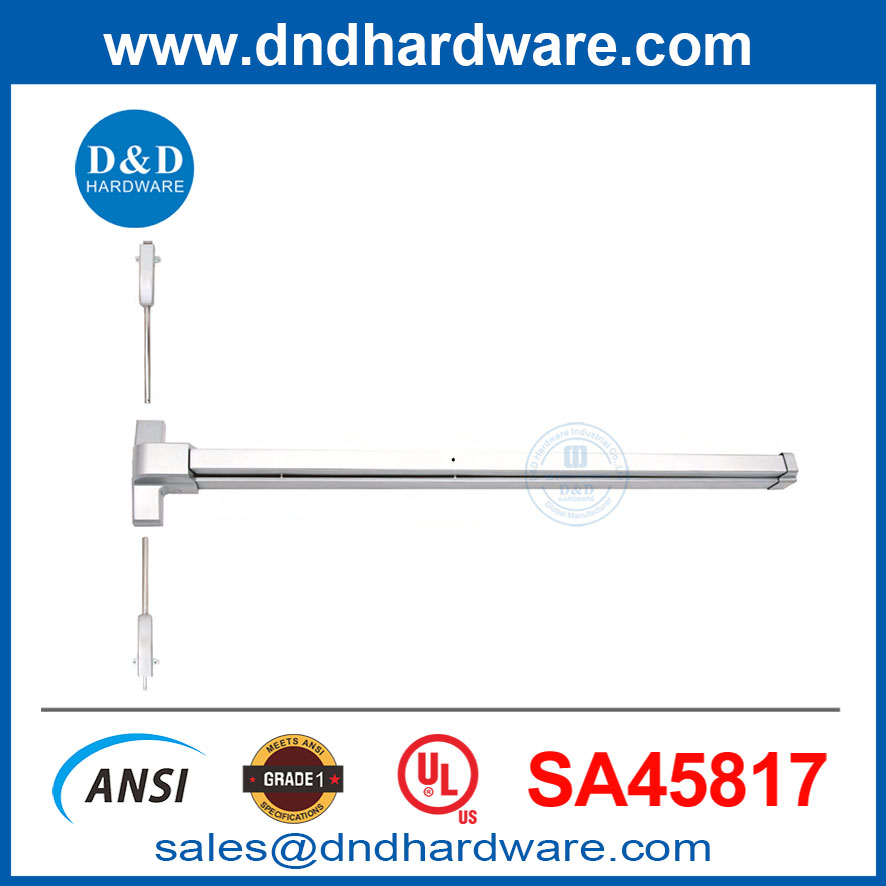
Our File No. SA45817 record covers rim panic devices DDPD025, DDPD026 and DDPD029 plus surface vertical rod models DDPD027 and DDPD028, investigated to ANSI/BHMA A156.3 (2008) Grade 1 in addition to UL 305. That record was last updated on April 26, 2022, which is why we tell buyers to re verify at submittal rather than trust a catalogue PDF.
Submittal packet: listing printout, certificate, data sheet, schedule line, and the door elevation with preparations marked.

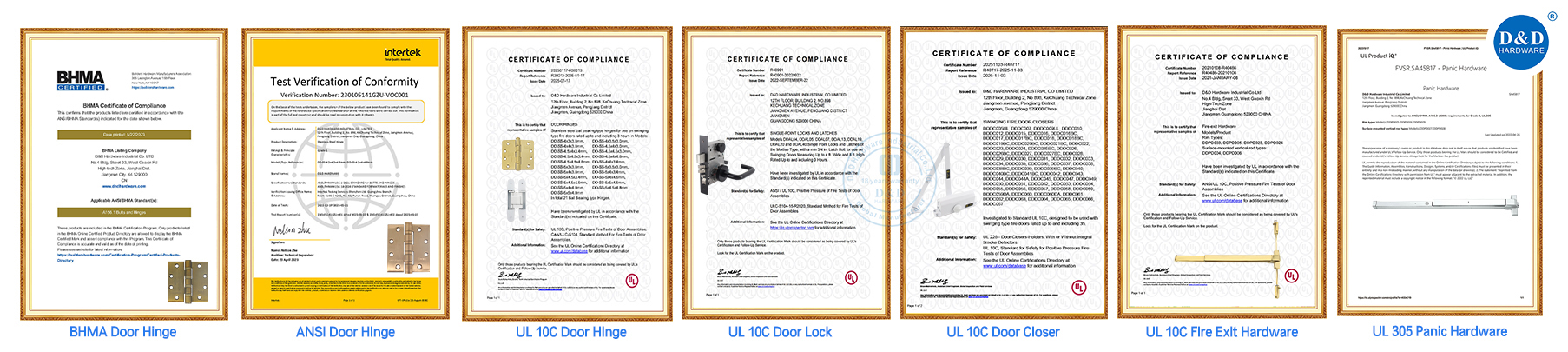
D&D Hardware UL Certification Coverage
D&D Hardware holds separate listings for separate functions.
Product | Standard | Rating | UL File No. | ANSI/BHMA |
Door hinge | UL/cUL UL 10C | Fire rated up to 3 hours | R38013 | A156.1 Grade 1 and Grade 2 |
Concealed hinge | UL 10C | Fire rated | R38013 | A156.1 |
Door lock | UL 10C | Fire rated up to 3 hours | R40901 | A156.13 |
Door closer | UL 10C | Fire rated up to 3 hours | R40717 | A156.4 |
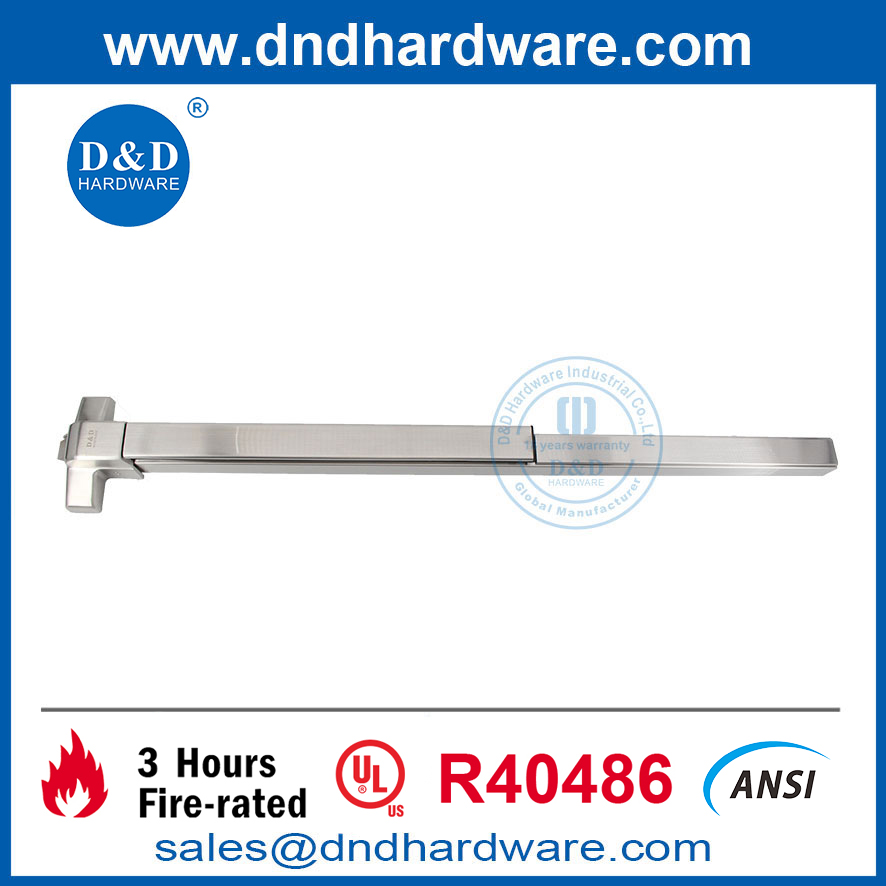
Fire exit hardware | UL 10C | Fire rated up to 3 hours | R40486 | A156.3 |
Panic hardware | UL 305 | Egress performance, not a fire rating | SA45817 | A156.3 Grade 1 |
The ANSI/BHMA column shows the durability standard normally specified for each category. Confirm grade coverage per model.
Two notes. First, our UL 305 panic hardware is not a UL 10C fire exit device. For a rated opening, specify the R40486 listing. Second, single-source supply simplifies compatibility but does not remove it: every listing must still match the certified door assembly it goes into. See our common sourcing mistakes guide.
Frequently Asked Questions
Is UL 305 fire rated?
No. UL 305 evaluates panic hardware for reliable release under emergency load and confers no fire protection rating. A rated opening needs fire exit hardware listed to both standards.
Can panic hardware be installed on a fire rated door?
Only if that device is also listed and labelled as fire exit hardware for the rated application. IBC 1010.2.9 requires both standards.
Which standard applies to hinges, locks and closers?
UL 10C. They are evaluated within the door assembly fire test, not as standalone products. UL 305 does not apply to them.
What is the difference between UL 10C and NFPA 252?
Both test door assemblies under positive pressure and the methods are harmonised. IBC 716.2 accepts either, so check which one the specification names.
Does ANSI/BHMA Grade 1 mean the product is fire rated?
No. Grades come from ANSI/BHMA cycling tests; fire rating comes from UL 10C or NFPA 252 assembly testing. The two are independent.
Contact us Now:
Contact: David Jian
Mob:0086-139 2903 7292
Email: David@dndhardware.com, sales@dndhardware.com,
Contact: Jobby Zhang
Mob:0086-137 2599 9617
Email: jobby@dndhardware.com
D&D HARDWARE INDUSTRIAL CO.,LTD
ADD:12th Floor, Building 2, No.898, KeChuang Technical Zone, Jiangmen Avenue, Pengjiang District, Jiangmen City, Guangdong, China (Postcode:529000)
https://www.dndhardware.com
Tel: +86-750-3856396
Fax: +86-750-3856395
 English