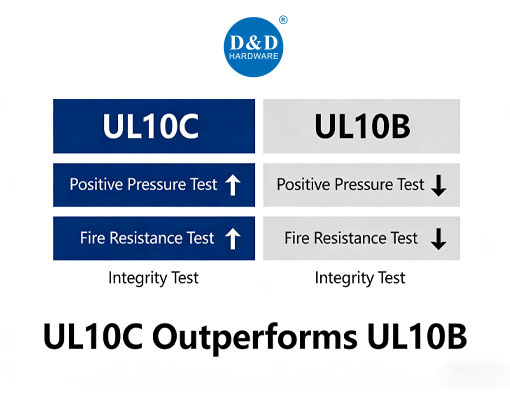
The core distinctions between UL10C and UL10B fire resistance testing lie in the test environment, sealing requirements, scope of application, and certification complexity, as detailed below:
1. Test Environment: Atmospheric Pressure vs Positive Pressure
UL10B: Conducted under atmospheric pressure fire conditions, simulating ordinary fire scenarios without additional airflow or pressure effects. The test focuses solely on the impact of flames and high temperatures on the fire door.
UL10C: Tests are conducted in a positive pressure fire environment, simulating the positive pressure conditions created by rising hot air currents during a fire (e.g., areas above the neutral pressure plane experiencing outward pressure). This environment imposes higher demands on the door's sealing integrity and structural integrity.
2. Sealing Requirements: Basic vs Stringent
UL10B: Imposes lower sealing requirements, primarily evaluating the door leaf's inherent fire resistance and thermal insulation. Requirements for the sealing performance of components such as door frames and gaskets are relatively lenient.
UL10C: Demands superior sealing to prevent the penetration of flames, hot gases, and smoke under positive pressure conditions. The test rigorously assesses the design of door frames, door leaves, and gaskets to ensure effective barrier performance under pressure.
3. Scope of Application: Broad vs Specific
UL10B: Applicable to all door types, including swing doors, sliding doors, roller shutters, horizontal sliding lift doors, access doors, chute doors, service counter doors, etc.
UL10C: Applicable solely to swing doors. Other door types require reference to alternative standards or UL10B.
4. Certification Difficulty: Basic vs Complex
UL10B: Simple test environment; fire doors must meet basic fire resistance and thermal insulation requirements, making certification relatively straightforward.
UL10C: Complex test conditions requiring structural integrity and seal maintenance under positive pressure, presenting higher certification difficulty.
5. Test Content and Evaluation Criteria
Common Requirements:
Both require fire doors to withstand high fire temperatures for specified durations (e.g., 30, 60, 90, or 120 minutes), preventing the spread of flames, heat, and smoke.
Assessment of fire resistance (structural integrity), thermal insulation (control of temperature on the non-fire side), and sealing (prevention of permeation).
Differences:
UL10C: Incorporates positive pressure testing and hose spray testing (immediate water impact post-fire exposure to assess thermal shock resistance).
Criteria: UL10C mandates component integrity (no openings) throughout testing, permitting minor glass detachment under specified conditions; UL10B prioritises absence of fire penetration holes and flame spread through the door leaf.
6. Test Significance and Application Scenarios
UL10B: Suitable for scenarios requiring fundamental fire door performance, such as standard building fire compartments.
UL10C: More closely simulates real fire scenarios, applicable to high-safety-standard premises (e.g., commercial buildings, high-rise structures, hospitals, schools) to ensure fire doors effectively contain flames under extreme conditions.

Direct Comparison Table
| Feature | UL10B (Obsolete) | UL10C (Current Standard) |
| Pressure Condition | Neutral Pressure | Positive Pressure |
| Realism | Low - does not simulate key real-fire conditions | High - simulates the pressure buildup in a compartment fire |
| Test Method | Measures endurance against heat and flames only. | Measures endurance against heat, flames, AND structural integrity under pressure. |
| Hose Stream Test | Conducted on a separate, duplicate sample. | Conducted on the same sample immediately after the fire test, proving its integrity. |
| Code Acceptance | Not accepted by modern building codes. | Required by the IBC, NFPA 80, and all related codes. |
| Purpose | Historical standard. | To evaluate the ability of a door assembly to remain in the opening during a fire under realistic conditions. |
D&D UL 10C door hardware certification
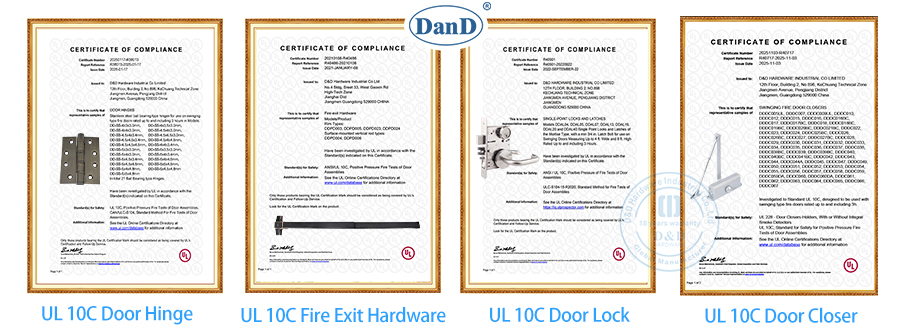
More UL door hardware, click here.
Contact us Now: Contact: David Jian
Mob:0086-139 2903 7292
Email: David@dndhardware.com, sales@dndhardware.com,
Jobby Zhang
Mob:0086-137 2599 9617
Email: jobby@dndhardware.com
D&D HARDWARE INDUSTRIAL CO.,LTD
ADD:12th Floor, Building 2, No.898, KeChuang Technical Zone, Jiangmen Avenue, Pengjiang District, Jiangmen City, Guangdong, China (Postcode:529000)
https://www.dndhardware.com
Tel: +86-750-3856396
Fax: +86-750-3856395
 English