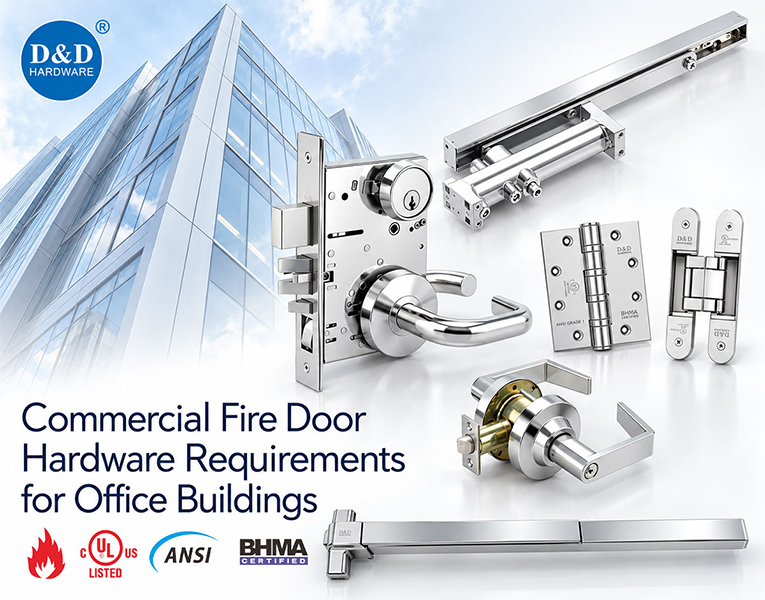
Commercial fire door hardware requirements for office buildings are governed by the intended function of each opening, the adopted codes, the required fire-protection rating, and the certification scope of the installed products.
For UL Listed Fire Rated Commercial Door Hardware, a reliable compliance review should establish which openings require rated protection, verify the applicable hardware certifications, confirm compatibility with the door assembly, and check installation and maintenance records.
The objective is not simply to specify products carrying a UL mark. It is to ensure that the certified products are used within their intended scope as part of a compliant fire door assembly.

1. Understanding Fire Door Hardware Requirements in Office Buildings
Office buildings contain a range of openings that may form part of a building's fire protection or means-of-egress system. These can include stairwell doors, doors in fire barriers, service-room openings, and other openings identified in the approved life-safety design.
The fire door hardware installed on these doors must meet the requirements for the specific opening. A product that is suitable for an ordinary office door is not automatically appropriate for a fire-rated door assembly.
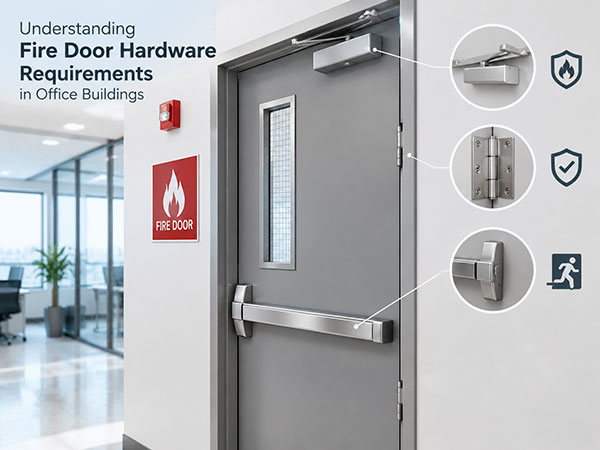
Commercial fire door hardware requirements for office buildings depend on the adopted building and fire codes, the required fire-protection rating, the function of the opening, and the certification scope of the installed products.
In the United States, the applicable requirements may draw on the International Building Code (IBC), NFPA 80, NFPA 101, and local amendments. The precise requirements depend on the code edition adopted by the jurisdiction and the building's design.
For UL Listed Fire Rated Commercial Door Hardware, compliance involves more than identifying a UL mark. The product must be certified for the relevant application, installed according to its permitted conditions, and compatible with the specified door assembly.
2. Determine Which Office Doors Require Fire-Rated Hardware
Not every door in an office building is a fire door. The first step is to establish which openings are required to be fire-protection-rated and what function each opening serves.
For example, a door protecting a stair enclosure may have different requirements from a standard office partition door. A door in a fire barrier may also have different requirements from one in a smoke-control arrangement.
Before approving hardware, the project team should confirm:
*The applicable building and fire codes.
*The location and function of the opening.
*The required fire-protection rating.
*Whether smoke-control requirements apply.
*The required closing, latching, locking, and egress functions.
*The approved door and frame configuration.
The rating of an opening protective is not necessarily identical to the fire-resistance rating of the wall. Applicable code provisions determine the required rating and acceptable assembly.
This is why hardware should be reviewed against the approved door schedule and certification documentation rather than selected solely by product description.

3. UL 10C and Fire Door Assembly Compliance
UL 10C is the Standard for Positive Pressure Fire Tests of Door Assemblies. It establishes fire-test methods for applicable swinging door assemblies, including specified door and frame constructions used to resist the passage of fire. It is not a universal standard for every hardware product.
For an office building project, the relevant question is whether the specified door assembly meets the required rating and whether the installed hardware is suitable for that certified application.
A UL-certified hinge, lock, or closer does not independently establish that the complete opening complies. The door, frame, hardware, accessories, preparation, and installation must be considered together.
When reviewing a UL fire door assembly, verify:
(1)The required fire-protection rating.
(2)The applicable door and frame certification.
(3)The certification scope of each hardware component.
(4)The exact product model and any conditions of use.
(5)The installation requirements and required markings.
The installed configuration should remain within the permitted scope of the relevant certifications. Similar appearance or matching dimensions are not proof that a replacement component is equivalent.

4. UL 305, Panic Hardware, and Fire Exit Hardware
Office buildings must also meet applicable means-of-egress requirements. This is where the distinction between panic hardware and fire exit hardware becomes important.
UL 305 covers panic hardware intended to facilitate egress during an emergency. Fire exit hardware used on applicable fire-rated doors has additional fire-door requirements, including evaluation to UL 10C as well as UL 305 where required by the certification and code provisions.
Under the 2024 IBC, Section 1010.2.8.3 specifies that panic hardware must be listed to UL 305 and fire exit hardware must be listed to UL 10C and UL 305. The code also specifies requirements concerning the releasing-device actuating portion and unlatching force. The adopted edition and applicable exceptions must be checked for each project.
The need for panic or fire exit hardware depends on the occupancy, occupant load, door location, and applicable egress provisions. It should not be assumed that every office door requires an exit device.
Where electrified locks, card readers, or other access-control arrangements are used, the locking configuration must also comply with the applicable release and egress requirements.
5. Verify Certification by Hardware Category
Certification is product-specific. A hinge's certification does not establish that a lock or exit device is certified for the same application.
Depending on the opening, the office building hardware schedule may include:
*Hinges and concealed hinges.
*Mortise locks and latches.
*Door closers.
*Fire exit hardware.
*Panic hardware.
*Flush bolts and coordinators, where applicable.
*Gasketing and edge-sealing components, where required.
*Electrified hardware and accessories, where specified.
Each product should be reviewed against its certification record and intended application.
UL Product iQ can be used to verify published certification information. Check the manufacturer, model or series, product category, applicable standard, markings, and conditions of use. UL's marking and application guides are designed to help code authorities, designers, and installers determine whether certified products are suitable for particular installations.
A UL File Number is a useful reference for this process, but it is not a substitute for reviewing the actual certification record.
6. D&D UL Fire-Rated Hardware Certification References
D&D Hardware's UL product range includes several categories used in commercial door applications. The following references can help identify the relevant product certification during a technical review.
| Hardware category | Hardware category | Certification reference |
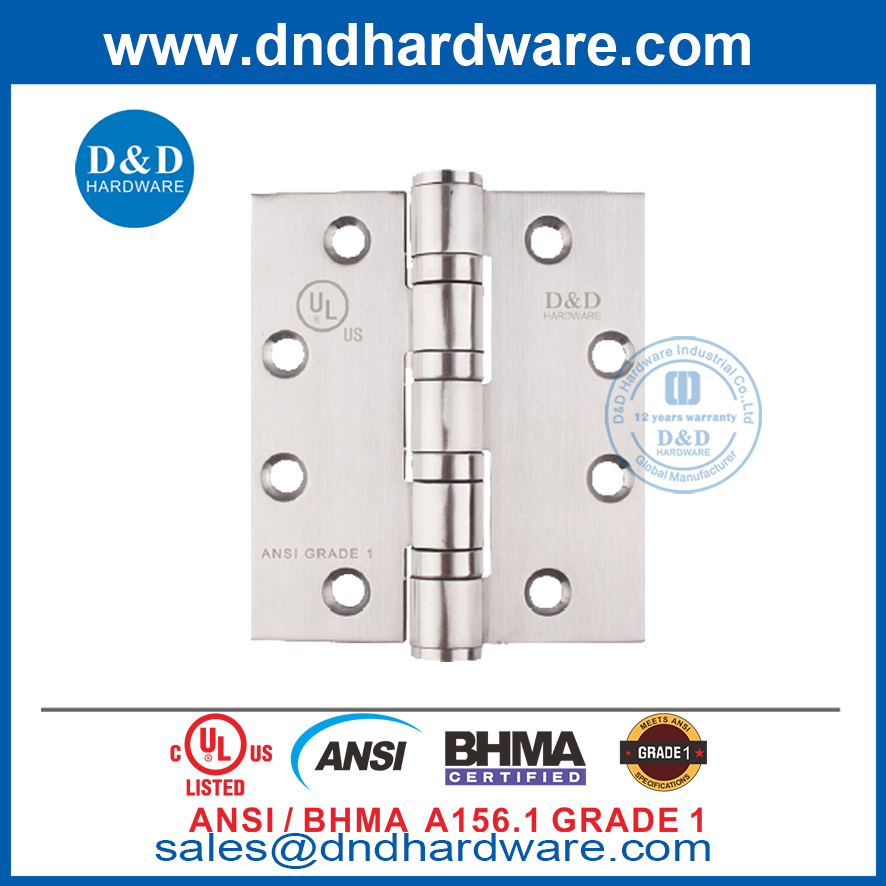 | Door hinges | UL 10C, File R38013; 3-hour fire rating |
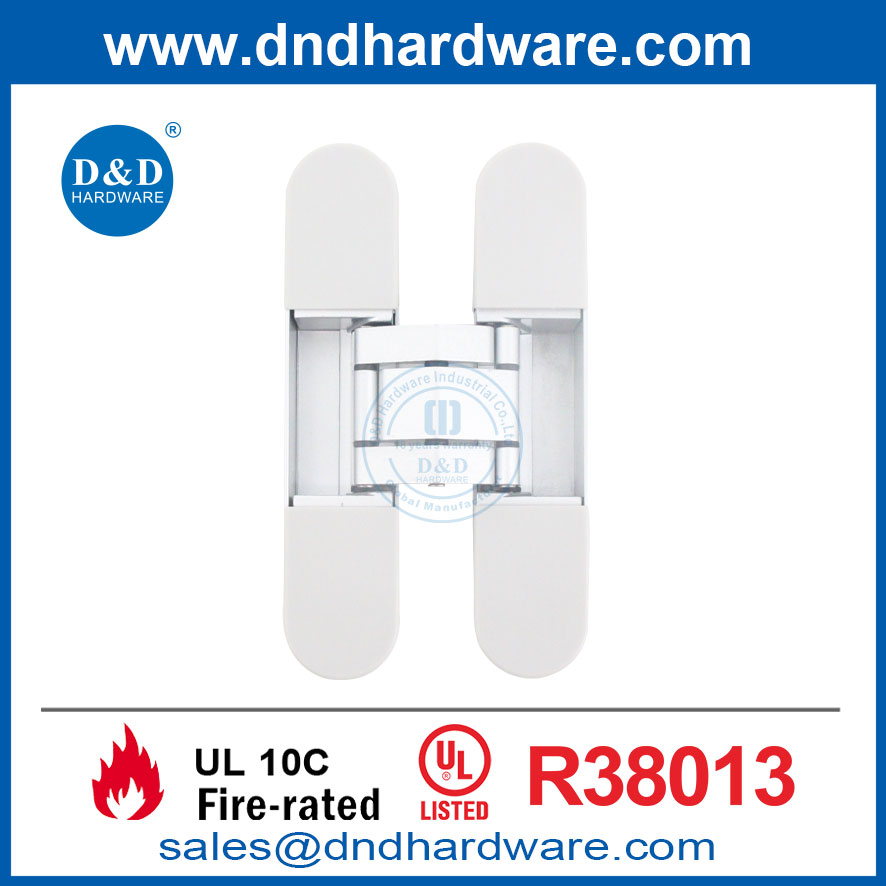 | Concealed hinges | UL 10C, File R38013 |
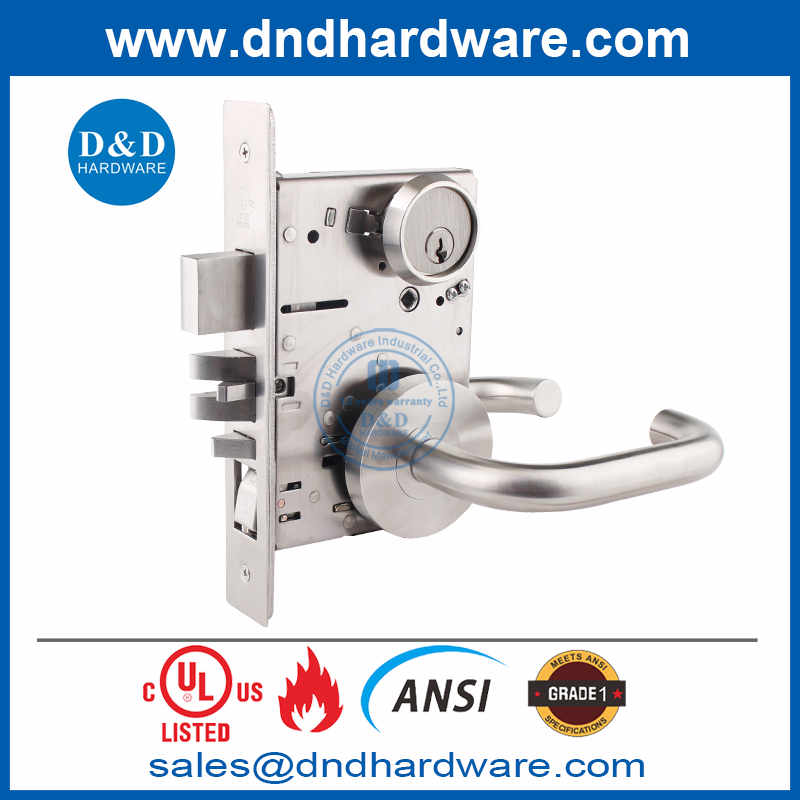 | Door locks | UL 10C, File R40901; 3-hour fire rating |
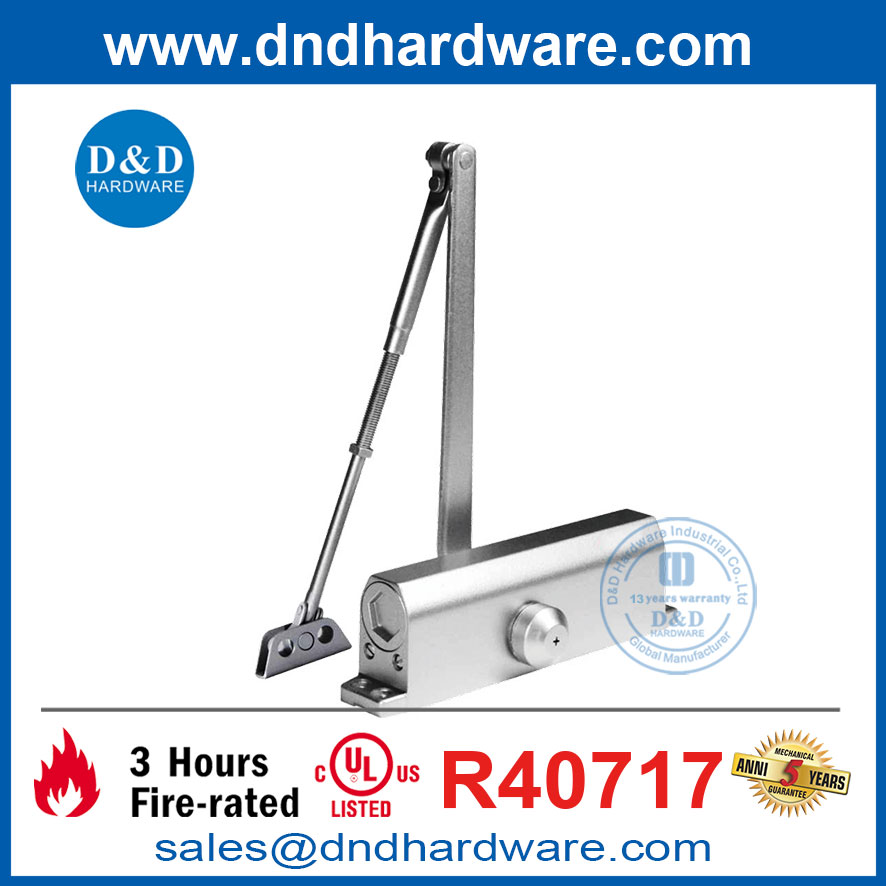 | Door closers | UL 10C, File R40717; 3-hour fire rating |
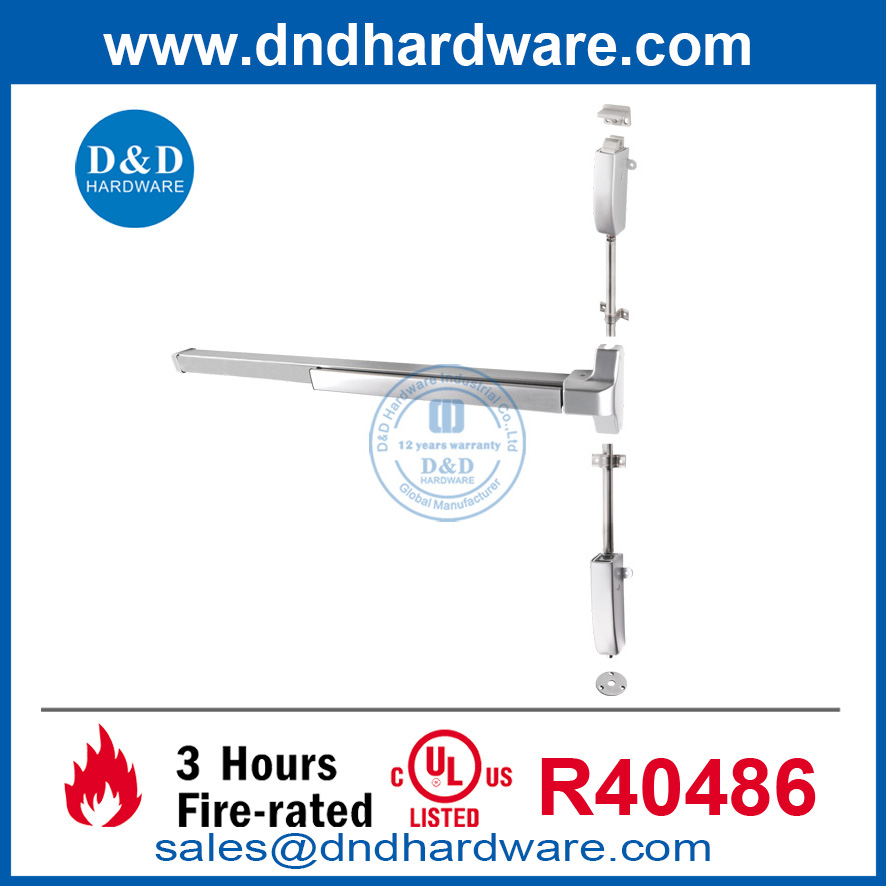 | Fire exit hardware | UL 10C, File R40486; 3-hour fire rating |
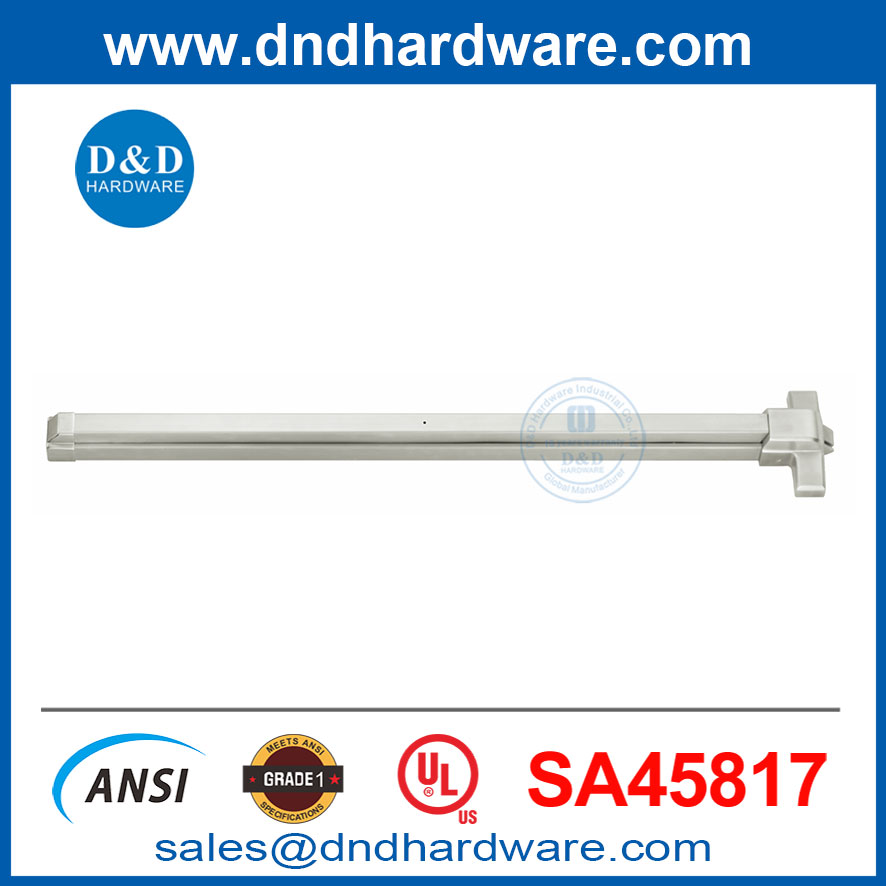 | Panic hardware | UL 305, File SA45817 |
These are product-level certification references, not blanket approval for every opening in an office building. The exact model, listing scope, installation conditions, and project requirements still need to be checked.
For concealed hinges, verify the specific certification record and permitted application without assuming a fire-duration rating that has not been established for the product.

7. Installation, Inspection, and Documentation
A correctly certified product can still contribute to a compliance deficiency if it is installed incorrectly, damaged, or used outside its approved scope.
NFPA 80 addresses the installation, inspection, testing, and maintenance of applicable fire doors and other opening protectives. The specific inspection obligations depend on the adopted requirements and the building's circumstances.
For office building fire doors, inspections may identify:
*Hinges with loose or missing fasteners.
*Closers that cannot close the door reliably.
*Latches that fail to engage.
*Incorrect replacement hardware.
*Damaged or missing components.
*Unauthorized field modifications.
*Incomplete or unverifiable product identification.
Project documentation should include the approved hardware schedule, product data, certification information, installation instructions, and relevant inspection or maintenance records.
If hardware is replaced during building operation, the replacement should be verified against the same application requirements. A generic description such as “commercial grade” or “fire rated” does not establish compliance.
FAQ: Commercial Fire Door Hardware Requirements for Office Buildings
Is UL-listed hardware required on every office door?
No. Requirements depend on whether the opening is required to be fire-rated or serves another regulated function. The hardware must meet the applicable requirements for that particular opening.
What is the role of UL 10C in commercial fire door compliance?
UL 10C establishes positive-pressure fire-test methods for applicable swinging door assemblies. It is relevant to assembly certification and to certain fire exit hardware categories, but it does not replace verification of each product's certification scope.
What is the difference between UL 305 panic hardware and fire exit hardware?
UL 305 covers panic hardware. Fire exit hardware used on applicable fire-rated doors requires additional fire-door evaluation, including UL 10C where required. The correct category depends on the opening and applicable code.
Can any UL-listed lock be installed on a fire-rated office door?
No. The lock's certification scope, model, installation conditions, and compatibility with the door assembly must be verified.
How can a contractor verify UL-listed door hardware?
Use UL Product iQ to check the exact manufacturer and model, applicable product category, standard, and conditions of use. Compare the record with the approved hardware schedule and installed product.
Does UL-listed hardware guarantee that the entire door assembly is compliant?
No. Hardware certification is one part of the compliance process. The complete assembly, installation, operation, and applicable code requirements must also be satisfied.
Contact us Now:
Contact: David Jian
Mob:0086-139 2903 7292
Email: David@dndhardware.com, sales@dndhardware.com,
Contact: Jobby Zhang
Mob:0086-137 2599 9617
Email: jobby@dndhardware.com
D&D HARDWARE INDUSTRIAL CO.,LTD
ADD:12th Floor, Building 2, No.898, KeChuang Technical Zone, Jiangmen Avenue, Pengjiang District, Jiangmen City, Guangdong, China (Postcode:529000)
https://www.dndhardware.com
Tel: +86-750-3856396
Fax: +86-750-3856395
 English