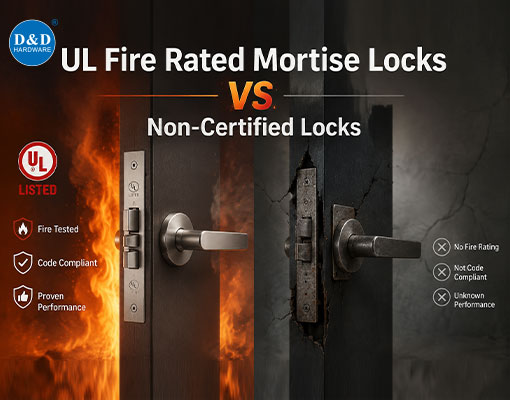
Fire-rated doors are designed to slow the spread of fire and smoke, helping protect building occupants and property during emergencies. However, the performance of a fire-rated door depends not only on the door itself but also on every component installed within the assembly. Among these components, the lock plays a critical role.
When selecting a lock for a fire-rated opening, one of the most important questions is whether to use a UL Listed Mortise Lock or a non-certified alternative. While both products may appear similar externally, the differences in testing, compliance, and fire performance can be significant.
As a Fire Door Hardware Manufacturer, D&D Hardware understands the importance of certified fire door hardware and the role it plays in maintaining fire door integrity. This article explains the differences between a UL Fire Rated Mortise Lock and a non-certified lock, helping clarify why certification matters for fire door applications.

What Is a UL Listed Mortise Lock?
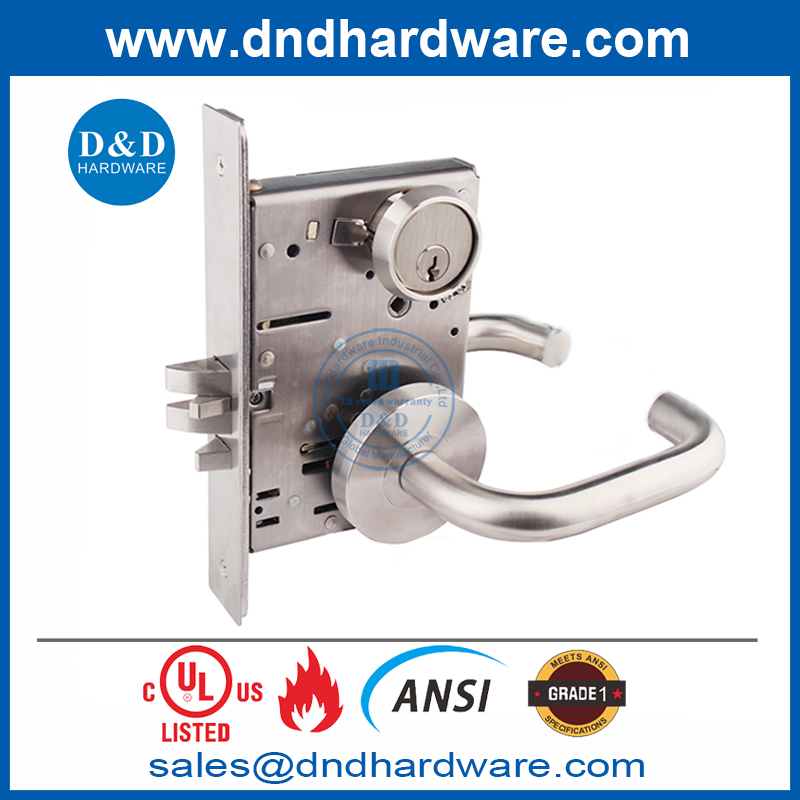
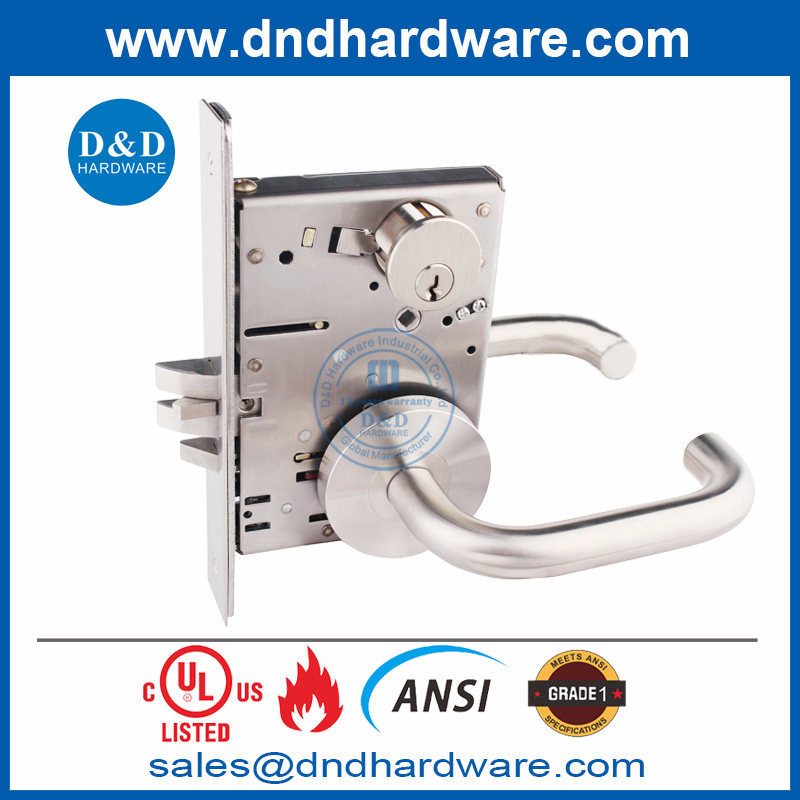
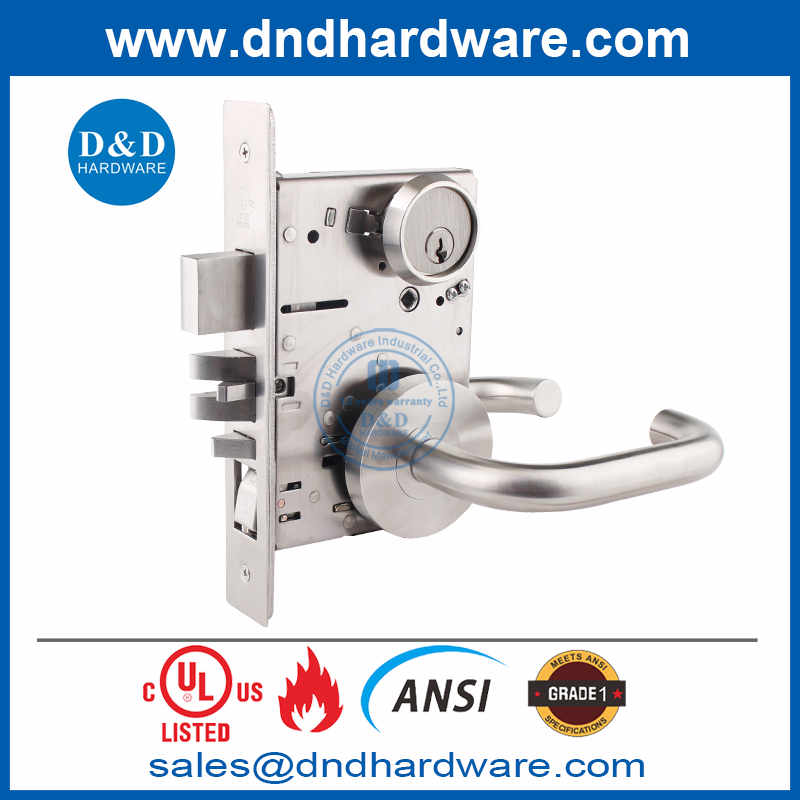
A UL Listed Mortise Lock is a lock that has been independently tested and certified by Underwriters Laboratories (UL) for use in fire-rated door assemblies.
Unlike standard locks, a UL-listed lock must meet specific fire performance requirements and be evaluated according to recognized testing standards. Certification confirms that the lock is suitable for use on fire-rated openings and can support the performance of the door assembly during a fire event.
For fire door applications, certification provides documented evidence that the lock has been assessed for compliance rather than simply relying on manufacturer claims.
Why Does Fire Door Compliance Matter?
Fire-rated doors are intended to remain closed during a fire and help prevent flames and smoke from spreading from one area of a building to another.
The lock is responsible for maintaining secure latching of the door. If the locking mechanism fails during a fire, the door may not remain closed, reducing the effectiveness of the entire assembly.
This is why Fire Door Compliance is a critical requirement in modern building design.
A compliant fire-rated opening typically requires:
·Fire-rated door leaf
·Fire-rated frame
· Certified hinges
· Certified door closer
· Certified locking hardware
· Compatible accessories
A non-certified lock may compromise the performance of the entire fire door system.
How Are UL Fire Rated Mortise Locks Tested?
One of the biggest differences between certified and non-certified hardware is the testing process.
A UL Fire Rated Mortise Lock must undergo independent evaluation under recognized fire testing standards.
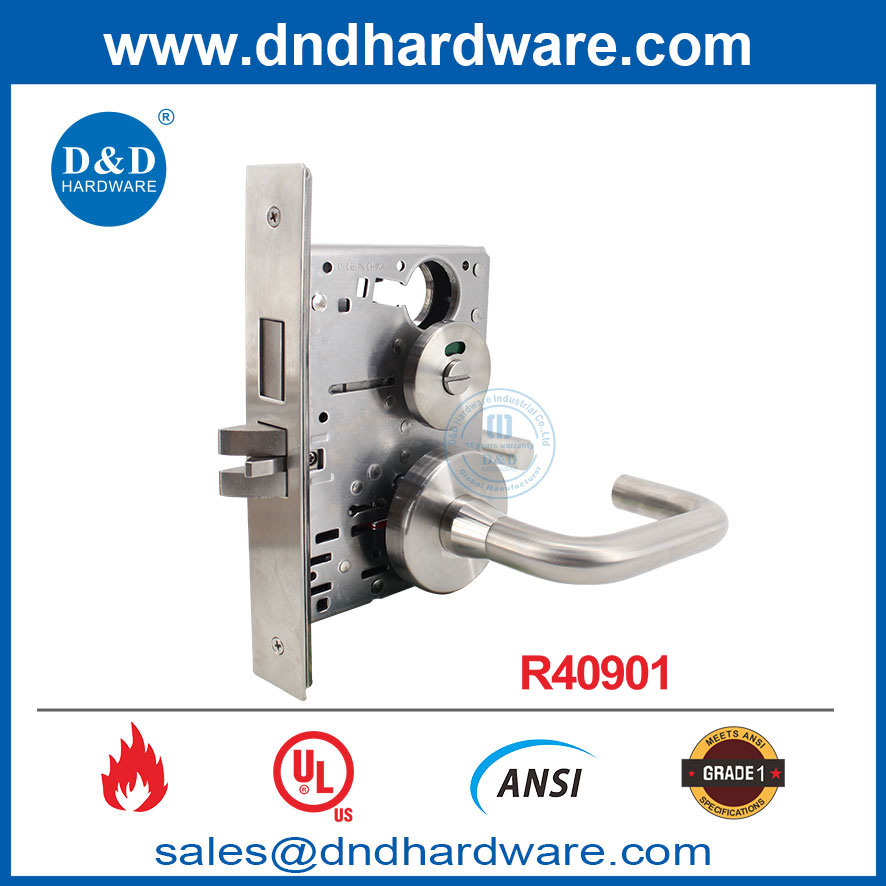
For example, D&D Hardware’s UL fire-rated mortise lock is certified under:
UL 10C Fire Rated 3 Hours
UL File No. R40901
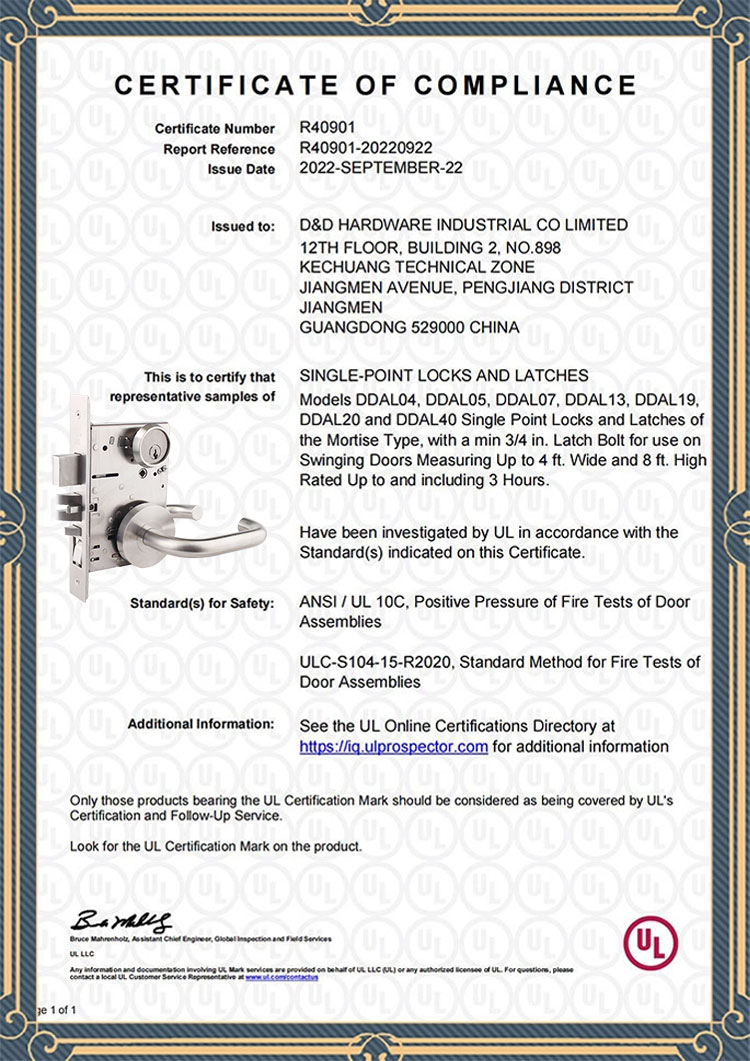
UL 10C evaluates fire door assemblies under positive pressure fire conditions. The testing process assesses whether the lock can continue supporting the fire door’s ability to remain closed and maintain compartmentation during fire exposure.
Testing verifies:
·Structural integrity
·Latching performance
·Compatibility with fire-rated assemblies
·Reliability under fire conditions
A lock that successfully passes UL testing receives a listing and file number that can be verified through official certification channels.
How Are Non-Certified Locks Different?
A non-certified lock may look similar to a certified lock in terms of appearance, dimensions, or operation. However, there is a key difference:
There is no independent verification of fire performance.
Without certification:
·Fire resistance is unknown
·Compliance documentation may not exist
·Performance during fire conditions cannot be verified
· Approval by inspectors may be more difficult
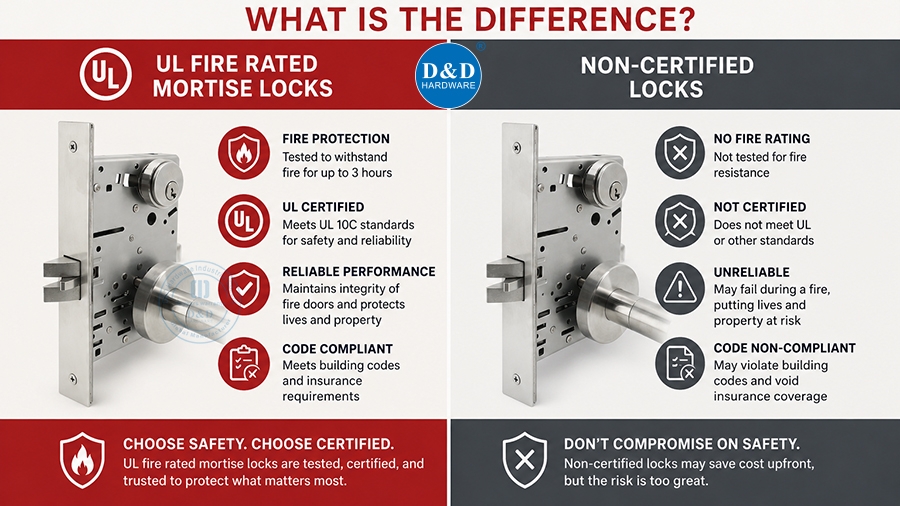
A non-certified lock may perform adequately during normal daily use but still fail when exposed to extreme temperatures during a fire.
This is the primary distinction between Certified vs Non-Certified Hardware.
Why Is Certification More Than Just a Label?
Some people assume that certification is simply a mark applied to a product. In reality, certification represents a comprehensive process that includes testing, documentation, and ongoing manufacturing oversight.
A certified Fire Rated Door Lock typically involves:
•Product design evaluation
•Fire testing
•Compliance review
•Factory inspection
•Ongoing quality monitoring
For manufacturers, maintaining certification requires consistent production standards and traceability.
As a UL Fire Rated Door Hardware Manufacturer, D&D Hardware maintains certification requirements to ensure that products continue meeting the standards under which they were originally approved.

What Risks Can Arise from Using Non-Certified Locks?
The use of non-certified hardware in fire-rated door applications can create several potential risks.
Compliance Risk
Building codes and fire safety regulations often require certified hardware for fire-rated openings.
Inspection Risk
Authorities may request evidence of certification during inspections.
Performance Risk
The lock may not function as expected under fire conditions.
Liability Risk
Failure of uncertified hardware during a fire incident can lead to significant legal and safety concerns.
Because of these factors, many fire door specifications prioritize certified products that have undergone recognized testing procedures.
How Does a UL Listed Mortise Lock Support Fire Door Performance?
The primary purpose of a Fire Rated Door Lock is to help ensure that the door remains properly secured during a fire.
A certified lock supports:
•Door latching integrity
•Fire compartmentation
•Smoke control
•Overall fire door performance
In a fire-rated assembly, each component contributes to the performance of the complete system. A UL Listed Mortise Lock helps ensure that the locking point does not become a weak link in that system.
Why Do Fire Door Hardware Manufacturers Invest in Certification?
Certification requires significant investment in testing, engineering, and quality control.
A professional Fire Door Hardware Manufacturer pursues certification because it provides:
•Verified product performance
•Independent validation
•Regulatory acceptance
•Technical credibility
At D&D Hardware, certification is viewed as a fundamental part of product development rather than a marketing feature.
With more than 18 years of manufacturing experience in architectural door hardware, D&D Hardware continues to focus on certified solutions that support fire-rated door applications.
How Can a UL File Number Help Verify Certification?
One important advantage of certified hardware is traceability.
For example, D&D Hardware’s UL Fire Rated Mortise Lock carries:
UL 10C Fire Rated 3 Hours
UL File No. R40901
A UL file number allows project stakeholders to verify certification status and confirm that the product has been independently evaluated according to applicable standards.
This level of transparency is typically unavailable for non-certified products.
What Should Be Considered When Comparing Certified vs Non-Certified Hardware?
When comparing a certified and non-certified lock, the decision should extend beyond appearance and basic functionality.
Key considerations include:
•Fire testing documentation
•Certification status
•Compliance requirements
•Traceability
•Quality control systems
•Long-term reliability
A certified lock provides documented evidence of performance, while a non-certified lock may rely solely on manufacturer declarations.
Conclusion
The difference between a UL Fire Rated Mortise Lock and a non-certified lock goes far beyond labeling. Certification provides independent verification that the lock has been tested and approved for use in fire-rated door assemblies.
A UL Listed Mortise Lock supports Fire Door Compliance, helps maintain the integrity of fire-rated openings, and provides traceable evidence of performance under recognized standards.
As a dedicated Fire Door Hardware Manufacturer, D&D Hardware continues to invest in certified fire-rated solutions, including mortise locks tested to UL 10C Fire Rated 3 Hours and listed under UL File No. R40901. These certifications reflect a commitment to product performance, safety, and compliance in fire door applications.
FAQ
What is a UL Listed Mortise Lock?
A UL Listed Mortise Lock is a mortise lock that has been independently tested and certified by UL for use in fire-rated door assemblies.
Why is a Fire Rated Door Lock important?
A Fire Rated Door Lock helps maintain door latching during a fire, supporting the performance of the complete fire door system.
What is the difference between certified and non-certified hardware?
Certified hardware has undergone independent testing and verification, while non-certified hardware may not have documented fire performance data.
What does UL 10C Fire Rated 3 Hours mean?
It means the product has been evaluated according to UL 10C fire testing requirements and is approved for use in fire-rated assemblies with a fire rating of up to three hours.
How can certification be verified?
Certification can be verified through the UL file number. D&D Hardware’s UL fire-rated mortise lock is listed under UL File No. R40901.
Why do fire door systems require certified hardware?
Certified hardware helps ensure compliance, performance, and reliability within a fire-rated door assembly, supporting overall fire door safety.
Contact us Now:
Contact: David Jian
Mob:0086-139 2903 7292
Email: David@dndhardware.com, sales@dndhardware.com,
Contact: Jobby Zhang
Mob:0086-137 2599 9617
Email: jobby@dndhardware.com
D&D HARDWARE INDUSTRIAL CO.,LTD
ADD:12th Floor, Building 2, No.898, KeChuang Technical Zone, Jiangmen Avenue, Pengjiang District, Jiangmen City, Guangdong, China (Postcode:529000)
https://www.dndhardware.com
Tel: +86-750-3856396
Fax: +86-750-3856395
 English