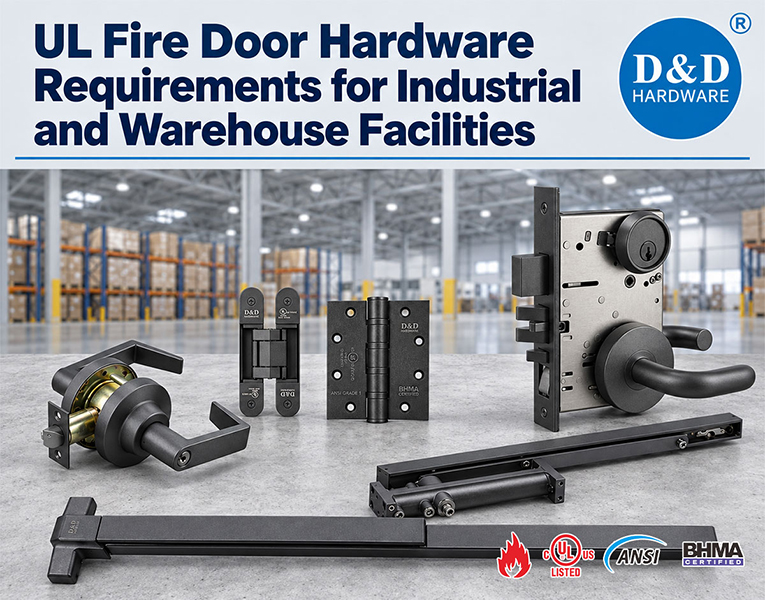
A warehouse fire door may look secure while failing its intended function. A bent strike, an added deadbolt or a closer disconnected for forklift traffic can prevent a rated opening from closing, latching or allowing safe escape.
For industrial facilities, specifying UL Listed Fire Rated Commercial Door Hardware involves more than selecting products with a certification mark. Compliance depends on the opening’s required rating, the exact hardware listing, installation conditions and continued operation.
This guide addresses swinging personnel fire doors in factories, warehouses and distribution centers under U.S. code frameworks. Rolling fire doors and large industrial opening protectives require separate evaluation.

1 Establish the Occupancy and Opening Requirements
“Industrial” is a building description, not a complete code classification. Manufacturing operations may fall within Factory Group F, while warehouses commonly fall within Storage Group S. Hazardous materials can introduce Group H requirements, depending on their type, quantity and use. Different areas within one facility may require different classifications.
Before approving a hardware schedule, establish:
· The adopted building and fire code editions, including local amendments.
· The occupancy classification and use of the area served.
· The required fire protection rating for each opening.
· Applicable egress, accessibility and smoke protection requirements.
A personnel exit leading outdoors is not automatically a fire-rated opening. Conversely, an internal door separating a production area from another compartment may require fire protection even when it is not the building’s main exit.
The approved plans and door schedule should establish these requirements before hardware is selected.
2 Understand What UL 10C Certification Covers
UL 10C addresses positive-pressure fire testing of door assemblies. UL’s application guide explains that a fire door assembly can comprise separately supplied doors, frames, hardware and accessories assembled at the job site. Their suitability must be assessed together.
A lock listed for use on certain three-hour fire doors does not give an otherwise unqualified opening a three-hour rating. Its listing also does not authorize every door material, preparation or installation arrangement.
For industrial fire door hardware, verify the exact model, permitted application and installation instructions. Avoid approving a product solely because its brochure states “fire tested.”
The practical question is whether the supplied hardware is certified for the proposed opening and installed within that certification’s conditions.
3 Determine Whether Fire Exit Hardware Is Required
Warehouse fire door requirements do not impose panic hardware on every door simply because the building stores goods.
Under the 2024 IBC, swinging doors serving Group H occupancies have specific panic or fire exit hardware requirements. Other triggers include certain assembly and educational spaces and qualifying electrical equipment rooms. The adopted edition and local amendments must govern the actual project.
Where an exit device is specified on a fire-rated door, distinguish between these certifications:
Hardware designation | Certification distinction |
Panic hardware | Listed to UL 305 for emergency release |
Fire exit hardware | Listed to UL 305 and UL 10C for emergency release and fire door use |
A UL 305 listing alone does not establish suitability for a fire-rated opening. UL explicitly distinguishes panic hardware from fire exit hardware in its application guidance.
For a warehouse containing hazardous storage rooms or electrical service areas, review each opening individually. Applying one generic exit-device specification throughout the building can overlook important differences.

4 Preserve Closing and Positive Latching
Daily operations create predictable compliance problems. Workers may wedge doors open during deliveries, disconnect closer arms or alter strikes after impact damage.
NFPA’s fire door inspection checklist checks that the door closes completely, the latch secures it in the closed position, and auxiliary hardware does not interfere with operation. These are functional acceptance criteria, not merely visual checks.
Inspect the opening under actual operating conditions. Pressure differences, damaged frames and misaligned latches may prevent reliable closure even when individual components appear serviceable.
For paired doors, confirm that the approved configuration closes and latches correctly. Where a coordinator is installed, NFPA’s checklist calls for the inactive leaf to close before the active leaf. Added bolts or replacement strikes should not be accepted without checking compatibility and egress requirements.
5 Verify Certification Before Installation
A supplier’s certificate should be traceable to the delivered product. A file number associated with the manufacturer is a starting point; the review must also establish whether the exact model and configuration fall within its scope.
Use the certification record, product markings and installation instructions to resolve questions such as:
·Is the supplied model covered?
·Does the certification support the required application?
·Are the door type, dimensions and hardware arrangement permitted?
·Do the supplied fasteners and preparations match the instructions?
Record the approved model against its door number. This makes substitutions easier to control and gives maintenance staff a reliable reference when ordering replacements.
For UL Listed Fire Rated Commercial Door Hardware, documentation should explain the permitted use clearly enough for the installer and reviewer to reach the same conclusion.

6 Control Alterations and Inspection Records
Industrial doors face repeated impact from carts, pallets and handling equipment. Repairs can introduce new problems: oversized latch openings, additional drilled holes, replacement hinges or protective plates that interfere with operation.
NFPA’s checklist includes checks for damage, secure attachment, hardware labeling and signs of field modification. A repair that restores movement should therefore also be reviewed for its effect on fire door compliance.
Maintain a register containing each opening’s identification, approved hardware, inspection findings and corrective actions. Follow the inspection and testing requirements of the adopted NFPA 80 edition and applicable fire code. Inspect impact damage promptly rather than leaving it until the next scheduled review.
Contact us Now:
Contact: David Jian
Mob:0086-139 2903 7292
Email: David@dndhardware.com, sales@dndhardware.com,
Contact: Jobby Zhang
Mob:0086-137 2599 9617
Email: jobby@dndhardware.com
D&D HARDWARE INDUSTRIAL CO.,LTD
ADD:12th Floor, Building 2, No.898, KeChuang Technical Zone, Jiangmen Avenue, Pengjiang District, Jiangmen City, Guangdong, China (Postcode:529000)
https://www.dndhardware.com
Tel: +86-750-3856396
Fax: +86-750-3856395
FAQ
Does every warehouse exit need UL fire rated hardware?
No. First determine whether the opening must be fire rated. Egress requirements also apply and must be assessed separately.
Can UL 305 panic hardware be used on a fire door?
A UL 305-only listing is insufficient. Fire exit hardware must also be listed for fire door use under UL 10C.
Does three hour hardware make the entire door assembly three hour rated?
No. Hardware certification does not upgrade the door, frame or other components. The complete opening must satisfy its required rating and applicable conditions.
Can damaged hardware be replaced with a similar looking model?
Appearance is insufficient. Verify the replacement’s certification, application, preparations and installation requirements before approving it.
What should a manufacturer provide for compliance review?
Request the exact model identification, applicable certification records, installation instructions and confirmation of suitability for the scheduled opening.
Need documentation for an industrial or warehouse fire door review? Contact D&D Hardware with your door schedule, required ratings and proposed hardware configurations to request model-specific certification information.
 English