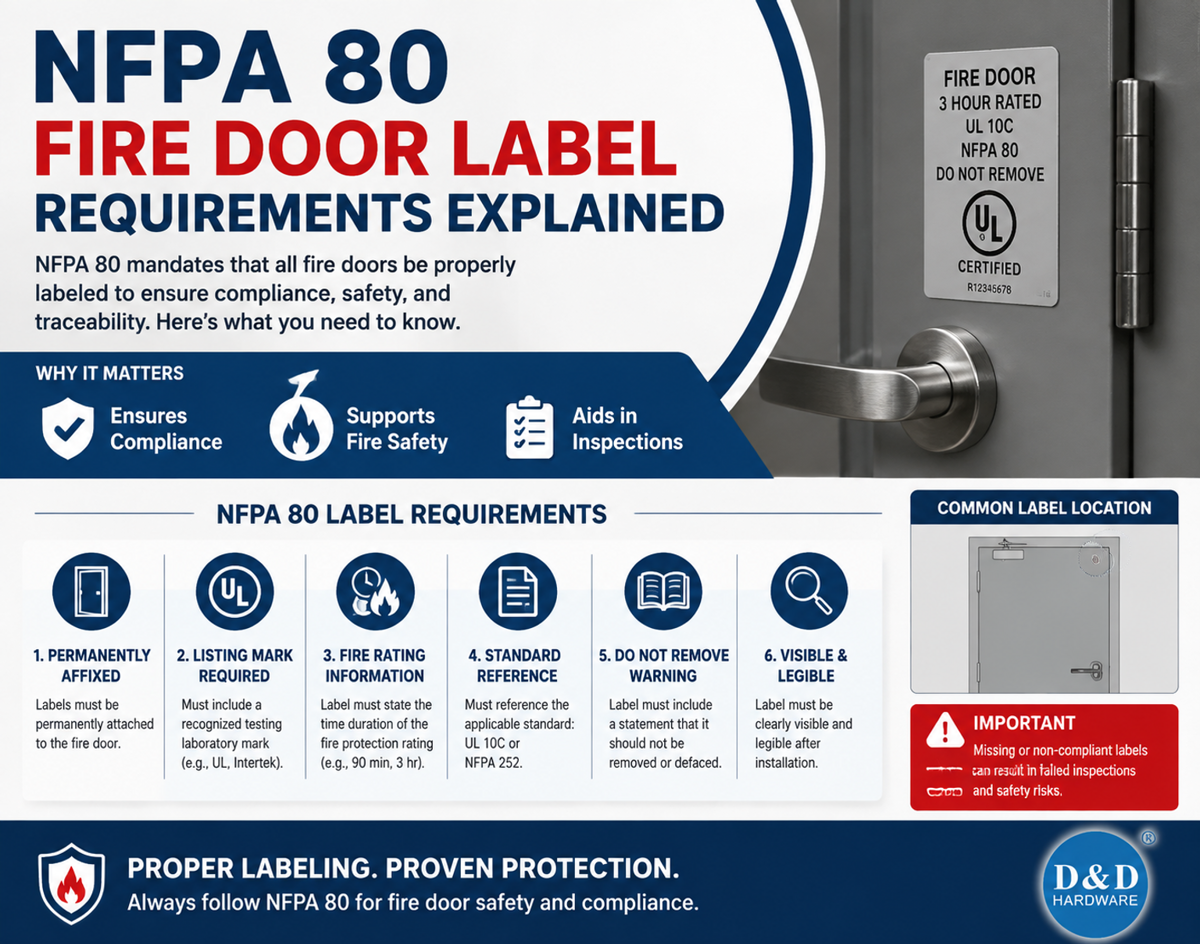
A fire door label is small, but it carries the identity of the tested and certified product. It helps inspectors connect the installed door or frame with a manufacturer, listing agency, fire-protection rating and specific performance limitations. If the label is missing, obscured or inconsistent with the opening, the visual appearance of the door is not enough to establish its rating.
NFPA 80 requires labels and listing marks to remain visible and legible during the service life of the assembly. Correct label review is therefore part of design submittals, delivery inspection, installation, annual inspection and any later repair. The task is not simply to find a metal plate; it is to confirm that every required marked component belongs in the actual opening.

What Is a Fire Door Label?
A fire door label is an identification mark applied under a certification or listing program. It indicates that the labeled product was manufactured under the procedures of the labeling organization and evaluated for the stated use. Depending on the product and certification body, the mark may be an applied metal label, an adhesive label, an embossed mark, an etched marking or another authorized format.
The label does not certify the entire installed opening by itself. A labeled leaf can be placed in the wrong frame, fitted with incompatible hardware or modified outside its listing. Compliance depends on the door, frame, glazing, hardware, seals, installation and operating condition working as a compatible assembly.
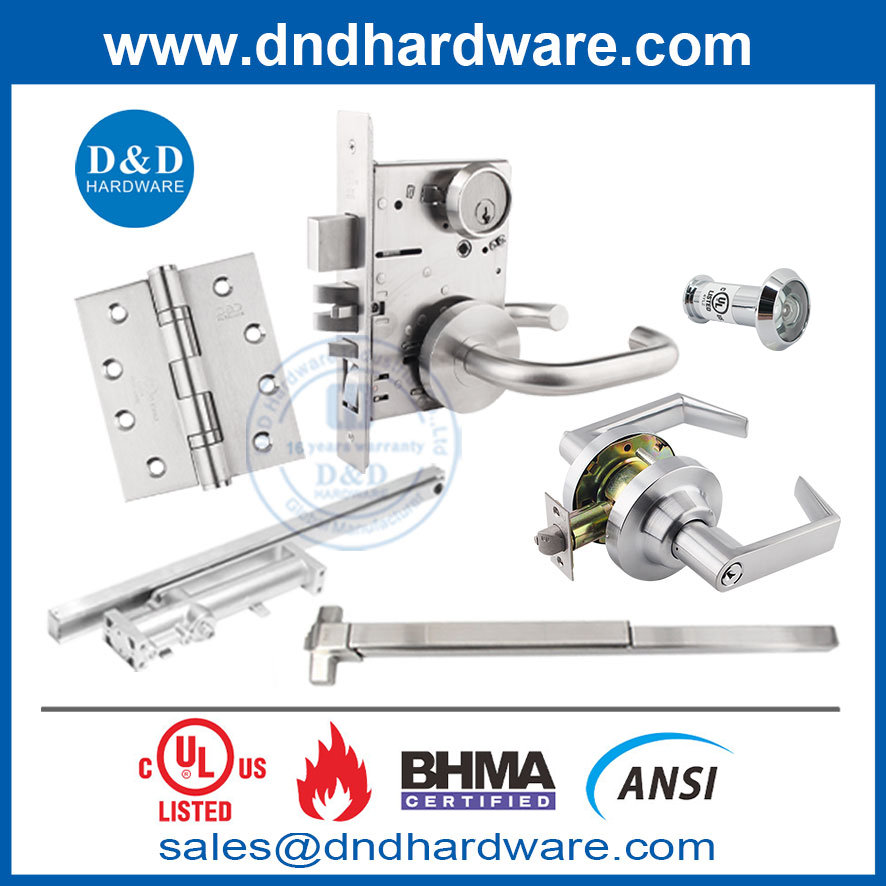
D&D's UL Door Hardware range provides listed hardware categories for compatible fire door projects. The product mark and exact model should be checked together with the opening schedule; a general certificate or webpage is supporting documentation, not a replacement for the required marking on the supplied product.
Which Parts of a Fire Door Assembly Are Labeled?
The required markings depend on the assembly and product category, but a typical swinging fire door opening can include several separately identified components.
· Door leaf: usually carries the primary fire door certification mark and rating information.
· Door frame: carries its own label or embossment, normally located where it can be examined after installation.
· Glazing and vision-light components: glass and glazing frames may carry separate markings showing their evaluated use and rating.
· Fire exit hardware, locks, latches, closers and certain other hardware: may require labels or certification markings appropriate to their product category.
· Louvers, protection systems, seals and accessories: may require separate markings when their function or listing is necessary for the rated opening.
Do not assume that identical finishes mean the components share a listing. Each mark should be traced to its own manufacturer and certification record, then coordinated with the complete opening.
Information Commonly Found on Fire Door Labels
Label formats vary, and not every mark contains the same fields. Recent NFPA 80 editions and certification programs can require or provide information such as:
· Manufacturer or product-identification information.
· Name or mark of the listing or certification agency.
· Fire-protection rating, often expressed in minutes or hours.
· The fire-test standard or standards applicable to the product.
· Temperature-rise classification where the door was evaluated for that performance.
· Smoke and draft designation, commonly the letter S, when applicable.
· Minimum latch throw or other construction or use limitations for certain products.
· A serial, issue, control or traceability number used by the manufacturer or certification body.
Absence of one item is not automatic proof that a genuine older label is invalid. Label content has changed across editions and certification programs. Inspectors should avoid judging an existing opening only against the newest label layout without considering its manufacturing date, listing and adopted code.

Understanding the Fire-Protection Rating
The rating on the door identifies the duration for which the product was evaluated for fire-protection performance under the applicable test. Common door ratings include 20, 45, 60 and 90 minutes, with longer ratings used in certain openings. The required rating comes from the building or life safety code based on the wall, barrier, shaft, corridor or other protected construction.
Door and frame markings must support the required opening, but the displayed values do not always look identical. Some frame labels or embossments are governed by listing conventions that differ from door-leaf labels. The design professional and inspector should verify the permitted relationship through the certification information rather than assuming a mismatch from typography alone.
A higher number on one component does not upgrade the opening. The installed assembly is limited by the required design, the compatible listed components and the conditions of use.
Temperature-Rise Labels
A temperature-rise rating addresses heat transmission through the door during the first 30 minutes of fire exposure. UL explains that common classifications limit the temperature rise on the unexposed face to 250°F, 450°F or 650°F. Building and life safety codes may require a particular temperature-rise door at selected locations, such as certain enclosed exit stairways.
Temperature rise is not the same as the fire-protection time. A 90-minute door may also carry a 250°F temperature-rise classification, but these values describe different aspects of performance. Where the mark does not state a temperature-rise value, it should not be assumed to meet a project requirement for one.
What Does the S Label Mean?
The letter S is associated with smoke and draft control. It indicates that the door assembly is intended to meet the applicable air-leakage criteria when installed with the required listed gasketing and related components. The S mark does not mean that the bare door leaf alone controls smoke under every field condition.
Project teams must confirm the required perimeter seals, meeting-stile treatment, door bottom or threshold condition, and installation instructions. A fire-rating label without an S designation should not be treated as smoke evidence, and an S designation does not replace the need to verify the complete smoke-control assembly.
Where Should Labels Be Located?
Labels must be accessible for inspection without destructive work. On swinging doors, the door label is commonly found on the hinge edge or top of the leaf, depending on the product and manufacturer. Hollow-metal frame labels are commonly placed on the hinge jamb, often between the top and middle hinge; some frames use an embossment in the rabbet.
Hardware marks can appear on the device body, cover, arm, latch case, mounting plate or another location specified by the manufacturer. Inspectors should use adequate lighting and a mirror or camera where needed, but should not dismantle a device or remove a cover unless permitted and necessary under the inspection procedure.
Labels on Fire Door Hardware
NFPA 80 distinguishes product categories and does not treat every piece of commercial hardware identically. Where a labeled or listed product is required, the mark must correspond with the actual category and intended use.
For hanging and closing functions, D&D UL-listed fire door hinges under File R38013 and UL door closers under File R40717 provide listed options for compatible fire door assemblies. Procurement documents should identify exact models so receiving teams can compare the product marking with the approved submittal.
For latching, D&D UL mortise locks under File R40901 include UL 10C three-hour options. The label or mark must relate to the supplied lock model and function; a certificate for the broader family should not be used to justify an unverified model.
Exit devices require particular attention. Hardware identified only as panic hardware is not automatically fire exit hardware. D&D maintains UL 305 panic hardware under File SA45817 and UL 10C fire exit hardware under File R40486 as separate certifications. On a rated exit door, verify the fire exit hardware marking and listing rather than relying on visual similarity.
Labels Must Remain Visible and Legible
NFPA guidance states that labels should not be removed, defaced or made illegible while the door is in service. Damage can result from painting, aggressive cleaning, sanding, corrosion, impact, adhesive removal or repeated replacement of hardware near the mark.
Before refinishing a door or frame, identify the label type. Industry guidance distinguishes embossed markings from applied metal or Mylar labels. An embossment may be permitted to receive paint because the information remains readable, while applied labels should not be painted over. Specifications and manufacturer instructions can impose additional restrictions, so masking the label before painting is the safer routine practice.
· Do not scrape or sand a label to expose hidden text without manufacturer or listing-agency direction.
· Do not relocate a genuine label from one door, frame or device to another.
· Do not reproduce a label from a photograph or print a replacement locally.
· Protect labels during cleaning, repainting, welding and nearby hardware work.
· Photograph readable labels during commissioning and retain the images with the opening record.
What If a Label Is Painted Over?
First determine whether the mark is embossed or applied. If an applied label has been painted, do not use solvents, heat or abrasive tools without authorization; these methods can destroy the mark or the door finish. Record the condition and contact the door or frame manufacturer, certification body or qualified field-labeling provider for direction.
A painted embossment may remain acceptable when all required information is legible and the applicable requirements permit paint over that label type. The final determination belongs to the AHJ based on the adopted edition and evidence available.
Missing, Damaged or Illegible Labels
A missing label creates an evidence problem. The door might have been manufactured as a rated product, but appearance, thickness or hardware preparation alone cannot prove the certification. Purchase records, shop drawings, serialized manufacturing data and previous inspection photographs can help identify the product, but they do not authorize an installer to apply a new label.
Possible resolution paths include manufacturer review, replacement, or a field evaluation and labeling process performed through an authorized listing agency. Intertek describes field labeling as an inspection of the installed product against certification and listing information, with a label applied only when the product is found eligible.
· Quarantine loose or detached labels and record exactly where they were found.
· Collect opening number, manufacturer, dimensions, construction, hardware preparation and available documents.
· Do not attach a spare label or move a label from another product.
· Ask the original manufacturer or certification body whether traceability can be established.
· Where appropriate, arrange a recognized field evaluation before making irreversible modifications.
· Submit the proposed resolution to the AHJ and retain the final report with the inspection record.
Field Labeling Is Not a Paperwork Shortcut
Field labeling is a controlled conformity assessment, not a service that automatically approves any existing door. The evaluator may need to review construction, materials, dimensions, glazing, edge details, preparations, hardware, installation and available manufacturing records. The product may require approved corrections or may be found ineligible.
The labeling organization must be authorized for the relevant product and program. A contractor, distributor or facility employee cannot create a valid fire label merely because the product appears similar to a listed model.
Label Checks During Procurement and Installation
The lowest-cost time to resolve label problems is before installation. Submittals and purchase orders should identify the exact rated opening, test basis, required rating, temperature-rise or smoke designation, and model-level hardware certifications.
· Compare door, frame and hardware model numbers with approved submittals before shipment.
· Confirm required labels and marks are present, readable and appropriate to the specified rating.
· Photograph labels before doors are hung or hardware covers make access more difficult.
· Protect labels during storage, finishing, installation and cleaning.
· Verify the installed opening number matches the door and frame intended for that location.
· Record substitutions and obtain approval before installation rather than after inspection.
D&D can provide model-level certification information for relevant listed hinges, closers, locks and fire exit hardware when the project schedule and exact product requirements are supplied. This supports receiving inspection and reduces the risk of mixing products that share a general appearance but have different certification coverage.
Annual Inspection and Recordkeeping
NFPA 80 requires inspection and testing after installation and at least annually thereafter. Label visibility and legibility are among the basic inspection items, but the inspection also evaluates physical condition, clearances, hardware, closing, sequencing and latching. A readable label does not compensate for a nonfunctional opening.
A useful record includes the opening identifier, location, door and frame label photographs, visible ratings and markings, hardware model information, observed deficiencies, corrective actions and date of retest. This history is especially valuable when a label later becomes damaged or when a component must be replaced.
Common Fire Door Label Mistakes
· Assuming a label on the leaf proves the entire opening is compliant.
· Treating a catalog certificate as a substitute for the mark on the exact supplied product.
· Matching only the fire rating while ignoring temperature-rise, smoke or use limitations.
· Painting over an applied metal or Mylar label during refinishing.
· Moving a label from a damaged door to a replacement leaf.
· Confusing panic hardware with labeled fire exit hardware.
· Accepting a field-applied label without confirming the authorized listing organization and evaluation record.
· Photographing labels but failing to verify closing, latching and the rest of the assembly.

Frequently Asked Questions
Can a fire door label be painted over?
Applied labels generally should not be painted. An embossed mark may be permitted to receive paint if it remains legible and the specification does not prohibit it. Confirm the label type, manufacturer guidance and AHJ interpretation before refinishing.
Does every fire door label show an hourly rating?
Label content and conventions vary by product, certification program and age. Do not assume an older or frame label is invalid because it differs from a current door label. Verify it through the applicable listing information.
What does S mean on a fire door label?
S identifies a smoke and draft control application and normally depends on the door being installed with the required listed gasketing and related components. It does not describe the bare leaf alone.
Can a missing label be replaced?
Potentially, but only through an authorized process supported by product identification and evaluation. An installer or owner cannot print or transfer a replacement label independently.
Is a UL certificate enough if the hardware has no mark?
Not automatically. Verify whether the category requires a product marking, whether the exact model is included in the current certification, and whether the supplied item bears the required identification. Refer uncertainty to the manufacturer, certification body and AHJ.
Conclusion
Fire door labels provide traceability, not automatic approval. Effective label review connects the installed door, frame and hardware to their certification records, checks the specific performance needed by the opening and preserves the marks throughout installation and maintenance.
When a label is damaged or missing, protect the evidence, avoid improvised replacement and use an authorized manufacturer, listing-agency or field-evaluation route. The final opening must combine valid identification with correct components, installation, clearances, self-closing operation and positive latching.
Application note: Code requirements vary by jurisdiction and adopted edition. Confirm the applicable NFPA 80 edition, building and life safety codes, local amendments, product listings, manufacturer instructions and project conditions with the authority having jurisdiction (AHJ).
Contact us Now:
Contact: David Jian
Mob:0086-139 2903 7292
Email: David@dndhardware.com, sales@dndhardware.com,
Contact: Jobby Zhang
Mob:0086-137 2599 9617
Email: jobby@dndhardware.com
D&D HARDWARE INDUSTRIAL CO.,LTD
ADD:12th Floor, Building 2, No.898, KeChuang Technical Zone, Jiangmen Avenue, Pengjiang District, Jiangmen City, Guangdong, China (Postcode:529000)
https://www.dndhardware.com
Tel: +86-750-3856396
Fax: +86-750-3856395
 English