You want to choose the right door closer fast. With the latest chart, you match your door’s size in seconds. D&D Hardware brings you certified door control solutions that fit your needs. Use the most accurate door closer size and measurement guide so you never guess or risk the wrong fit. Trust expert charts for easy, smart choices every time.
Key Takeaways
Use the door closer size chart to find the right fit fast. Match your door’s width and weight for smooth use.
Measure your door carefully before picking a closer. Check both width and weight so you do not make mistakes.
Think about how often people use the door. Busy places need stronger door closers.
Always look at building codes for door closers. Make sure your choice is safe and easy to use.
Double-check your measurements to avoid mistakes. Leave space for shims when you install the closer.
Pick the best mounting style for your door. Some styles work better for certain doors and places.
For glass or special doors, choose closers that close gently. This helps stop damage to the door.
D&D Hardware has certified door closers for every need. Their team can help you pick the right one.

Door Closer Size Chart: Quick Reference
Main Chart Overview
You want to find the right door closer size quickly. The latest door closer size chart makes this easy. You can match your door’s width and weight to the correct closer size in seconds. This chart helps you avoid mistakes and ensures your door works smoothly.
Here is the most up-to-date door closer size chart for 2026:
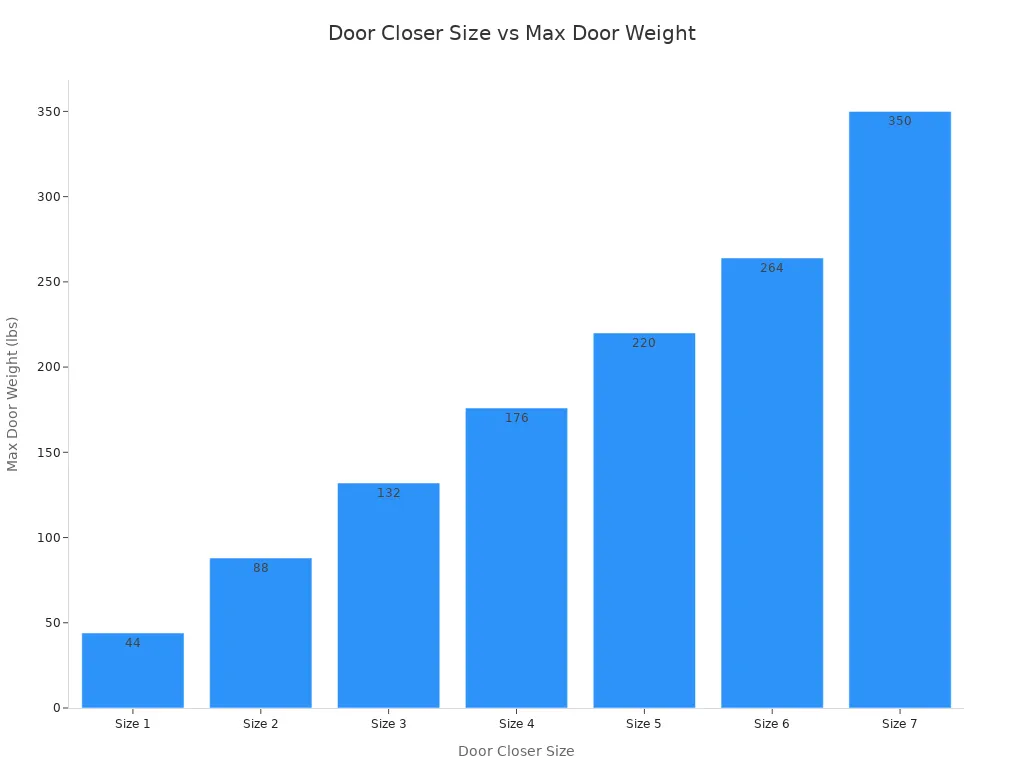
Size | Max Door Width (Interior) | Max Door Width (Exterior) | Max Door Weight (lbs/kg) | Typical Applications |
1 | up to 30" | up to 26" | ~44 lbs / 20 kg | Light interior doors, closets |
2 | up to 34" | up to 30" | ~88 lbs / 40 kg | Small offices, light residential |
3 | up to 40" | up to 34" | ~132 lbs / 60 kg | Standard interior office/classroom, minimum size for fire-rated doors |
4 | up to 44" | up to 38" | ~176 lbs / 80 kg | Commercial entries, heavier interior or exterior doors |
5 | up to 50" | up to 44" | ~220 lbs / 100 kg | Large doors, high-traffic entrances, heavy commercial use |
6 | up to 56" | up to 50" | ~264 lbs / 120 kg | Extra-heavy institutional doors, wide exterior entrances |
7 | up to 60 - 63" (specialty only) | up to 56 - 58" (specialty only) | ~350 lbs / 160 kg | Specialty oversize or industrial doors (less common) |
You can also see the door closer size categories in this simple list:
Size | Description |
1 | Size 1 |
2 | Size 2 |
3 | Size 3 |
4 | Size 4 |
5 | Size 5 |
6 | Size 6 |
7 | Size 7 |
If you want a visual overview, check out this chart showing the maximum door weight each size can handle:
D&D Hardware offers certified door closers that match every size in this chart. You can trust these products for safety and performance.
How to Use the Chart
You can use the door closer size chart in a few simple steps. This door closer size guide helps you make the right choice every time:
Measure your door’s width and weight.
Check how much traffic the door gets. Is it a busy entrance or a quiet room?
Think about special needs. Does your door need to meet fire or accessibility rules?
Look at how you will mount the closer. Some doors need special mounting styles.
Match your measurements to the right size in the chart above.
Tip: Always use the door closer size chart before you buy. This helps you avoid picking the wrong size and keeps your door working safely.
Fast Selection Tips
You can save time and avoid mistakes by following these quick tips:
Look at the type of door and where it is. Interior doors often need smaller closers than exterior doors.
Check the door’s weight. Heavier doors need a larger door closer size.
Make sure your choice meets building codes. For example, interior doors should not need more than 5 pounds of force to open. Exterior doors should not need more than 8.5 pounds.
Use adjustable closers if you want to fine-tune the spring tension.
Never use a door closer as a doorstop. This can damage the closer.
For commercial exterior doors, pick a size 4 or 5 closer. For standard office doors, size 3 is usually best.
If you have a storm or security door, you may need a pneumatic or dual closer.
D&D Hardware’s certified door closers make it easy to follow these tips. You get reliable products that fit your needs and meet all safety standards.
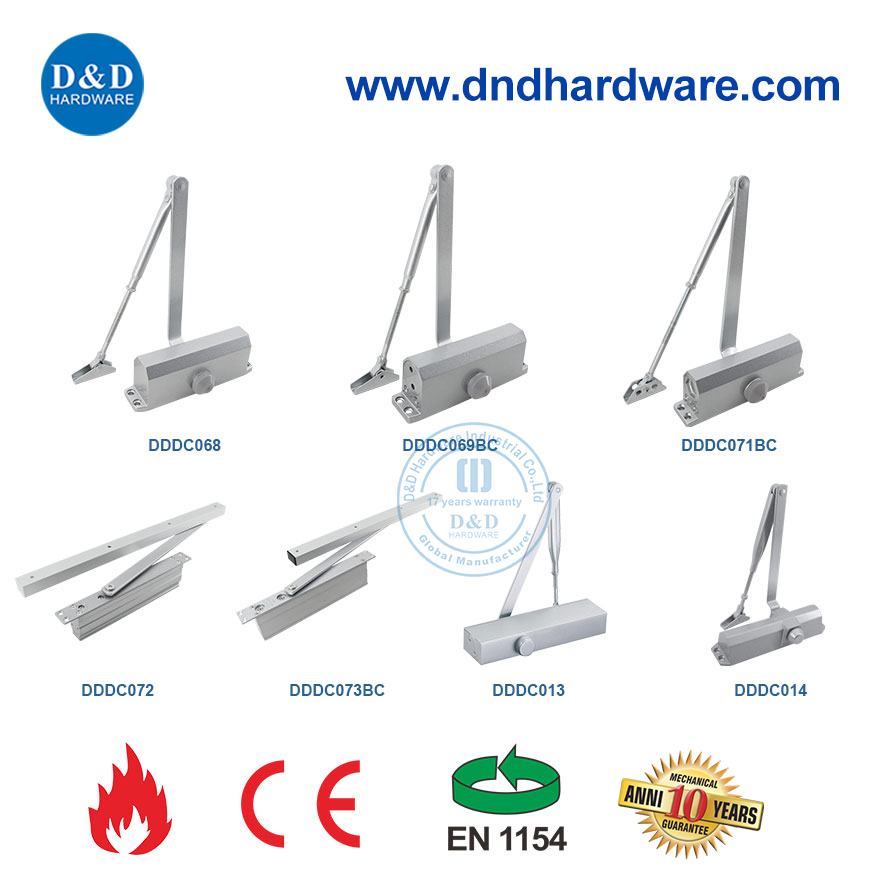
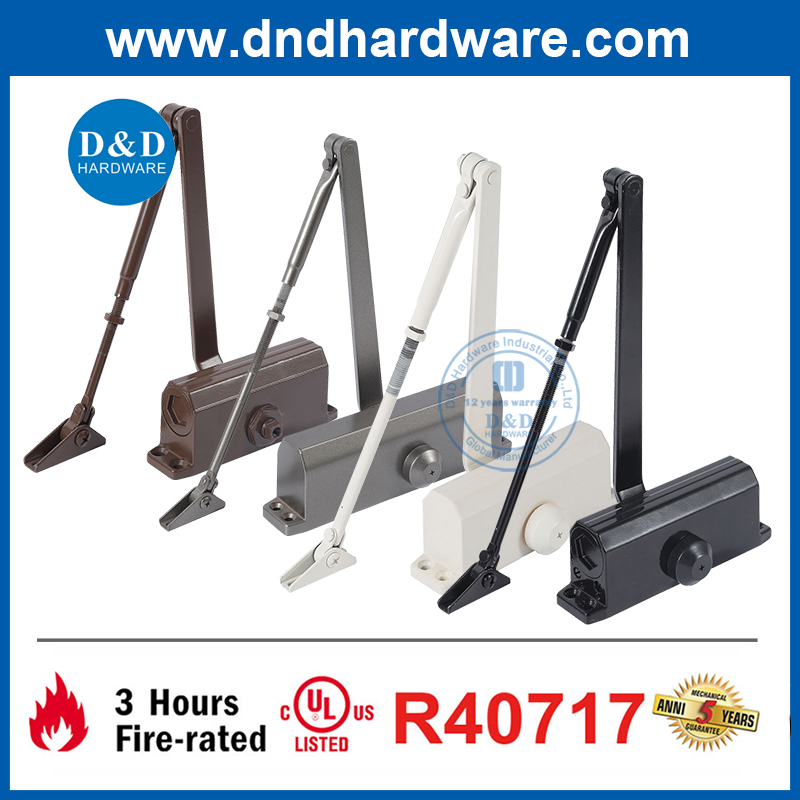
Door Closer Size and Measurement Guide: Step-by-Step
Identify Door Type
Start your door closer size and measurement guide by identifying the type of door you have. This step helps you choose the right door closer size for your needs. Different doors need different closers. You should look at where the door is, how it is used, and what it is made of.
Here is a table to help you consider the main factors:
Factor | Description |
Type and Location of Opening | What kind of door is it, and where is it installed? |
Interior or Exterior Mounting | Will the closer be inside or outside? |
Traffic Type, Volume, Frequency | How often will people use the door? |
Type of Door | Is it wood, glass, metal, or another material? |
Door Swing | Does the door open in or out? |
Size and Weight of Door | What are the measurements and weight? |
Wind or Building Pressure | Will wind or air pressure affect the door? |
You will see many types of doors in homes and businesses. Some of the most common include:
Sectional doors: These have several panels and are often used in garages.
Coiling doors: These roll up and are good for security in storefronts.
Counter doors: These secure openings in commercial spaces.
Wooden doors: These are strong and look nice, often used inside.
Glass doors: These let you see through and are common in shops.
Knowing your door type helps you pick the right door closer size and ensures the closer will work well.
Measure Door Width & Weight
Next, you need to take accurate measurements. This step is key in the door closer size and measurement guide. Use a tape measure to find the width of your door. Measure from one edge to the other at the widest point. Write down this number.
Now, check the weight of your door. If you do not know the exact weight, you can look up the average weight for your door type and size. For example, a solid wooden door is heavier than a hollow one. Glass and metal doors also have different weights.
You should measure both width and weight because both affect which door closer size you need. If you skip this step, you might pick a closer that does not work well. Always double-check your measurements before moving to the next step.
Tip: If your door is used a lot or is very heavy, you may need a larger door closer size.
Match to Chart Criteria
Once you have your measurements, use the door closer size chart. Find your door’s width and weight on the chart. Match these numbers to the right door closer size. The chart will show you which size fits your door best.
If your door’s measurements fall between two sizes, choose the larger door closer size. This gives you better control and longer life for your closer. Always check if your door has special needs, like fire safety or high traffic. Some doors need a certified closer, like the ones from D&D Hardware.
You can use the door closer size and measurement guide for every door in your building. This process helps you avoid mistakes and keeps your doors working safely. If you have questions about matching your measurements to the chart, D&D Hardware can help you find the right solution for any door type.
Avoid Common Mistakes
You want your door closer to work perfectly. Small mistakes during measurement or selection can cause big problems later. Many people run into the same issues when using a door closer size and measurement guide. You can avoid these problems by learning what to watch out for.
Here is a table showing the most common mistakes, what happens if you make them, and how you can fix them:
Mistake | Result | Fix |
Forgetting Flooring Thickness | Door drags on the floor or leaves a gap. | Always add the final flooring thickness to your rough opening height calculation. |
Measuring Only Once | One number can mislead you. | Take three width measurements and two height measurements. Use the smallest numbers. |
Ignoring Wall Depth | Jamb doesn’t fit, leading to exposed gaps. | Confirm wall thickness and adjust accordingly. |
Not Leaving Room for Shims | Crooked installation. | Leave ¼–½ inch clearance on each side for shims. |
Skipping a Double-Check | Costly mistakes if the door is ordered wrong. | Re-measure width, height, and depth twice before ordering. |
You should always measure more than once. If you only measure your door one time, you might get the wrong number. Take three measurements across the width and two for the height. Use the smallest numbers to make sure your door fits well.
Flooring thickness matters. If you forget to include the final flooring, your door might drag or leave a gap. Always add the thickness of the finished floor to your height calculation.
Wall depth is important. If you ignore it, the door jamb may not fit, and you could see gaps around the frame. Check the wall thickness before you order or install anything.
Shims help you get a straight installation. If you do not leave enough room for shims, your door could end up crooked. Leave a small clearance on each side for shims.
Double-check everything before you order. If you skip this step, you might have to reorder parts or even a new door. Measure width, height, and depth twice to avoid mistakes.
Tip: Use the door closer size and measurement guide for every door project. Careful measuring and checking will save you time and money.
D&D Hardware supports you at every step. If you have questions or need help, their team can guide you through the process. You get expert advice for all types of doors, so you can avoid these common mistakes and get the right fit every time.

2026 Size Charts by Door Type
Interior Doors
You want your interior doors to open and close smoothly. The right door closer size makes this possible. The 2026 door closer size chart helps you match your door’s measurements to the best closer. Most interior doors in homes, schools, and offices have standard sizes. You can use the chart below to see common heights and widths for these doors.
Door Height (inches) | Common Widths (inches) | Typical Applications |
80 | 18, 24, 28, 30, 32, 36, 42 | Standard-height rooms, closets, bathrooms, bedrooms |
84 | 24, 28, 30, 32, 36 | Rooms with higher ceilings or for an upgraded aesthetic |
96 | 24, 28, 30, 32, 36 | Luxury homes, spacious designs, and grand entrances |
You should check your door’s width and height before using the door closer size chart. Most interior doors use a door closer size between 1 and 3. Bedrooms and bathrooms often need a size 2 or 3 closer. If you have a wide or heavy door, you may need a larger size.
Tip: For wheelchair accessible doors, choose a minimum width of 36 inches. This gives you a clear passage and meets ADA guidelines.
Exterior Doors
Exterior doors face more stress from weather and frequent use. You need a stronger door closer size for these doors. The door closer size chart for 2026 recommends larger closers for exterior entryways. You can see the recommended sizes in the table below.
Door Type | Recommended Closer Size |
Exterior entry door | Size 4–5 |
You should use a door closer size 4 or 5 for most exterior doors. These closers handle heavier doors and higher traffic. If your door is extra wide or in a busy area, pick the larger size. Always check the door closer size chart before you buy.
Note: Exterior doors usually have a thickness of 1 ¾ inches. Add 2 inches to the width and 2.5 inches to the height for the rough opening.
Fire-Rated Doors: D&D Hardware Solutions
Fire-rated doors protect you and your building in emergencies. You need a certified door closer size for these doors. D&D Hardware offers fire-rated hydraulic door closers that meet strict safety standards. These closers work for up to 90 minutes during a fire and hold important certifications.
Certification Type | Details |
UL Listed | Yes |
BS EN 1154 | Yes |
Fire Resistance | 90 minutes |
You should always use the door closer size chart to pick the right closer for fire-rated doors. Most fire-rated doors need a minimum door closer size 3. D&D Hardware’s fire-rated hydraulic door closers give you reliable performance and peace of mind. You get smooth operation and strong protection.
Tip: Choose a certified door closer size for any door that must meet fire safety codes. D&D Hardware’s solutions help you stay safe and compliant.
You can use the door closer size chart for every door type. This makes your selection easy and accurate. D&D Hardware supports you with certified products and expert advice.
Specialty & Glass Doors
You may have doors that do not fit the standard categories. Specialty and glass doors need special attention when you choose a door closer. These doors often appear in modern offices, retail stores, hotels, and high-end homes. You want your specialty or glass door to work smoothly and look great. The right door closer size helps you achieve both.
Specialty doors include sliding doors, double-action doors, and oversized doors. Glass doors can be frameless or framed. Each type has its own needs. You must consider the door’s weight, width, and how often people use it. Glass doors often weigh less than wood or metal doors, but they need gentle, controlled closing to prevent damage.
Here is a quick chart to help you match door closer sizes for specialty and glass doors:
Door Type | Typical Width (inches) | Typical Weight (lbs) | Recommended Closer Size | Notes |
Frameless Glass Door | 24–36 | 60–120 | 2–3 | Use patch or floor spring closers |
Framed Glass Door | 28–42 | 80–150 | 3–4 | Surface or concealed closers possible |
Sliding Glass Door | 30–48 | 60–180 | Specialty track system | Use sliding door closers, not standard |
Double-Action Door | 30–42 | 100–200 | 4–5 | Floor springs or heavy-duty closers |
Oversized Specialty Door | 42–60 | 150–300 | 5–6 | Custom solutions may be needed |
Tip: Always check if your glass door has pre-drilled holes or special mounting hardware. This affects which closer you can use.
You should use a door closer that matches the door’s weight and width. For glass doors, you want a closer that closes the door gently. This prevents cracks and chips. D&D Hardware offers closers with adjustable speed and strength. You can fine-tune the closing action for your glass or specialty door.
If you have a frameless glass door, you may need a patch fitting or a floor spring closer. These closers hide in the floor or the door’s hardware. They keep the look clean and modern. For framed glass doors, you can use a surface-mounted closer or a concealed closer. D&D Hardware provides both options.
Specialty doors like double-action or oversized doors need strong, reliable closers. You should pick a closer with a higher size rating. This ensures the door closes safely every time. D&D Hardware can help you choose a custom solution if your door is very large or heavy.
You may want to match the finish of your closer to your door hardware. D&D Hardware offers closers in several finishes, including silver, black, and gold. You can keep your space looking stylish and professional.
If you need help choosing a closer for a specialty or glass door, contact D&D Hardware. Their team can guide you to the right product for your unique needs.
Key Measurement Factors
Door Width
Door width is one of the most important factors when you select a commercial door closer. You need to measure your door from edge to edge. Most commercial doors have standard widths, but you should always check your own door. The width helps you choose the right size closer so your door opens and closes smoothly.
Here is a table that shows how door width matches with commercial door closer size:
Door Width Range | Door Closer Size |
Up to 32" | Size 1 |
33" to 36" | Size 2 |
37" to 42" (interior) | Size 3 |
43" to 48" (interior) | Size 4 |
Over 48" (interior) | Size 5 |
34" to 36" (exterior) | Size 4 |
37" to 42" (exterior) | Size 5 |
43" to 48" (heavy ext.) | Size 6 |
You will see that most commercial door closer installations use doors that are 36 inches wide. Some doors are 30 or 32 inches wide, especially in smaller spaces. For double doors, you may see widths up to 72 inches. Always make sure your door meets the minimum width for safety and accessibility.
Most commercial swing doors need at least 32 inches of clear opening.
For pairs of doors, at least one leaf must provide 32 inches of clear width.
Sliding and folding doors also need at least 32 inches of clear opening.
If you have a wider door, you need a larger commercial door closer. This ensures your door closes safely and does not slam.
Door Weight
Door weight works together with door width and weight to determine the right commercial door closer. Heavier doors need more force to close. If you use a closer that is too small, your door may not close all the way. If you use a closer that is too strong, it may be hard to open.
Here is a table that shows how door weight and width affect commercial door closer size:
Door Size Category | Door Width (inches) | Closer Size |
Size 1 | Up to 32 | 1 |
Size 2 | 33 to 36 | 2 |
Size 3 | 37 to 42 (interior), up to 33 (exterior) | 3 |
Size 4 | 43 to 48 (interior), 34 to 36 (exterior) | 4 |
Size 5 | Over 48 (interior), 37 to 42 (exterior) | 5 |
Size 6 | 43 to 48 (heavy exterior) | 6 |
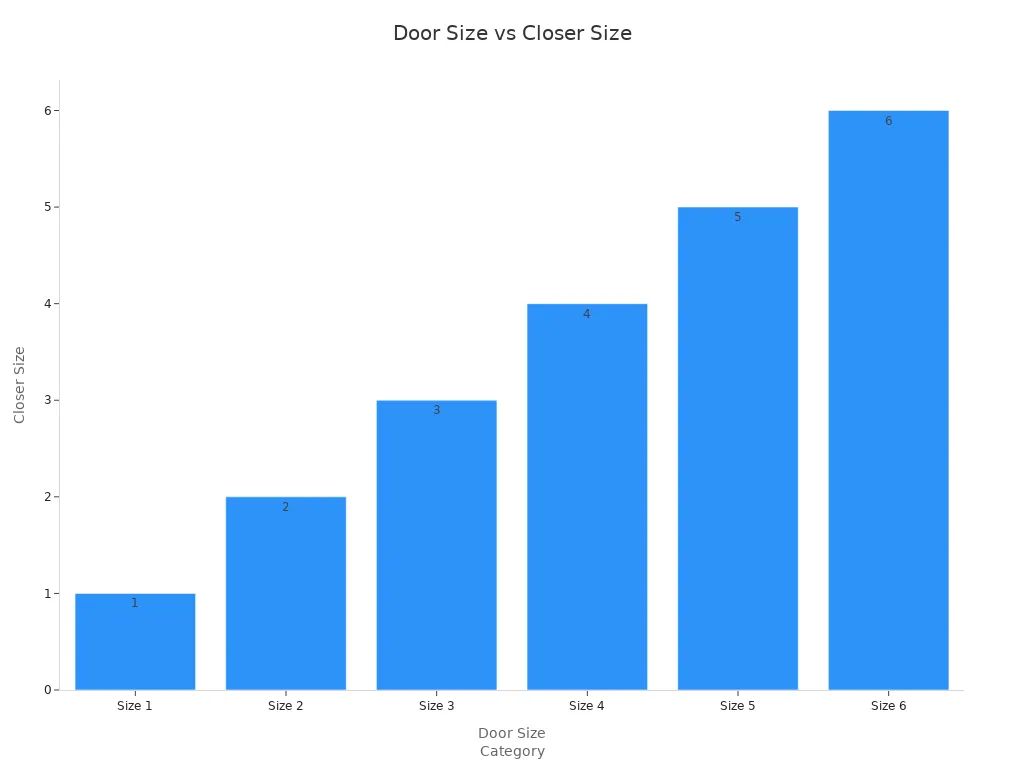
You can also see from the chart below that as the door gets bigger and heavier, the commercial door closer size increases:
Always check both the width and the weight before you choose your commercial door closer. If you are not sure about the weight, you can ask your hardware supplier or look up the average weight for your door type.
Usage Frequency
How often people use your door affects which commercial door closer you need. Doors in busy places like schools, hospitals, and stores open and close many times each day. These doors need a closer that can handle lots of cycles without wearing out.
Here is a table that shows the grades for commercial door closers based on how many times they can open and close:
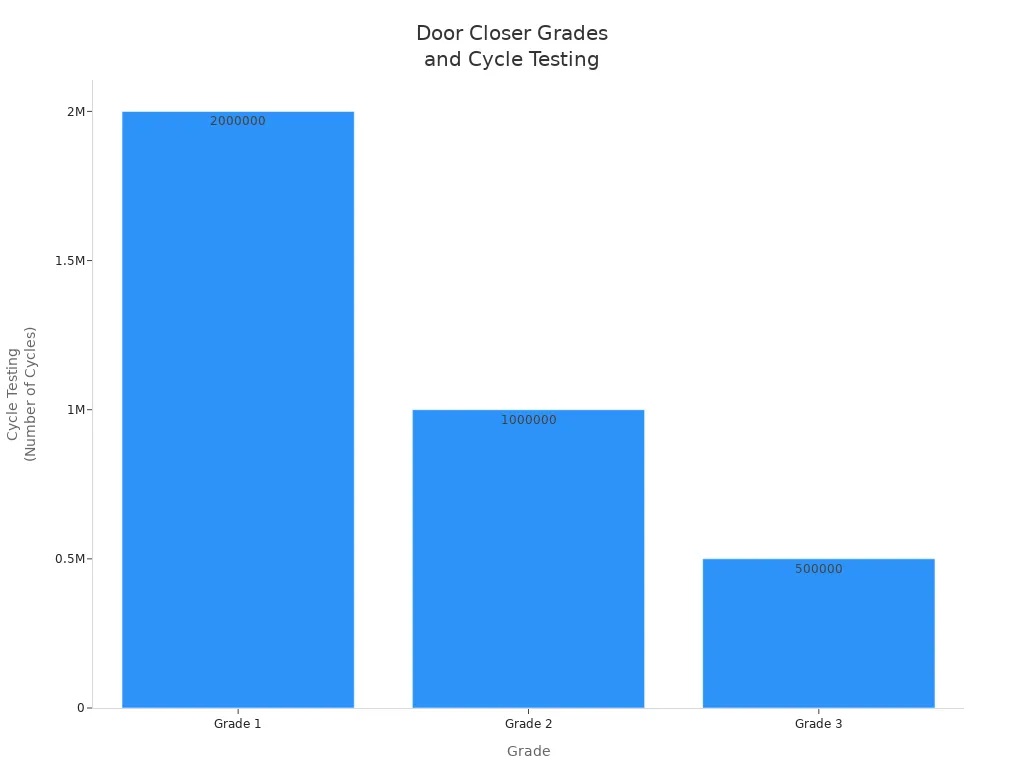
Grade | Cycle Testing | Suitable Applications |
1 | 2 million | High-traffic entrances (hospitals, schools, retail entrances) |
2 | 1 million | Moderate traffic (offices, hotel rooms, interior common areas) |
3 | 500,000 | Light traffic residential applications |
If your door is in a high-traffic area, you should choose a grade 1 commercial door closer. These closers last longer and work better for busy doors. For offices or hotel rooms, a grade 2 closer is usually enough. For homes, a grade 3 closer works well.
You can see from the chart below how the grades compare by cycle testing:
If you need help choosing the right commercial door closer for your door width and weight, D&D Hardware can help you find a solution that fits your needs. Their team can also help you with custom requirements for special doors or unique situations.
Environmental Factors
You should think about where you will put your door closer. The environment can change how well it works. Things like temperature, humidity, wind, and dust all matter.
Temperature and humidity can change how hydraulic door closers work. When it is cold, the hydraulic fluid gets thick. This makes the door close slowly and puts more strain on the parts. When it is hot, the fluid gets thin. This can cause leaks and make the door move in strange ways. If the air is very humid, water can mix with the fluid. This can cause rust and damage inside the door closer. These problems can make the door closer stop working right.
If you put a door closer in a place that gets very hot or cold, you may see changes. In winter, the door may move slower. In summer, it may move faster. Humidity can also cause trouble. If there is a lot of moisture, the inside of the closer can rust. This can make the door hard to open or close.
Wind can be a problem too. If your door faces strong wind, you need a stronger closer. If not, the wind might slam the door or keep it open. Dust and dirt can get inside the moving parts. This can wear out the closer and make it break sooner.
Here are some things to check about the environment:
D&D Hardware has door closers that work in many places. You can pick models with special finishes to stop rust. Some closers have seals to keep out dust and water. If you have a special problem, D&D Hardware can help you find the right solution.
Mounting Options
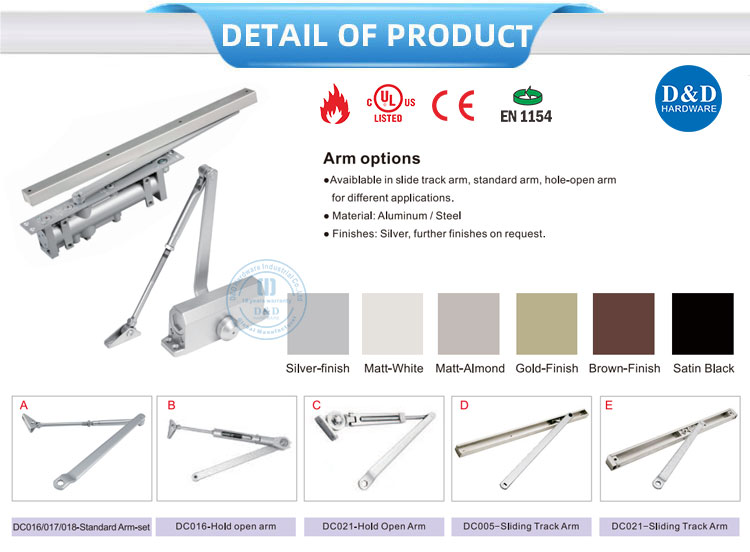
You need to choose the best way to mount your door closer. How you mount it changes how well it works and how long it lasts. There are a few common ways to mount a door closer. Each way fits different doors and spaces.
Mounting Type | Description | Best For |
Regular Arm | Closer on pull side of door | Most interior doors |
Top Jamb | Closer on push side, mounted to top frame | Glass doors, narrow frames |
Parallel Arm | Closer on push side, arm parallel to door | Schools, public buildings |
Slide Track | Uses a sliding arm for a low-profile look | Modern designs, glass doors |
Concealed/Floor Spring | Hidden inside door or floor | High-end, specialty installations |
Pick the mounting style that matches your door and how you use it. Regular arm mounting works for most doors. Top jamb mounting is good for doors with narrow frames or glass. Parallel arm mounting is strong and safe for busy places. Slide track and concealed mounting look neat in modern rooms.
If you do not know which mounting style to use, ask D&D Hardware for help. Their team can help you pick the best one for your door and space. You can also ask for custom mounting if you have a special project.
Tip: Always follow the instructions from the manufacturer when you mount your door closer. This helps your door closer work well and last longer.
Matching Door Closer Size: Common Scenarios
Popular Door Sizes
You see many common door sizes in homes, schools, and offices. Knowing these sizes helps you choose the right door closer size quickly. Most interior doors measure 30, 32, or 36 inches wide. Exterior doors often measure 36 or 42 inches wide. Fire-rated doors and specialty doors can be even larger or heavier.
Here is a table showing popular door sizes and the typical door closer size you need:
Door Width (inches) | Door Weight (lbs) | Typical Door Closer Size |
28–32 | 44–88 | 1–2 |
33–36 | 88–132 | 2–3 |
37–42 | 132–176 | 3–4 |
43–48 | 176–220 | 4–5 |
You should always measure your door before you select a closer. Even if your door looks standard, small differences can affect which door closer size works best.
Tip: If your door is heavier than average, choose the next larger door closer size for better performance.
Recommended Models: D&D Hardware
D&D Hardware offers a wide range of certified door closers for every need. You can find models that fit light interior doors, heavy exterior doors, and even fire-rated doors. Each model meets strict international standards for safety and durability.
Here are some recommended D&D Hardware models for different door types:
Interior doors (light to medium weight): D&D DC-801 or DC-802
Exterior doors (medium to heavy weight): D&D DC-803 or DC-805
Fire-rated doors: D&D Fire Rated Hydraulic Door Closer (UL 228, UL 10C certified)
Glass or specialty doors: D&D DC-806 with patch fitting or floor spring options
You can adjust many D&D Hardware closers to fit a range of door sizes. This flexibility makes it easy to get the right match for your project. If you need help, D&D Hardware’s team can guide you to the best model for your door.
Note: Always check the door closer size chart before you order. This ensures you get the correct model for your door’s width and weight.
Upgrading Existing Closers
You may need to upgrade an old or worn-out door closer. This process is simple if you follow a few steps. First, remove the old closer and measure your door’s width and weight. Next, check the mounting holes and hardware. Some new closers fit the same holes, making installation easy.
Follow these steps to upgrade your door closer:
Remove the old closer and clean the mounting area.
Measure the door’s width and weight.
Use the door closer size chart to find the right size.
Choose a D&D Hardware model that matches your needs.
Install the new closer using the instructions provided.
If you upgrade to a D&D Hardware closer, you get better performance and longer life. Their certified models work for many door types and sizes. You also improve safety and compliance with current standards.
If you have questions about matching door closer size or installation, contact D&D Hardware for expert support.
Troubleshooting Fit Issues
You may run into problems when installing or replacing a door closer. These issues can stop your door from working smoothly. You want your door closer to fit right and work every time. Here are some common fit issues and how you can solve them.
1. Door Closer Does Not Fit the Mounting Holes
Sometimes, the new door closer does not line up with the old mounting holes. This can happen if you upgrade to a different model or brand.
Solution:
Use an adapter plate to cover old holes and create a new mounting surface.
Fill unused holes with wood filler or metal plugs.
Mark and drill new holes carefully to avoid damaging the door.
Tip: D&D Hardware offers models with universal mounting patterns. These make upgrades easier.
2. Door Does Not Close or Latch Properly
If your door does not close all the way or does not latch, the closer size or adjustment may be wrong.
Solution:
Check the door closer size. Use the size chart to confirm you have the right one.
Adjust the closing and latching speed screws. Turn them slowly and test after each change.
Make sure the door and frame are not warped or blocked.
3. Door Closer Arm Hits the Door Frame
You may see the arm of the closer hitting the frame or not moving smoothly. This often means the mounting position is off.
Solution:
Check the installation instructions. Move the closer or arm to the correct spot.
Use the right mounting style (regular, top jamb, or parallel arm) for your door type.
4. Oil Leaks from the Door Closer
If you see oil leaking, the closer may have internal damage or is not rated for your environment.
Solution:
Replace the closer with a certified, high-quality model like those from D&D Hardware.
Pick a closer with the right temperature rating for your location.
5. Door Closer Size Feels Too Strong or Too Weak
If the door is hard to open or slams shut, the closer size may not match your door.
Problem | Quick Fix |
Mounting holes do not match | Use adapter plate or fill and redrill |
Door will not close/latch | Adjust speed, check size, inspect door |
Arm hits frame | Reposition closer or arm |
Oil leaks | Replace with certified closer |
Door too hard/easy to open | Check size, use adjustable closer |
If you need help, contact D&D Hardware’s support team. You get expert advice for any door closer issue.
You can choose the right door closer size quickly with the main chart. Accurate measurements help you avoid mistakes and keep your doors safe. D&D Hardware’s certified solutions give you peace of mind for every project. Use these charts and tips whenever you need to select a door closer.
Need help? Contact D&D Hardware for expert advice and custom solutions. Your next project will be easier and safer with the right support.

FAQ
What is the best way to measure my door for a closer?
You should use a tape measure to check the width and weight of your door. Write down these numbers. Use the size chart to match your measurements to the right door closer.
Can I use a residential door closer on a heavy exterior door?
You should not use a residential door closer on a heavy exterior door. Choose a model designed for heavier doors. This ensures safe and smooth operation.
How do I know if I need a fixed-size door closer?
You need a fixed-size door closer if your door has standard use and does not require frequent adjustments. These closers work well for doors with consistent traffic and weight.
Are D&D Hardware door closers certified for fire-rated doors?
Yes, D&D Hardware offers door closers that meet UL and BS EN standards. These models work for fire-rated doors and provide reliable safety in emergencies.
What should I do if my door closer leaks oil?
If you see oil leaking, replace the closer right away. Oil leaks mean the closer will not work properly. Choose a certified model for better performance.
Can I install a door closer myself?
You can install a door closer if you follow the instructions carefully. Use the right tools and check the mounting style. If you have questions, ask D&D Hardware for help.
How do I adjust the speed of my door closer?
You can turn the adjustment screws on the closer body. Turn them slowly and test the door after each change. This helps you set the closing and latching speed.
What is the lifespan of a typical door closer?
Most door closers last for many years. High-quality models from D&D Hardware can handle millions of cycles. Check the grade and cycle rating for your chosen closer.
Contact us Now:
Contact: David Jian
Mob:0086-139 2903 7292
Email: David@dndhardware.com, sales@dndhardware.com,
Contact: Jobby Zhang
Mob:0086-137 2599 9617
Email: jobby@dndhardware.com
D&D HARDWARE INDUSTRIAL CO.,LTD
ADD:12th Floor, Building 2, No.898, KeChuang Technical Zone, Jiangmen Avenue, Pengjiang District, Jiangmen City, Guangdong, China (Postcode:529000)
https://www.dndhardware.com
Tel: +86-750-3856396
Fax: +86-750-3856395


 English