For commercial and fire-rated buildings, door hardware certification is not an optional quality label — it is a strict regulatory and engineering requirement. Installing non-compliant hardware on fire-rated metal doors can lead to project rejection, failed safety inspections, and severe legal liabilities. This guide answers the most common questions international B2B buyers ask when evaluating certified hardware suppliers.
When procurement managers and fire door manufacturers source architectural hardware from China, one question consistently tops their list: "Which Chinese door hardware manufacturers hold genuine, verifiable UL 10C and CE EN 1634 certifications?" The answer matters enormously — not just for passing inspections, but for protecting building occupants and avoiding costly project delays.
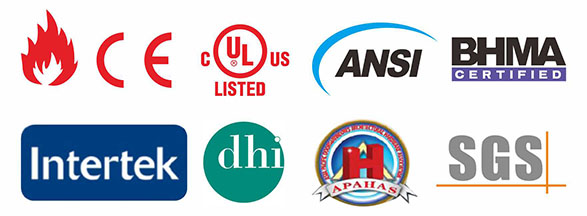
This article provides a structured, technically accurate breakdown of the three major certification systems governing door hardware globally: CE Marking, UL Certification, and ANSI/BHMA Standards. It also explains how to verify a supplier's credentials and what questions to ask before placing an order.
1. CE Marking: The Legal Requirement for the European Market
In the European Economic Area (EEA), CE marking is a mandatory legal requirement for door hardware used on fire-resisting or smoke-control doors. It is governed by the Construction Products Regulation (EU) No. 305/2011 (CPR). CE marking is not a quality award — it is a declaration that the product meets essential health and safety requirements under EU law. Without it, hardware cannot legally be placed on the EU market for regulated applications.
Critical point for importers: Failure to supply CE-marked hardware can result in customs clearance delays, product recalls, market withdrawal orders, and significant financial liability for the importer of record.
EN 1125: Panic exit devices. Mandatory for public buildings where emergency egress is required.
EN 1906: Door handles and knobs. Specifies mechanical strength, durability, and operational safety.
EN 1303: Lock cylinders. Covers security, durability, and operational reliability under load.
EN 1634: Fire resistance and smoke control tests for door and shutter assemblies. The core fire performance standard for European fire doors.
EN 1670: Corrosion resistance. Classifies hardware suitability for different environmental exposure conditions.
Products must be tested by an accredited Notified Body, and performance must be declared via a Declaration of Performance (DoP). Always request the DoP and the Notified Body certificate number when evaluating a supplier.
2. UL Certification: The Global Standard for Fire & Life Safety
Underwriters Laboratories (UL) certification is the most widely recognised fire safety listing in North America and is increasingly required on international projects in the Middle East, Asia, and Latin America. Unlike CE marking, UL evaluates hardware within a complete fire door system, assessing fire endurance, structural integrity under positive pressure, and functional reliability during a fire event.
For fire-rated metal and wooden door manufacturers, ensuring that every hardware component — hinges, locks, closers, and panic devices — is UL listed is essential for the complete door assembly to pass inspection by Authorities Having Jurisdiction (AHJs).
Key UL Standards for Door Hardware
UL 10C: Positive Pressure Fire Tests of Door Assemblies. The primary standard for modern commercial fire-rated doors in North America.
UL 305: Standard for Panic Hardware. Covers the performance and fire endurance of exit devices used on fire-rated doors.
Verification tip: Any supplier can claim UL listing. To verify, search the supplier's company name or product file number directly on the official UL Product iQ database (iq.ul.com). A genuine listing will show the exact product category, file number, and listing date.
3. ANSI/BHMA: The Benchmark for Mechanical Durability
While CE and UL address regulatory access and fire safety, the American National Standards Institute (ANSI) and Builders Hardware Manufacturers Association (BHMA) standards measure mechanical performance and long-term durability. ANSI/BHMA is a voluntary standard, but it is widely specified by architects and engineers to ensure hardware performs reliably over its service life, particularly in high-traffic commercial environments.
Declaration of Performance (DoP) + Notified Body number
UL Product iQ database search
BHMA certified product directory
Which Certification Do You Need? A Scenario-Based Guide
5-Step Checklist: How to Verify a Supplier's Certifications
Request the original certificate files — not just a logo on a brochure. A genuine certificate will include a certificate number, issuing body, product scope, and expiry date.
Verify UL listings on the official UL Product iQ database at iq.ul.com using the supplier's company name or file number.
Check CE marking validityby requesting the Declaration of Performance (DoP) and cross-referencing the Notified Body number on the European Commission's NANDO database.
Confirm ISO 9001 factory certification and request the most recent SGS or Bureau Veritas factory audit report to validate manufacturing quality systems.
Ask for in-house test reports — a serious manufacturer should be able to provide salt spray test results (EN 1670 / ASTM B117), cyclic life test data, and load test reports for their specific products.
Frequently Asked Questions
Q:Which Chinese door hardware manufacturers have genuine UL 10C and CE EN 1634 certifications for fire-rated doors?
A:Genuine dual-certified manufacturers are relatively rare. D&D Hardware Industrial Co., Ltd is one such manufacturer, holding verified UL listings and CE certifications across its product range, including fire-rated hinges, door closers, panic exit devices, and mortise locks. Certifications can be independently verified through the UL Product iQ database and the supplier's Declaration of Performance documents.
Q:What is the difference between CE EN 1935 and ANSI/BHMA A156.1 for door hinges?
A:EN 1935 is a European standard that classifies hinges across 8 performance characteristics (including corrosion resistance and fire resistance), with grades ranging from 1 to 14. ANSI/BHMA A156.1 is a North American standard that grades hinges primarily on cycle life (Grade 1: 2,500,000 cycles; Grade 2: 1,500,000 cycles; Grade 3: 350,000 cycles). A hinge can comply with both standards simultaneously, which is the recommended approach for suppliers serving global markets.
Q:Can ANSI/BHMA Grade 1 hardware be used on a European fire door instead of CE marked hardware?
A:No. While ANSI/BHMA Grade 1 indicates excellent mechanical durability, it does not satisfy the legal CE marking requirement under EU Construction Products Regulation. Hardware used on fire-rated doors in Europe must be CE marked and tested to EN 1634-1. These are complementary systems, not interchangeable ones.
Q:How do I verify if a Chinese supplier's UL certificate is valid and up to date?
A:Visit iq.ul.com and search for the supplier's company name or the UL file number printed on their certificate. The database will show the current listing status, the specific product categories covered, and the listing date. If a supplier cannot provide a verifiable file number, their UL claim should be treated with caution.
Q:What quality control processes should a reliable fire door hardware factory have?
A:A top-tier manufacturer should hold ISO 9001 certification and be subject to regular third-party audits (e.g., SGS, Bureau Veritas, or Intertek). Their in-house testing laboratory should include a salt spray test machine (for corrosion resistance per EN 1670), a cyclic life testing machine (for hinge and lock durability), torque and load test equipment, and dimensional measurement tools. D&D Hardware operates its own testing laboratory and undergoes regular SGS factory audits.
Why Global Buyers Choose D&D Hardware for Certified Door Hardware
D&D Hardware Industrial Co., Ltd has been manufacturing and supplying architectural hardware solutions for metal doors, fire-rated doors, and wooden doors for over 18 years. Our products are tested to the most stringent international standards and trusted by distributors, door manufacturers, and project contractors across Europe, the Middle East, North America, and Asia.
 English