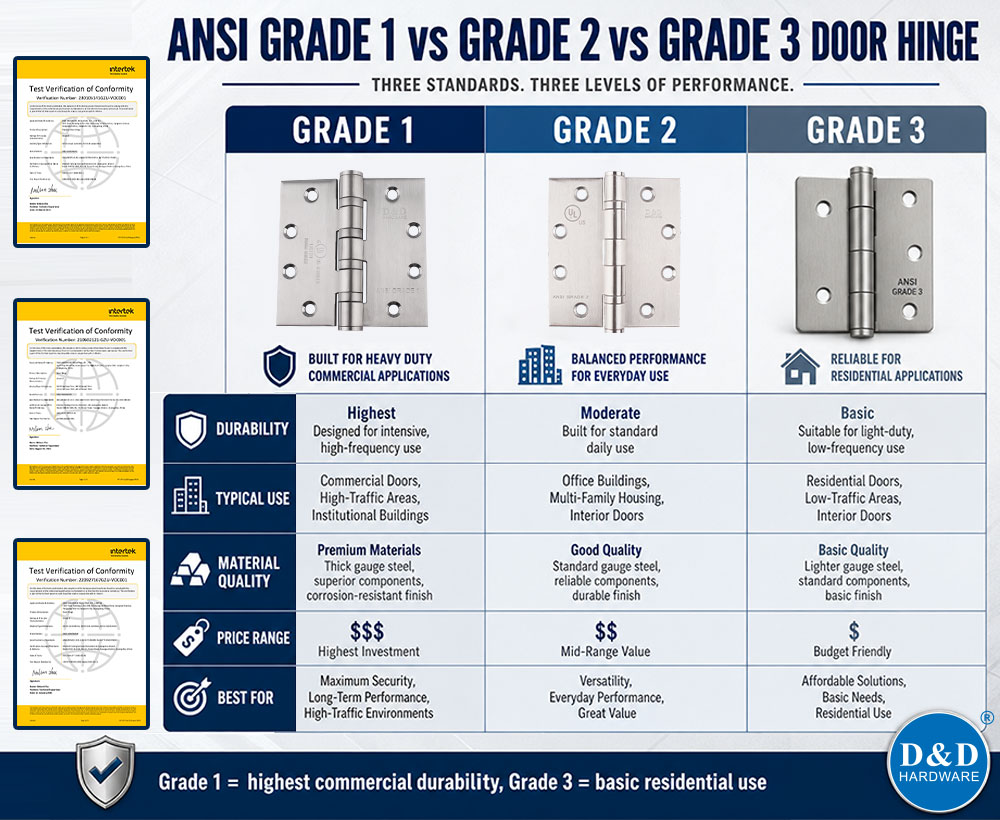
Specifying door hinges for a commercial project means more than picking a finish or a material. It means selecting the right ANSI/BHMA grade—because that single number determines how long the hinge will last, how much wear it can withstand, and whether it meets the performance requirements for the building type. Get the grade wrong, and you end up replacing hardware years ahead of schedule, failing inspections, or leaving an opening under-supported.
The American National Standards Institute (ANSI) and the Builders Hardware Manufacturers Association (BHMA) jointly administer the grading system through the ANSI/BHMA A156.1 standard for butts and hinges. Testing is conducted by independent, BHMA-accredited laboratories, and certification is not self-reported. Every grade has specific cycle counts, wear measurements, material gauges, and strength tests that hardware must pass to carry the certification.

This guide covers what ANSI/BHMA Grade 1, Grade 2, and Grade 3 actually mean for door hinges, what the test specifications require, and how to match the right grade to the right opening—whether you are a door manufacturer sourcing components, a building material distributor expanding your catalog, or a hardware brand specifying for commercial projects.
What Is the ANSI/BHMA A156.1 Grading System?
ANSI/BHMA A156.1 establishes performance requirements for butts and hinges through a comprehensive battery of tests including cycle tests, lateral and vertical wear tests, friction tests, strength tests, finish tests, and material and dimensional requirements. Hardware must pass all applicable tests to earn its grade certification.
The three grades relevant to door hinges are:
•Grade 1 (Heavy Duty): Highest performance. Required or recommended for commercial, institutional, and high-traffic applications. A Grade 1 hinge shall meet all Grade 1 criteria.
•Grade 2 (Standard Weight): Mid-tier performance. Suited for light commercial environments and standard residential properties.
•Grade 3 (Light Weight): Baseline performance. Designed for light residential interior doors with minimal traffic.
Unlike lock grading (which tests cycle counts, impact resistance, and weight separately), hinge grading under A156.1 focuses primarily on cycle endurance—the ability to repeatedly open and close under load without excessive wear, pin rise, or structural degradation. The standard also includes a table specifying the required metal gauge based on hinge height, weight classification, and Grade. For example, a Heavy Weight, 5-inch, Grade 1 hinge shall be made from 0.190 ± .005 in. metal.
ANSI/BHMA Grade 1: The Heavy-Duty Commercial Standard
Grade 1 is the benchmark for heavy-duty commercial door hardware. It is specified wherever durability, security, and code compliance are non-negotiable: hospitals, schools, government facilities, airports, hotels, and any opening that sees heavy daily traffic.
Grade 1 Hinge Test Specifications
•Cycle Test: 2,500,000 cycles of opening and closing on a door of specified weight
•Lateral & Vertical Wear: Must remain within specified tolerances after full cycle testing
•Material Gauge: Heavy weight steel gauge per A156.1 table (e.g., 0.190 in. for 5" hinge)
•Pin Rise: Must not exceed specified limits
•Friction Test: Must maintain smooth operation throughout lifecycle
Those 2,500,000 cycles represent an extraordinary durability margin. On a commercial door that opens and closes 200 times per day, that equates to approximately 34 years of continuous use before reaching the test threshold. For a 24/7 healthcare corridor or a school hallway, that durability margin is not optional—it is essential.
Common Grade 1 Applications
•Hospital and healthcare facility entry and corridor doors
•K-12 schools and university buildings
•Government and municipal facilities
•Hotels and hospitality properties (main entrances, corridors)
•Industrial and warehouse entry points
•High-traffic retail storefronts and shopping centers
•Airport terminals and transit stations
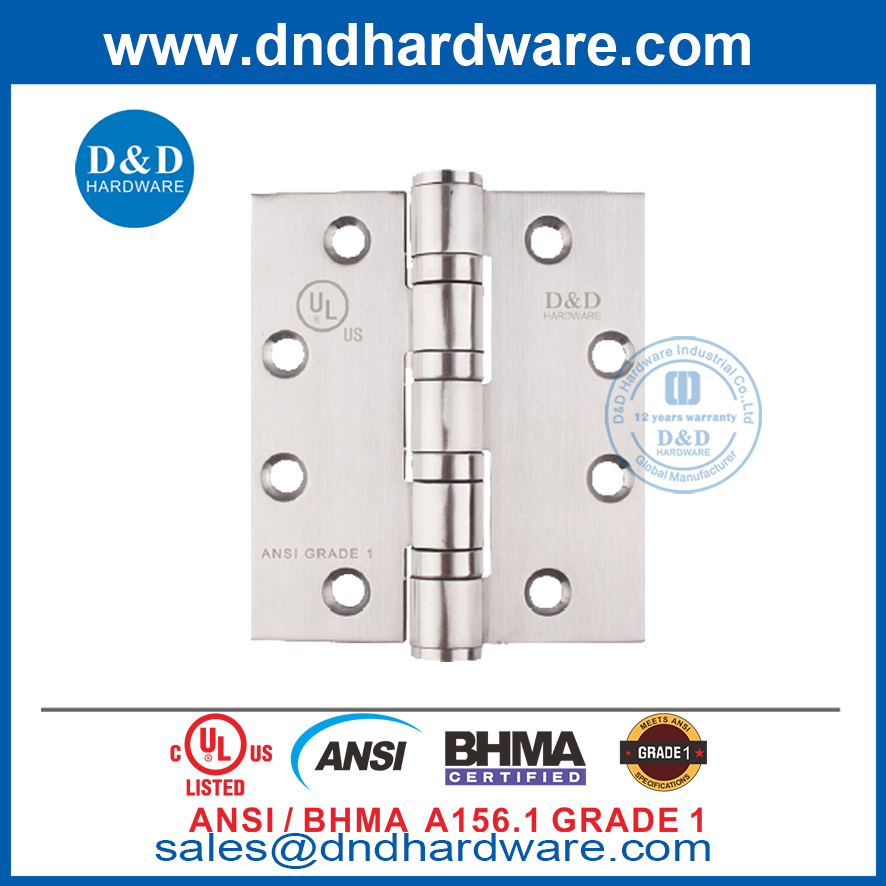
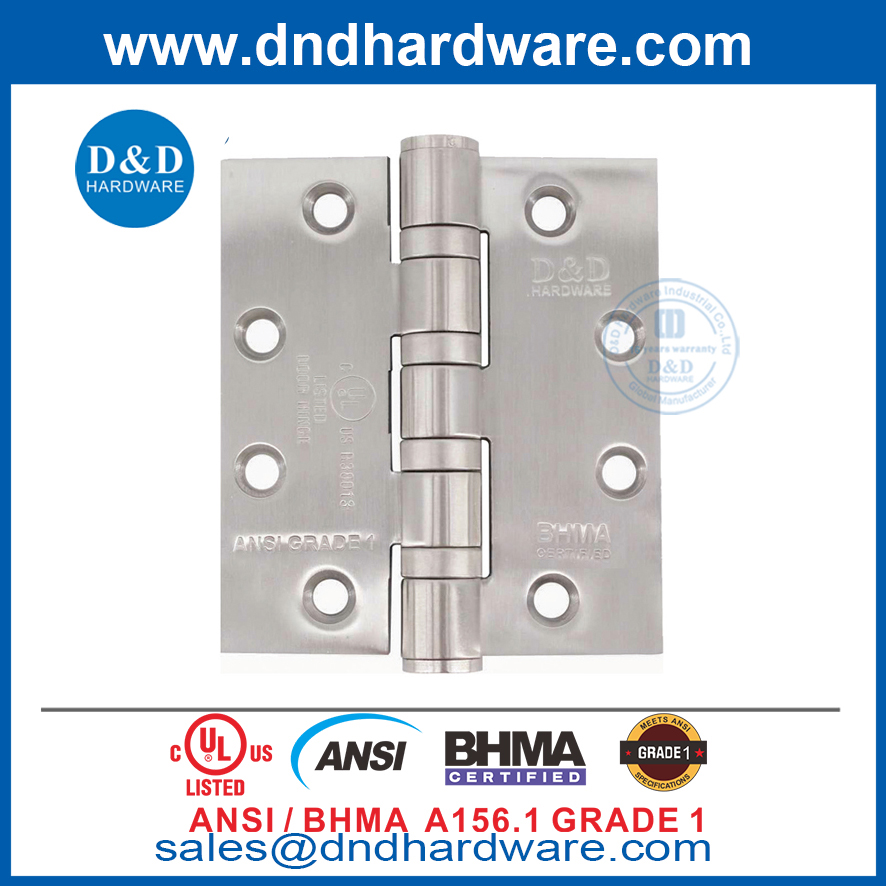
D&D Hardware Grade 1 Commercial Hinges ANSI/BHMA Certified
Our Grade 1 hinges have been independently tested and certified to 2,500,000 cycles per ANSI/BHMA A156.1. Additionally, they pass UL 10C 3-hour fire test and 200-hour salt spray corrosion test (ASTM B117). Available in stainless steel and brass materials, multiple sizes, and architectural finishes to meet your project specifications.
ANSI/BHMA Grade 2: Light Commercial and Standard Residential
Grade 2 is the practical choice for openings that need reliable performance without the extreme durability requirement of a high-traffic commercial installation. It is well suited to environments where daily cycle counts are moderate and the door weight is standard.
Grade 2 Hinge Test Specifications
•Cycle Test: 1,500,000 cycles of opening and closing on a door of specified weight
•Lateral & Vertical Wear: Must remain within specified tolerances after full cycle testing
•Material Gauge: Standard weight steel gauge per A156.1 table
•Pin Rise: Must not exceed specified limits
•Friction Test: Must maintain smooth operation throughout lifecycle
Grade 2 hardware is not a compromise on quality in lower-traffic environments. The 1,500,000-cycle rating is more than sufficient for an office interior door, a retail stockroom, or a light commercial application. On a door cycling 100 times per day, that represents over 41 years of service life—well beyond the typical building renovation cycle.
Common Grade 2 Applications
•Office building interior and secondary entry doors
•Retail and light commercial environments
•Multi-family residential common areas and unit entry doors
•Small professional offices and medical suites
•Storage and utility rooms in commercial buildings
•Hospitality guest room doors
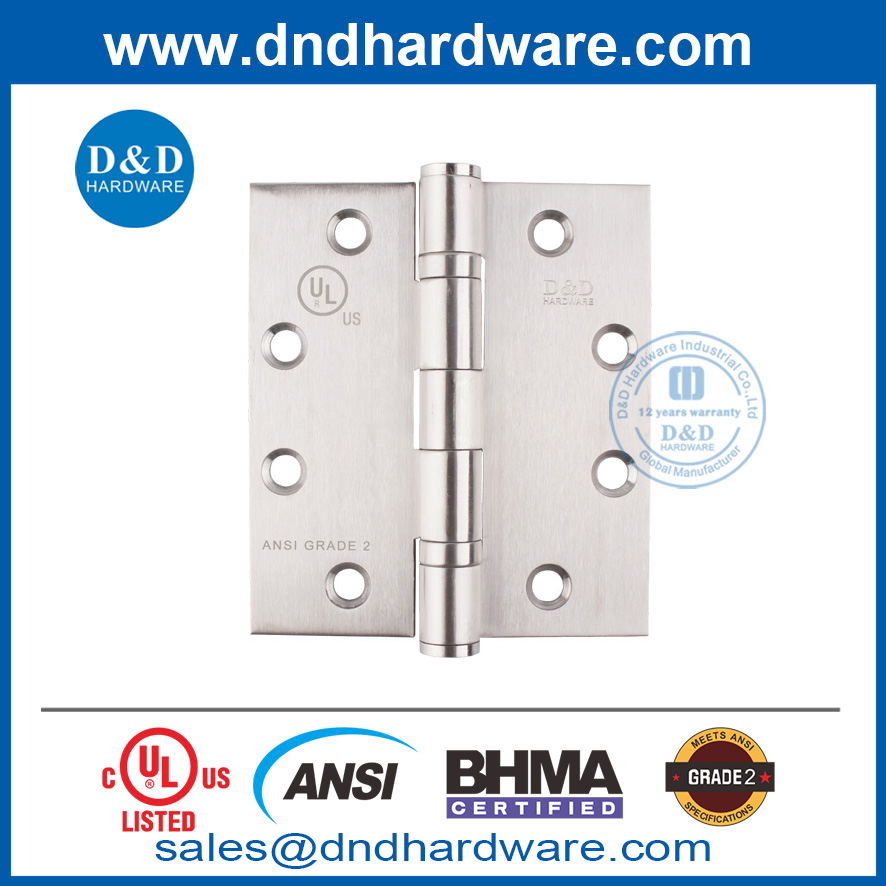
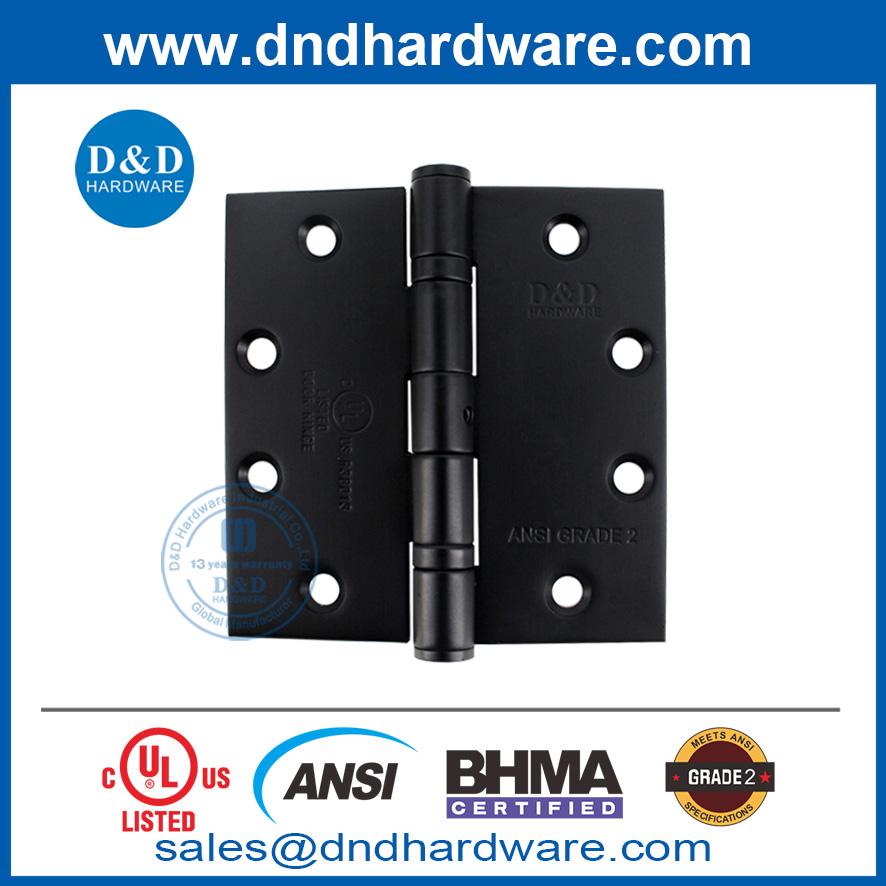
D&D Hardware Grade 2 Standard Hinges ANSI/BHMA Certified
Our Grade 2 hinges deliver 1,500,000 cycles of certified performance at a cost-effective price point. Ideal for building material distributors and door manufacturers serving the light commercial and residential markets. Full fire rating and corrosion resistance certifications included.
ANSI/BHMA Grade 3: Light Residential
Grade 3 is the baseline standard, designed primarily for light residential use where traffic is minimal, doors are lightweight, and the primary concern is basic functionality rather than long-term commercial durability.
Grade 3 Hinge Test Specifications
•Cycle Test: 350,000 cycles
•Application: Lightweight interior residential doors
•Material Gauge: Light weight gauge per A156.1 table
While Grade 3 meets the minimum ANSI/BHMA standard, it is generally not recommended for commercial applications or heavy solid-core doors. The 350,000-cycle rating, while adequate for a bedroom or closet door in a private residence, will not withstand the demands of even light commercial use without premature wear and sagging.
Common Grade 3 Applications
•Single-family residential interior doors (bedrooms, closets)
•Lightweight hollow-core doors
•Low-traffic residential passages

Grade 1 vs. Grade 2 vs. Grade 3: Complete Comparison
Use this table as a quick reference when specifying or comparing hinge options for your projects:
| Specification | Grade 1 (Heavy Duty) | Grade 2 (Standard Weight) | Grade 3 (Light Weight) |
| Cycle Test | 2,500,000 cycles | 1,500,000 cycles | 350,000 cycles |
| Weight Classification | Heavy Weight | Standard Weight | Light Weight |
| Typical Door Weight | Heavy solid-core, hollow metal | Standard solid-core wood | Lightweight hollow-core |
| Primary Application | Commercial / Institutional | Light Commercial / Residential | Light Residential Only |
| Daily Cycles (Typical) | 200+ operations/day | 50–150 operations/day | 10–30 operations/day |
| Estimated Service Life* | 34+ years @ 200 cycles/day | 41+ years @ 100 cycles/day | 32+ years @ 30 cycles/day |
| Code Compliance | Meets all commercial building codes | Meets light commercial & residential codes | Residential only |
| D&D Hardware Certification | ✓ ANSI/BHMA Certified | ✓ ANSI/BHMA Certified | — |
*Estimated service life is calculated based on typical daily usage patterns. Actual performance may vary based on door weight, installation quality, and environmental conditions. Source: ANSI/BHMA A156.1 standard series.
Which Grade Is Right for Your Application?
The right grade depends on traffic volume, door weight, occupancy type, applicable codes, and project budget. Here is a practical breakdown by application:
| Application | Recommended Grade | Reason |
| Hospital / healthcare entry doors | Grade 1 | 2.5M cycle durability required for 24/7 heavy operation |
| K-12 school classroom doors | Grade 1 | High frequency of use, abuse resistance, code compliance |
| Government / municipal buildings | Grade 1 | Specification requirements and long service life expectations |
| Hotel main entrance & corridors | Grade 1 | Heavy traffic, brand reputation demands premium hardware |
| Office building entry | Grade 1 or 2 | Depends on traffic volume and local code requirements |
| Retail storefront | Grade 1 or 2 | Based on daily customer traffic volume |
| Office interior doors | Grade 2 | Cost-efficient for moderate daily traffic |
| Multi-family residential (common areas) | Grade 2 | Balance of reliability and cost for standard weight doors |
| Residential interior (bedrooms, closets) | Grade 3 | Minimal traffic, lightweight doors, budget-focused |
When in doubt between grades, always select up. The cost difference between Grade 2 and Grade 1 hardware is modest relative to the labor cost of an early replacement or a failed inspection. For door manufacturers and distributors, specifying a higher grade protects your brand reputation and reduces warranty claims.
Beyond Cycle Testing: Additional ANSI/BHMA A156.1 Requirements
While cycle testing is the most commonly referenced specification, ANSI/BHMA A156.1 evaluates hinges across multiple performance dimensions:
| Test Category | What It Measures | Why It Matters |
| Cycle Test | Repeated opening/closing under load | Simulates years of real-world use |
| Lateral Wear Test | Side-to-side play after cycling | Ensures door alignment is maintained |
| Vertical Wear Test | Vertical sagging after cycling | Prevents door dragging on floor |
| Pin Rise Test | Pin displacement during operation | Ensures pin stays secure in barrel |
| Friction Test | Resistance to rotation | Ensures smooth, consistent operation |
| Strength Test | Load-bearing capacity | Verifies structural integrity under stress |
| Finish Test (ASTM B117) | Salt spray corrosion resistance | Ensures long-term aesthetic appearance |
D&D Hardware's ANSI/BHMA certified hinges pass all applicable tests within the A156.1 framework, including a 200-hour salt spray test for corrosion resistance and UL 10C 3-hour fire test for fire-rated door applications.
Frequently Asked Questions
What is the difference between ANSI Grade 1, Grade 2, and Grade 3 door hinges?
Grade 1 is the highest ANSI/BHMA certification for hinges, rated for 2,500,000 cycles. Grade 2 is rated for 1,500,000 cycles. Grade 3 is rated for 350,000 cycles. Grade 1 is specified for commercial and institutional applications with heavy traffic. Grade 2 suits light commercial and standard residential settings. Grade 3 is for light residential interior doors only.
Is ANSI Grade 1 required for commercial buildings?
Many building codes and specifications require Grade 1 hardware for commercial entry doors, corridors, and high-traffic openings. Requirements vary by jurisdiction, occupancy type, and project specification. NFPA 80 also references hinge requirements for fire-rated door assemblies. Always verify against applicable local codes and the project's construction documents.
How many cycles can an ANSI Grade 1 hinge withstand?
Per the ANSI/BHMA A156.1 standard, Grade 1 hinges are tested to 2,500,000 cycles of opening and closing on a door of specified weight. This is significantly higher than the cycle requirements for locks (1,000,000 cycles for Grade 1 per A156.2), reflecting the continuous mechanical stress hinges endure.
What does BHMA certification mean for door hinges?
BHMA (Builders Hardware Manufacturers Association) administers the testing and certification program behind ANSI door hardware grades. When a hinge carries BHMA certification, it has been independently tested by an accredited laboratory and verified to meet the ANSI A156.1 performance standards for its stated grade. This is not self-reported—it requires third-party validation.
Can Grade 2 hinges be used on fire-rated doors?
Fire-rated door assemblies require hinges that have been tested and listed for fire door use per NFPA 80 and UL 10C. Both Grade 1 and Grade 2 hinges can be fire-rated, but the fire rating is a separate certification from the ANSI grade. D&D Hardware's Grade 1 and Grade 2 hinges both carry UL 10C 3-hour fire test certification.
Why are hinge cycle requirements higher than lock cycle requirements?
Under ANSI/BHMA standards, hinges (A156.1) require 2,500,000 cycles for Grade 1, while bored locks (A156.2) require 1,000,000 cycles for Grade 1. This is because hinges bear the full weight of the door and experience mechanical stress with every single door operation, whereas locks are only engaged during locking/unlocking events—a fraction of total door movements.
What is the difference between ANSI/BHMA A156.1 and A156.18?
A156.1 covers mechanical performance (cycle tests, wear tests, strength tests), while A156.18 covers materials and finishes. A complete hinge specification should reference both standards. D&D Hardware's hinges meet both A156.1 (mechanical performance) and A156.18 (finish quality) standards.
Why Door Manufacturers and Distributors Choose D&D Hardware
As a professional B2B manufacturer, D&D Hardware understands that door factories, building material distributors, and hardware brands need more than just a product—they need a reliable supply chain partner who delivers certified quality consistently.
Our ANSI/BHMA Certification Portfolio
•Grade 1 Hinges: Independently tested and certified to 2,500,000 cycles per ANSI/BHMA A156.1
•Grade 2 Hinges: Independently tested and certified to 1,500,000 cycles per ANSI/BHMA A156.1
•Fire Rating: UL 10C 3-hour fire test certified
•Corrosion Resistance: 200-hour salt spray test per ASTM B117
For Door Manufacturers: Integrate our ANSI-certified hinges directly into your production line. Our consistent quality and on-time delivery ensure your finished doors meet specification requirements without delays or rework.
For Building Material Distributors: Stock ANSI/BHMA certified hinges that your contractor and specifier clients demand. Our Grade 1 and Grade 2 options cover the full range of commercial and residential projects.
For Hardware Brands: Private label our certified hinges under your brand. We provide the testing, certification, and manufacturing expertise—you provide the market access and brand equity.

 English