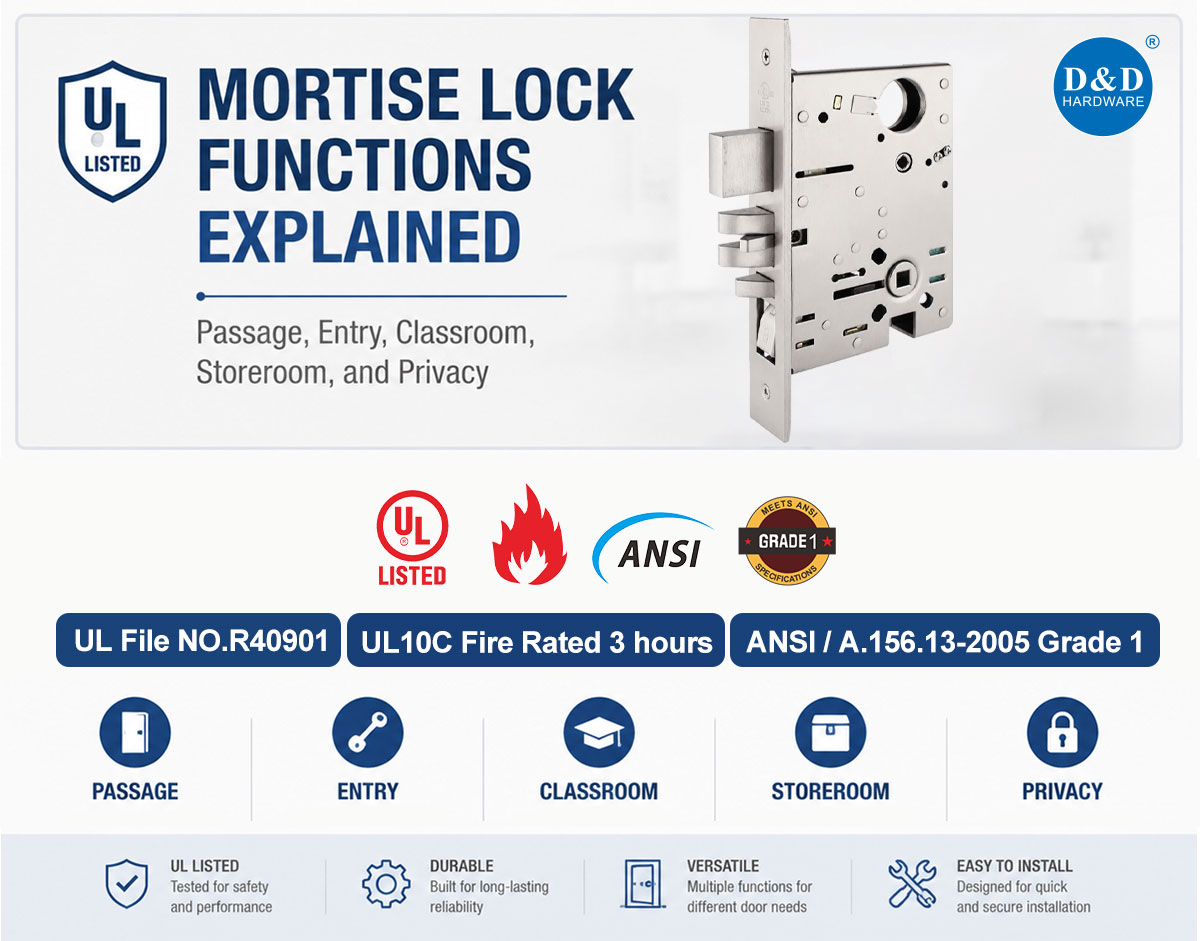
Choosing a mortise lock by room name alone is unreliable.
An "office lock" may allow the occupant to lock the outside lever from inside. A classroom lock may require a key on the corridor side to change its locked state. A storeroom lock may keep the outside lever permanently inoperative. Two privacy functions may use completely different locking mechanisms even though both are described as suitable for bedrooms or bathrooms.
These differences affect daily access, emergency egress, key management, and the risk of someone being unintentionally locked out.
For commercial projects, the required function should therefore be defined by its exact operating sequence:
What does the outside lever do?
What does the inside lever do?
How is the outside lever locked?
How is it unlocked?
Does the door automatically become secure after closing?
Is a deadbolt involved?
Can the door be released from outside in an emergency?
This guide compares five common ANSI mortise lock functions—passage, entry, classroom, storeroom, and privacy—and explains how UL listing relates to function selection.

Quick Comparison of Common Mortise Lock Functions
| Function | Common ANSI designation | Outside operation | Inside operation | How locking is controlled | Typical application |
| Passage | F01 | Lever always retracts latch | Lever always retracts latch | No locking function | Corridors, common rooms, interior circulation doors |
| Entry/Office | F04 | Lever works when unlocked; key retracts latch when locked | Lever remains available for exit | Outside lever can be locked or unlocked as defined by the lock design | Private offices, staff rooms, administrative spaces |
| Classroom | F05 | Lever works when unlocked; key changes locked state from outside | Lever remains free for exit | Locked and unlocked by key from the corridor side | Traditional classrooms, teaching rooms |
| Storeroom | F07 | Outside lever is always inoperative; key retracts latch | Lever remains free for exit | Outside never enters an unlocked passage state | Stockrooms, equipment rooms, controlled service spaces |
| Privacy with deadbolt | F19 | Lever operates latch; emergency release operates deadbolt where provided | Thumbturn controls deadbolt; inside lever retracts both bolts | Inside thumbturn projects deadbolt | Bedrooms, bathrooms, consultation rooms where a deadbolt privacy function is appropriate |
| Privacy without separate deadbolt | F22 | Lever works unless locked from inside; emergency release unlocks it | Inside lever remains free | Inside thumbturn locks outside lever; opening from inside or closing the door may reset it | Restrooms, changing rooms, interior privacy spaces |
The ANSI number should always be accompanied by a plain-language operational description. Function names and manufacturer model codes are not enough on their own.
First: "UL Listed" and "Lock Function" Are Not the Same Thing
The phrase "UL Listed mortise lock function" can be misunderstood.
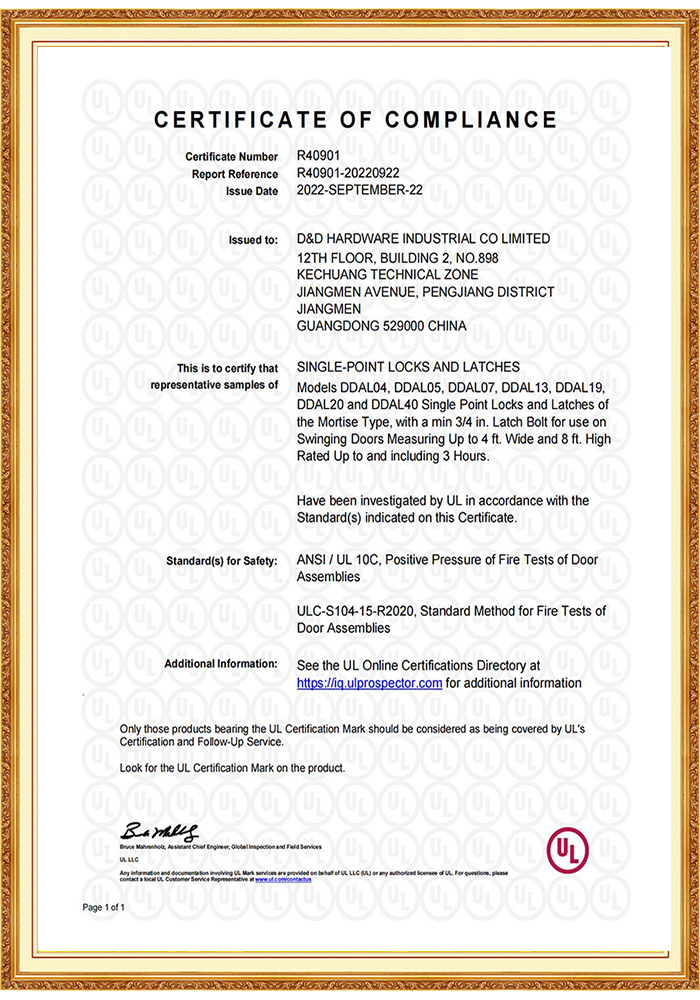
UL listing addresses the certification of a specific product or product family for a defined application. The ANSI/BHMA function designation describes how the levers, key, latchbolt, deadbolt, thumbturn, and other controls operate.
Therefore:
F05 identifies a classroom operating function; it does not prove that the lock is UL Listed.
A UL file number does not prove that every function offered by the manufacturer is covered.
ANSI/BHMA Grade 1 does not automatically establish a fire-door listing.
A passage, classroom, or storeroom function may be available in a UL-listed configuration, but the exact model must still be verified.
Changing a function, bolt arrangement, electrical component, or model suffix may affect certification scope.
The function number also does not identify the finish, lever design, cylinder, security grade, operational grade, door preparation, or fire rating.
Readers who need the certification background can review what a UL listed mortise lock means for fire door compliance. This article concentrates on selecting the correct operating function after the opening requirements are understood.
How to Read a Mortise Lock Function
Every function can be understood by following the door through four conditions.
1. Door unlocked
Can both levers retract the latchbolt?
2. Door locked
Is the outside lever rigid, free-moving without retracting the latch, or still operable? Can a key retract the latch directly?
3. Door opened from inside
Does operating the inside lever only retract the latch, or does it also unlock the outside lever and retract a deadbolt?
4. Door closed again
Does the lock remain unlocked, return to a locked condition, or reset the privacy control?
These questions are more dependable than labels such as "office," "closet," or "bedroom." The same room may require different functions depending on occupancy, security policy, key control, and egress conditions.
Passage Function: F01
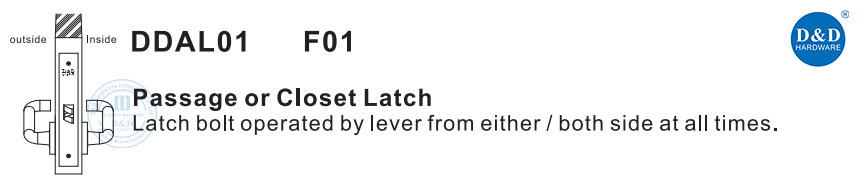
A passage mortise lock provides latching without controlled locking.
The latchbolt is normally operated by the lever from either side at all times. There is no key cylinder, thumbturn, push button, or other user-operated control intended to prevent entry.
Operating sequence
From outside:
Turning the lever retracts the latchbolt.
From inside:
Turning the lever retracts the latchbolt.
After the door closes:
The latchbolt holds the door closed, but the outside lever remains operable.
Where passage function is appropriate
Passage locks are commonly considered for:
Interior corridors where access does not need to be restricted
Shared meeting or conference rooms
General circulation doors
Unsecured closets
Common rooms
Interior doors controlled by another opening or security boundary
A passage lock is useful when the door must remain positively latched but should not be locked by normal users.
Passage does not mean "no latch"
A passage function is different from a dummy trim or non-latching push-pull door. The latchbolt still engages the strike and holds the door closed.
This distinction can be important on a fire-rated door. A passage function may be suitable where positive latching is required but access control is not. However, the exact passage model must be listed for the applicable fire-door use and installed as part of the approved assembly.
When not to use passage function
Do not use passage function where the opening must:
Restrict public entry
Protect stock, records, equipment, or medication
Provide user-controlled privacy
Remain secured after each use
Support a key-management or access-control policy
A common mistake is specifying passage locks for meeting rooms that later need privacy or staff-only access. Because the passage function has no locking control, resolving the problem may require changing the lock case rather than simply adding a cylinder.
Entry or Office Function: F04
An entry or office function allows the outside lever to change between an operable and an inoperative state.
When the lock is unlocked, either lever retracts the latchbolt. When the outside lever is locked, authorized users can enter with a key, while the inside lever remains available for egress.
Depending on the lock design, the outside lever may be controlled by a key, an inside thumbturn, a stop mechanism, or another specified mechanical control. The exact sequence must be confirmed from the manufacturer's function description.
Typical operating sequence
When unlocked:
Either lever retracts the latchbolt.
When locked:
The outside lever does not retract the latchbolt. A key from outside can retract the latch or return the outside lever to its unlocked state, depending on the design.
From inside:
The inside lever retracts the latchbolt and remains available for exit.
Why entry function works for offices
The occupant can allow normal lever access during working hours and restrict outside entry when the room is unattended or a private meeting is taking place.
Typical applications include:
Private offices
Staff rooms
Administrative departments
Interview rooms
Small meeting rooms requiring controlled access
Back-of-house commercial rooms
The locked state may be retained
Unlike a temporary privacy function, an entry lock may remain locked after the door is opened and closed. It does not necessarily reset automatically.
This matters operationally. A person leaving an office may close the door and discover that the outside lever is still locked. Whether that behavior is desirable depends on the room and the building's key policy.
Entry function is not automatically the best choice for every office
Ask:
Who is allowed to change the locked state?
Can an occupant lock the outside lever from inside?
Should the room remain locked after the occupant leaves?
Could users accidentally lock themselves out?
Does management require the door to remain accessible during occupied hours?
Is the opening part of an access-control system?
Where unauthorized occupants must not be able to lock the corridor side, a classroom-style function may be more appropriate. Where the room must always re-secure after closing, a storeroom function may be more reliable.

Classroom Function: F05
The traditional classroom function allows the outside lever to be locked or unlocked with a key from the corridor side. The inside lever remains free for immediate exit.
Its defining characteristic is not simply that it is used on a classroom door. It is that the lock's normal locked or unlocked state is changed from outside with an authorized key.
Operating sequence
When unlocked:
Either lever retracts the latchbolt.
To lock the door:
An authorized user operates the cylinder from outside, making the outside lever inoperative.
When locked:
The inside lever continues to retract the latchbolt. From outside, a key can provide access or return the lock to its unlocked state, depending on the specified operation.
After the door closes:
The lock remains in the state selected by the key. It does not normally change state merely because the door closed.
Why the traditional classroom function was developed
The function prevents an unauthorized room occupant from locking the corridor side using an inside button or thumbturn. Control remains with staff members who possess the appropriate key.
This has historically made it useful for:
The security limitation of a traditional classroom lock
A person inside the classroom may need to open the door or reach the outside cylinder to lock it. That can be a serious operational limitation during an emergency.
For this reason, many current school security programs evaluate other functions, including classroom security or intruder functions that can be locked from inside with a credential while maintaining free egress. Entry and storeroom functions may also be considered in some retrofit guidance.
The correct choice depends on the school's adopted security plan, applicable codes, emergency procedures, and authority requirements. The name "classroom function" should not be treated as proof that the lock meets every current classroom-security objective.
Do not confuse classroom and storeroom functions
Both provide free egress through the inside lever, but their outside behavior differs:
A classroom lock can remain unlocked for normal access.
A storeroom lock never gives the outside lever an unlocked passage state.
A classroom lock requires someone to change its state.
A storeroom lock automatically remains secure from outside whenever the door closes.
That difference affects convenience, emergency planning, and the risk of an opening being left unsecured.

Storeroom Function: F07
A storeroom function keeps the outside lever permanently inoperative. Entry from outside requires a key to retract the latchbolt.
The inside lever remains operable for egress.
Operating sequence
From outside:
The outside lever does not retract the latchbolt. An authorized user operates the key to retract the latch and open the door.
From inside:
The inside lever retracts the latchbolt.
After the door closes:
The latchbolt engages again, and the opening is secure from outside. No separate relocking action is required.
Why storeroom function provides consistent security
Because the outside lever cannot be left in an unlocked state, the room re-secures each time the door closes.
This makes the function suitable for spaces where users may forget to relock the door, including:
Supply rooms
Equipment rooms
Records storage
Housekeeping closets
Maintenance rooms
Selected medicine or controlled-storage rooms
IT or communications rooms without electronic access control
Back-of-house service areas
The main operational disadvantage
Every entry from outside requires a key. This can become inconvenient where staff enter repeatedly or carry materials through the doorway.
Before specifying storeroom function, consider:
Frequency of access
Number of authorized users
Whether users will have both hands occupied
Risk of keys being left in the cylinder
Master-keying requirements
Whether access events need to be recorded
Whether an electronic credential system would be more suitable
Storeroom does not always mean higher total security
The storeroom function prevents the outside lever from being left unlocked, but overall security still depends on the cylinder, key control, strike, door, frame, hinges, installation, and surrounding construction.
A storeroom function with an uncontrolled key system may provide less practical security than an entry function supported by well-managed credentials and procedures.

Privacy Functions: F19 and F22
"Privacy" is not one single operating sequence.
Two common mortise lock privacy arrangements are F19 and F22. Both are intended to provide privacy rather than high-security access control, but they use different mechanisms.
The project should not specify only "privacy lock." It should define whether a deadbolt is required, how the outside side is released, and what actions reset the locked state.
F19 Privacy Function: Privacy with a Deadbolt
F19 commonly uses a latchbolt operated by the levers and a separate deadbolt controlled from inside by a thumbturn.
An emergency release is normally provided on the outside instead of a conventional keyed security cylinder.
Typical operating sequence
In the normal condition:
Either lever retracts the latchbolt.
To obtain privacy:
The occupant uses the inside thumbturn to project the deadbolt.
From outside:
The outside lever cannot provide normal entry while the deadbolt is projected. An emergency-release device may be used to retract the deadbolt when necessary.
From inside:
Operating the inside lever typically retracts both the latchbolt and deadbolt in one action.
Typical applications
F19 may be considered for:
The suitability of a deadbolt on any means-of-egress or fire-rated door must be confirmed against the applicable opening requirements.

F22 Privacy Function: Outside Lever Locking Without a Separate Deadbolt
F22 commonly provides privacy by locking the outside lever rather than projecting a separate deadbolt.
The outside lever is controlled by an inside thumbturn or similar privacy control. The inside lever remains free for exit, and an emergency release is available from outside.
Typical operating sequence
In the normal condition:
Either lever retracts the latchbolt.
To obtain privacy:
The occupant operates the inside thumbturn, making the outside lever inoperative.
From inside:
The inside lever retracts the latch and normally cancels the privacy setting.
From outside:
An emergency-release device can restore access when necessary.
After the door closes:
Some F22 arrangements automatically reset the outside lever to its unlocked condition. The exact reset sequence must be confirmed for the selected model.
Typical applications
F22 is commonly considered for:

F19 vs F22: Why the Difference Matters
| Selection question | F19 | F22 |
| Separate deadbolt | Generally yes | Generally no |
| Privacy control | Inside thumbturn projects deadbolt | Inside thumbturn disables outside lever |
| Inside lever action | Typically retracts latch and deadbolt | Retracts latch and cancels privacy setting |
| Outside access | Emergency release for deadbolt | Emergency release for outside lever |
| Automatic reset after closing | Not necessarily | Common on some configurations |
| Primary purpose | Privacy with a physical deadbolt | Temporary privacy through lever control |
| Preparation and trim | Requires deadbolt-related preparation and controls | Uses privacy-control and emergency-release trim |
Neither function should be treated as a substitute for an entry or storeroom security lock. An emergency release designed for staff access to a restroom is not equivalent to a restricted keyed cylinder.
Entry vs Classroom vs Storeroom
These three functions are frequently confused because each can restrict the outside lever while preserving inside egress.
| Question | Entry/Office F04 | Classroom F05 | Storeroom F07 |
| Can the outside lever operate when unlocked? | Yes | Yes | No |
| Can the lock remain in passage mode? | Yes | Yes | No |
| Who controls the outside locked state? | Key and/or inside control, depending on design | Authorized key from outside | No state change; outside lever remains inoperative |
| Does closing the door automatically secure outside access? | Only if it was already locked | Only if it was already locked | Yes |
| Does the inside lever remain available? | Yes | Yes | Yes |
| Typical concern | Occupant may change or forget the state | Cannot normally be secured from inside | Key needed for every outside entry |
A useful selection rule is:
Choose entry when an authorized occupant needs to switch between open access and controlled access.
Choose classroom when management should control that change from the corridor side.
Choose storeroom when the outside should never provide free lever access.
These are starting points, not substitutes for an opening-by-opening review.
Function Selection by Door Scenario
Unrestricted conference room
A passage function may be adequate if the room never needs to be reserved through physical locking.
If private meetings require controlled access, an entry function may be more appropriate.
Private office
Entry function commonly provides the required balance between normal access, occupant control, keyed entry, and free inside egress.
If only facility management should control whether the outside lever is locked, review a classroom-type operation instead.
Teaching room
Do not select F05 solely because the room is called a classroom. Confirm whether the school requires the door to be lockable from inside during an emergency and what credential method is permitted.
The traditional classroom function, classroom-security function, entry function, and storeroom function produce different emergency procedures.
Supply or equipment room
Storeroom function is useful where the door should re-secure automatically after every use.
If staff enter continuously throughout the day, an entry lock, scheduled unlocking arrangement, or electronic access-controlled lock may reduce unnecessary key operation.
Restroom
A privacy function with an outside emergency release is generally more appropriate than a keyed entry function.
Confirm whether the project requires:
Fire-rated corridor door
Begin with the required door function, but confirm that the exact lock model and configuration are listed for the fire-rated application.
Do not assume that any F01, F04, F05, F07, F19, or F22 lock can be installed simply because another function in the same product family is UL Listed.

How Function Affects Fire Door and Egress Review
A fire-rated opening normally needs a listed latching arrangement that keeps the door closed when required. Function selection adds another layer: the door must also operate correctly for the occupancy and required means of egress.
Review at least the following:
The inside lever or releasing hardware required for egress
Whether one releasing operation is required
Whether the inside operation retracts every bolt that could prevent exit
Whether a key, tool, or special knowledge would be required from the egress side
Whether the latch provides the positive latching required by the assembly
Whether the selected function is included in the exact model's listing
Whether a conventional mortise lock is appropriate or panic/fire-exit hardware is required
Whether a deadbolt is permitted at that opening
Whether the door must support re-entry, access control, or emergency lockdown
UL listing should not be used to bypass these questions. A listed lock can still be the wrong function for a particular opening.
The Function Code Is Not a Complete Specification
Writing F05 mortise lock in a hardware schedule leaves important information unresolved.
A complete schedule entry should also define:
Plain-language operating sequence
Exact manufacturer and model
Mechanical or electrified construction
Applicable ANSI/BHMA standard and required grade
Required UL-listed application
Latchbolt and deadbolt configuration
Door thickness and backset
Handing
Lever and escutcheon or rose
Cylinder or emergency-release arrangement
Keying system
Strike
Finish
Accessibility requirements
Any special security or emergency procedure
A clearer function description would be:
Classroom function, ANSI F05: outside lever lockable and unlockable by key from corridor side; inside lever always retracts latchbolt for egress; lock remains in the selected state after door operation.
For a storeroom:
Storeroom function, ANSI F07: outside lever always inoperative; key outside retracts latchbolt; inside lever always retracts latchbolt; door automatically re-secures from outside when closed.
This wording reduces the risk caused by different manufacturer terminology.
Common Function-Selection Mistakes
Choosing by room name only
A classroom does not automatically need traditional classroom function, and an office does not automatically need entry function. Start with the required user behavior.
Treating classroom and storeroom as interchangeable
A classroom lock can remain unlocked. A storeroom lock cannot. That difference can determine whether an opening is accidentally left unsecured.
Using entry function where privacy is needed
An entry lock normally relies on a key and may remain locked after the user leaves. A privacy lock is designed for temporary occupancy and emergency release.
Using privacy function as a security lock
Privacy functions are intended to prevent casual entry, not to secure valuable stock, records, medication, or equipment.
Assuming every privacy lock has the same mechanism
F19 and F22 differ in deadbolt construction, trim, emergency release, and reset behavior.
Assuming UL listing defines the function
UL certification and ANSI function designation answer different questions. The exact function model must be traced to the certified scope.
Specifying only an ANSI function number
The function number does not identify grade, finish, design, cylinder, door preparation, or listing. Always add an operational description and supplementary requirements.
Ignoring the lock's retained state
Determine whether the outside lever remains locked after:
Many lock-selection errors begin with an incorrect assumption about one of these actions.
Forgetting key-management consequences
Classroom, entry, and storeroom functions place different demands on key holders. The hardware may function correctly while the building's actual key procedures fail.
Function Information to Include in an RFQ
| RFQ field | Information required |
| Opening | Door number and room relationship |
| Required function | ANSI number plus plain-language operation |
| Outside lever | Always free, selectively lockable, or always inoperative |
| Inside lever | Required egress operation |
| Locking method | Key, thumbturn, stop, button, or other control |
| Unlocking method | Key, inside lever, emergency release, or automatic reset |
| Bolt arrangement | Latchbolt only, latch with deadbolt, auxiliary deadlatch |
| Retained state | What happens after key removal, inside operation, and door closing |
| Cylinder | Type, length, keyway, core format, and cam |
| Keying | Keyed alike, keyed different, master keyed, or restricted system |
| Fire-door requirement | Rating and listed application required by the opening |
| Performance | Applicable ANSI/BHMA edition and grade |
| Door details | Construction, thickness, backset, handing, and bevel |
| Trim | Lever, rose or escutcheon, thumbturn, indicator, and emergency release |
| Documentation | Product data, function chart, listing evidence, template, and instructions |
The supplier should confirm the proposed function in writing rather than inferring it from a room name.
Selecting D&D ANSI Mortise Lock Functions
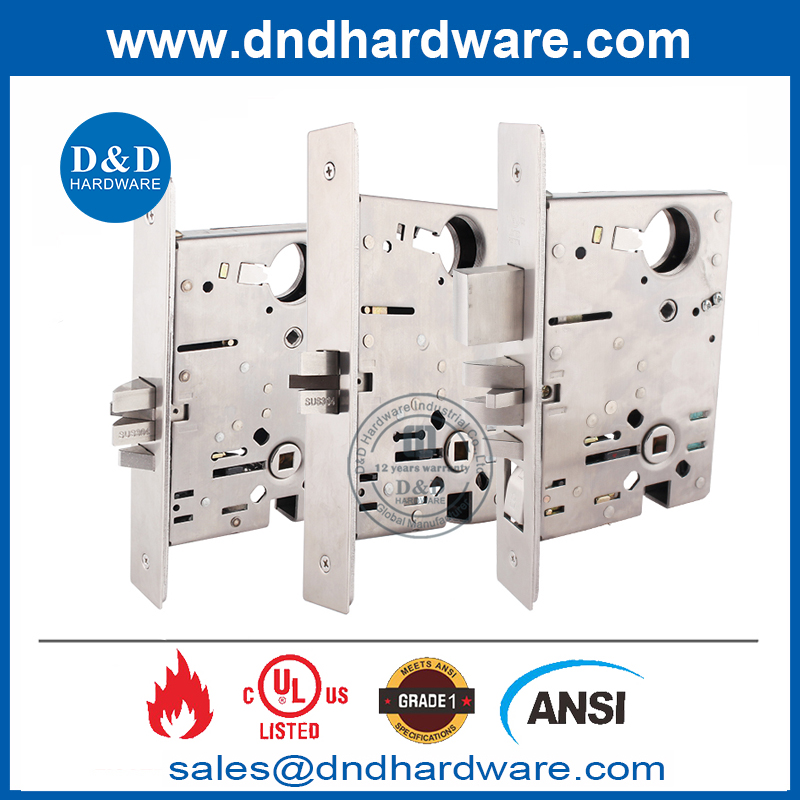
D&D HARDWARE's UL-listed ANSI mortise lock range includes commercial lock cases presented in multiple operating functions, including passage, entry, classroom, storeroom, and privacy configurations.
Relevant function designations in the range include:
These designations should be treated as starting points for model selection. Before approval or ordering, confirm:
The complete function sequence required at the opening
Whether F19 or F22 privacy behavior is intended
The exact D&D model and suffix
The model's UL certification scope
The applicable ANSI/BHMA evidence and referenced edition
Latchbolt, deadbolt, and auxiliary-latch construction
Cylinder, thumbturn, indicator, or emergency-release trim
Door thickness, preparation, handing, and strike
The required finish and lever design
Compatibility with the approved fire-door assembly
A request for "UL classroom lock" or "UL privacy mortise lock" does not provide enough information to identify the correct configuration.

Conclusion
Passage, entry, classroom, storeroom, and privacy mortise locks may look similar from the outside, but they create very different access conditions.
Passage provides unrestricted lever operation. Entry allows controlled switching between free access and locked access. Traditional classroom function places control at the corridor-side cylinder. Storeroom keeps the outside lever permanently inoperative. Privacy provides temporary occupant control and emergency access, with F19 and F22 using different locking mechanisms.
The correct function is the one whose complete operating sequence matches the opening—not simply the one whose name resembles the room.
After selecting the function, verify the exact model, ANSI/BHMA performance requirement, UL certification scope, door preparation, cylinder or privacy trim, and compatibility with the complete door assembly. This prevents a correct function name from being attached to the wrong physical lock.
Frequently Asked Questions
What is the simplest mortise lock function?
Passage, or F01, is the simplest of these functions. Either lever retracts the latchbolt, and there is no controlled locking function.
What is the difference between entry and classroom functions?
An entry function commonly allows the outside lever to be controlled from inside as well as by an outside key, depending on the design. A traditional classroom function changes the locked state using a key from the corridor side, preventing ordinary occupants from locking the outside lever from inside.
What is the difference between classroom and storeroom functions?
A classroom lock can be left unlocked so that the outside lever operates normally. A storeroom lock keeps the outside lever permanently inoperative, and every outside entry requires a key.
Does a storeroom lock automatically lock when the door closes?
The outside lever is always inoperative, so once the door closes and the latch engages, the opening is secure from outside without a separate relocking action.
Can a passage lock be used on a fire door?
A passage function can provide positive latching, but the exact lock model must be listed for the applicable fire-door use and compatible with the complete assembly. The F01 designation alone does not prove fire-door suitability.
Is a classroom lock always the safest lock for a classroom?
No. Traditional classroom function may require the user to secure the door from the corridor side. Current school security plans may require a function that can be locked from inside with an authorized credential while maintaining free egress. The decision must follow the project's security and code requirements.
What is the difference between F19 and F22 privacy locks?
F19 generally uses an inside thumbturn to project a separate deadbolt. F22 generally locks the outside lever without a separate deadbolt and may reset when the inside lever is operated or the door closes. The exact manufacturer sequence must be checked.
Is privacy function suitable for a storeroom?
No. Privacy locks are designed for temporary occupant privacy and normally include an emergency release. A storeroom function is intended to keep outside access under continuous key control.
Does UL listing mean the inside lever always allows exit?
Not by itself. Inside operation is determined by the lock function and the product construction. The selected lock must also comply with the egress requirements applicable to the opening.
Does an ANSI function number prove ANSI/BHMA Grade 1 performance?
No. The function number describes operation. Grade and compliance with a specific edition of ANSI/BHMA A156.13 must be stated and supported separately.
Should the hardware schedule include both the function number and description?
Yes. The number supports standardized identification, while the plain-language description confirms the intended operation and helps detect differences in manufacturer terminology.
Contact us Now:
Contact: David Jian
Mob:0086-139 2903 7292
Email: David@dndhardware.com, sales@dndhardware.com,
Contact: Jobby Zhang
Mob:0086-137 2599 9617
Email: jobby@dndhardware.com
D&D HARDWARE INDUSTRIAL CO.,LTD
ADD:12th Floor, Building 2, No.898, KeChuang Technical Zone, Jiangmen Avenue, Pengjiang District, Jiangmen City, Guangdong, China (Postcode:529000)
https://www.dndhardware.com
Tel: +86-750-3856396
Fax: +86-750-3856395


 English