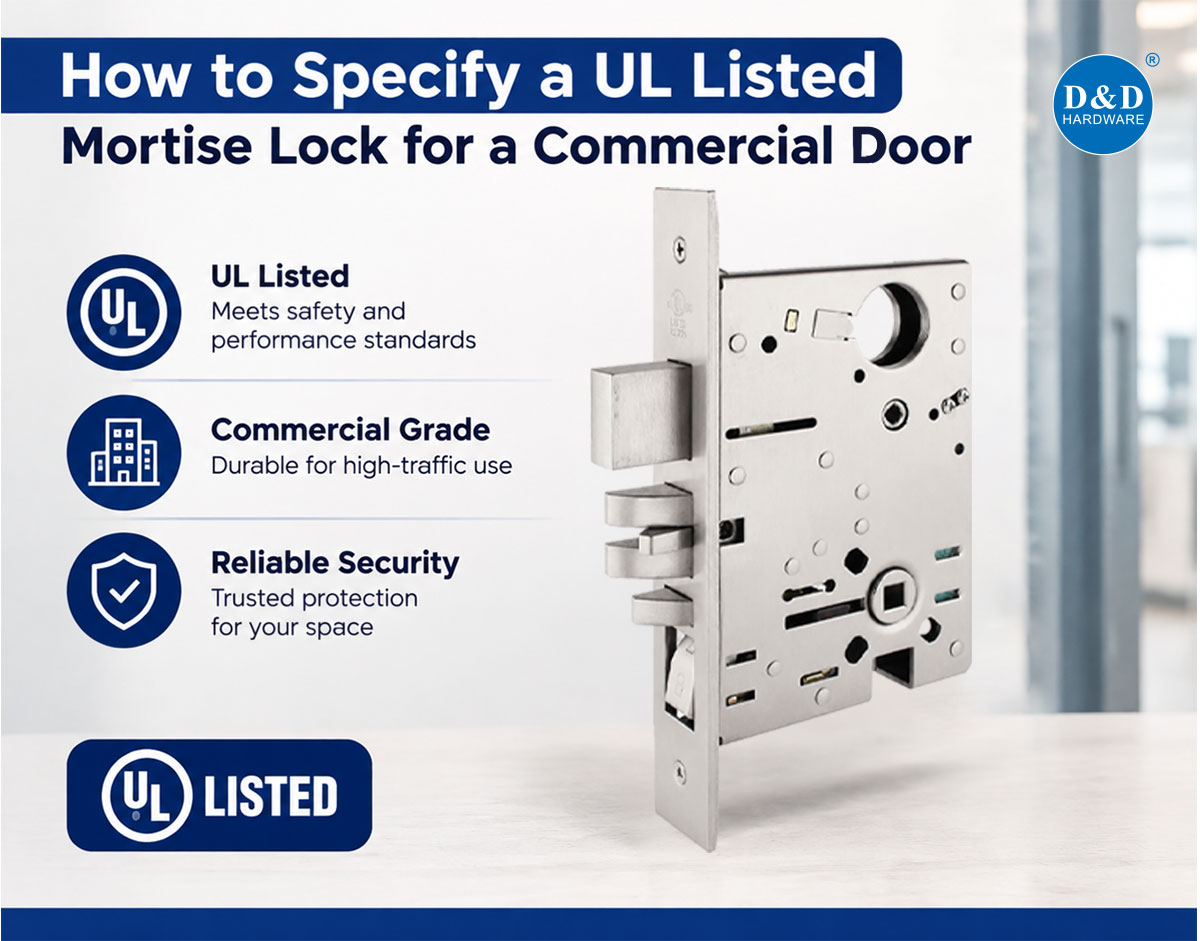
Specifying a mortise lock for a commercial door involves more than selecting a lock function and finish. The lock must match the fire rating of the opening, the door and frame preparation, the required security and egress sequence, the project's performance standard, and the cylinders and trim used throughout the building.
A specification that says only "UL listed mortise lock, Grade 1" leaves several important decisions unresolved. It does not identify the listed application, lock function, door thickness, backset, handing, trim, cylinder format, strike preparation, or documentation required for approval.
A more reliable specification starts with the opening—not the lock catalog.
Quick Specification Checklist
Before requesting a quotation or approving a submittal, confirm the following information:
| Specification item | Information to confirm |
| Opening type | Single door, active leaf of a pair, or another approved configuration |
| Door application | Fire-rated or non-fire-rated; wood or hollow metal construction |
| Required fire rating | Rating shown in the door schedule and applicable opening requirements |
| UL listing | Applicable listing, covered model, intended use, and installation limitations |
| Lock function | Passage, entry, classroom, storeroom, privacy, or another scheduled function |
| Performance standard | Required ANSI/BHMA standard, grade, and edition |
| Backset | Distance from the door edge to the operating spindle or cylinder centerline |
| Door thickness | Actual door thickness and permitted trim range |
| Handing | LH, RH, LHR, or RHR where the selected lock or trim requires it |
| Door bevel | Square edge or beveled edge |
| Trim | Lever design, rose or escutcheon, material, and finish |
| Cylinder | Cylinder type, length, keyway, keying system, and thumbturn requirement |
| Lock components | Latchbolt, auxiliary latch, deadbolt, armor front, and strike |
| Egress operation | Required inside release sequence and any prohibited locking condition |
| Documentation | UL listing information, test or compliance documents, templates, and installation instructions |
If any of these items remain unknown, the supplier may be able to provide only a budget estimate rather than a technically complete lock selection.

1. Start with the Door Schedule and Opening Requirements
The first step in specifying a UL listed mortise lock is to identify the opening where it will be installed. Review the architectural door schedule, hardware set, life-safety drawings, and project specification together.
At minimum, establish:
The opening number and location
The building occupancy and room use
Whether the door is part of a fire-rated assembly
The required door and frame rating
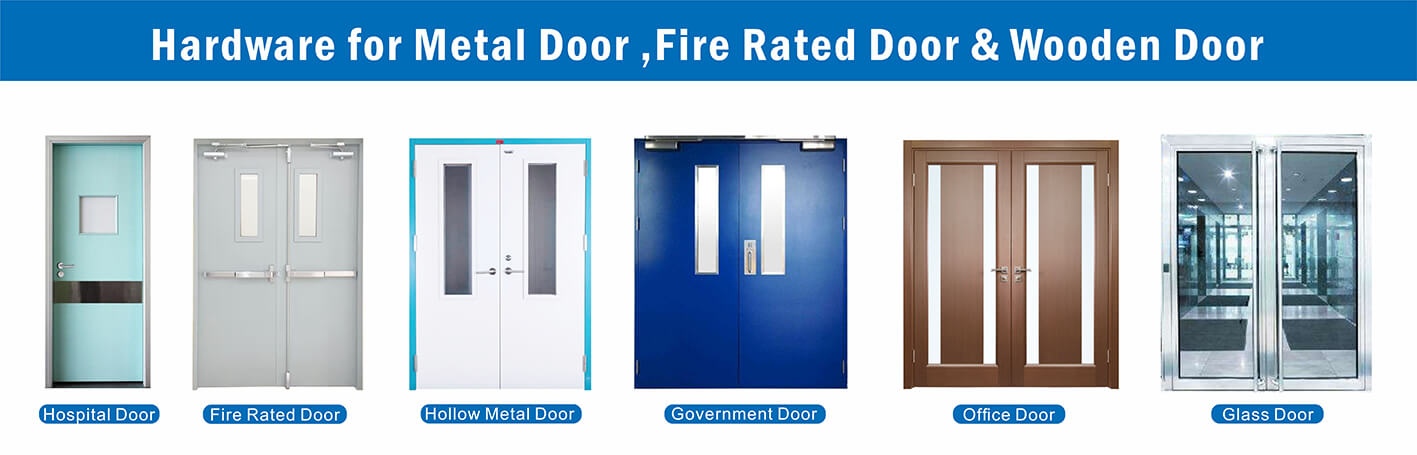
Whether the leaf is wood or hollow metal
Whether it is a single door or part of a pair
The direction of swing
The required security and egress operation
Any access-control interface
Applicable project, code, and authority requirements
Do not assign a fire rating based only on the type of building. A hotel guestroom door, hospital corridor door, stair enclosure door, electrical room door, and office entrance may require different hardware even when they are located in the same project.
The opening schedule and approved fire-door assembly should determine the requirement.
2. State What the UL Listing Must Cover
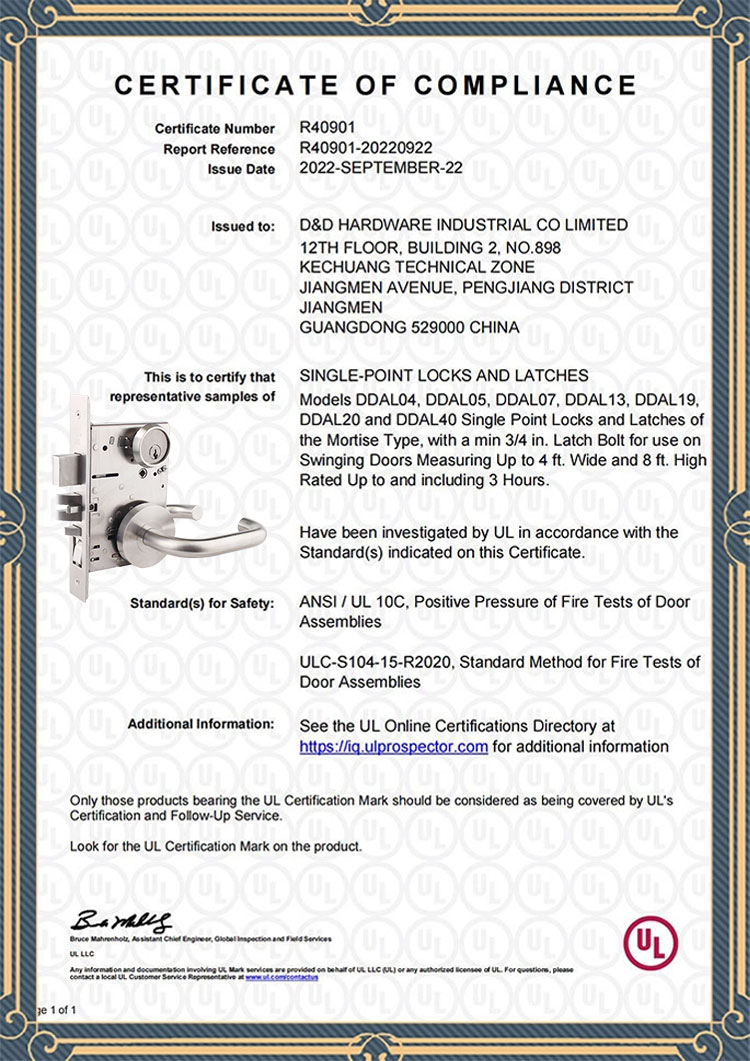
"UL listed" should not be used as a general synonym for commercial quality. In a fire-door specification, the relevant question is whether the particular mortise lock model is listed for the intended fire-rated application.
The specification should require the supplier to identify:
The UL-listed manufacturer
The UL file or certification reference
The exact model or model family
The product category and listed use
The applicable fire-test standard
The maximum rating or application covered
Any limitations concerning door construction, dimensions, installation, or hardware configuration
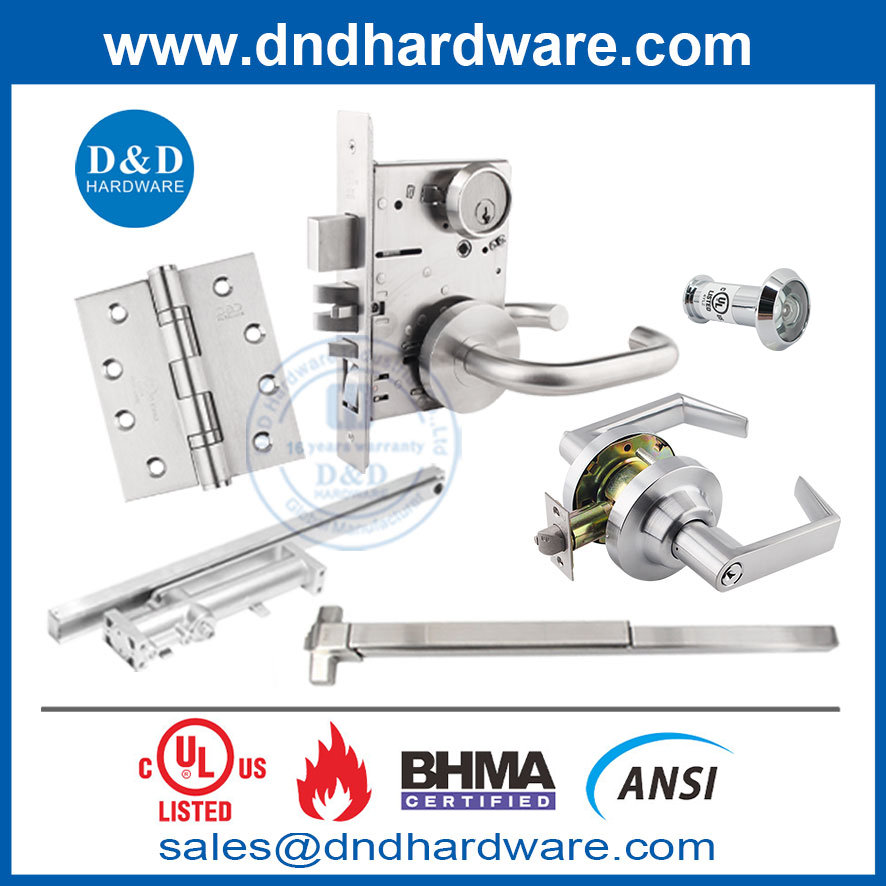
A catalog image carrying a UL logo is not enough to establish that every function, trim combination, or variation in the product range is covered. Certification must be traceable to the model proposed for the opening.
Readers who need a more detailed introduction can first review what a UL listed mortise lock means for fire door compliance. Certification verification procedures, label interpretation, and model-scope checks should be handled separately during submittal review.
3. Match the Lock to the Required Fire-Rated Application
The lock should be suitable for the fire rating and construction of the opening in which it will be installed. Do not assume that the highest fire rating stated in a brochure automatically applies to every door.
Confirm that the proposed configuration is compatible with:
The scheduled fire rating
The listed wood or hollow metal door construction
The door size and thickness
The preparation permitted by the door manufacturer
The frame and strike arrangement
The lock function and bolt configuration
The installation instructions associated with the listing
A three-hour-rated lock may be appropriate for some openings, but many commercial doors have different ratings. The correct requirement is the rating and application needed by the scheduled opening, not the highest available number.
The mortise lock is also only one component of the opening. A listed lock does not independently make an unapproved door, frame, closer, hinge, glazing system, or installation compliant. The complete door assembly and its hardware must remain compatible with the approved application.
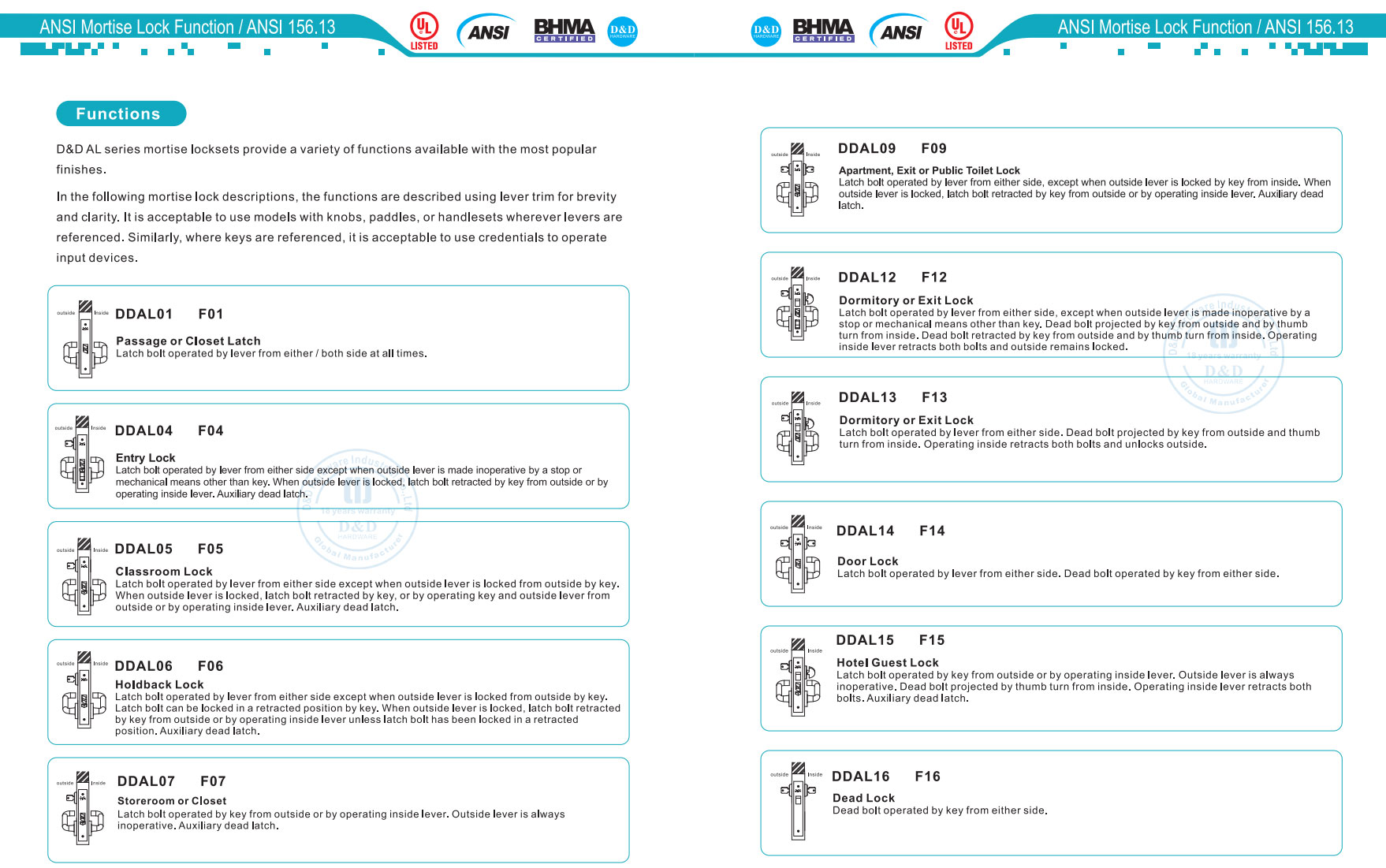
4. Define the Required Lock Function
The function determines how the outside lever, inside lever, key, thumbturn, latchbolt, and deadbolt interact. It should be selected from the intended operation of the door rather than from the room name alone.
Before assigning a function number, answer four practical questions:
Should the outside lever ever be locked?
Must the inside lever always permit immediate exit?
Is a deadbolt required?
How should authorized users lock or unlock the outside trim?
For example, an office, classroom, storeroom, and guestroom may all require different operating sequences. Two locks that look identical can behave very differently after the key is removed.
The hardware schedule should state both the recognized function designation and a plain-language operational description. The description prevents misunderstandings when project terminology, manufacturer numbering, or regional naming differs.
A suitable functional note might read:
Outside lever lockable and unlockable by key; inside lever always retracts the latchbolt for egress.
The detailed differences among passage, entry, classroom, storeroom, and privacy functions belong in a dedicated function-selection guide. At the specification stage, the priority is to record the exact operation required at the opening.
5. Specify the ANSI/BHMA Performance Requirement Separately
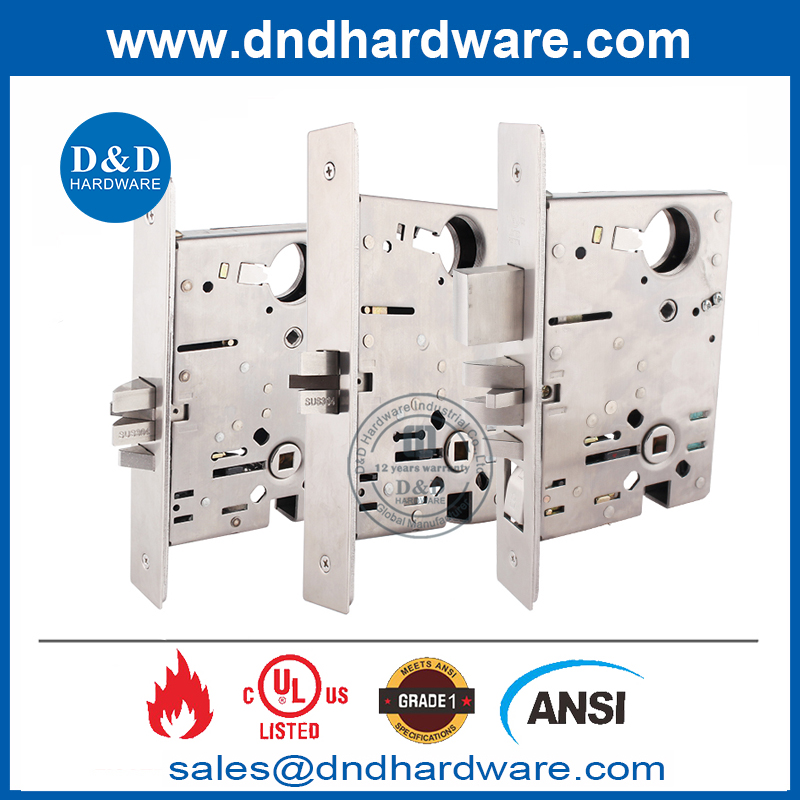
UL listing and ANSI/BHMA grading address different aspects of a mortise lock. One requirement should not be used as a substitute for the other.
For commercial mortise locks, the project may reference ANSI/BHMA A156.13. This standard addresses areas such as operation, strength, security, cycle performance, and dimensional criteria. If Grade 1 performance is required, write it explicitly.
The specification should also identify the required edition of the standard or state that the edition adopted by the contract documents applies. This matters when a manufacturer's existing test report references an earlier edition while the project specification references a newer one.
A clear requirement would be:
Mortise lock shall comply with ANSI/BHMA A156.13, Grade 1, using the edition required by the contract documents.
During submittal review, confirm that the supplied evidence supports that exact claim. Do not automatically describe a product as compliant with a newer edition merely because it was tested to an earlier version of the same standard.
6. Confirm Door Construction and Preparation
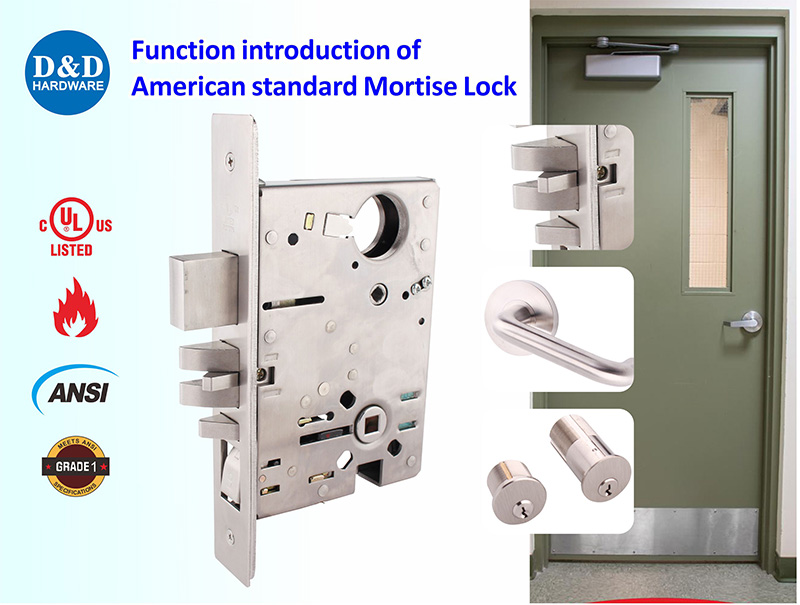
A mortise lock requires a pocket in the door edge and accurately positioned preparations for the spindle, cylinder, fasteners, trim, and strike. The available preparation depends on the door construction and manufacturer's approved template.
For the initial specification, identify:
Wood or hollow metal door
Actual door thickness
Factory-prepared or field-prepared opening
Required lock-case dimensions
Faceplate dimensions
Backset
Spindle and cylinder locations
Strike type and frame preparation
Any required reinforcement
Wood and hollow metal doors do not necessarily use the same preparation or fastening method. On a labeled fire door, changes made after manufacture may also be restricted by the door listing, installation instructions, and applicable field-modification procedures.
This article does not attempt to define every preparation difference. Those details should be checked against the approved door, frame, lock template, and listing before manufacturing begins.
7. Record Backset, Door Thickness, Handing, and Bevel
These basic dimensions are frequent causes of ordering errors.
Backset
Backset is the horizontal distance from the door edge to the relevant lock centerline. Commercial mortise locks commonly use established industry dimensions, but the specification should never rely on "standard backset" without stating the required value.
Confirm the backset against:
Door thickness
State the actual door thickness and confirm that the selected trim, spindle, cylinder, mounting screws, and lock case accommodate it. If several door thicknesses occur in the same project, separate them in the hardware schedule.
Handing
Record the door swing using the project's accepted handing convention. Depending on the lock design, the latchbolt may be reversible, but the lock function, case, armor front, or lever trim may still require handing information.
Do not assume that "reversible latchbolt" means the complete lockset is non-handed.
Door bevel
Identify whether the door edge is square or beveled. The lock front and strike alignment must suit the door and frame condition so that the latch engages without binding.
8. Select Compatible Lever Trim, Rose, or Escutcheon
The visible trim must be mechanically compatible with the lock case and appropriate for the project environment.
Specify:
Lever design
Rose or escutcheon format
Trim material
Finish code
Spindle arrangement
Fixing method
Return-to-door requirement, if applicable
Accessibility-related lever geometry required by the project
Compatibility with the selected function and cylinder
Do not select trim only from an appearance image. A lever designed for one spindle, fixing pattern, or lock platform may not fit another manufacturer's mortise case.
For high-use commercial openings, trim strength, attachment, corrosion exposure, and replacement availability can be as important as appearance.

9. Define the Cylinder and Keying Requirements
"Cylinder by others" often creates coordination problems unless the required cylinder format is identified.
The lock specification or hardware schedule should clarify:
Mortise cylinder type and required length
Keyway or interchangeable core format
Keyed alike, keyed different, or master-keyed operation
Construction keying requirements
Thumbturn location, where permitted
Cylinder finish
Cam compatibility
Whether permanent cores will be supplied separately
Cylinder length must match the door, trim, collar, and lock case. A cylinder that is too short may not engage correctly; one that projects excessively can create an appearance or security problem.
If the project uses a restricted or proprietary key system, coordinate the lock case and cylinder cam before the locks are ordered.
10. Specify Latchbolt, Deadbolt, and Strike Requirements
The bolt configuration must match both the selected function and the opening.
Review:
Latchbolt type and projection
Auxiliary deadlatching feature
Deadbolt requirement and projection
Strike dimensions
Strike lip and frame condition
Dust box or strike box requirement
Compatibility with a paired-door condition
Interaction with an electric strike, where applicable
A fire-rated door generally needs reliable positive latching, but this does not mean that every fire-door opening requires a deadbolt. The function, egress rules, door assembly, and project requirements determine whether a deadbolt is appropriate.
The strike should not be treated as a generic accessory. Incorrect strike geometry or poor alignment can prevent the latchbolt from fully engaging even when the correct lock case has been selected.
11. Check Egress and Access-Control Conditions
A mechanically correct lock can still be unsuitable if its operating sequence conflicts with the required means of egress.
Confirm:
How occupants release the door from the egress side
Whether one releasing operation is required
Whether a key, tool, or special knowledge is prohibited on the egress side
Whether the opening is part of an exit enclosure
Whether panic or fire-exit hardware is required instead of a conventional mortise lock
Whether the lock will interact with access control
The required behavior following power loss or fire-alarm activation
An electrified mortise lock, delayed-egress arrangement, stairwell re-entry condition, or access-controlled opening requires additional coordination. Do not convert a mechanical lock specification into an electrified application by adding only a voltage or "fail-safe/fail-secure" note.
Where the opening requires panic or fire-exit hardware, a standard mortise lock may not be the correct product category at all.
12. Include Material, Finish, and Environmental Conditions
The specified finish should coordinate with the rest of the door hardware, but finish alone does not define material or corrosion performance.
State:
Base material where it is project-critical
Architectural finish designation
Interior or exterior location
Exposure to humidity, salt, cleaning chemicals, or industrial contaminants
Required corrosion or finish performance
Need for matching visible components
Stainless steel components may be appropriate for demanding commercial environments, but the complete lock contains more than its faceplate and lever. Ask the supplier which internal and external components use the stated material and what protection is provided for the lock case, springs, fasteners, and cylinder.
13. Require a Complete Submittal Package
The submittal should allow the consultant, contractor, door manufacturer, and inspector to determine whether the proposed lock matches the scheduled opening.
Request:
Product data sheet
Exact model and function designation
UL listing or certification reference
UL file number
Evidence showing that the submitted model is within the certified scope
Fire-rated application information
ANSI/BHMA compliance documentation
Door preparation template
Installation instructions
Trim and cylinder details
Handing chart
Finish information
Maintenance instructions
Schedule cross-reference showing each opening where the model will be used
A general certificate bearing the manufacturer's name is not a substitute for a model-specific submittal. The documentation must connect the proposed product to the certification and to the opening.

Common Mortise Lock Specification Mistakes
Writing only "UL certified"
This does not identify the product category, covered model, fire-rated application, or limitations.
Treating one listing as approval for every model
Different functions, cases, trims, or bolt arrangements may not automatically fall within the same certification scope.
Using UL listing and Grade 1 interchangeably
UL fire-related certification and ANSI/BHMA mechanical performance grading do not establish the same characteristics.
Specifying a function by room name only
"Classroom," "office," and "store" can be interpreted differently. Include the required operating sequence.
Omitting the standard edition
A supplier may submit evidence referencing an edition different from the one required by the project.
Assuming all locks use the same preparation
Backset, case dimensions, cylinder positions, faceplates, strikes, and fastener locations can differ.
Ignoring the cylinder until after the lock is ordered
Cylinder length, cam, keyway, and interchangeable-core format must be compatible with the selected lock case and trim.
Selecting the highest fire rating without checking the application
A large rating printed on a data sheet does not prove that the submitted configuration is suitable for the specific door assembly.
Allowing field preparation without review
Unapproved modifications to a labeled door can create inspection and compliance problems.
Information to Send with a Request for Quotation
A technically useful RFQ should include:
| RFQ field | Example of the required information |
| Project and opening | Building name and opening number |
| Quantity | Quantity by function and finish |
| Door type | Wood or hollow metal |
| Door rating | Rating shown in the approved schedule |
| Door dimensions | Width, height, and thickness |
| Door handing | LH, RH, LHR, or RHR |
| Function | Function number plus operational description |
| Performance | Required ANSI/BHMA grade and edition |
| UL requirement | Applicable listed fire-door application |
| Preparation | Backset, faceplate, and strike dimensions |
| Trim | Lever, rose or escutcheon, material, and finish |
| Cylinder | Type, length, keyway, core format, and keying |
| Documentation | Listing evidence, compliance documents, template, and instructions |
| Special conditions | Exterior exposure, access control, paired doors, or replacement work |
Providing this information at the beginning allows the manufacturer to identify conflicts before pricing, sampling, or production.
Specifying D&D Commercial Mortise Locks
D&D HARDWARE offers UL-listed ANSI mortise locks for commercial door applications, including multiple functions for wood and metal doors. Available product information includes UL-listed and ANSI/BHMA Grade 1 configurations, stainless steel construction, commercial backset options, and lever, cylinder, and finish choices.
However, selection should still be made opening by opening. Before approval, D&D can review the door schedule, required function, fire rating, door construction, dimensions, trim, and cylinder requirements and provide the corresponding model information and technical documents.
Sending a complete opening schedule is more reliable than requesting a general "UL mortise lock," because it allows the proposed configuration to be checked against both the project requirements and the available product scope.
Frequently Asked Questions
What information is most important when specifying a UL listed mortise lock?
Start with the fire-rated opening, required lock function, ANSI/BHMA performance requirement, door construction, backset, door thickness, handing, trim, cylinder, and required submittal evidence. A certification claim without these details is not a complete specification.
Does every commercial door require a UL listed mortise lock?
No. The requirement depends on the door assembly, applicable codes, contract documents, and authority requirements. Fire-rated openings commonly require appropriately listed hardware, while a non-rated interior opening may be governed mainly by function, durability, security, and accessibility requirements.
Is a UL listed mortise lock automatically ANSI/BHMA Grade 1?
No. UL listing and ANSI/BHMA grading are separate requirements. If the project needs both, both must be stated and supported by appropriate documentation.
Can the same mortise lock be used on wood and hollow metal doors?
A model may be available for both, but its suitability depends on the listed application, door preparation, reinforcement, fasteners, strike, and manufacturer's instructions. Do not assume that the same installation method applies to both door types.
Should the specification always require a three-hour-rated mortise lock?
Not automatically. Specify the rating and listed application required by the opening. A higher published rating does not eliminate the need to confirm model scope and compatibility with the door assembly.
What should be checked before approving the submittal?
Match the manufacturer, file reference, exact model, function, rating, ANSI/BHMA requirement, dimensions, handing, trim, cylinder, strike, and installation documentation to the hardware schedule and door preparation. Any mismatch should be resolved before procurement.
Contact us Now:
Contact: David Jian
Mob:0086-139 2903 7292
Email: David@dndhardware.com, sales@dndhardware.com,
Contact: Jobby Zhang
Mob:0086-137 2599 9617
Email: jobby@dndhardware.com
D&D HARDWARE INDUSTRIAL CO.,LTD
ADD:12th Floor, Building 2, No.898, KeChuang Technical Zone, Jiangmen Avenue, Pengjiang District, Jiangmen City, Guangdong, China (Postcode:529000)
https://www.dndhardware.com
Tel: +86-750-3856396
Fax: +86-750-3856395

 English