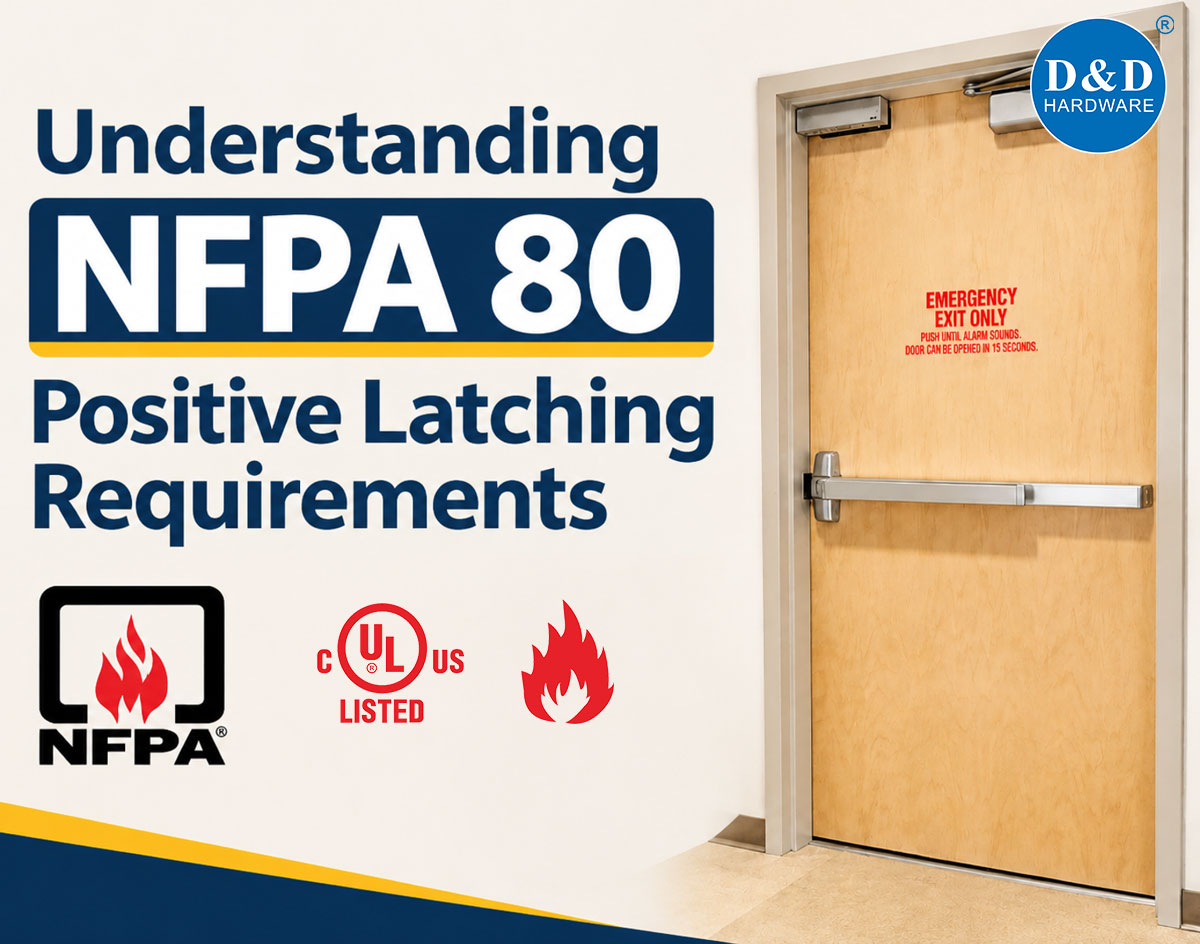
A fire door can swing shut and still fail at the last fraction of an inch. The latch bolt touches the strike, the leaf looks closed, and nobody notices that the bolt never engaged. Positive latching addresses that final step: the assembly must close and secure itself in the position needed to protect the opening. The result depends on the latch, strike, door alignment, closing force and—in a pair—the order in which the leaves meet.
This guide explains what positive latching means for a typical swinging fire door with builders hardware, how to verify it on site and what specifiers should check when selecting mechanical hardware. NFPA 80 governs the installation and maintenance of the rated assembly; the adopted building and life safety codes establish where a rated opening and particular egress hardware are required. The applicable edition, product listings and approved design control the details for a given project.

What Positive Latching Means in Practice
A self-latching device secures the fire door when it closes without someone turning a key, throwing a bolt or giving the leaf a final push. In a common single-leaf opening, a spring latch bolt enters and engages the strike. In an opening with fire exit hardware, the listed device’s latches engage their intended strikes. Other listed arrangements exist, so the required configuration must be checked against the door and hardware listings rather than reduced to one lock type.
The purpose is to keep the leaf closed when a fire creates pressure and heat. A door that is merely resting against its stop can open or separate from the frame. The question at an inspection is therefore operational: when the door is released from an open position, does it close fully and do the latches engage securely without assistance? Pulling gently at the latch edge after closure and observing the bolt and strike can help reveal a missed latch, subject to the applicable inspection procedure.
A roller catch, magnetic catch or a deadbolt that someone has to throw is not a direct substitute for an ordinary self-latching device on a fire door. Some code-recognized or specifically listed alternative arrangements can become positively latched under defined fire conditions, but their approval and operation depend on the adopted edition and the complete system. They should not be inferred from a generic product description or added as an improvised field fix.
The Latch and Strike Must Work Together
Engagement and latch throw
The bolt needs enough projection and actual engagement with the correct strike to remain secured under the opening’s listed conditions. There is no single minimum throw to apply to every fire door. Required dimensions may depend on the door material, construction, rating, size, hardware and label or manufacturer listing. A published lock case dimension alone does not prove adequate engagement once the door and frame are installed.
Check the door label and the door and hardware manufacturers’ instructions for the required latch bolt length and compatible strike. The Steel Door Institute notes that minimum latch bolt length can vary by construction and manufacturer listing. Measure what the installed bolt actually achieves after the leaf closes; a strike lip, excessive gap or a leaf that sits proud can reduce engagement below the intended condition.
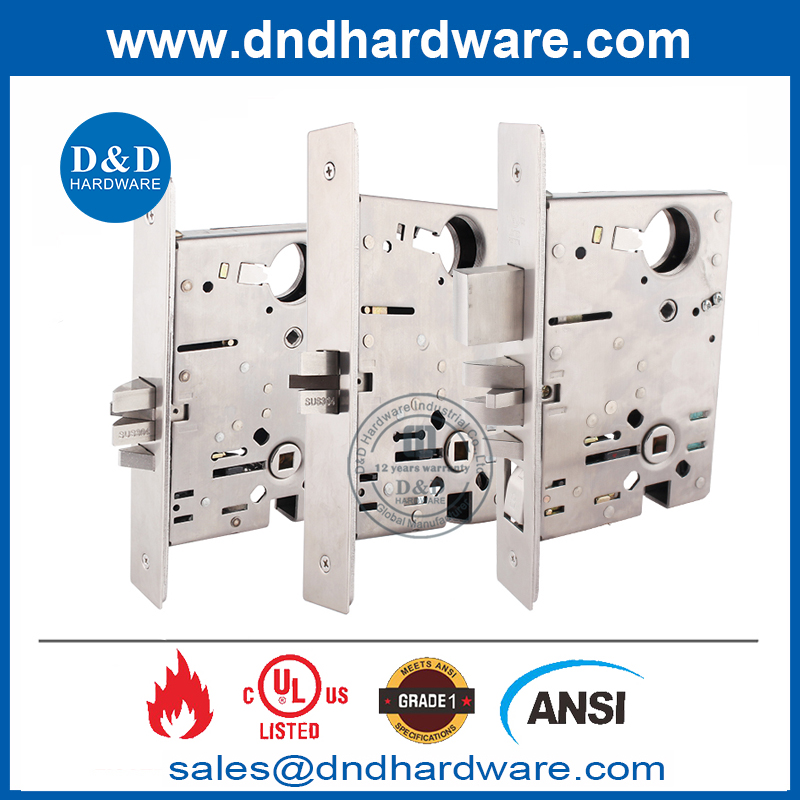
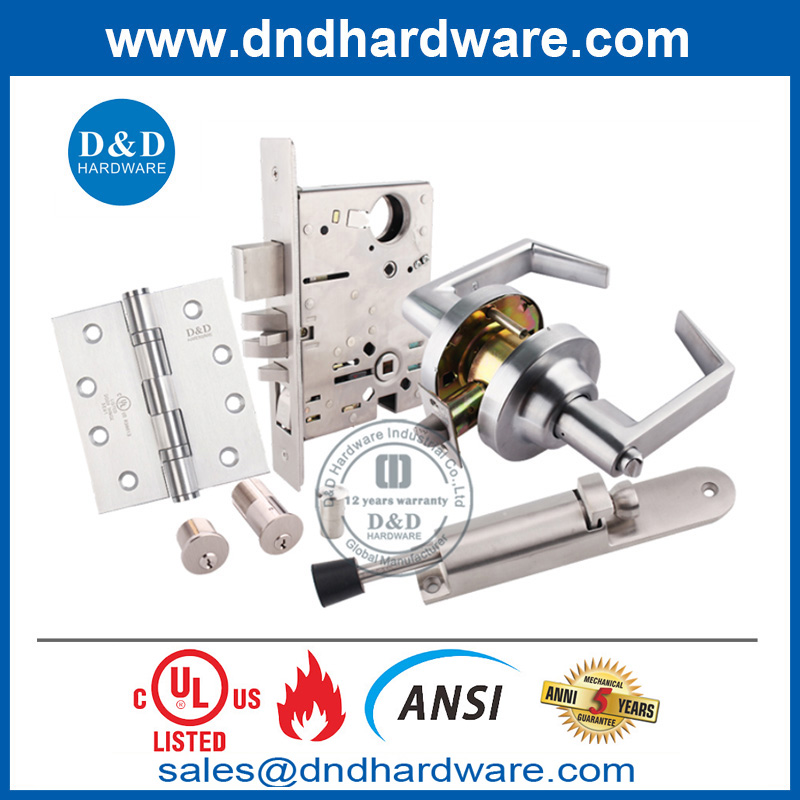
D&D’s UL 10C mortise lock range includes products associated with UL File R40901. For a rated opening, specify the exact lock function, bolt and strike that suit the labeled door and frame, then check the installed engagement. The listing of a lock supports its stated use within a compatible assembly; it does not automatically certify an arbitrary strike or modified frame.
Alignment, gaps and strike preparation
A door may latch reliably during a shop demonstration and fail on site because the frame is out of square, the leaf has dropped, the strike is offset or new seals add resistance. Diagnose the cause rather than filing the strike opening until the bolt just slips in. Unapproved cutting of a labeled frame can create a separate compliance problem, while a larger opening may allow the bolt to disengage more easily.
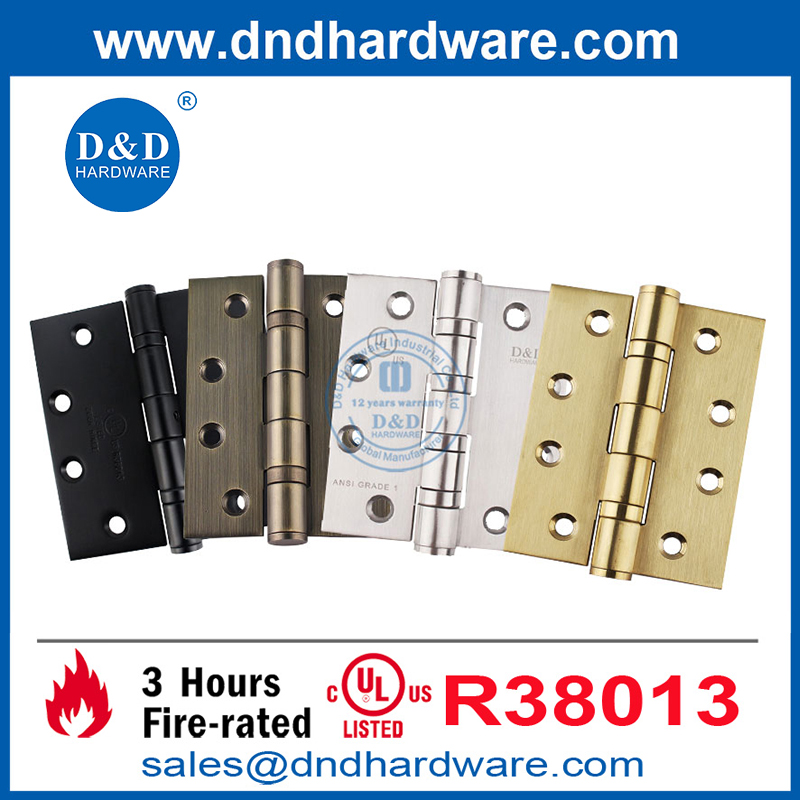
Inspect the hinge side, door sag, frame anchors, gaps and strike fastening. D&D’s UL listed door hinges associated with File R38013 are one component option for compatible assemblies; their correct size, quantity and fastening help hold the leaf in alignment. Replacing hinges alone will not correct a distorted frame or an incorrectly located strike.
The Closer Must Deliver the Door to the Latch
Positive latching is an assembly result, not a lock feature in isolation. A closer has to move the leaf through the final part of its travel and overcome the resistance of the latch, gasketing and ordinary pressure conditions while still meeting applicable accessibility and egress requirements. Too little latch action leaves the bolt on the strike lip. Excessive force can make the door difficult to use or cause impact and wear without solving misalignment.
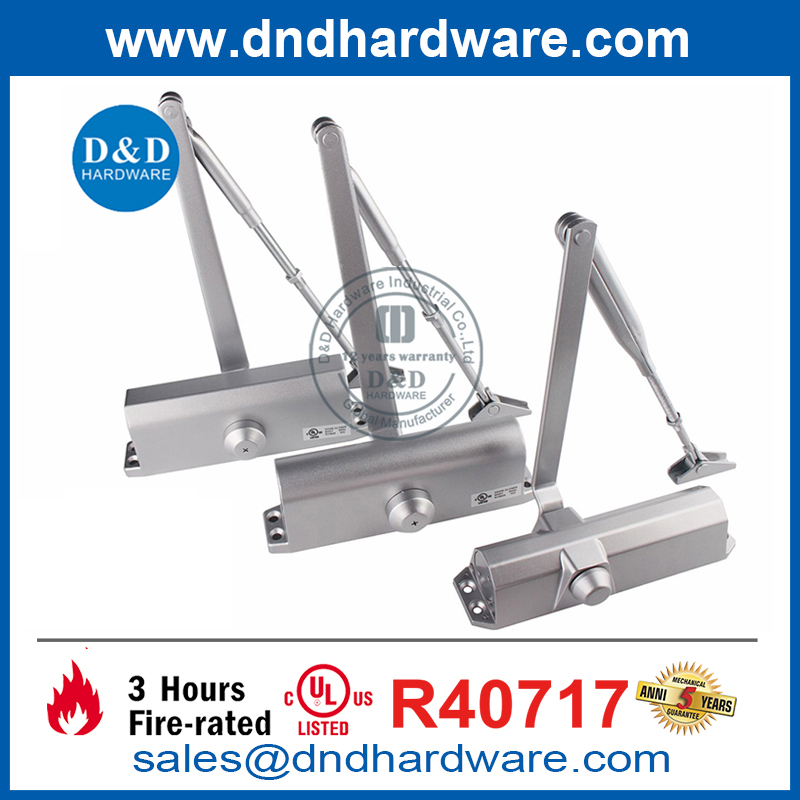
Select a closer for the actual leaf size, weight and mounting arrangement. Adjust it under the manufacturer’s instructions, with the seals and final floor conditions in place. D&D supplies UL 10C door closers associated with File R40717 for compatible rated openings. The commissioned closer should return the installed door to the closed, latched position; its certification or a successful empty-frame test is not enough.
Test more than a full-width swing. Release the door from representative open positions, including a smaller opening that provides less momentum. Where the adopted inspection procedure specifies test positions or methods, follow those instructions. Keep hands off the leaf during the final closing movement so the result reflects the closer and latch rather than the inspector’s push.
Pairs of Fire Doors Need a Defined Closing and Latching Sequence
On a pair, the active leaf may latch to the frame, to the inactive leaf or through the listed exit-device arrangement. The inactive leaf may have flush bolts or other approved retention. An overlapping astragal or projecting latch bolt can prevent the inactive leaf from reaching its closed, latched position if the active leaf gets there first. In that design, a coordinator is needed to hold the active leaf back until the inactive leaf closes. Other listed pair configurations may be designed without an astragal or coordinator, so the hardware schedule and door listing matter.
D&D door coordinators can be considered where a pair’s approved arrangement requires sequencing. Verify placement, durability and compatibility with the closers, strikes, astragal and inactive-leaf hardware. A coordinator is not a replacement for the latch or for correcting a sagging leaf.
To test the pair, open both leaves enough to activate the sequence and release them without assistance. Observe the inactive leaf close and engage as designed, then the active leaf; repeat with each leaf operated in normal use. Verify that the approved egress function is available from the required leaves. Manual flush bolts and automatic flush bolts have different use restrictions, particularly on egress doors; do not specify one solely because it can hold the inactive leaf shut.

Fire Exit Hardware Has Its Own Latching Conditions
When the adopted egress code calls for an exit device on a rated door, the device must be suitable as fire exit hardware for the fire-door application. Its latch or latches must engage the listed strikes while occupants can release the door as required. A UL 305 panic device identified for a non-rated exit is not interchangeable merely because the push bar looks similar. Mechanically holding fire exit latches retracted defeats the required latching function and is not an ordinary convenience setting for a fire door.
D&D identifies UL 10C fire exit hardware associated with File R40486, separately from UL 305 panic hardware associated with File SA45817. Verify the exact ordered device, its fire-door and egress certifications where required, strikes, rods and accessories. The file number is a starting point for model-level verification, not proof that every device in a category fits every door or pair.
Why a Fire Door Fails the Latching Check
· The latch bolt is taped back, a latch retraction feature is left engaged, or the strike is missing or loose.
· Hinge wear has dropped the leaf, moving the bolt below the strike opening.
· The closer stops short or lacks enough properly adjusted latch action to overcome seal friction.
· Paint, debris, a bent strike or a poorly fitted gasket obstructs the last part of the closing travel.
· An active leaf in a pair closes first and blocks the inactive leaf, or the inactive leaf’s retention does not engage.
· A replacement lock or exit device has a different bolt, strike or mounting geometry from the approved arrangement.
These conditions need different remedies. Document exactly what the door does, then compare the observed condition with the approved hardware set and listing. Avoid treating every missed latch as a closer problem. Increasing spring power may push a binding leaf harder into a frame without restoring the required engagement.
A Useful Site Check for Specifiers and Facility Teams
Identify the opening and its rating, confirm the door and frame labels, and review the approved latch and strike combination. Observe closure from representative positions without pushing the leaf. Look and listen for latch engagement, then verify that the door resists normal opening without operating the releasing hardware. On pairs, exercise both leaves and confirm their designed sequence and retention. Check that no person can defeat the latch with a routine wedge, tape or unauthorized dogging setting.
If a defect is found, note the opening ID, failure mode and conditions at the time of the test. A competent person should correct the source, using compatible listed hardware and permitted installation methods, and inspect and test the assembly after repair. Keep the work order and retest record together. NFPA 80 inspection frequency and full inspection criteria are separate topics; this targeted latching check supplements, rather than replaces, the required assembly inspection.

Frequently Asked Questions
Does a closed-looking fire door satisfy positive latching?
No. The latch must actually engage its intended strike or the approved latching arrangement must achieve its required state. A leaf resting against the stop can fail even when the gap is hard to see.
Is a deadbolt enough on a typical self-closing fire door?
A manually operated deadbolt does not normally create the self-latching result when the door simply closes. Use the listed arrangement and required egress function specified for that opening; exceptional arrangements require project-specific verification.
What is the required latch bolt throw?
There is no one-size value. Check the door label, construction and listing, together with the hardware and manufacturer instructions. Verify actual engagement with the installed strike.
Does every pair of fire doors need a coordinator?
No. A coordinator is required when the approved pair configuration needs a particular closing order, such as where an astragal or projecting latch would otherwise interfere. Other listed configurations can operate differently.
Can a closer be adjusted until a misaligned door latches?
The closer should be adjusted correctly, but it should not conceal an alignment, strike, hinge or seal defect. Investigate the underlying cause and confirm consistent latching without an excessive impact.
Applicable Edition and Authority
Code requirements vary by jurisdiction and adopted edition. Confirm the NFPA 80 edition in force, referenced building and life safety codes, local amendments, approved door and hardware schedules, manufacturer instructions and product listings with the authority having jurisdiction (AHJ). The 2025 edition of NFPA 80 is published, but a project may be governed by an earlier adopted edition. Any special latching arrangement must be verified for that actual opening.

Contact us Now:
Contact: David Jian
Mob:0086-139 2903 7292
Email: David@dndhardware.com, sales@dndhardware.com,
Contact: Jobby Zhang
Mob:0086-137 2599 9617
Email: jobby@dndhardware.com
D&D HARDWARE INDUSTRIAL CO.,LTD
ADD:12th Floor, Building 2, No.898, KeChuang Technical Zone, Jiangmen Avenue, Pengjiang District, Jiangmen City, Guangdong, China (Postcode:529000)
https://www.dndhardware.com
Tel: +86-750-3856396
Fax: +86-750-3856395


 English