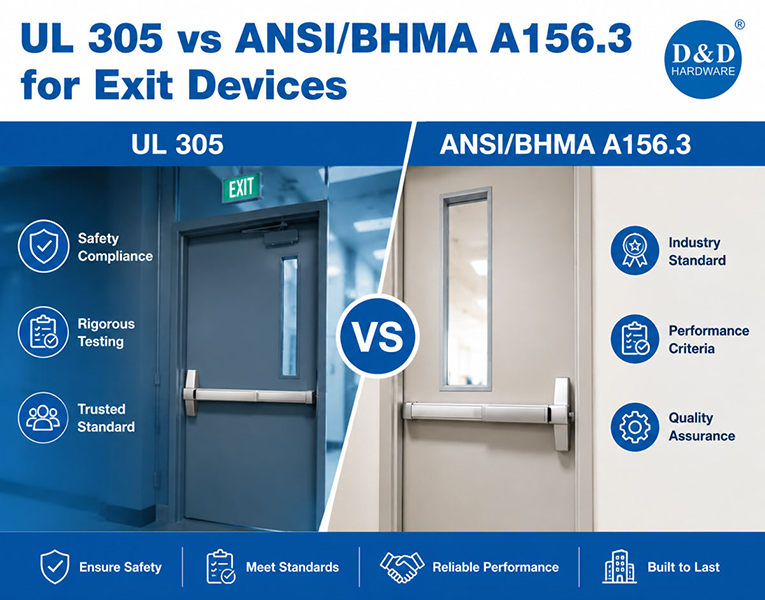
In commercial door hardware specification, misinterpreting standards often leads to compliance failures and costly field revisions. While both UL 305 and ANSI/BHMA A156.3 apply to commercial exit devices, they evaluate entirely different engineering parameters.
·UL 305 focuses strictly on life safety and panic release functionality during emergency egress.
·ANSI/BHMA A156.3 establishes mechanical durability, cycle life, strength, and finishing standards.
Understanding how UL 305 vs ANSI/BHMA A156.3 interact—along with fire-test standard UL 10C—is critical for architectural ironmongers, hardware consultants, and commercial builders.

What Is UL 305? The Life Safety Standard
UL 305 (Standard for Panic Hardware) governs releasing devices installed on outward-swinging doors within primary means of egress. Its fundamental purpose is ensuring unhindered emergency evacuation without requiring keys, specialized tools, or prior knowledge.
Egress Code Compliance -> UL 305 Investigation -> UL Category FVSR (Panic Hardware) |
Core UL 305 Design & Safety Criteria:
· Actuating Element Span: The push pad or crossbar must extend across at least half the width of the door leaf.
· Low Release Force: Unlatching must occur under limited force applied in the direction of exit travel.
· Reliable Emergency Unlatching: Mechanics must prevent binding during building movement or physical pressure on the door.
Under UL Solutions product category FVSR, devices passing this test earn a UL listed exit device rating strictly for life safety egress. However, a standard UL 305 panic device is not inherently rated for fire-rated door assemblies.
What Is ANSI/BHMA A156.3? Mechanical & Operational Performance
While UL 305 certifies emergency opening, ANSI/BHMA A156.3 (Exit Devices) evaluates the mechanical endurance and overall construction quality over a product's lifecycle. Updated under ANSI/BHMA A156.3-2025, this standard covers the entire hardware system, including exit devices, exterior trim, removable mullions, automatic flush bolts, carry-open bars, and coordinators.
Mechanical Evaluation Protocols Under A156.3:
1. Cycle Endurance Testing: Evaluates mechanical wear over hundreds of thousands of operations (e.g., Grade 1 requires 1,000,000 cycles).
2. Structural & Security Testing: Verifies tensile strength, latch retention, and lever torque resistance.
3. Operational Dynamics: Tests force-to-latch, force-to-release, and trim operation ergonomics.
4. Material & Finish Quality: Evaluates corrosion resistance on architectural finishes and exterior trims.
Where UL 305 answers "Will the door open during a panic?", ANSI/BHMA A156.3 answers "How many years will the device operate reliably in high-traffic commercial facilities?"

UL 305 vs ANSI/BHMA A156.3: Side-by-Side Comparison
Evaluation Parameter | UL 305 Standard | ANSI/BHMA A156.3 Standard |
Primary Scope | Life safety, egress release, panic hardware | Mechanical performance, durability, grade classification |
Governing Focus | Immediate emergency release under panic conditions | Long-term operational reliability & structural integrity |
Tested Hardware | Push pads, crossbars, releasing paddles | Panic hardware, exterior trim, mullions, coordinators |
Cycle & Wear Limits | Minimum functional baseline within UL investigation | Formal Grade 1, 2, or 3 cycle certifications (up to 1M+ cycles) |
Fire Door Application | Requires supplementary UL 10C positive-pressure testing | Optional reference; applies to both fire and non-fire exit hardware |
UL Category Code | Category FVSR (Panic Hardware) | Optional reference listed under individual UL certifications |
Key Distinction: Does a UL 305 Listing Mean A156.3 Compliance?
No. A common specification error is assuming a UL listed commercial door hardware item automatically fulfills ANSI/BHMA performance grades.
UL Solutions explicitly clarifies that panic hardware is evaluated to UL 305 as a baseline. If a device undergoes supplemental testing against ANSI/BHMA A156.3, that compliance is separately denoted in its individual UL Listing directory.
Specification Checklist:
[ ] UL 305 (Panic Egress Compliance)
[ ] ANSI/BHMA A156.3 Grade (Mechanical Cycle/Durability Requirement)
[ ] UL 10C (Fire Rating - if applicable) |
If a project specification mandates Grade 1 operational durability, specifiers must review the manufacturer's official UL Listing card rather than relying solely on a basic "UL Listed" stamp.
Panic Hardware vs Fire Exit Hardware: The UL 10C Connection
A critical distinction in commercial fire door hardware specification is separating panic hardware from fire exit hardware.
1. Panic Hardware (UL Category FVSR)
·Designed purely for egress on non-fire-rated outward-swinging doors.
·Mechanical Dogging Permitted: Features mechanical hold-back mechanisms (dogging keys) to keep latches retracted during normal business hours.
2. Fire Exit Hardware (UL Category GXHX)
·Evaluated under both UL 305 (panic egress) and UL 10C (positive-pressure fire test) for fire-rated assemblies.
·No Mechanical Dogging: Mechanical latch hold-back is strictly prohibited by fire codes to ensure full latch engagement during a fire event.
· Electrified Latch Retraction: If latch hold-back or remote control is necessary on fire rated exit hardware, it must use an electrified system linked directly to the facility's fire alarm control panel (FACP).
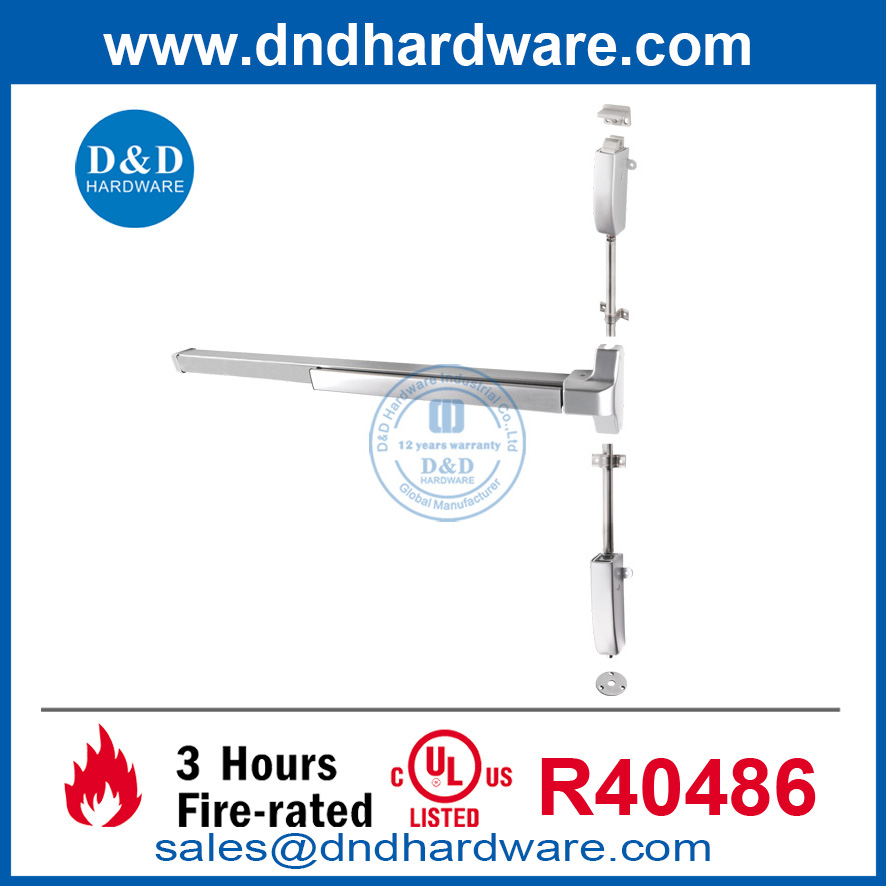
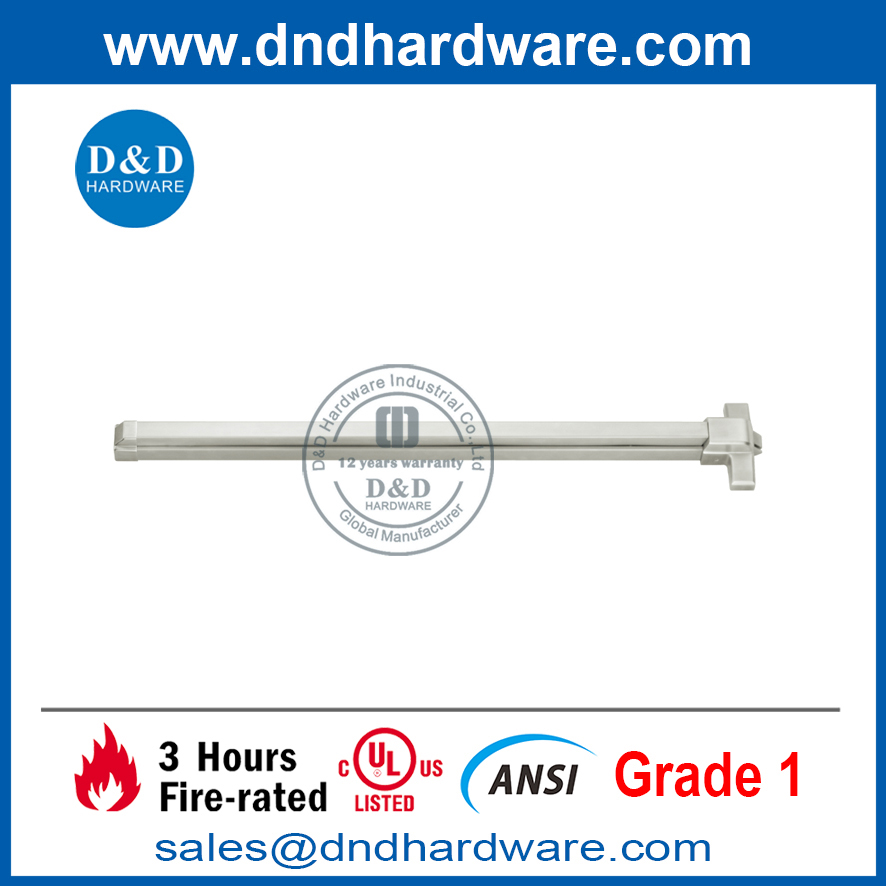

Manufacturer Example: D&D UL Exit Hardware Certifications
To illustrate how these standards are documented in real-world technical files, consider D&D Hardware’s third-party certified commercial door hardware:
D&D Egress & Fire Door Package Capabilities:
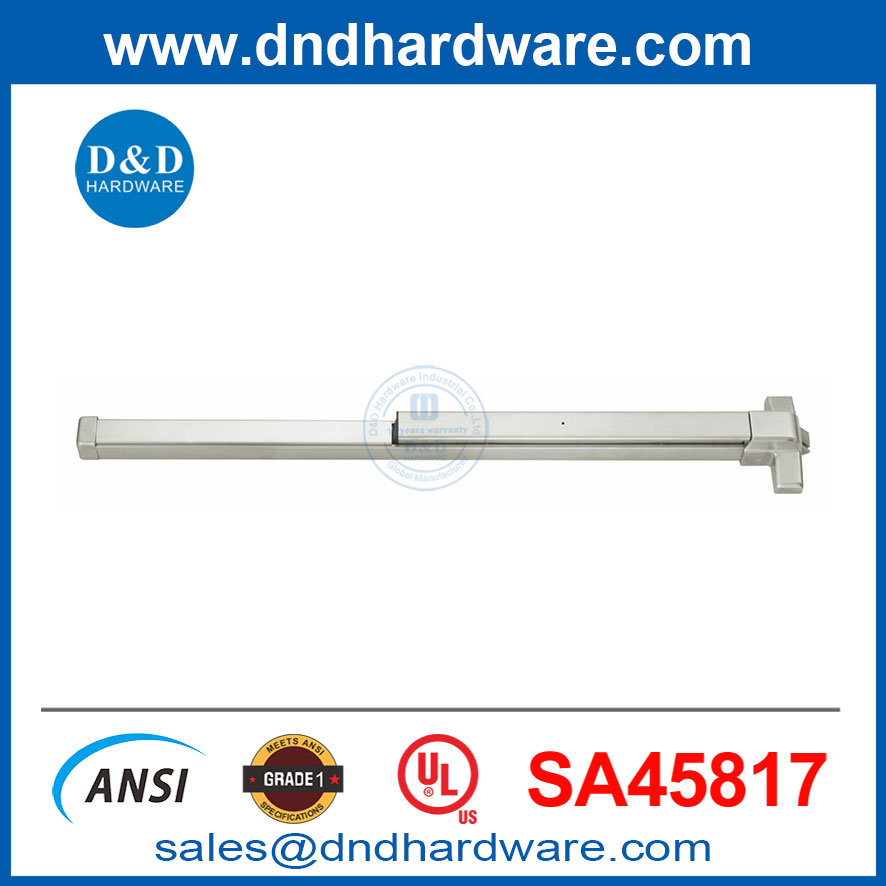
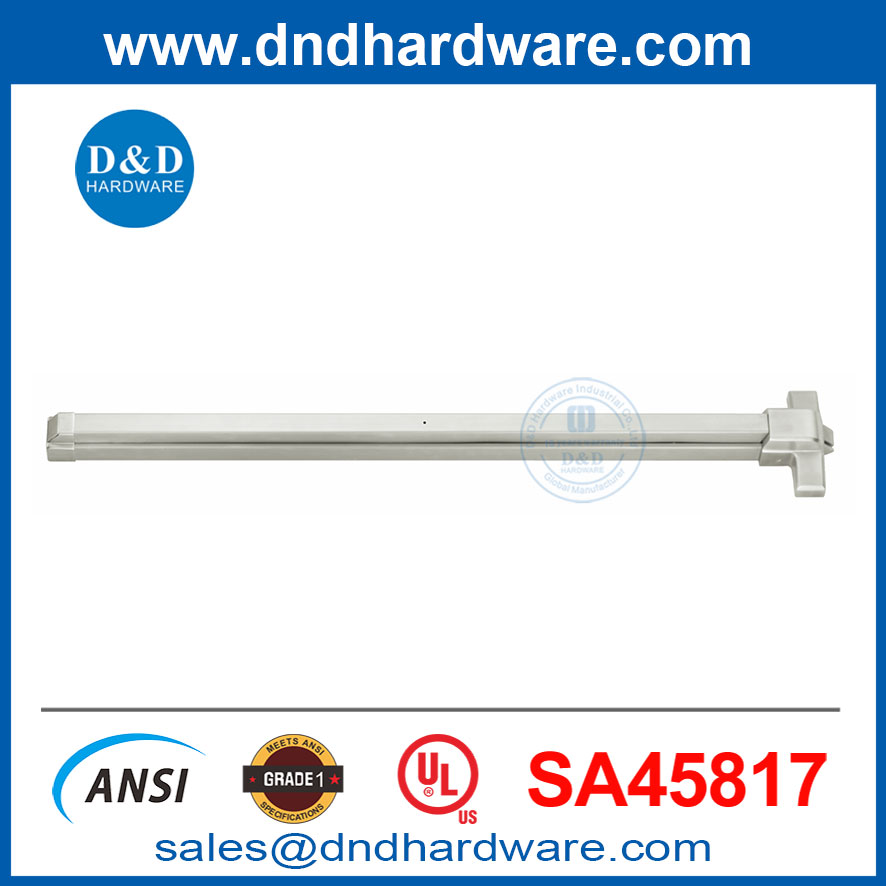
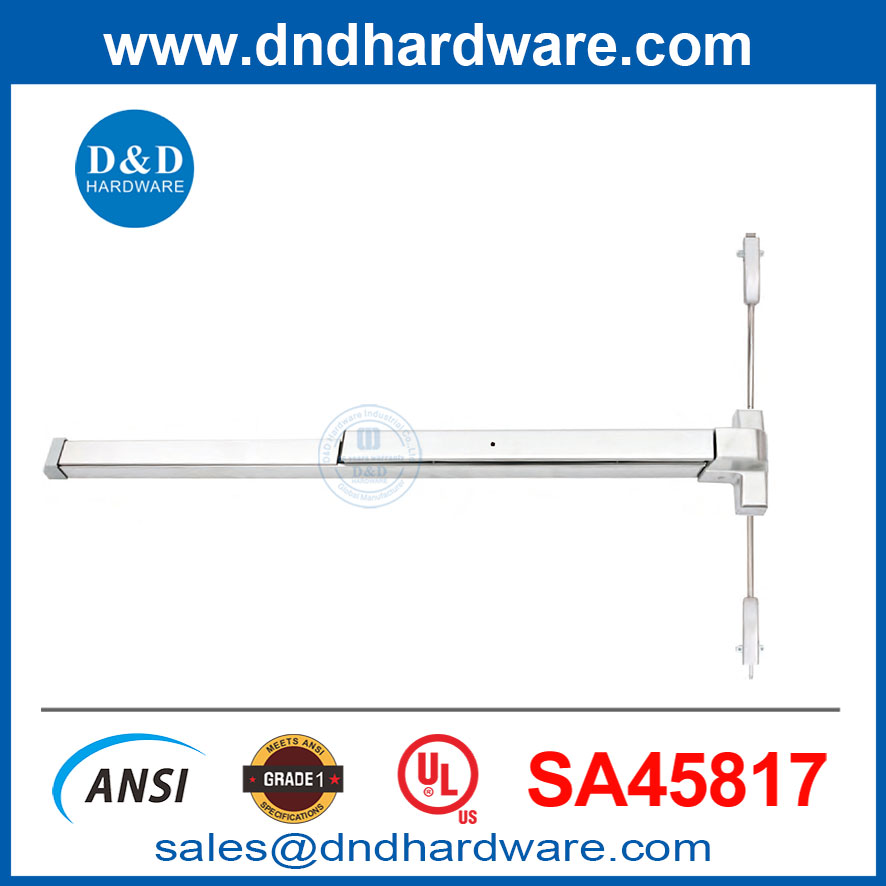
·D&D UL Panic Hardware: Tested and certified under UL 305 (UL File No. SA45817) for non-fire egress applications.
·D&D UL Fire Exit Hardware: Tested under UL 305 + UL 10C for positive-pressure fire door assemblies up to 3-Hour Fire Ratings (UL File No. R40486).
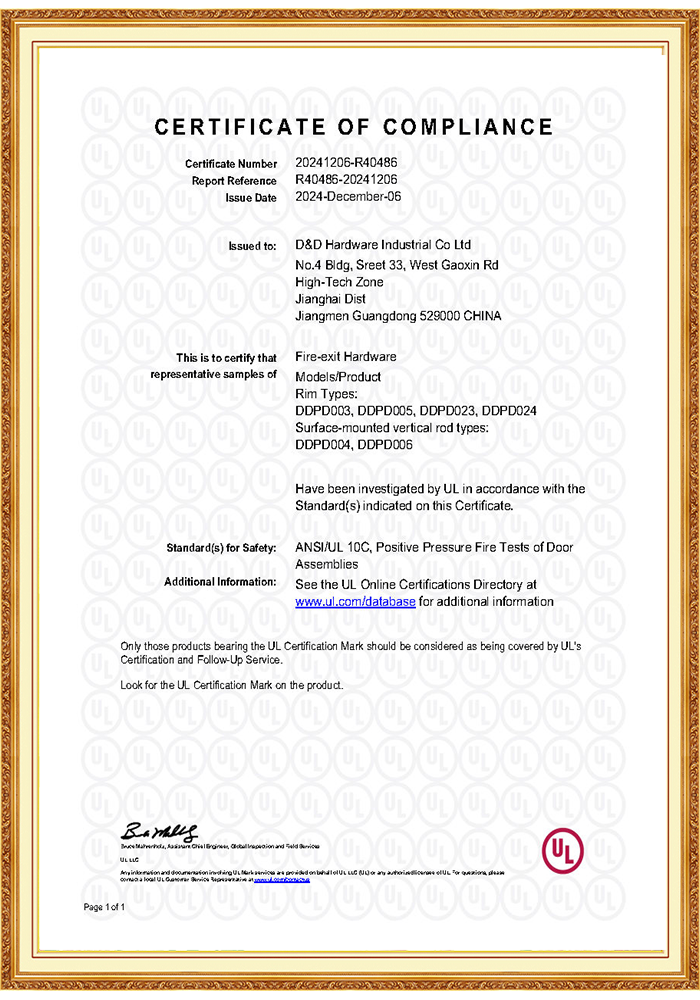
UL Fire Exit Hardware
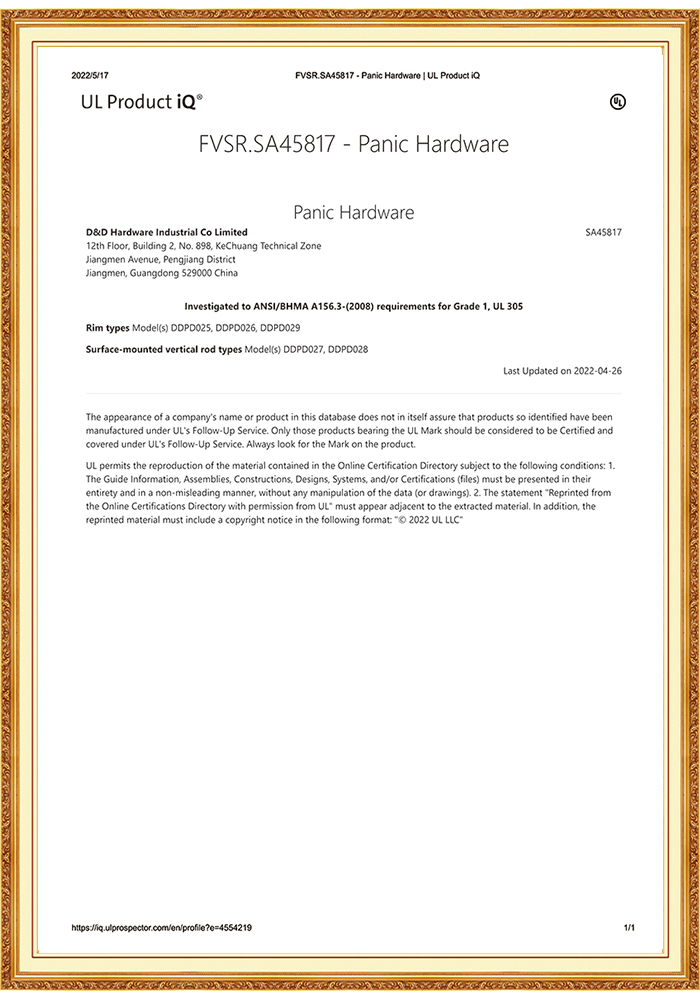
UL Panic Hardware
Complete Assembly Compatibility
Building a fully compliant commercial opening requires matching all fire-rated components:
| Compliant Commercial Door Assembly |
| • Fire Exit Hardware : UL 10C (3 Hours) — File No. R40486 |
| • Commercial Hinges : UL 10C (3 Hours) — File No. R38013 |
| • Mortise Locksets : UL 10C (3 Hours) — File No. R40901 |
| • Door Closers : UL 10C (3 Hours) — File No. R40717 |
|

How to Correctly Specify Commercial Exit Devices
To prevent project delays or code compliance issues, follow this five-step specification workflow:
1. Verify Fire Rating Needs: Identify if the opening is a rated fire assembly. If yes, mandate fire exit hardware tested to UL 10C.
2. Confirm Egress Life Safety Code: Ensure hardware meets UL 305 panic hardware requirements for outward-opening means of egress.
3. Define Mechanical Performance Grades: For high-abuse environments (e.g., schools, hospitals, transit hubs), explicitly specify ANSI/BHMA A156.3 Grade 1 endurance.
4. Audit Third-Party UL File Numbers: Request exact UL file numbers (e.g., Category FVSR or GXHX) rather than accepting non-specific vendor claims.
5. Validate Component Compatibility: Confirm exterior trim, door closers, hinges, and electromagnetic locks do not impair positive-pressure latching or mechanical egress.
Frequently Asked Questions (FAQ)
Is UL 305 the same as ANSI/BHMA A156.3?
No. UL 305 is a life safety standard focused on emergency panic release force and egress operation. ANSI/BHMA A156.3 is a mechanical performance standard evaluating cycle life, operational durability, finish quality, and structural strength.
Can panic hardware be installed on a fire-rated door?
No. Standard panic hardware (UL Category FVSR) allows mechanical dogging and lacks positive-pressure fire testing. Fire-rated openings require fire exit hardware certified to both UL 305 and UL 10C (UL Category GXHX).
How do I verify if a UL 305 exit device meets ANSI/BHMA A156.3?
Review the individual product's UL Listing card or manufacturer specification sheet. UL lists additional ANSI/BHMA A156.3 evaluations directly under the product’s official certification entry.
Contact us Now:
Contact: David Jian
Mob:0086-139 2903 7292
Email: David@dndhardware.com, sales@dndhardware.com,
Contact: Jobby Zhang
Mob:0086-137 2599 9617
Email: jobby@dndhardware.com
D&D HARDWARE INDUSTRIAL CO.,LTD
ADD:12th Floor, Building 2, No.898, KeChuang Technical Zone, Jiangmen Avenue, Pengjiang District, Jiangmen City, Guangdong, China (Postcode:529000)
https://www.dndhardware.com
Tel: +86-750-3856396
Fax: +86-750-3856395
 English