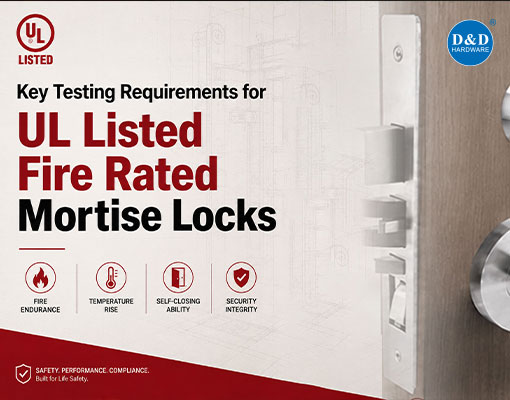
As a factory deeply rooted in the life safety industry, we at D&D Hardware understand that a fire door is only as reliable as its locking mechanism. When a building is engulfed in smoke and extreme heat, the difference between containment and catastrophe often rests on a few ounces of steel.
We are not just hardware suppliers; we are a fire door hardware manufacturer that engineers products for the harshest conditions. Our UL File No. R40901 and UL 10C 3-hour rating are not just badges of honor—they are data points verified by destruction. In this guide, we break down the brutal testing requirements for UL Listed fire rated mortise locks and what the standard actually demands of the metal inside the door.

What Does the UL 10C Positive Pressure Fire Test Actually Simulate?
The UL 10C standard is the cornerstone of modern fire safety in North America. Unlike older standards that may have allowed flames to drift naturally, UL 10C mandates positive pressure. Why does this matter to us as engineers?
During a real fire, the super-heated gases expand and pressurize the upper portion of a room. This pressure forces flames through any gap at the top of a door assembly. The UL 10C test replicates this by maintaining a pressure differential across the door assembly.
For our mortise locks, this means surviving in an environment where the door is being violently pushed open by air pressure. We watch for these specific conditions:
•The Time-Temperature Curve: The furnace does not just get hot; it follows a strict schedule. It reaches 1000°F (538°C) in just 5 minutes and soars to 1700°F (927°C) within 1 hour.
•The Hose Stream Test: Immediately after the furnace shuts off, the assembly is blasted with a high-pressure fire hose. Thermal shock is a real killer of hardware. A lock might hold during heat but shatter when hit by cold water. Our 3-hour rating confirms our locks hold integrity even after this brutal thermal shock.
Why Is the 3-Hour Rating the Gold Standard for Commercial Hardware?
Not all fire ratings are equal. We often hear the question: "Why does a skyscraper need a 3-hour lock when a 1-hour lock works for a small office?"
The answer lies in the building's structural fire resistance. A 3-hour rated mortise lock is required for walls that separate high-hazard areas, stairwell enclosures in high-rises (over 75 feet tall), and specific occupancy separations.
From our manufacturing perspective, the leap from 90 minutes to 180 minutes requires a complete metallurgical upgrade.
•Material Integrity: Standard brass or zinc alloys begin to soften and creep under 3 hours of continuous heat. Our UL Listed fire rated mortise locks utilize high-grade stainless steel components that maintain their tensile strength even when the furnace reads over 1850°F.
•Latch Bolt Projection: Heat causes the door and frame to warp. A latch bolt that is too short will slip out of the strike plate. Our design criteria mandate a specific, deep projection to ensure that even if the door drops 1/4 inch, the latch stays fully engaged.
How Does the Test Validate Latching Integrity Under Fireload?
The most critical moment in a fire test for a lock is not the first minute—it is the last. The assembly must remain latched without the assistance of melting plastics or springs.
In the UL 10C certification process for fire rated mortise locks, the specimen is installed on a vertical test door. The furnace is lit, and we watch specifically for "Integrity Failure."
This occurs if flames or hot gases penetrate through the lock or the gap around it.
We design our D&D Hardware mortise locks to pass this via three specific engineering defenses:
1.Positive Latching Mechanism: Unlike a friction latch that might vibrate open, our internal mechanism is gravity-fed and spring-assisted to drop into the strike plate. Even if the return spring loses its temper due to heat, the bolt stays thrown.
2.Intumescent Compatibility: While the lock itself is metal, the cavity cut into the wood door is a weak point. We design our lock cases to allow for the expansion of intumescent materials (which swell in heat) to seal the gap between the lock body and the wood, preventing smoke from bypassing the lock.
3.Spindle Protection: Many fire-rated locks fail because the handles fall off, rendering the lock inoperable. We engineer heavy-duty spindles and hubs that retain the lever even as the thermoplastic handles melt away, ensuring firefighters can still operate the exit.
What Is the Role of ANSI/BHMA Grading in Fire Rated Locks?
A fire is a rare event, but doors open and close millions of times. If a lock jams due to mechanical wear two years after installation, it is a safety hazard.
This is why we pair our UL 10C certification with ANSI/BHMA A156.13 Grade 1 standards. We consider a fire door hardware manufacturer responsible for both emergency performance and daily operation.
The UL test ensures survival in a fire. The ANSI Grade 1 test ensures survival in a hospital or school hallway.
•Cycle Testing: We run our mortise locks through over 1 million operational cycles. We are verifying that the metal does not fatigue or wear down, which could change the latching points.
•Security Testing: The lock must withstand specific torque and impact forces. A damaged lock case might still look fine, but if internal tolerances shift by a millimeter, the latch might not fully extend into the strike—compromising the fire rating.
Why Does UL File Number Traceability Matter for Compliance?
You will often see our locks marked with UL File No. R40901. This is not random ink. For an architect or a building inspector, this number is the link to the original test data.
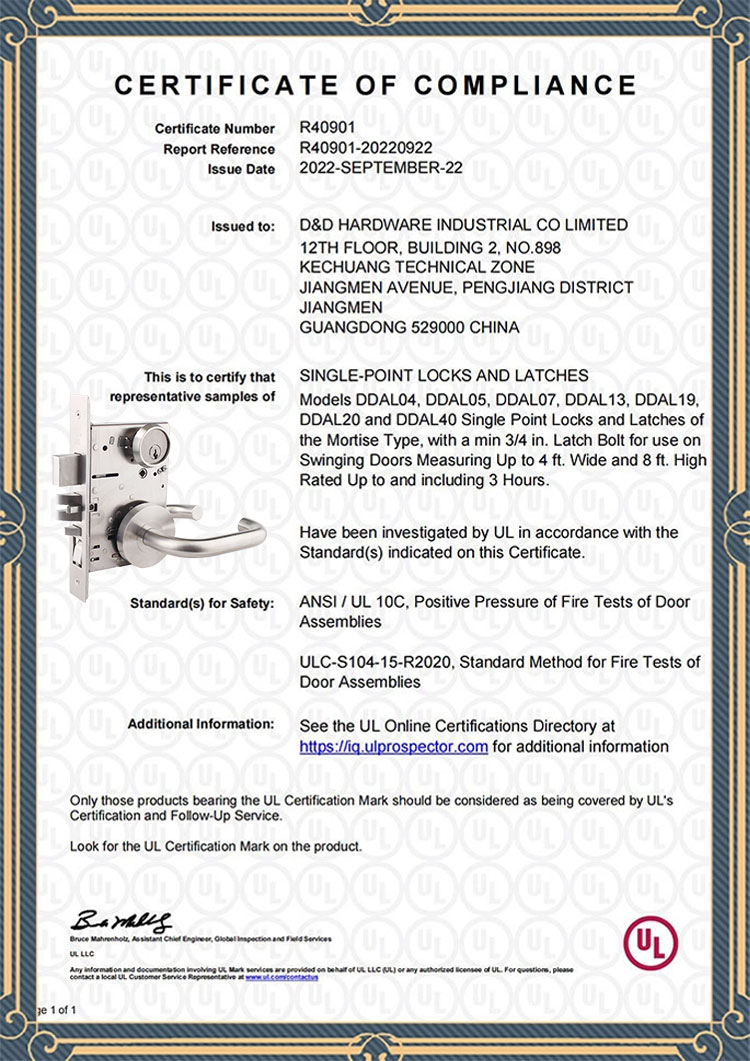
In our factory, strict controls ensure that every UL Listed fire rated mortise lock we ship is bit-for-bit identical to the samples that survived the 3-hour furnace test.
•No Unauthorized Substitutions: Cheap knock-offs often swap steel for sintered metal to save costs. Sintered metal disintegrates in heat. Our UL file number guarantees that the material we specified in the test is the material we use on the assembly line.
•The Labeling Requirement: NFPA 80 requires that fire door hardware carry a visible, permanent label. Without the label and the traceable file number, the entire door assembly fails inspection, regardless of how good the lock looks.

How Do We Maintain Certification as a Fire Door Hardware Manufacturer?
UL certification is not a one-time "test and forget." Maintaining the UL File No. R40901 requires a surrender of our manufacturing autonomy.
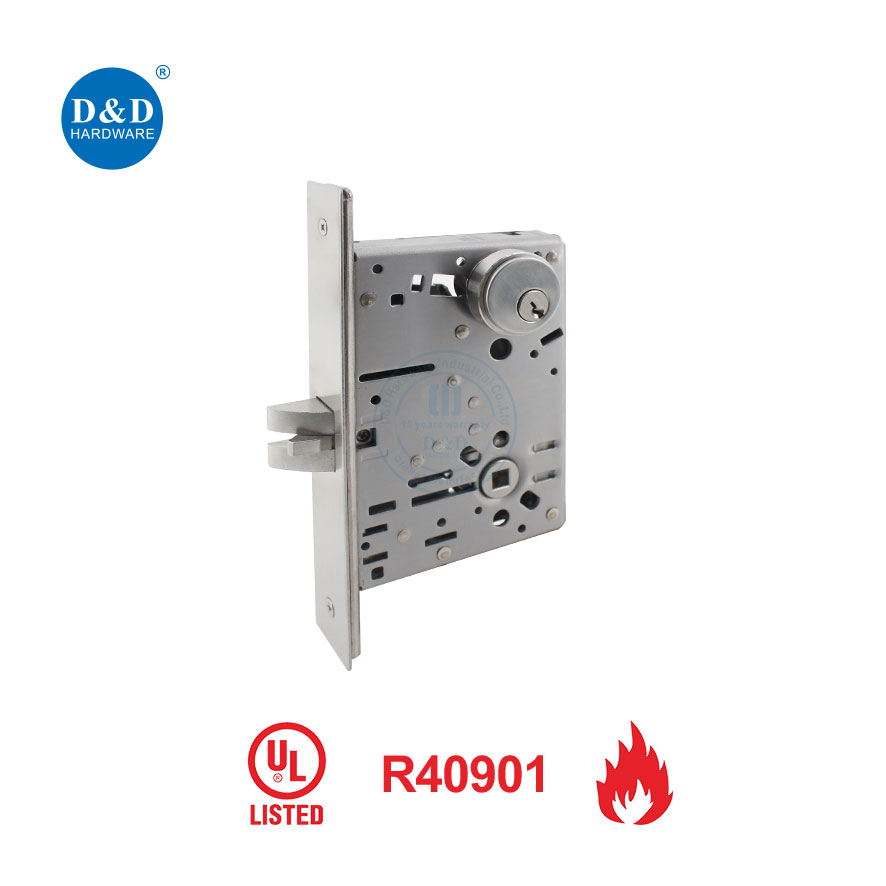
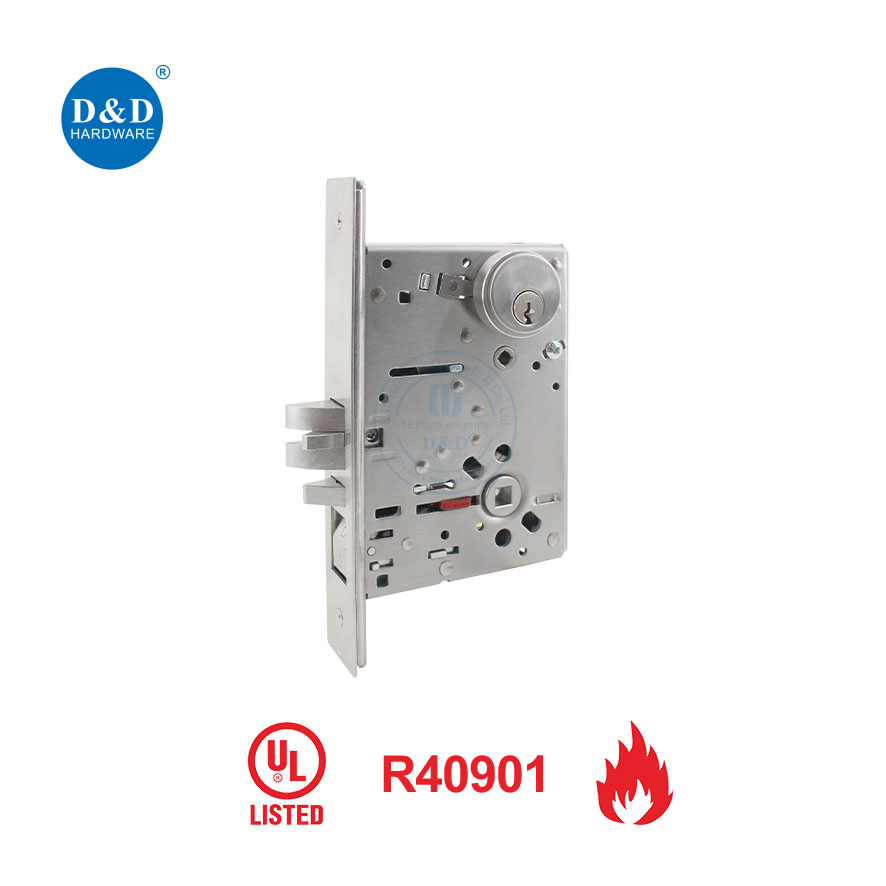
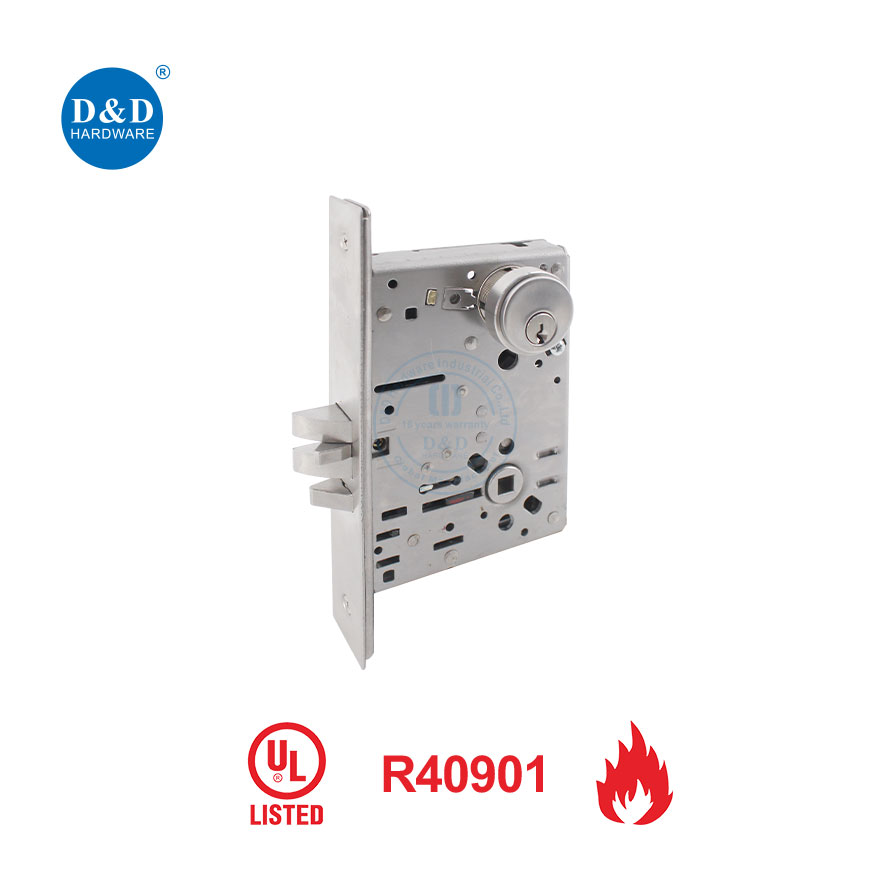
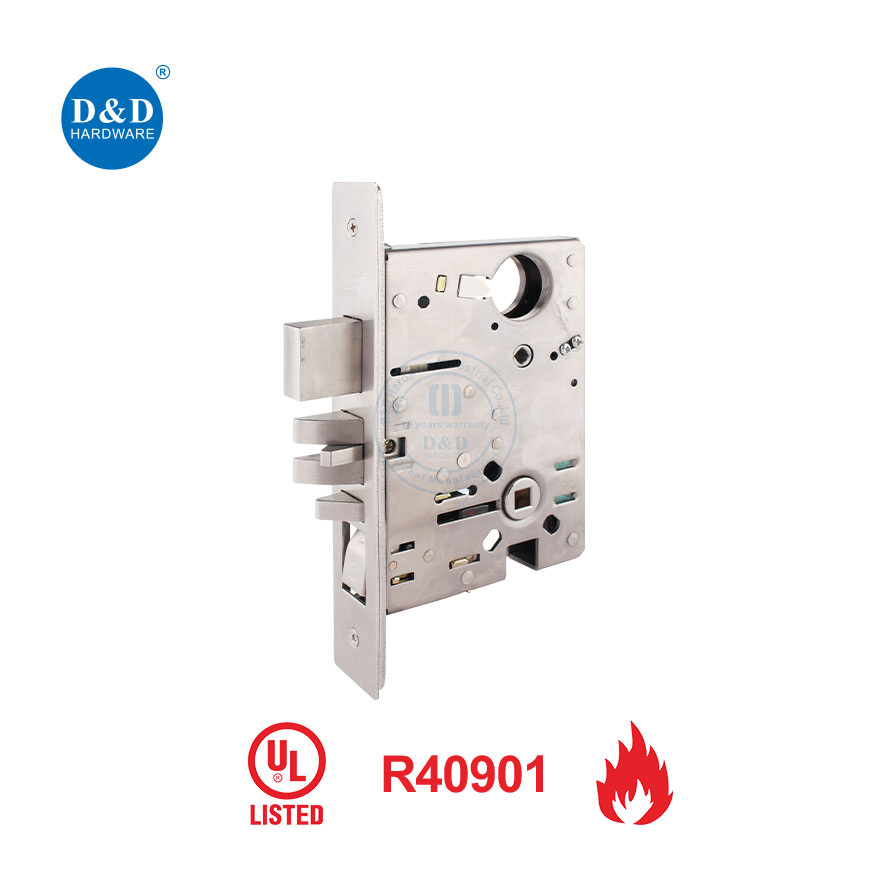
We operate under the UL Follow-Up Service (FUS) . This means UL inspectors can (and do) show up at our factory unannounced. They walk our line, pull our raw materials, and take our finished fire rated mortise locks off the pallet to cut them open.
They verify:
•The gauge of the steel case matches the test sample.
•The hardness of the deadbolt matches the specification.
•The exact composition of the lubricant (some oils emit flammable vapors at high heat).
This ongoing scrutiny is what separates a true fire door hardware manufacturer from a simple assembler. We welcome this pressure. It ensures that when you see our logo on a lock, you are looking at verified safety.
Frequently Asked Questions (FAQ)
What is the difference between UL 10C and UL 10B for mortise locks?
UL 10C applies positive pressure during the test, which is more representative of real modern building fire conditions. UL 10B does not use positive pressure. For high-rise and commercial applications, UL 10C is the stricter and more relevant standard.
Can I install any Grade 1 mortise lock on a 3-hour fire door?
No. A standard Grade 1 lock has passed mechanical durability tests, not fire endurance tests. Only a UL Listed lock with a specific fire rating (like our 3-hour rating) has been proven to maintain latching integrity during the heat and hose stream test.
How does the hose stream test affect the lock?
After the furnace cycle, the door assembly is hit with a high-pressure fire hose. This causes rapid cooling (thermal shock). A lock will fail if the case cracks, the latch jams, or the bolt retracts due to the impact. Our 3-hour rating confirms resistance to both heat and impact.
What is File No. R40901?
It is the specific UL registration number assigned to D&D HARDWARE for our Single-point Locks and Latches. It allows inspectors to look up our exact test documentation online, proving our 3-hour rating is legitimate and certified.
Does the lock require intumescent seals to be UL 10C rated?
Often, yes. The lock body removes material from the door. For wooden fire doors, we recommend or supply intumescent kits that expand around the lock case to block smoke and flame passage during a fire, as detailed in our installation sheets.
Contact us Now:
Contact: David Jian
Mob:0086-139 2903 7292
Email: David@dndhardware.com, sales@dndhardware.com,
Contact: Jobby Zhang
Mob:0086-137 2599 9617
Email: jobby@dndhardware.com
D&D HARDWARE INDUSTRIAL CO.,LTD
ADD:12th Floor, Building 2, No.898, KeChuang Technical Zone, Jiangmen Avenue, Pengjiang District, Jiangmen City, Guangdong, China (Postcode:529000)
https://www.dndhardware.com
Tel: +86-750-3856396
Fax: +86-750-3856395
 English