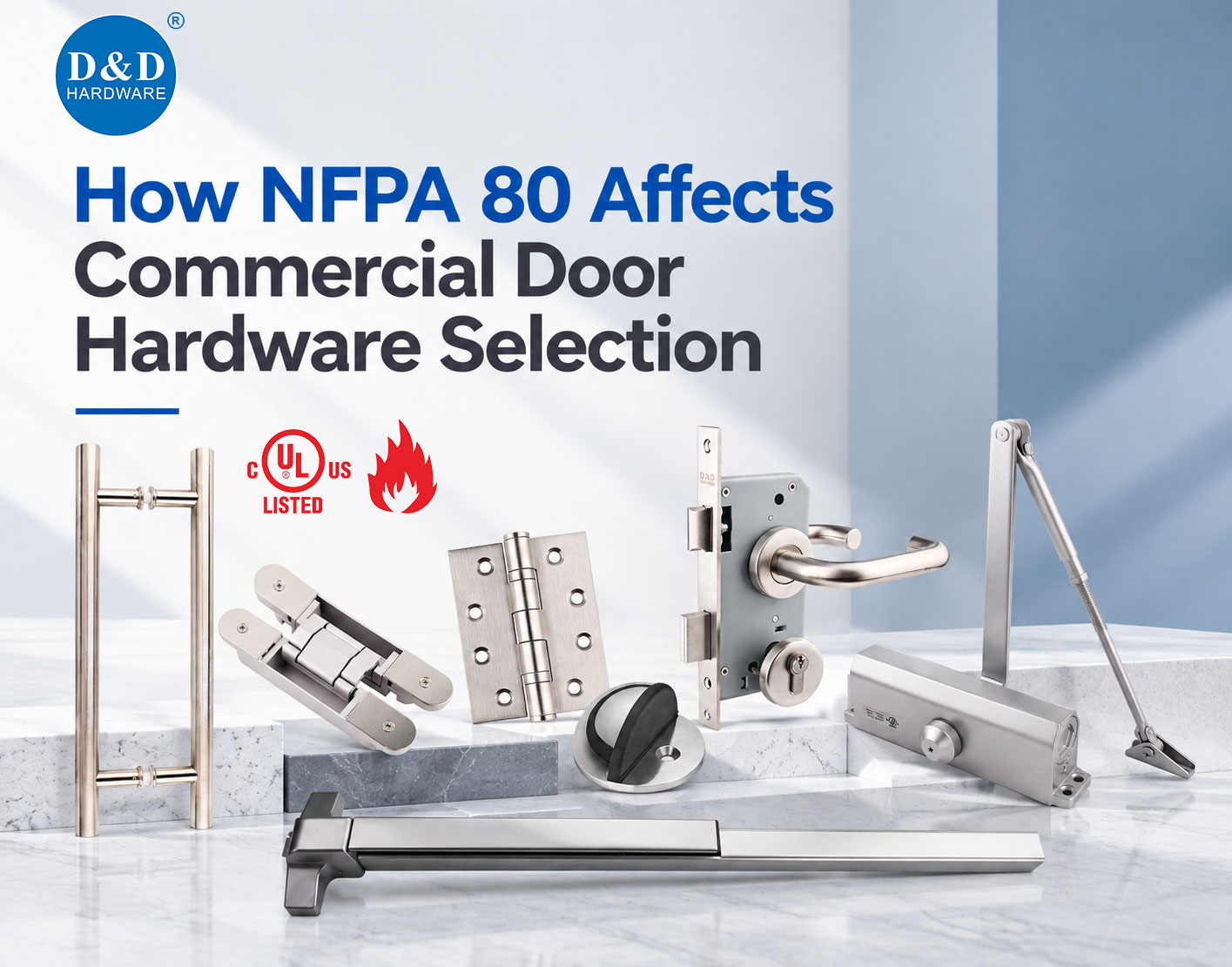
A fire door hardware schedule can look complete on paper and still leave a critical question unanswered: will these exact components work together on this exact opening? A closer may be certified yet lack the force or mounting geometry needed to latch the installed leaf. An exit device may meet an egress test while being unsuitable for a rated door. Even a seemingly equivalent substitution can introduce new holes that the labeled door cannot accept.
NFPA 80 shapes the selection process by treating the door, frame and hardware as an installed fire door assembly. The adopted building and life safety codes establish where a rated opening and particular egress functions are required; NFPA 80, the product listings and manufacturer instructions govern how the selected assembly is installed and kept functional. This guide follows the decisions a specifier or buyer makes before issuing a purchase order. For a breakdown of each hardware category’s operating requirements, see D&D’s NFPA 80 fire door hardware guide.

Start With the Opening, Not the Catalog
The first input is the approved door and frame schedule, together with the wall or opening protection requirements. A product labeled for a three-hour application does not turn an unrated or 90-minute door into a three-hour assembly. Conversely, a rated opening may need more than a fire rating: required egress hardware, smoke control, accessibility and the specified door operation can change the hardware set.
Before comparing product numbers, record the opening ID, required fire-protection rating, door and frame manufacturers, material and label information, opening size, leaf thickness and weight, swing and handing, existing reinforcements and preparations, and whether the opening is a single leaf or a pair. For pairs, identify active and inactive leaves, meeting-edge construction, astragal and intended latching arrangement. Note the wall location, pressure conditions, floor transition, seals and glazing. Ask which requirements arise from the adopted code and approved plans rather than assuming every fire door needs the same device.
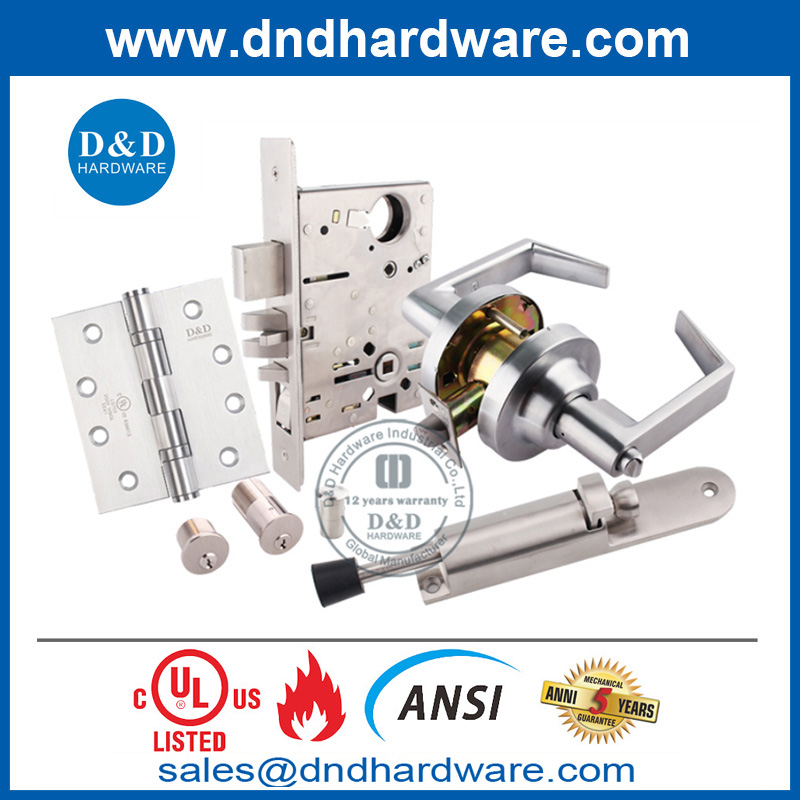
An opening-by-opening schedule avoids a frequent purchasing mistake: using one standard hardware kit across doors with different ratings, leaf sizes, functions or preparations. D&D’s UL Door Hardware range is a useful starting set of product categories; the schedule and exact model documentation determine which options fit a particular opening.
Match Mechanical Functions to the Complete Assembly
Support the leaf before calculating closing force
Hinge selection begins with door construction, dimensions, weight, frequency of use, frame reinforcement and the manufacturer’s approved hinge preparations. A heavy, wide leaf or high-cycle opening can require different bearing construction, hinge quantities or fastening details from a small office door. Specify the permitted hinge size, type, location and fasteners, then check the door and frame instructions. Do not attempt to compensate for a sagging leaf by oversizing the closer.
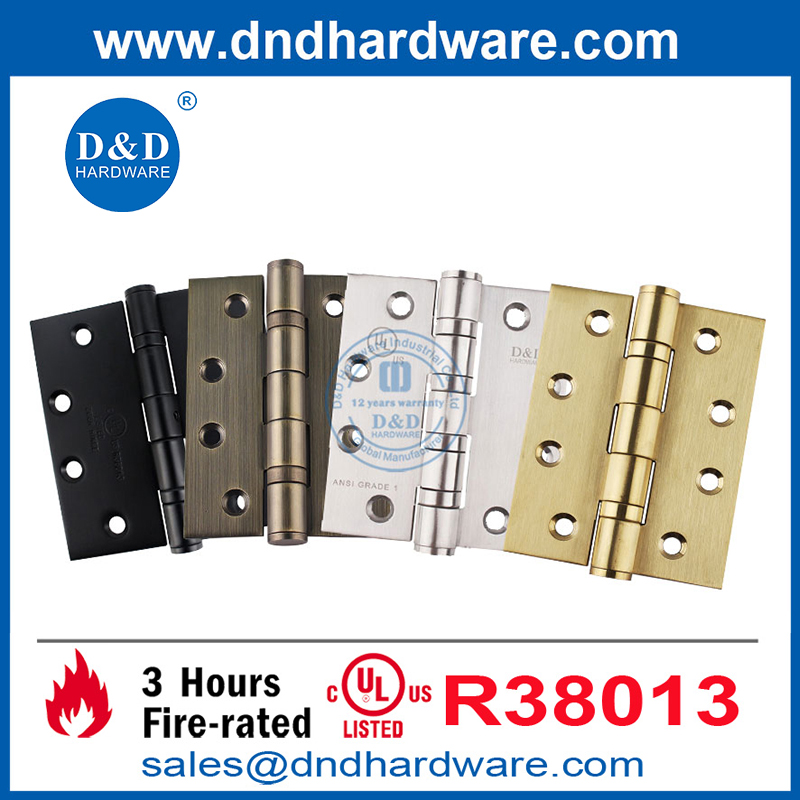
D&D offers UL 10C listed fire door hinges associated with File R38013 for suitable applications. Verify the particular hinge and its installation conditions; NFPA 80 also allows certain hinge types under prescribed conditions, so a universal claim that every hinge must carry an individual listing would be misleading.
Choose a closer that can actually close and latch
A closer’s catalog certification is only one selection criterion. Compare the manufacturer’s door-width and weight limits, mounting method, arm geometry, handing, backcheck needs, opening angle and available reinforcement. The selected setting must allow the door to close from an open position and engage its latch under representative conditions, without defeating applicable accessibility and egress requirements. Seal drag and air pressure can change actual performance after installation.
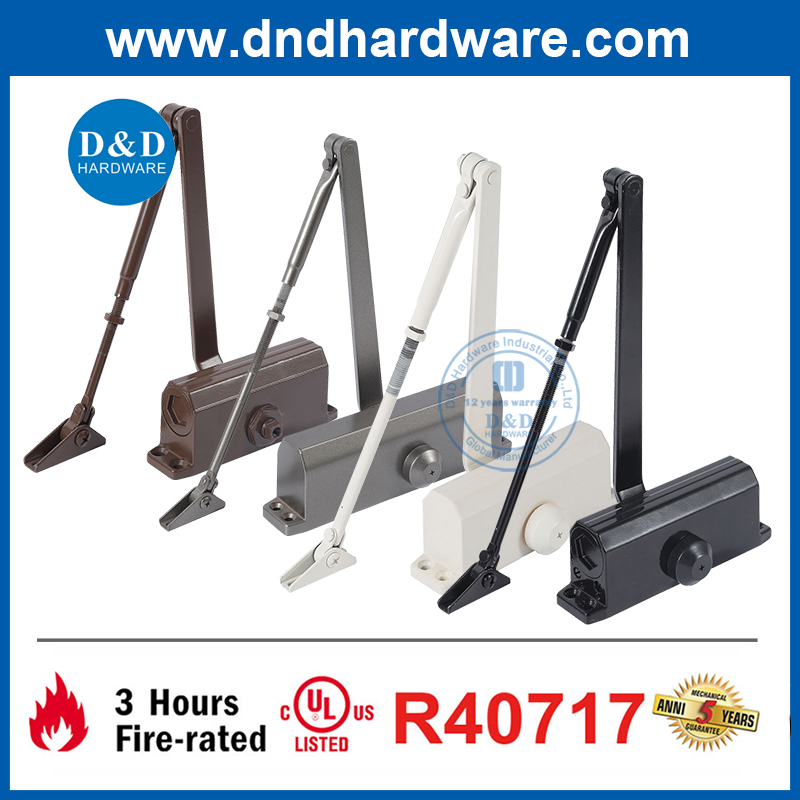
D&D’s UL 10C door closers associated with File R40717 provide candidate models for compatible rated openings. Request the exact mounting template and instructions with the quotation. Where a door is intended to remain open in normal use, the project must specify an approved automatic-closing arrangement; an ordinary mechanical hold-open or wedge cannot be substituted for it.
Specify positive latching as an operating result
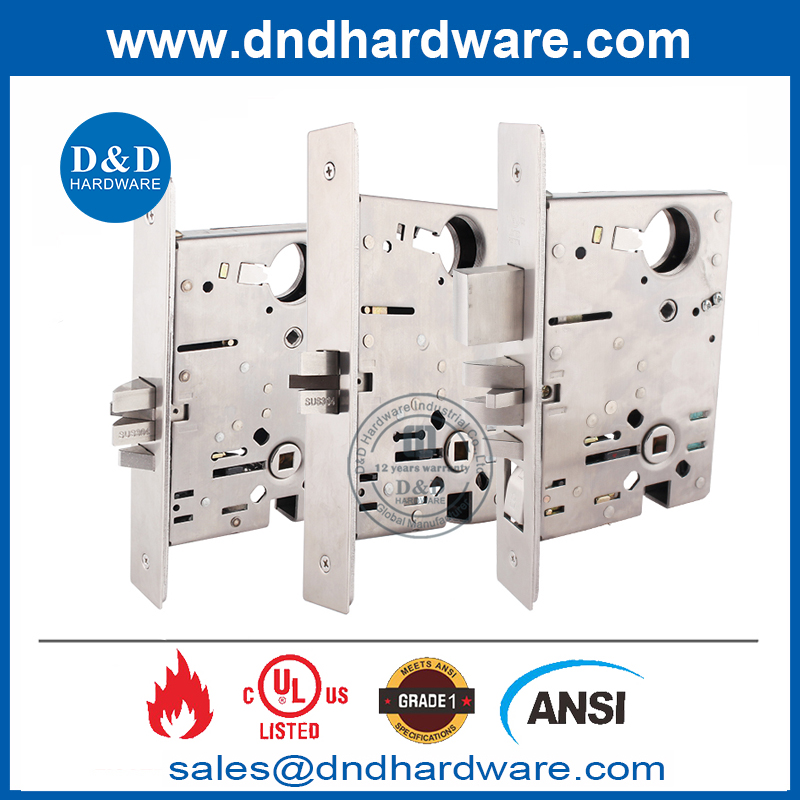
A latch must engage its strike after the closer releases the leaf; a door that appears shut but requires a final push has not achieved the required result. Match the mechanical lock or latch to the door construction, strike preparation, required function and applicable listing. Check whether existing preparations accommodate the new lock case, faceplate, strike and fasteners before a supplier proposes a substitution. Cylindrical and mortise patterns should not be treated as interchangeable simply because both use a lever.
For applicable mortise-lock openings, D&D’s UL 10C mortise lock selection includes products associated with File R40901. The model and configuration still need verification against the opening schedule. During commissioning, observe latch engagement with the specified seals fitted and the closer adjusted; a certification number alone cannot demonstrate that the installed door latches.
Resolve Rated Egress and Paired-Door Conditions
Distinguish panic hardware from fire exit hardware
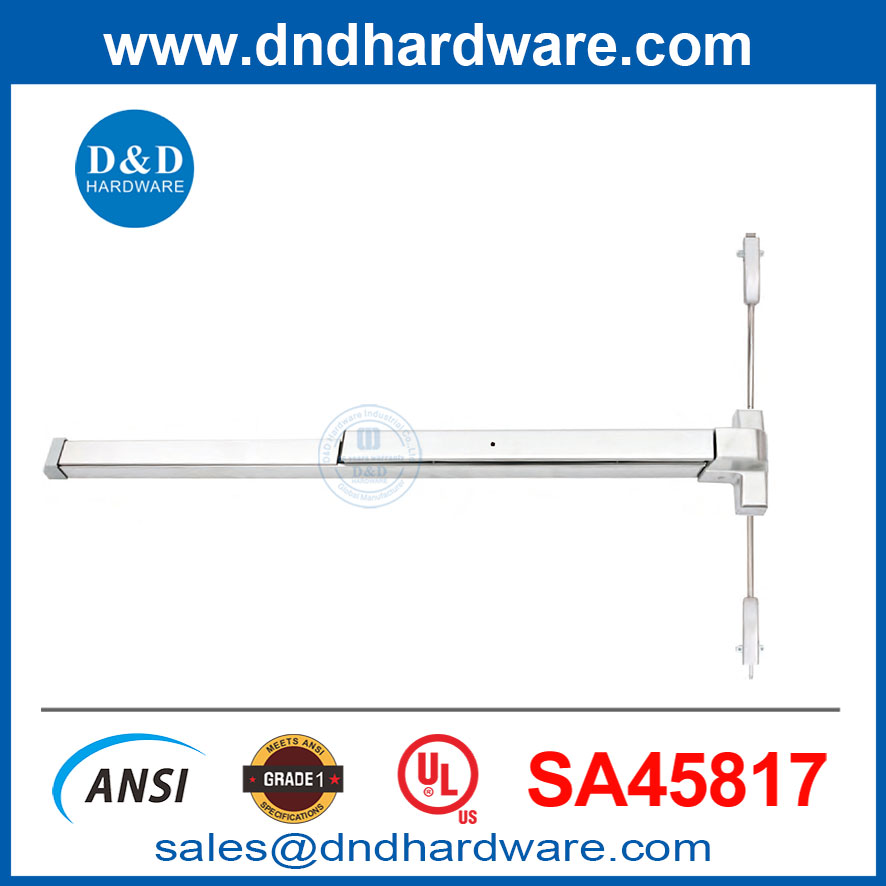
First determine from the adopted egress code and approved design whether an exit device is required at this location. If the opening is fire rated, the chosen device must be suitable as fire exit hardware for the fire-door application, with the required egress performance. A product offered solely as UL 305 panic hardware for a non-rated door is not automatically acceptable on a labeled fire door. This distinction belongs in the schedule before price comparison, because the two devices may appear similar in a product photograph.
D&D identifies fire exit hardware associated with its UL 10C File R40486 and panic hardware associated with UL 305 File SA45817. Obtain the marking and certification details for the actual ordered device, including its fire-door and egress uses as required. Do not infer that a file covering one category automatically certifies every model for both categories.
Check both leaves of a pair as a single operating system
On a pair, hardware selection depends on how the active and inactive leaves close, are retained and latch. If the approved assembly needs the inactive leaf to close before the active leaf, closer settings alone may not reliably create the sequence. The coordinator must work with the astragal, any flush bolts or other inactive-leaf retention, strikes and both closers. Confirm which component is permitted for the specific construction, then test by opening and releasing both leaves.
D&D’s door coordinators can be evaluated for suitable paired openings. Do not assume that every coordinator shown in a commercial catalog has an independent fire listing or that its addition cures incorrectly located strikes. Where the pair uses fire exit devices or requires egress from both leaves, verify the complete pair configuration in the approved schedule and product documentation.
Verify the Exact Certification and Installation Limits
A listing applies to identified products and specified uses, not to a generic product name. Ask for the manufacturer, model and configuration, certification category, file number when available, permitted fire rating, door material and thickness, size restrictions and installation instructions. Confirm whether associated strikes, mounting plates, fasteners or protection components are required. A rated assembly may also impose conditions through the door or frame listing that a hardware-only submittal does not show.
Use the certification body’s current directory, such as UL Product iQ, to confirm the exact model and file. A catalog headline such as “UL listed” is insufficient without the relevant product category and conditions. Keep the matching listing information in the submittal package rather than relying on a screenshot of an unrelated model. Where a listing is unclear, ask the manufacturer or listing organization for documentation before the purchase order is released.
The visible UL mark on a component also does not replace the door and frame identification. Compare all labels and approved documents as a system, and do not claim that installing one D&D listed hinge, lock or closer automatically makes an assembled opening NFPA 80 compliant.

Treat Substitutions and Existing Doors as Separate Decisions
A replacement that matches the old component’s dimensions may differ in listing, operating function, strike design or mounting pattern. Start by documenting the existing part and the opening’s labels, preparations and fire rating. Compare old and proposed templates at full scale. If changing hardware would require new holes, cutouts, filler or reinforcements, confirm that the change falls within the adopted NFPA 80 edition, door and frame listings and manufacturer permissions. Obtain any necessary authorization or evaluation before drilling.
For new work, require a substitution request to identify the opening IDs affected and show a side-by-side comparison of models, certifications, required accessories, mounting preparations and operating behavior. For repairs, record the old model, approved replacement, work completed and final functional test. This reduces the chance that a “same size” component introduces an undocumented change to the assembly.
A Procurement Example: Two Similar Openings, Different Decisions
Consider two identical-looking stair doors in the same project. Opening A is a labeled single leaf whose adopted egress provisions call for a mechanical latch but no exit device. Opening B is a labeled pair with an exit-device requirement in the approved hardware schedule. Both may need properly selected hinges and closers, but specifying the same lockset and single-leaf closer arrangement for B would ignore the pair’s sequence and exit-device conditions.
For A, the buyer checks the lock, strike and closer against its rating, leaf size and existing preparations. For B, the buyer additionally resolves active/inactive leaf behavior, coordinator and astragal conditions, and the exact fire exit hardware certification required for the rated application. The decision comes from each opening’s approved requirements, not from a blanket statement that every stair door needs panic hardware.
What to Require Before Approving the Hardware Schedule
· An opening ID and approved rating for each distinct hardware set, with leaf and frame construction, handing, size and door operation identified.
· The exact manufacturer and model for each hinge, closer, latch or exit device, plus required strikes, coordinators and mounting accessories.
· Model-level certification and listing conditions that match the rated application; separate evidence for egress and fire exit functions where applicable.
· Installation templates and confirmation that door and frame preparations, reinforcements, fasteners and any field work are permitted.
· A pair-of-doors sequence review and a site test plan for full closing, positive latching and intended egress operation.
· A substitution approval trail and a turnover record linking as-built models, labels, instructions and commissioning results to opening IDs.
If any field condition differs from the submittal, pause the affected selection and resolve it through the designer, door manufacturer, supplier and authority having jurisdiction as appropriate. The final acceptance criterion is the compatible, correctly installed and functioning opening, supported by traceable documentation.
Frequently Asked Questions
Does NFPA 80 prescribe a single standard hardware set for all fire doors?
No. The opening rating, listed constructions, adopted codes, location, egress function and operation determine the suitable set. Product selection must also follow listing and installation conditions.
Is the highest available UL fire rating always the safest choice?
Not by itself. The model must suit the particular door and frame, meet the required function and install within the approved preparations. A component’s rating does not raise the rating of the surrounding assembly.
May UL 305 panic hardware be used on a fire door?
A UL 305 marking alone does not establish suitability as fire exit hardware on a rated opening. Verify the exact device’s applicable fire-door certification and the project’s egress requirements.
Can purchasing approve a substitute with the same footprint?
Only after checking the listing, function, mounting method, required accessories and actual installation conditions. Similar mounting dimensions do not establish equivalence.
When should the hardware schedule be revised?
Revise and approve it before ordering when the opening rating, door construction, pair operation, egress requirement or proposed model changes. Capture approved field substitutions in the as-built record.

Code and Edition Note
Code requirements vary by jurisdiction and adopted edition. Confirm the NFPA 80 edition in force, the adopted building and life safety codes, local amendments, approved plans, product listings and manufacturer instructions with the authority having jurisdiction (AHJ). The guidance above is a selection framework; it does not replace project-specific approval or verification of the complete assembly.

Contact: David Jian
Mob: 0086-139 2903 7292
Email: David@dndhardware.com, sales@dndhardware.com,
Contact: Jobby Zhang
Mob: 0086-137 2599 9617
Email: jobby@dndhardware.com
D&D HARDWARE INDUSTRIAL CO.,LTD
ADD:12th Floor, Building 2, No.898, KeChuang Technical Zone, Jiangmen Avenue, Pengjiang District, Jiangmen City, Guangdong, China (Postcode:529000)
https://www.dndhardware.com
Tel: +86-750-3856396
Fax: +86-750-3856395

 English