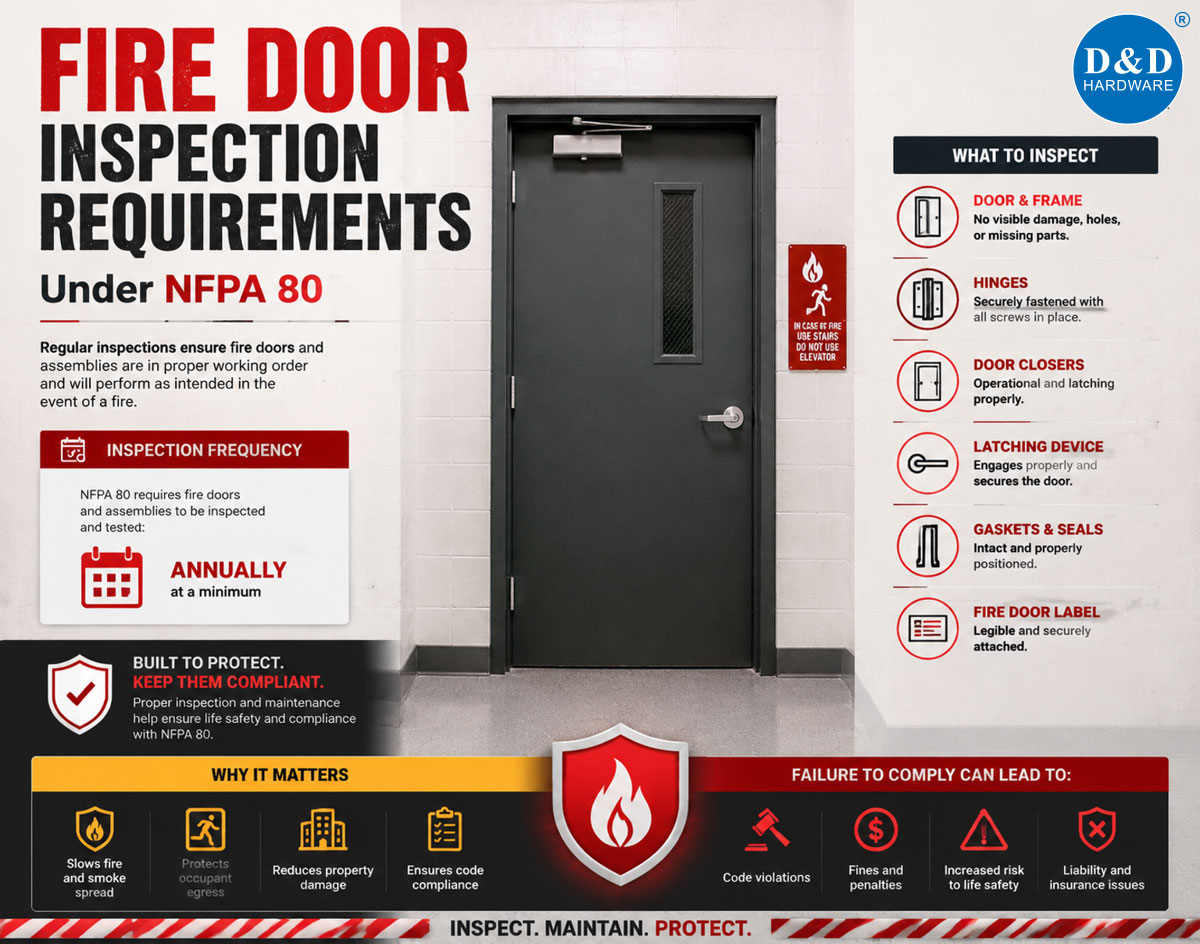
A fire door can look complete and still fail at the moment it is needed. A loose hinge can pull the leaf out of alignment, a closer can stop short of the latch, or an added door wedge can defeat the entire protective function. Inspection turns these hidden operational problems into documented, correctable findings.
NFPA 80 treats a fire door as an assembly: the leaf, frame, glazing, hinges, closing and latching hardware, seals and accessories must remain compatible and operate together. A useful inspection therefore goes beyond checking for a label. It combines visual examination, functional testing and records that allow the owner and the authority having jurisdiction (AHJ) to understand the condition of each opening.

What Does NFPA 80 Require?
NFPA 80 establishes requirements for the installation, inspection, testing and maintenance of fire doors and other opening protectives. For swinging fire door assemblies, the standard requires inspection and testing after installation and at least annually thereafter. The applicable edition, building code, life safety code, local amendments and AHJ direction determine the exact project requirements.
The inspection is intended to confirm that the assembly has not been damaged, altered or allowed to deteriorate in a way that compromises its protective functions. The standard identifies a series of visual and operational items for swinging fire doors. It is not a laboratory fire test, and an annual inspection does not assign a new fire rating to an unidentified product.
Inspection confirms the condition and operation of an installed assembly. It does not replace product listings, approved construction documents, manufacturer instructions or acceptance by the AHJ.
When Should Fire Doors Be Inspected?
After installation
New fire door assemblies should be inspected and tested after installation. This acceptance-stage review catches mismatched components, installation damage, incorrect clearances and functional problems before the opening enters normal service. It is also the best time to capture baseline photographs, labels, hardware models and the opening number.
At least annually
NFPA guidance identifies annual inspection and testing as the minimum recurring interval. The owner should maintain an inventory and schedule that prevents openings from being missed. A rolling program may be practical for a large facility, provided every required opening is covered within the prescribed interval and records clearly show the inspection date.
After work that can affect performance
Repair, replacement, field modification, impact damage or construction activity can change the assembly after the annual inspection. The affected functions should be checked again before the opening is returned to service. Replacing a closer, hinge, lock, exit device, glazing component or seal should trigger verification of compatibility, installation and operation—not merely confirmation that the new part fits.
Routine observations by facility personnel are also valuable. Staff can report propped doors, rubbing leaves, oil leakage, loose hardware or damaged labels as soon as they appear. These checks support preventive maintenance, but they do not replace the formal inspection and testing required by the adopted standard.
Who Is Qualified to Perform the Inspection?
NFPA 80 calls for the work to be performed by a qualified person with knowledge and understanding of the type of assembly being inspected. Qualification can be demonstrated through education, training, professional standing, skills or relevant experience. The standard does not make one specific private certification the only route, although a jurisdiction, contract or facility policy may require additional credentials.
A qualified inspector should be able to identify the opening, interpret labels and listings, recognize permitted versus questionable modifications, measure clearances correctly, test the complete operating cycle and produce a defensible report. Independence and scope should be established in advance: the party who inspects, the party who repairs and the person who accepts the completed correction may have different roles.
· Confirm the adopted NFPA 80 edition and any local inspection forms or credential requirements.
· Define which opening types and buildings are included in the assignment.
· Agree on how inaccessible, concealed or unsafe conditions will be reported.
· Establish whether the inspector may perform minor adjustments or will document findings only.
· Identify who has authority to approve repairs, substitutions and field-evaluation work.
Prepare an Opening Inventory Before Fieldwork
Reliable inspection begins with an opening inventory. Each fire door should have a durable identifier tied to a location, rating and record. Hardware schedules, approved submittals, previous reports, repair history and label photographs help the inspector distinguish an existing deficiency from a newly developed condition.
· Building, floor, room or wall location and a unique opening number.
· Door type, configuration, size, handing and required fire-protection rating.
· Door, frame, glazing and hardware manufacturers or models where available.
· Special conditions such as a pair, coordinator, fire exit hardware, smoke seals or hold-open arrangement.
· Previous deficiencies, completed repairs and unresolved AHJ decisions.
Do not allow missing historical documents to stop the physical inspection. Record what can be verified in the field, clearly identify what cannot be confirmed and recommend the appropriate research, manufacturer review or field evaluation.

The NFPA 80 Fire Door Inspection Checklist
The adopted edition should always be consulted for exact wording. In practical terms, the inspection of a swinging fire door assembly covers the following thirteen areas.
1. Labels are visible and legible
Inspect the door and frame labels and any required markings on glazing or hardware. A label should not be painted over, removed or made unreadable. Confirm that the rating and product identification are appropriate to the opening; a visible label on the leaf does not prove that all installed components are compatible.
2. The door and frame have no holes or breaks
Look for open fastener holes, damaged faces, cracked edges, split cores, field-cut preparations and frame damage. Small cosmetic marks and penetrations are not the same issue. Record the size, location and cause of each questionable opening so the repair method can be evaluated against NFPA 80, the listing and manufacturer instructions.
3. Glazing, vision-light frames and glazing beads are intact
Verify that fire-rated glazing and its retaining system are secure and undamaged. Check for cracks, missing fasteners, loose beads or unapproved replacement glass. Required glazing marks should remain readable, and the size and configuration should agree with the listing for the door.
4. The door, frame, hinges and hardware are secured and working
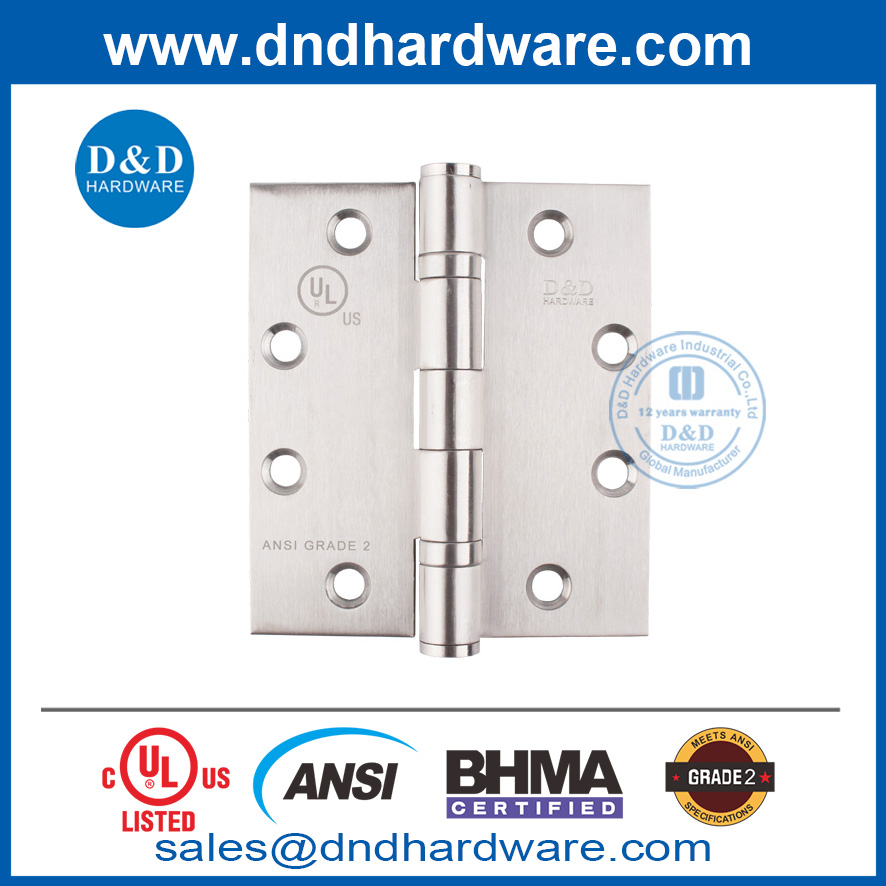
Fasteners should be present and tight, components should not be bent or loose, and the leaf should move without binding. Hinge wear often appears as a dropped latch edge, unequal margins, metal dust, loose screws or a leaf that rubs the frame.
Where listed replacement hinges are required for a compatible opening, D&D UL-listed fire door hinges under UL File R38013 provide three-hour UL 10C options. Selection must still match the door size, weight, preparation, fasteners and listing conditions.
5. No parts are missing or broken
Inspectors should account for hinge screws, closer arms, lock components, strikes, exit-device parts, coordinator components, seals and other required items. A door may swing even when a part is missing, but it may not close, sequence or latch reliably under real operating conditions.
6. Clearances are within the permitted limits
Measure gaps at the head, jambs, meeting edges and bottom using an appropriate gauge. The acceptable limits depend on the adopted NFPA 80 edition, door construction, threshold condition, listing and other applicable codes. Measurements should be taken at representative locations and recorded when they are near or outside the limit.
Do not correct a clearance problem only by increasing closer force. Determine whether the cause is hinge wear, loose fasteners, frame movement, an out-of-square opening, floor changes or an incorrect door size. This preserves both reliable closing and usable opening force.
7. The self-closing device closes the door completely
Release the door from the open position and observe the entire closing cycle. It must reach the fully closed position without manual assistance. Binding, air pressure, a weak or leaking closer, incorrect adjustment and floor contact can all prevent closure.
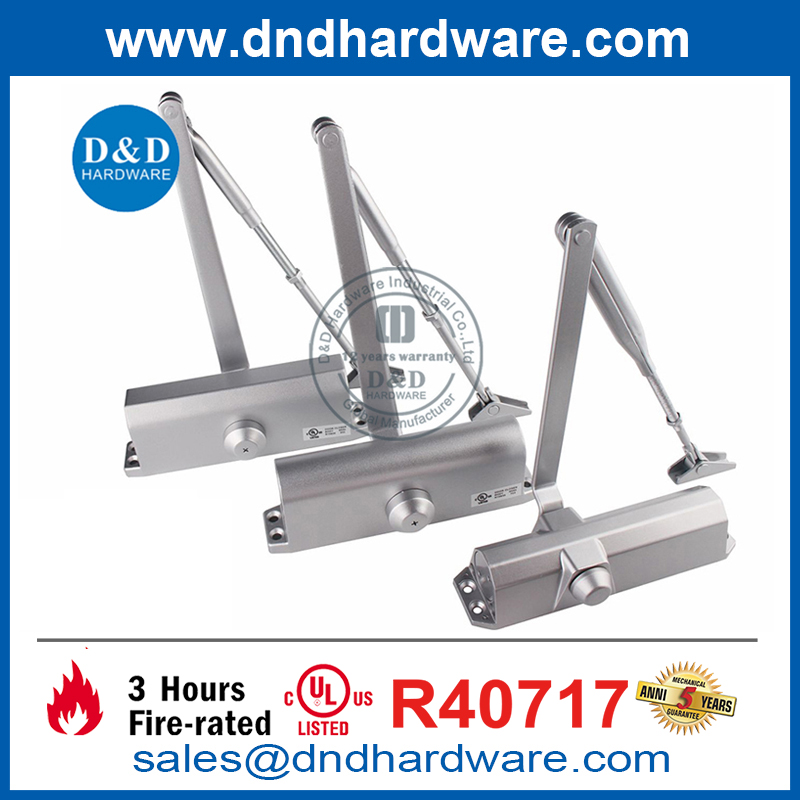
For suitable replacement or new work, D&D UL-listed door closers under UL File R40717 provide UL 10C three-hour options. During inspection, however, the question is not the brand alone: confirm secure mounting, correct arm geometry, controlled movement and enough energy to overcome latch resistance without unsafe slamming.
8. Leaves in a pair close in the correct sequence
Where an inactive leaf must close before the active leaf, test the pair from positions that require the coordinator to control both leaves. Confirm that the coordinator, closer arms, astragal and latching hardware do not interfere. A successful test from one convenient opening angle may not reveal inconsistent sequencing.
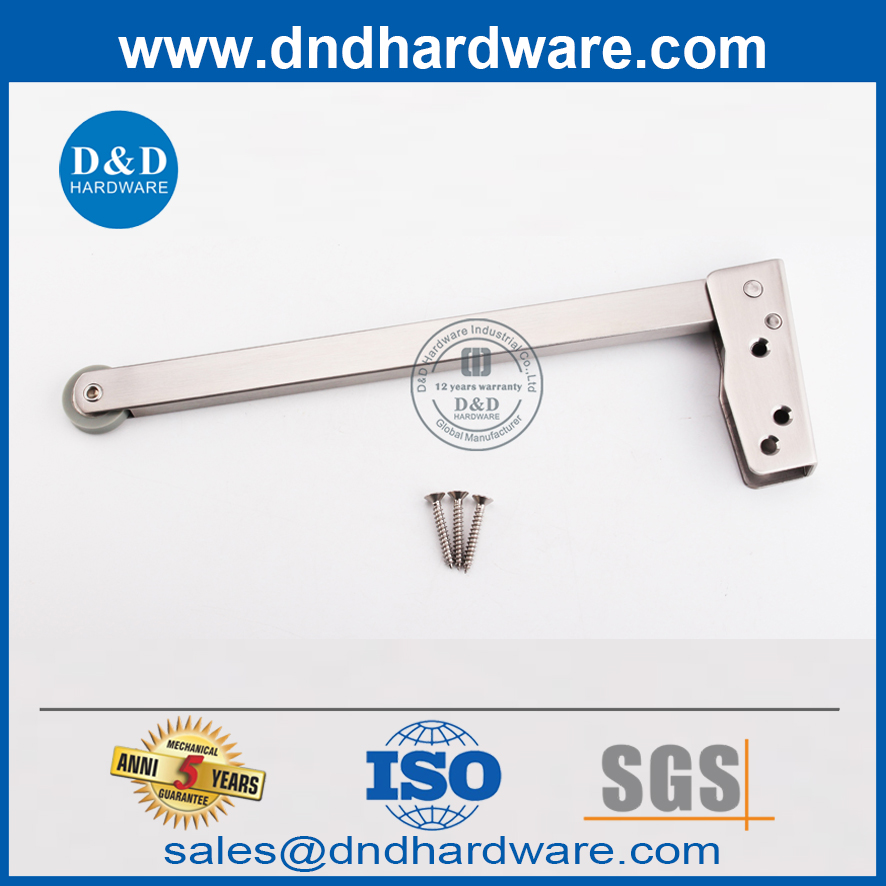
D&D door coordinators can support the required closing order on appropriate pairs. Inspection should verify the complete pair as installed, including coordinator engagement, closer timing and positive latching of both leaves.
9. The door positively latches in the closed position
The door should close and engage its latch without someone pushing or pulling the leaf. Inspect latch projection, strike alignment, loose trim and wear. Do not tape back a latch, disable an auxiliary latch or enlarge a strike opening as an improvised cure.
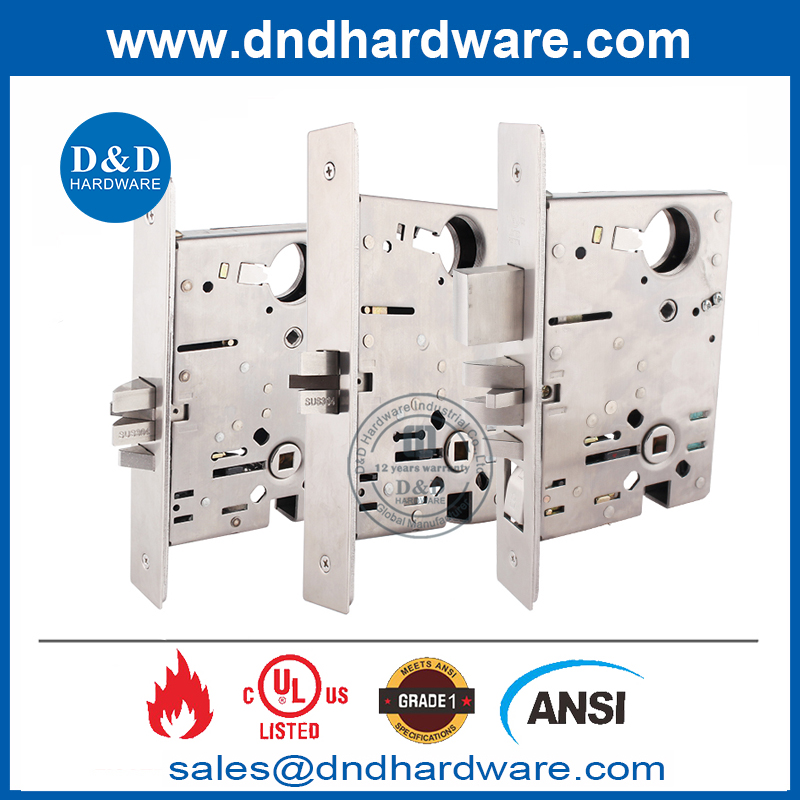
D&D UL-listed mortise locks under UL File R40901 include three-hour UL 10C options for compatible assemblies. When replacement is necessary, verify the exact model, function, latch requirements, door preparation and strike—not simply the faceplate dimensions.
10. Auxiliary hardware does not interfere
Kick-down stops, wedges, surface bolts, security devices, decorations and other additions must not prevent the door from closing and latching. Inspect both the hardware and how occupants actually use it. A compliant component can still create a deficiency if it is installed or adjusted so that it obstructs another required function.
11. No unapproved field modifications are present
Look for drilled holes, cutouts, altered louvers, raceways, surface-mounted hardware and repaired areas that may exceed permitted field work. Record the exact modification. The proper resolution may involve documentation from the manufacturer, an approved repair, a recognized field evaluation or replacement; the inspector should not assume that filler or a cover plate restores the listing.
12. Required gasketing and edge protection are present and intact
Where the opening requires smoke gasketing, edge seals, meeting-stile protection or other listed materials, verify that they are continuous, securely attached and not painted, torn or displaced. Seals should not create enough friction to prevent closing and latching. The door, label, listing and project documents determine which products are required.
13. Signage is securely attached and within the permitted limits
Signs should not be installed with through-bolts or other methods that damage the door unless specifically permitted. Their size, location, attachment and total area must comply with the adopted edition and listing. Heavy decorations, mirrors or unapproved protective plates should not be treated as ordinary signs.
How to Perform the Functional Test
Visual review and functional testing should be coordinated so the inspector can connect a symptom with its likely cause. Before releasing the door, remove only temporary conditions that are safe and within the inspection scope. Do not disconnect life-safety systems or dismantle hardware without authorization.
· Open the door sufficiently to observe controlled movement through the full closing cycle.
· Release it without giving it additional momentum and confirm that it closes completely.
· Repeat from a smaller opening angle where closer performance or latch resistance is questionable.
· For a pair, test each leaf and then both leaves together to verify sequence and latching.
· Operate the latch or exit device from the egress side and check that it releases and returns normally.
· Observe the opening under normal building pressure where practical; unusual HVAC conditions can mask or create a closing problem.
· Retest after adjustment or repair and document the result rather than closing the finding from a work order alone.
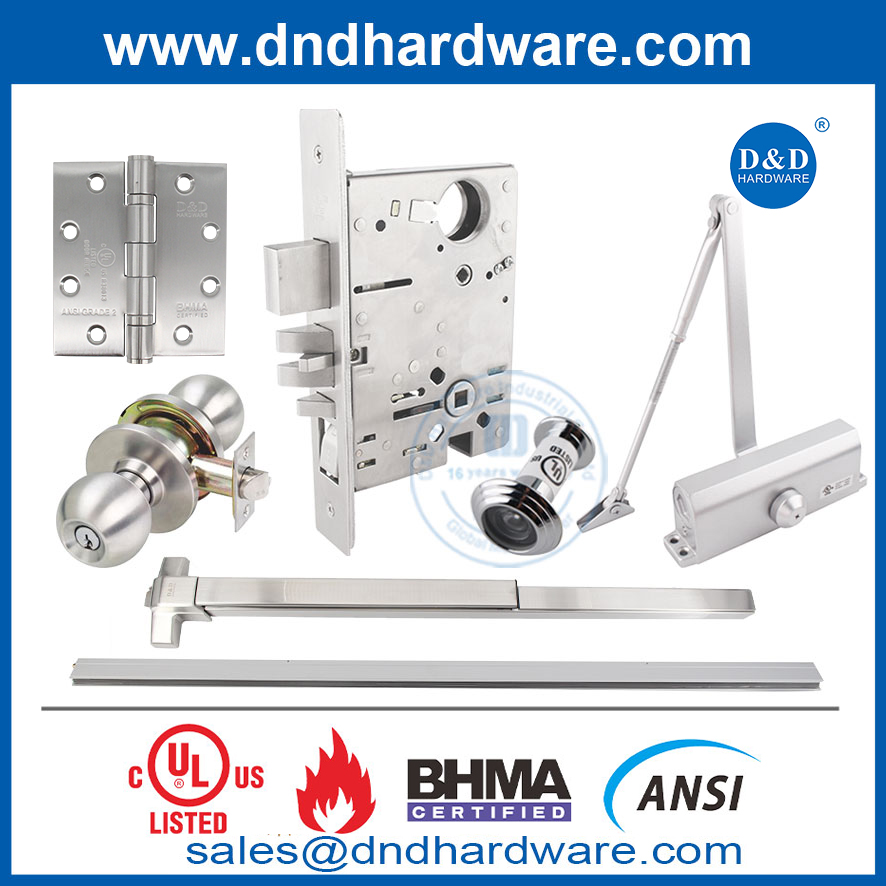
On rated egress doors, verify that the installed device is listed for the actual application. Panic hardware evaluated under UL 305 and fire exit hardware evaluated for fire-door use are not interchangeable labels. D&D's UL 10C fire exit hardware under File R40486 is distinct from its UL 305 panic hardware under File SA45817; a rated opening requiring an exit device must have the appropriate fire exit hardware and compatible installation.
Documenting Deficiencies and Corrective Action
A report should allow another qualified person to locate the opening, understand the defect and verify the correction. A statement such as ‘door failed’ is rarely sufficient. Describe the observed condition, affected component, measurement or test result and the action required for resolution.
· Facility name, inspection date and inspector identity or qualification basis.
· Unique opening number and precise location.
· Door configuration, rating and visible label information.
· Each deficiency, supported by measurements and photographs where useful.
· Recommended next step, responsible party and target status.
· Repair date, materials or model used, person performing the work and retest result.
· Items referred to the manufacturer, listing agency, design professional or AHJ.
NFPA guidance requires inspection records to be retained for review by the AHJ. The adopted edition and local rules determine the precise retention and format requirements. Electronic records are useful when they preserve traceability and can be produced promptly; a spreadsheet without opening IDs, evidence or repair history is not an effective compliance system.
From Failed Inspection to Verified Repair
Inspection is only the first half of the process. Deficiencies should be evaluated and corrected without allowing an impaired opening to remain unnoticed. Facilities should use a documented workflow that assigns responsibility, controls replacement parts, and requires a functional retest before the finding is closed.
· Protect the opening and follow the facility's impairment procedure when a deficiency presents an immediate life-safety concern.
· Diagnose the cause before choosing a repair; closer adjustment cannot correct a dropped door or distorted frame.
· Confirm replacement hardware through model-level listing information and the approved hardware schedule.
· Keep preparation and field modifications within the permitted limits or obtain authorized evaluation.
· Retest closing, sequencing and latching after the work is complete.
· Attach invoices, product data, photographs and approvals to the opening record.
Inspection data can also improve purchasing. Repeated hinge wear may indicate underspecified load capacity; repeated closer failures may point to poor arm geometry or pressure conditions; recurring latch misalignment may reveal frame movement. Using these trends to update specifications is more effective than repeatedly replacing parts with the same unsuitable selection.
Common Fire Door Inspection Mistakes
· Checking the label but not operating the door through a complete closing and latching cycle.
· Using a generic checklist without confirming the adopted NFPA 80 edition and local requirements.
· Treating a private credential as the sole proof of qualification—or assuming experience needs no documented basis.
· Inspecting only the leaf and overlooking the frame, glazing, seals, pair coordination and auxiliary hardware.
· Recording ‘adjust closer’ without identifying binding, pressure, hinge wear or latch resistance.
· Closing deficiencies when parts are ordered instead of after installation and successful retest.
· Replacing hardware by dimensions alone without checking the exact listing, function and preparation.
· Allowing operational staff to prop a repaired door open after it passes inspection.

Frequently Asked Questions
How often does NFPA 80 require fire door inspections?
Inspection and testing are required after installation and at least annually. Additional checks are appropriate after damage, repair, replacement or modification that can affect performance. Always confirm the adopted edition and AHJ requirements.
Does a fire door inspector have to be certified?
NFPA 80 uses a qualified-person standard based on knowledge and understanding. Certification may help demonstrate competence, but NFPA 80 does not make one certification the only route. Contracts, jurisdictions or facility policies may impose additional requirements.
Can maintenance staff perform the inspection?
They can when they are demonstrably qualified and any local or contractual requirements are satisfied. The owner should document the basis of qualification and manage potential conflicts between inspection, repair and acceptance roles.
What happens when a fire door fails inspection?
The deficiency should be documented, evaluated and corrected using compatible materials and permitted methods. The affected function must then be retested, and the result added to the opening record. Serious impairments may require immediate protective measures under facility and AHJ procedures.
Does an annual inspection prove the fire rating?
No. It verifies visible condition and operational performance at the time of inspection. The rating still depends on labeled or otherwise accepted components, listing conditions, approved construction and AHJ acceptance.
Conclusion
An effective NFPA 80 inspection program connects three things: a complete inventory, a competent examination of every required function and a repair record that closes the loop. The goal is not a stack of checklists. It is evidence that each fire door can close, sequence and latch while its components remain identifiable, intact and compatible.
Owners who use inspection findings to guide maintenance and procurement can address recurring causes instead of repeatedly treating symptoms. Specifiers and contractors can support that process by supplying model-level listing data, correct installation instructions and compatible mechanical hardware for each opening.
Application note: Code requirements vary by jurisdiction and adopted edition. Confirm the applicable NFPA 80 edition, building and life safety codes, local amendments, product listings, manufacturer instructions and inspection requirements with the authority having jurisdiction (AHJ).
Contact us Now:
Contact: David Jian
Mob:0086-139 2903 7292
Email: David@dndhardware.com, sales@dndhardware.com,
Contact: Jobby Zhang
Mob:0086-137 2599 9617
Email: jobby@dndhardware.com
D&D HARDWARE INDUSTRIAL CO.,LTD
ADD:12th Floor, Building 2, No.898, KeChuang Technical Zone, Jiangmen Avenue, Pengjiang District, Jiangmen City, Guangdong, China (Postcode:529000)
https://www.dndhardware.com
Tel: +86-750-3856396
Fax: +86-750-3856395


 English