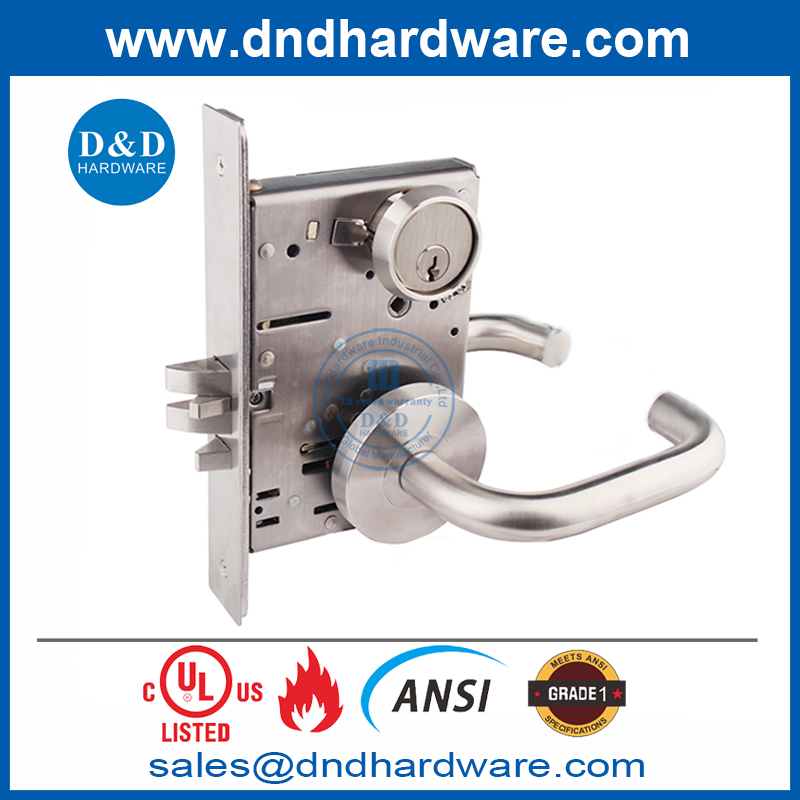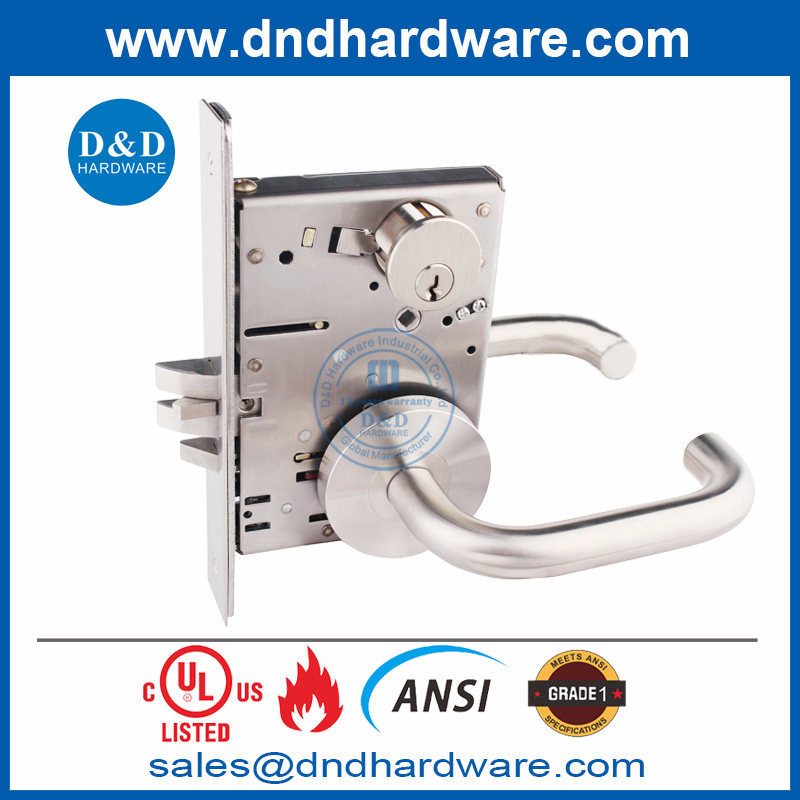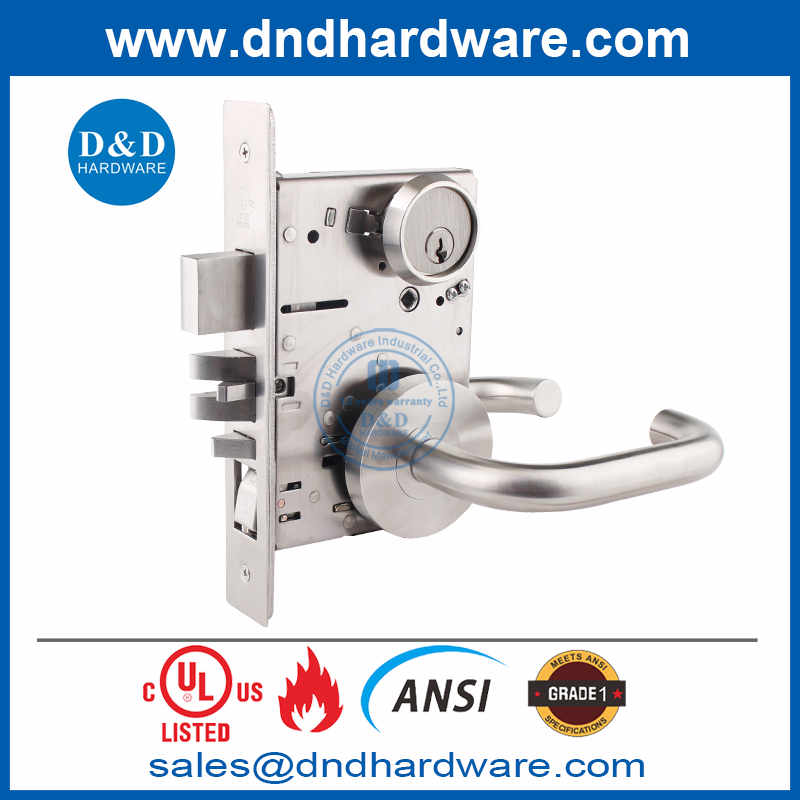
Specifying mortise lock hardware for a commercial or institutional project means more than selecting a finish or a function code. It means choosing the right ANSI/BHMA grade—because that single designation determines how long the lock body will last, how much force it can withstand under attack, and whether it meets the security and code compliance requirements for the building type.
For door manufacturers, building material distributors, and hardware brand owners, getting the grade wrong can lead to failed inspections, security vulnerabilities, warranty claims, or costly early replacements that damage your reputation with end-users and specifiers.
The American National Standards Institute (ANSI) and the Builders Hardware Manufacturers Association (BHMA) jointly administer the grading system through the ANSI/BHMA A156.13 standard for mortise locks and latches. Testing is conducted by independent, BHMA-accredited laboratories, and certification is not self-reported. Every grade has specific cycle counts, impact resistance benchmarks, strength tests, material evaluations, and finish tests that hardware must pass to carry the certification.
This guide covers what ANSI/BHMA Grade 1, Grade 2, and Grade 3 actually mean for mortise locks, what the test specifications require, and how to match the right grade to the right opening—so you can specify with confidence and deliver hardware that performs.

What Is the ANSI/BHMA Grading System for Mortise Locks?
ANSI/BHMA grades classify door hardware based on performance under six categories of laboratory testing, as defined in the ANSI/BHMA A156.13-2022 standard:
•Operational Tests — Measure the force required to retract the latch and operate the trim, ensuring ease of egress and ADA accessibility.
•Cycle Tests — The lockset is installed on a mechanically operated test door and cycled repeatedly with a 10-pound load applied until the required count is reached.
•Strength Tests — Ensure the trim, latches, deadbolts, and lock mechanisms hold up to daily abuse (excessive forces on a lever).
•Security Tests — Simulate forced-entry attacks, including ram impacts to the cylinder face and locked lever torque tests.
•Material Evaluation — Assess the physical properties of trim components (e.g., rose thickness under impact).
•Finish Tests — Verify resistance to corrosion, chemicals, abrasion, and UV exposure.
Hardware must pass all six categories to earn its grade certification. The three grades relevant to mortise locks are:
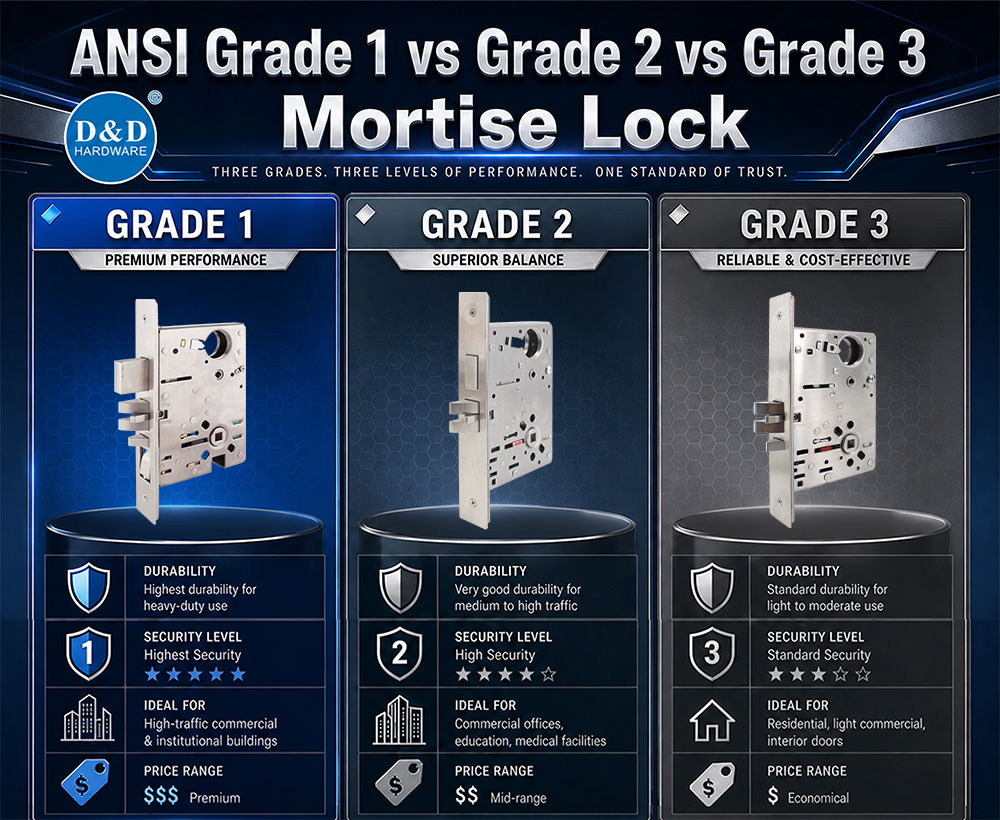
•Grade 1: Highest performance and security. Required or recommended for commercial, institutional, and high-traffic applications.
•Grade 2: Mid-tier performance. Suited for light commercial environments and standard residential entry doors.
•Grade 3: Basic performance. Intended primarily for interior residential doors or low-security areas with the same cycle requirement as Grade 2 but significantly lower security thresholds.
Key Insight for B2B Buyers: Unlike bored/cylindrical locks (ANSI/BHMA A156.2) where Grade 1 requires 1,000,000 cycles and Grade 3 only 200,000 cycles, mortise locks under A156.13 require 800,000 cycles for both Grade 2 and Grade 3. The primary differentiator between Grade 2 and Grade 3 mortise locks is security performance (impact resistance), not cycle life. This is a critical distinction when specifying for your projects.
ANSI/BHMA Grade 1: The Commercial & Institutional Standard
Grade 1 is the benchmark for commercial and institutional door hardware. It is specified wherever durability, security, and code compliance are non-negotiable: hospitals, schools, government facilities, airports, hotels, correctional facilities, and any opening that sees heavy daily traffic or requires maximum forced-entry resistance.
Grade 1 Test Specifications (ANSI/BHMA A156.13)
| Test Category | Grade 1 Requirement |
| Cycle Test | 1,000,000 cycles with 10 lb. load applied |
| Operational (Lever Torque) | Maximum 28 lbf-in. (3.1 Nm) to retract latch |
| Strength (Lever) | 450 lbf-in. (50 Nm) |
| Security (Cylinder Impact) | 10 blows at 75 ft-lbf (100 J) |
| Security (Locked Lever Torque) | 1,200 lbf-in. |
| Material Evaluation (Rose) | 0.075 in. (1.9 mm) maximum penetration |
Those 1,000,000 cycles assume multiple operations per day across the life of the product. On a door that opens and closes 100 times a day, that is roughly 27 years of use before reaching the test threshold. For a 24/7 healthcare corridor or a school hallway with hundreds of daily passages, that durability margin is essential.
Common Grade 1 Applications
•Hospital and healthcare facility entry and corridor doors
•K-12 schools and university buildings
•Government and municipal facilities
•Hotels and hospitality properties
•Industrial and warehouse entry points
•High-traffic retail storefronts
•Airports and transportation hubs
•Correctional and detention facilities
ANSI/BHMA Grade 2: Light Commercial & Residential
Grade 2 is the practical choice for openings that need reliable security without the full durability and extreme forced-entry resistance of a high-traffic commercial installation. It is well suited to environments where daily cycle counts are moderate and the primary concern is balanced performance at a reasonable cost point.
Grade 2 Test Specifications (ANSI/BHMA A156.13)
| Test Category | Grade 2 Requirement |
| Cycle Test | 800,000 cycles with 10 lb. load applied |
| Operational (Lever Torque) | Maximum 28 lbf-in. (3.1 Nm) to retract latch |
| Strength (Lever) | 450 lbf-in. (50 Nm) |
| Security (Cylinder Impact) | 5 blows at 75 ft-lbf (100 J) |
| Material Evaluation (Rose) | 0.100 in. (2.5 mm) maximum penetration |
Grade 2 hardware is not a compromise on security in lower-traffic environments. The 800,000-cycle rating is more than sufficient for an office interior door, a retail stockroom, or a residential entry where the door cycles significantly fewer times per day than a high-traffic commercial corridor. At 50 cycles per day, 800,000 cycles translates to over 43 years of service life.
Common Grade 2 Applications
•Office building interior and secondary entry doors
•Retail and light commercial environments
•Multi-family residential common areas
•Small professional offices and medical suites
•Storage and utility rooms in commercial buildings
•Standard residential entry doors (higher-end)
ANSI/BHMA Grade 3: Basic Residential
Grade 3 offers basic security for everyday residential use. While sharing the same 800,000-cycle requirement as Grade 2 for mortise locks under A156.13, Grade 3 has significantly lower security thresholds. It is not intended for commercial or industrial settings but serves well for internal doors and lower-security areas where privacy rather than security is the primary function.
Grade 3 Test Specifications (ANSI/BHMA A156.13)
| Test Category | Grade 3 Requirement |
| Cycle Test | 800,000 cycles with 10 lb. load applied |
| Operational (Lever Torque) | Maximum 28 lbf-in. (3.1 Nm) to retract latch |
| Strength (Lever) | 450 lbf-in. (50 Nm) |
| Security (Cylinder Impact) | 2 blows at 75 ft-lbf (100 J) |
| Material Evaluation (Rose) | 0.100 in. (2.5 mm) maximum penetration |
Common Grade 3 Applications
•Residential interior doors (bedrooms, bathrooms)
•Low-security storage and utility rooms
•Secondary interior passages in residential buildings
Important Note: Grade 3 mortise locks should not be specified for exterior entry doors, commercial applications, or any opening where forced-entry resistance is a concern. The 2-blow impact rating provides minimal security against deliberate attack.
Grade 1 vs. Grade 2 vs. Grade 3: Mortise Lock Specifications at a Glance
Use this table as a quick reference when specifying or comparing mortise lock options. All data is based on ANSI/BHMA A156.13-2022:
| Test / Specification | Grade 1 | Grade 2 | Grade 3 |
| Cycle Test | 1,000,000 | 800,000 | 800,000 |
| Operational (Lever Max Torque) | 28 lbf-in. | 28 lbf-in. | 28 lbf-in. |
| Strength (Lever) | 450 lbf-in. | 450 lbf-in. | 450 lbf-in. |
| Security – Cylinder Impact (75 ft-lbf) | 10 blows | 5 blows | 2 blows |
| Material Evaluation (Rose Penetration) | 0.075 in. | 0.100 in. | 0.100 in. |
| Primary Application | Commercial / Institutional / High-traffic | Light Commercial / Residential Entry | Residential Interior / Low-security |
| Estimated Service Life (at 100 cycles/day) | ~27 years | ~22 years | ~22 years |

Fire Rating & Mortise Lock Compliance
For door manufacturers and building material suppliers, fire rating is often as critical as the ANSI grade itself. Fire-rated doors require hardware that has been independently tested and listed to maintain the door assembly's fire resistance rating. The relevant standard is UL 10C (Positive Pressure Fire Tests of Door Assemblies).
When specifying mortise locks for fire-rated openings, the hardware must:
•Be listed by a recognized testing laboratory (UL, Intertek/WHI) for use on fire-rated door assemblies
•Maintain the latch bolt in the projected position during fire exposure
•Not compromise the door assembly's fire resistance rating
•Comply with local building codes (IBC, NFPA 80) which typically require self-latching hardware on fire doors
D&D Hardware Fire Rating Certification
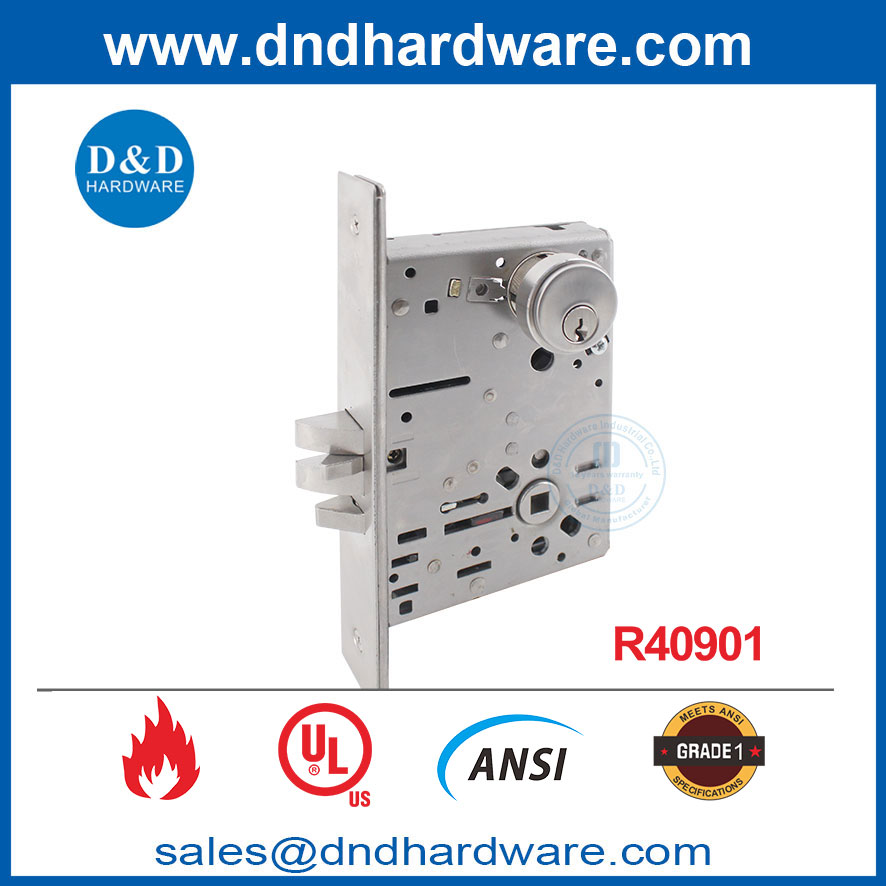
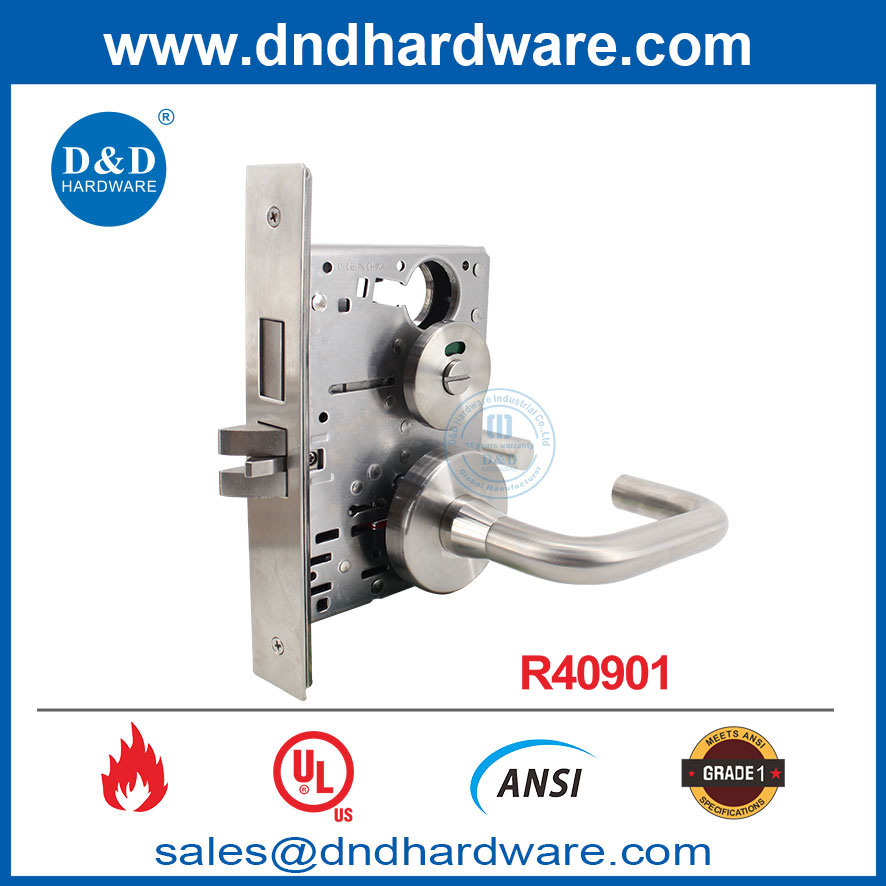
D&D Hardware mortise locks are tested and listed to UL 10C — Fire Rated 3 Hours, with UL File Number R40901. This certification ensures our mortise locks are approved for use on fire-rated door assemblies up to 3 hours, meeting the most demanding fire safety requirements for commercial and institutional buildings.
The combination of ANSI Grade 1 performance capability and UL 10C fire rating makes a mortise lock suitable for the most demanding commercial applications—including stairwell doors, corridor separations, and exit enclosures in hospitals, schools, and high-rise buildings.
Which Grade Is Right for Your Application?
The right grade depends on traffic volume, occupancy type, applicable building codes, and project budget. Here is a practical breakdown by application:
| Application | Recommended Grade | Reason |
| Hospital / healthcare entry doors | Grade 1 | 1M+ cycle durability required for 24/7 operation; code compliance |
| K-12 school classroom locks | Grade 1 | Forced-entry resistance and lockdown security requirements |
| Government / municipal facilities | Grade 1 | High security requirements and heavy daily traffic |
| Hotels (guest room & corridor) | Grade 1 | High cycle count and security for guest safety |
| Office building main entry | Grade 1 or 2 | Depends on traffic volume and local code requirements |
| Retail storefront | Grade 1 or 2 | Security needs vary; high-value retail should use Grade 1 |
| Multi-family residential (common areas) | Grade 2 | Balance of security and cost for moderate traffic |
| Light industrial / warehouse | Grade 1 | Durability in demanding environments with heavy use |
| Standard residential entry | Grade 2 | Adequate security and durability for typical home use |
| Residential interior doors | Grade 3 | Basic privacy function; minimal security requirement |
When in doubt between grades, select up. The cost difference between Grade 2 and Grade 1 hardware is modest relative to the labor cost of an early replacement, a failed inspection, or a warranty claim from your end-user.
Why Choose D&D Hardware as Your Mortise Lock Supplier
D&D Hardware — Your Trusted B2B Partner for ANSI Mortise Locks
As a specialized door hardware manufacturer based in Jiangmen, China, D&D Hardware serves door manufacturers, building material distributors, and hardware brand owners worldwide with high-performance mortise lock solutions.
•Grade 1 Manufacturing Capability: Our factory is fully equipped to produce mortise locks meeting ANSI Grade 1 standards (1,000,000 cycles), delivering maximum durability for commercial and institutional projects.
•UL 10C Fire Rated — 3 Hours (File NO. R40901): Our mortise locks carry UL fire rating certification, approved for fire-rated door assemblies up to 3 hours—meeting the strictest fire safety codes.
•ISO 9001 Certified Quality System: Rigorous quality control from raw material inspection through final assembly ensures consistent, reliable performance.
•Complete Door Hardware Ecosystem: Beyond mortise locks, we supply hinges, door closers, panic exit devices, lever handles, and accessories—enabling one-stop procurement for your projects.
•OEM/ODM Flexibility: Custom function codes, finishes, and branding options to support your product line and market positioning.
•Stainless Steel 304 Construction: Our ANSI mortise locks feature SS304 bodies for superior corrosion resistance and long-term durability in demanding environments.
•Competitive Factory-Direct Pricing: As a manufacturer, we offer cost efficiency that helps you maintain healthy margins while delivering premium-grade hardware to your customers.
Frequently Asked Questions
What is the difference between ANSI Grade 1, Grade 2, and Grade 3 mortise locks?
The primary differences lie in cycle life and security performance. Grade 1 mortise locks are tested to 1,000,000 cycles and must withstand 10 impact blows at 75 ft-lbf. Grade 2 is rated for 800,000 cycles with 5 impact blows. Grade 3 also requires 800,000 cycles but only 2 impact blows. Grade 1 is specified for commercial and institutional applications, Grade 2 for light commercial and residential entry, and Grade 3 for residential interior doors.
Is ANSI Grade 1 required for commercial buildings?
Many building codes and project specifications require Grade 1 hardware for commercial entry doors, corridors, and high-traffic openings. Requirements vary by jurisdiction, occupancy type, and the project's construction documents. The International Building Code (IBC) and NFPA 80 often reference ANSI/BHMA standards. Always verify against applicable local codes.
Why do Grade 2 and Grade 3 mortise locks have the same cycle count?
Under ANSI/BHMA A156.13, both Grade 2 and Grade 3 mortise locks require 800,000 cycles. The differentiation is primarily in security testing—Grade 2 must withstand 5 impact blows versus only 2 for Grade 3. This is different from bored locks (A156.2), where cycle counts vary significantly between grades. For mortise locks, security performance is the key differentiator between Grade 2 and Grade 3.
What does UL 10C fire rating mean for mortise locks?
UL 10C (Positive Pressure Fire Tests of Door Assemblies) certifies that the hardware has been tested as part of a fire-rated door assembly and maintains its function during fire exposure. A 3-hour UL 10C rating means the lock has been proven to perform on door assemblies rated for up to 3 hours of fire resistance—the highest commonly specified rating for commercial buildings.
Can D&D Hardware supply Grade 1 mortise locks for my project?
Yes. D&D Hardware's manufacturing facility is fully capable of producing mortise locks that meet ANSI Grade 1 performance standards, including the 1,000,000-cycle requirement. Our locks are also UL 10C fire rated for 3 hours (File NO. R40901), making them suitable for the most demanding commercial and institutional fire-rated door applications.
What ANSI mortise lock functions does D&D Hardware offer?
D&D Hardware offers a comprehensive range of ANSI mortise lock functions including Entry (F04), Classroom (F05), Storeroom (F07), Hotel/Motel (F08), Passage (F01), Privacy (F19), and more. Custom function configurations are available for OEM/ODM projects. Contact our team for the complete function code catalog.
How do I verify ANSI/BHMA certification on a mortise lock?
Look for official BHMA certification markings on the product and verify through the BHMA Certified Products Directory (CPD) at buildershardware.com. The certification confirms that the product has been independently tested by a BHMA-accredited laboratory and meets all requirements of the stated grade under A156.13.

 English