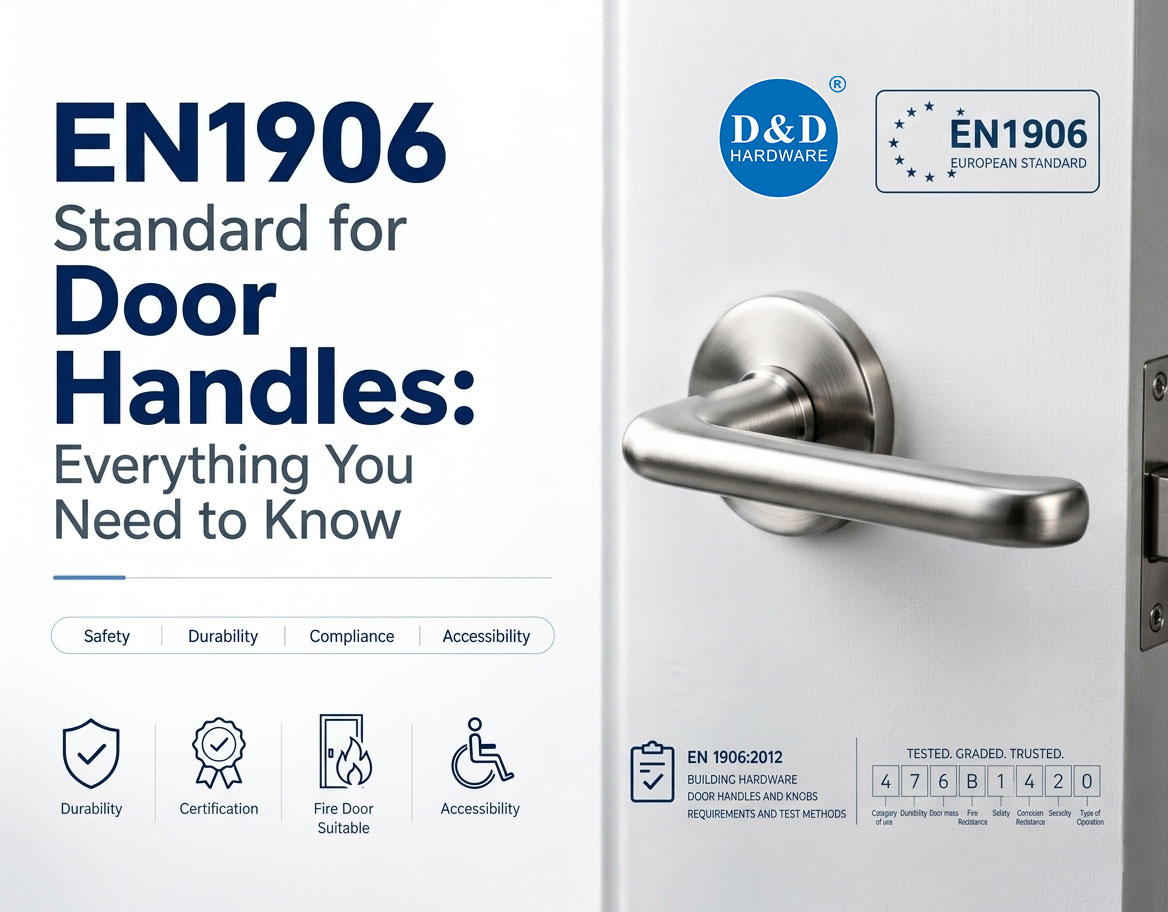
EN1906 is a European standard that specifies performance requirements and test methods for lever handles and knob furniture used to operate locks, latches and other door hardware. It helps architects, contractors, door manufacturers, distributors and hardware buyers evaluate the durability, safety, corrosion resistance, fire door suitability and application level of door handles.
For commercial projects, understanding the EN1906 classification code is important because it allows buyers to compare door handles based on tested performance rather than appearance alone. A handle may look strong, but only a clear classification code, test report or certificate can show whether it is suitable for residential, commercial, public, high-traffic or severe-duty applications.
This guide explains what EN1906 means, how to read the classification code, the difference between Grade 3 and Grade 4 door handles, how EN1906 relates to fire doors, and how to choose suitable lever handles for commercial and architectural door hardware projects.

Key Takeaways
EN1906 is a European rule. It makes sure door handles are strong and safe. It works for many places.
Pick the right lever grade for where the door is. Grade 1 is for homes. Grade 3 is for offices. Grade 4 is for busy places like hospitals.
Always look at the eight-digit EN1906 code on handles. This code shows how well the handle works. It also tells if it fits your needs.
Using EN1906 certified handles helps you follow safety rules. It also keeps you from legal trouble in business buildings.
Lever handles are easier to use than knobs. They help everyone open doors, especially in public places.
What Is EN1906?
EN1906 is a European standard for lever handles and knob furniture. It defines performance requirements and test methods for door furniture used with locks and latches.
The standard evaluates key performance factors such as:
EN1906 is commonly referenced in commercial, institutional and public building projects where door handles must meet specific durability, safety and performance requirements.
Typical applications include:
Office buildings
Hotels and apartments
Schools and universities
Hospitals and healthcare buildings
Shopping centers
Airports and transportation facilities
Government buildings
Public buildings
Fire-rated doors when applicable
Commercial and institutional door projects
Why EN1906 Matters for Door Handle Safety
Security and Durability
You want your lever door handles to last and keep your building safe. EN1906 sets high standards for both security and durability. When you choose EN1906 lever handles, you get products that pass tough tests. These tests check how many times a lever can open and close a door, how much force it can take, and how well it stands up to rust.
Here is a table that shows how Grade 3 and Grade 4 EN1906 lever handles perform:
Performance Metric | Grade 3 (High Use) | Grade 4 (Violent Use) |
Durability (Cycles) | 200,000 | 300,000+ |
Torque Resistance | 40 Nm | 60 Nm |
Corrosion Resistance | Grade 3 (96h) | Grade 4 (240h) |
You can see that Grade 4 lever door handles are made for places like commercial buildings, hospitals, and schools. These levers last longer and resist more force. They also pass a 240-hour salt spray test, so they work well in coastal or humid areas. EN1906-compliant lever handles are also tested by independent labs. Some even have extra features, like a backplate that protects against break-ins.
Tested to 300,000 cycles for long-term use in busy commercial spaces.
Passed tough corrosion tests for harsh environments.
Designed to meet strict fire safety rules.
Legal and Regulatory Role
If you manage a commercial building, you must follow safety rules. EN1906 helps you meet these rules. Using non-compliant lever door handles can lead to problems:
Legal consequences
Failed audits
Risks to life
You protect people and avoid trouble when you pick EN1906 lever handles for your doors. Many countries require EN1906 lever handles in public and commercial spaces. You show that you care about safety and quality when you choose the right lever for each door.
EN1906 Performance Requirements
Durability and Strength
You want your lever to last a long time. Many people might use the door every day. The EN1906 standard has clear rules for how strong and tough a lever should be. You can see how good a lever is by checking its grade. The table below shows how EN1906 puts levers into groups by how much they are used and how safe they are:
Category of Use | Durability Grade | Safety Grade |
Grade 1 | 100,000 cycles | Normal use |
Grade 2 | 200,000 cycles | Safety application |
Grade 3 | High frequency | High strength |
Grade 4 | Frequent violent use | High strength |
Higher grades mean the lever can handle more use and stronger force. These tests help you pick the best lever for your door. If you need a lever for a busy place like a school or hospital, you should get Grade 3 or Grade 4. These grades show the lever passed hard tests for strength and lasting a long time.
Corrosion Resistance
Some doors are in places with water or changing weather. En1906 checks if levers can fight rust and damage from the air. You want a lever that stays strong and looks nice for years. The standard uses salt spray tests to prove the lever will last. If you see a high corrosion grade, you know the lever will work well on any door, even in hard places.
Accessibility Features
The EN1906 standard says lever handles are better than knobs for opening doors in public buildings. Knobs need you to grip and twist, which is hard for people with disabilities. Lever handles can be used with a closed fist or elbow, so they are easier for everyone. The standard also says all door handles should be easy to use with one hand and should not need you to grip or twist.
When you pick a lever that meets EN1906 accessibility rules, you help everyone open the door. This makes your building safer and easier for all people.
EN1906 Grading and Coding System
The Eight-Digit Code Explained
You might see an eight-digit code when you look at EN1906 lever door handles. This code tells you everything you need to know about the lever and its performance. Each digit stands for a different feature. You can use this code to compare levers and pick the right one for your door.
Here is a table that shows what each digit means:
Digit | Feature Description | Details |
1 | Category of use | Grades 1-3 for different usage frequencies |
2 | Durability | Twelve grades based on operational figures |
3 | Door mass and closing force | Nine grades for closing force at various masses |
4 | Fire resistance | Two grades for fire/smoke door suitability |
5 | Safety | No specific requirement, but can be part of exit devices |
6 | Corrosion resistance | Eight grades based on NSS corrosion resistance |
7 | Security and drill resistance | Seven grades for physical attack resistance |
8 | Type of operation | Type of lever handle or knob operation |
You can read this code on the box or in the product details. For example, if you see a code like 3 7 5 1 0 4 2 1, you know the lever is strong, durable, and safe for a busy commercial building. This system helps you find the best lever for your needs.
Tip: Always check the eight-digit code before you buy a lever. This code helps you avoid mistakes and makes sure you get the right lever for your door.
EN1906 Category of Use: Grade 1 to Grade 4
When people refer to EN 1906 Grade 3 or Grade 4 door handles, they usually mean the first digit of the classification code: Category of Use.
This category describes the expected usage level and the risk of misuse or rough operation.
Category of Use | Typical Application | Recommended For |
Grade 1 | Medium frequency of use with high incentive to exercise care | Residential internal doors |
Grade 2 | Medium frequency of use with some chance of misuse | Offices and light commercial doors |
Grade 3 | High frequency of use with high chance of misuse | Commercial and public buildings |
Grade 4 | High frequency of use with severe or rough use | Hospitals, schools, stadiums, transport hubs and public buildings |
EN 1906 Grade 3 Door Handles
Grade 3 lever handles are suitable for high-frequency public or commercial doors where there is a higher chance of misuse. They are often selected for offices, hotels, schools, apartments, public buildings and other commercial applications.
EN 1906 Grade 4 Door Handles
Grade 4 lever handles are intended for severe-duty applications. They are suitable for doors exposed to frequent use, rough operation or demanding public environments. Typical applications include hospitals, stadiums, schools, transportation facilities and high-traffic public buildings.
For most commercial projects, Grade 3 or Grade 4 handles are usually preferred, depending on traffic level, door location and project specification.
How to Read EN1906 Codes
An EN1906 classification code is usually shown as eight digits or characters. It should be read from left to right, with each position representing a specific performance category.
For example, a product may show a classification code in this general format:
4 | 7 | - | 1 | 1 | 4 | 0 | A
This type of code should be checked digit by digit. It may indicate the category of use, durability test level, fire or smoke door suitability, safety, corrosion resistance, security level and type of operation.
When reviewing a product, buyers should ask:
What is the full EN1906 classification code?
Which version of the standard was used?
Is there a test report or certificate?
Is the handle suitable for fire or smoke doors?
What material and finish were tested?
Is the handle compatible with the required lock or latch?
Is the product suitable for the project environment?
Note: If you are not sure how to read the code, ask your supplier or check the EN1906 guide. This helps you avoid buying the wrong lever for your door.

Choosing EN1906 Door Handles
Residential vs. Commercial Use
Think about where you will use the door handle. Homes and businesses need different things. In your house, you might want a lever handle for bedrooms or bathrooms. These rooms do not get as much use as offices or hospitals. Commercial places need stronger door handles. These handles must last longer and be tougher.
Grade | Application | Characteristics |
1 | Residential | Good for inside doors at home, made for light use. |
2 | Commercial | Works well in offices and stores, built for more use. |
3 | Heavy Duty | Best for busy places, gives the most strength and lasts longest. |
Always check the grade before you put in a new handle. Office, school, and hospital doors need commercial-grade lever handles. Heavy-duty handles are best for doors that many people use all day.
Matching Grades to Needs
Follow these steps to pick the right EN1906 lever handle:
Choose where you will put the lever. Entry doors, bathrooms, and closets need different types.
Measure your door's thickness and space. This helps you install it right.
Pick a good material. For wet or outside doors, use fire-rated stainless steel or PVD-coated brass.
Look for EN1906 certification and CE marking. This means the lever passed tests for quality.
Try the lever if you can. Make sure it feels good and works well.
Do not buy levers with missing maker details or unclear warranty.
Think about how many people use the door. Busy doors need higher-grade commercial handles. Less busy doors can use lower grades.
Fire Door and Accessibility Compliance
Fire doors need special lever handles. EN1906 lever handles for fire doors must pass hard tests. Look for handles that meet EN1634 fire rules. These handles have a 2.0mm steel plate for extra strength. Lever handles are better for accessibility. They help everyone open doors. ADA rules say you must use a lever handle that works with one hand and does not need twisting. Lever handles help people who have trouble gripping or turning. You can swap a knob for a lever to make doors easier to use. ADA and fire-rated handles help you follow safety and accessibility laws in businesses. Always pick lever handles that pass fire and ADA tests.
Tip: When you put in a lever handle, follow the fire and ADA rules. This keeps people safe and makes doors easy to use for everyone.
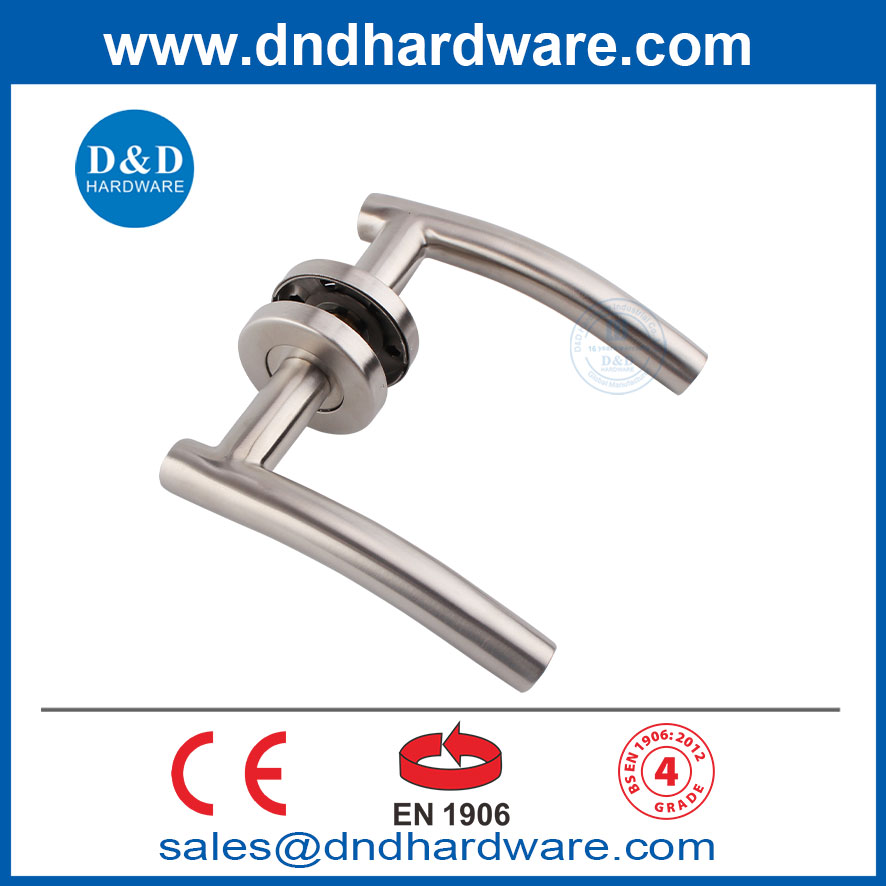
BS EN 1906:2012 and International Standards
How BS EN 1906:2012 Relates to EN1906
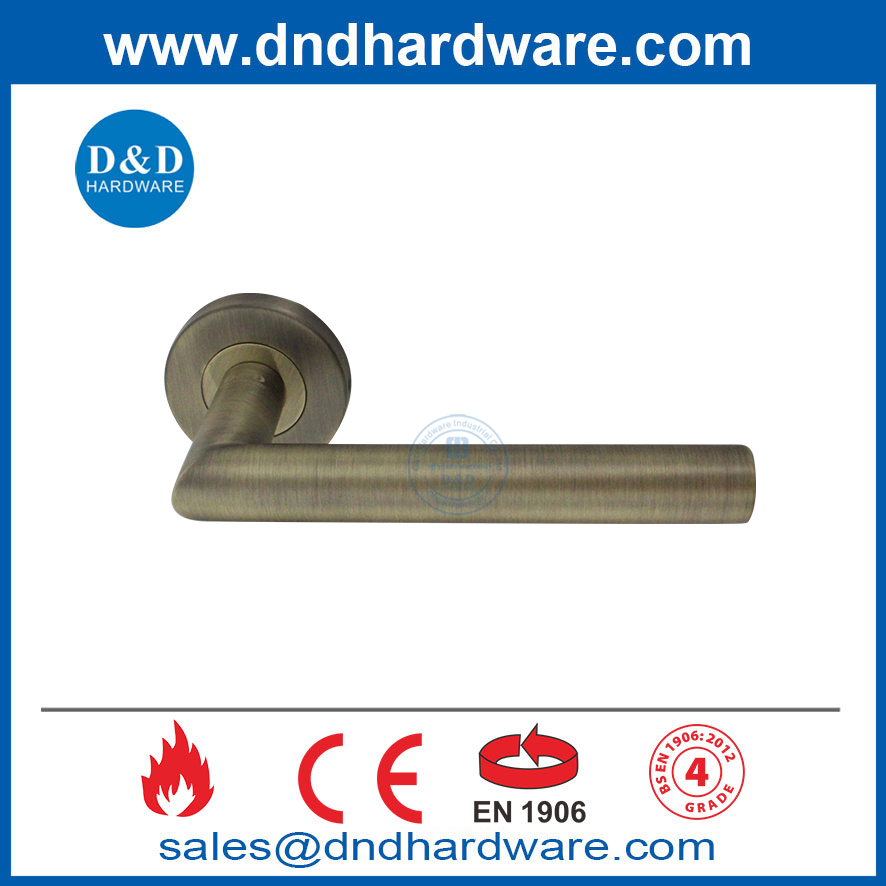
You may see the term BS EN 1906:2012 when you shop for a lever or door handle. This is the British version of the EN1906 standard. It gives you the same rules for testing and grading lever handles. You can trust BS EN 1906:2012 if you want a lever for a commercial building or a busy public space. The standard checks how strong the lever is and how well it works on a door. You will find that BS EN 1906:2012 uses the same eight-digit code as EN1906. This helps you compare products from different suppliers.
Note: If you buy a lever with BS EN 1906:2012 on the box, you know it meets strict European and British safety rules.
Certification and Compliance
You need to check for certification before you buy a lever for a commercial door. Certification means the lever passed all the tests in BS EN 1906:2012. You will see a mark or label that shows the lever is safe and strong. This helps you follow building laws and keep people safe.
Here are steps you can follow to make sure your lever is compliant:
Look for the BS EN 1906:2012 mark on the lever or packaging.
Ask your supplier for a copy of the certification.
Check if the lever passed fire and corrosion tests.
Make sure the lever matches the grade you need for your commercial door.
If you use certified lever handles, you lower the risk of accidents in your building. You also avoid problems during safety checks. Always choose a lever with proper certification for every commercial project.
Tip: Certified lever handles last longer and give you peace of mind. You protect your building and everyone who uses the door.
Common Pitfalls and Best Practices
Avoiding Non-Compliant Handles
You need every lever to meet EN1906 standards, especially in busy buildings. People often make mistakes when picking or putting in lever handles. These mistakes can cause safety problems and failed checks. Here are some common mistakes:
Not checking the right grade for your building's use.
Forgetting to ask for the code that matches the lever to your door.
Not looking at how the lever is built inside, which matters for how long it lasts.
Missing out on checking if the handle works with fire doors, which is very important for safety.
Choosing handles that are hard to put in or do not fit right.
Not making sure the maker always keeps good quality.
Tip: Always look at the lever's grade, code, and fire door rating before you buy. This helps you avoid spending extra money and keeps your building safe.
You should also make sure the lever is made from strong stuff like 304 stainless steel. This helps the handle fight rust, damage, and heat. Handles that pass tests like EN 1906 and EN 1634-1 work well on wood and steel fire doors in busy places.
Working with Certified Suppliers
Picking a certified supplier helps you find lever handles that pass all the needed tests. Certified suppliers give you more than just handles—they help you and make your projects easier.
Certification | Benefit |
EN1906 | Makes sure the handle is safe and meets rules |
ANSI UL | Shows the product is safe and works well |
ANSI BHMA | Proves the handle meets industry rules |
BS EN | Means the handle is good quality and works well |
When you buy from certified suppliers, you get:
Help if you have trouble with a lever or door.
Warranties for hardware used in busy places.
Fast help and easy returns if something breaks.
Quick ways to get new parts.
You should also follow good steps to keep your building safe. Pick the right lever and hardware for each spot. Check your doors and handles often. Make sure all fire doors and their parts meet safety rules. Testing and fixing things often helps you avoid trouble and keeps everyone safe in your building.

D&D Hardware EN 1906 Door Handle Solutions
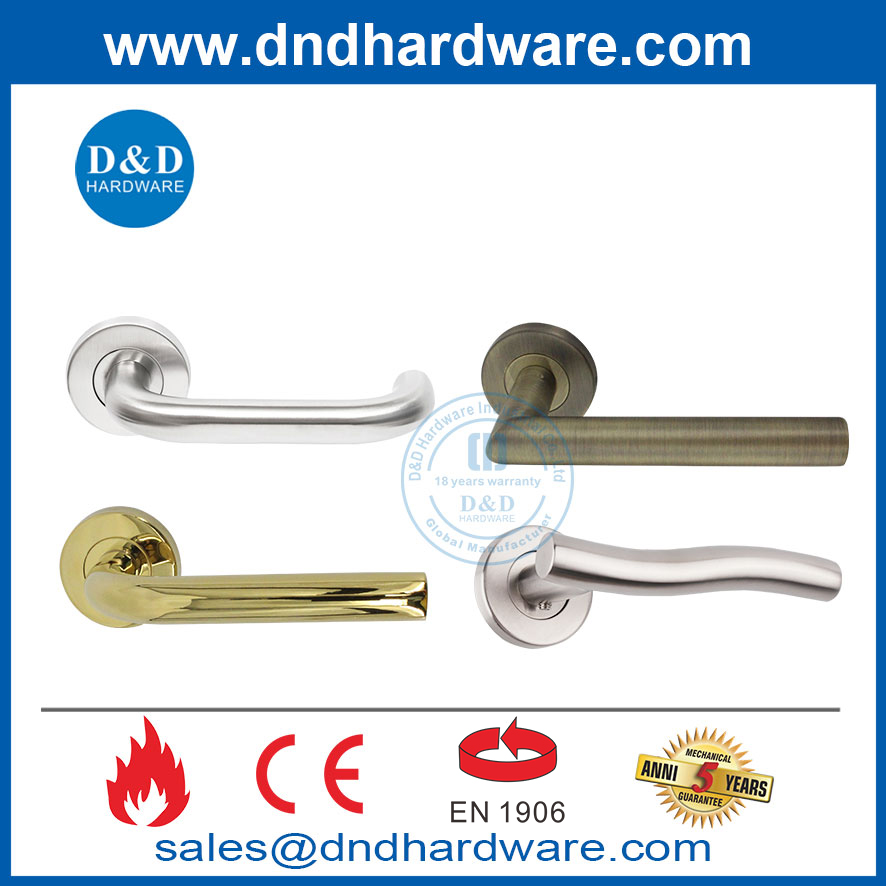
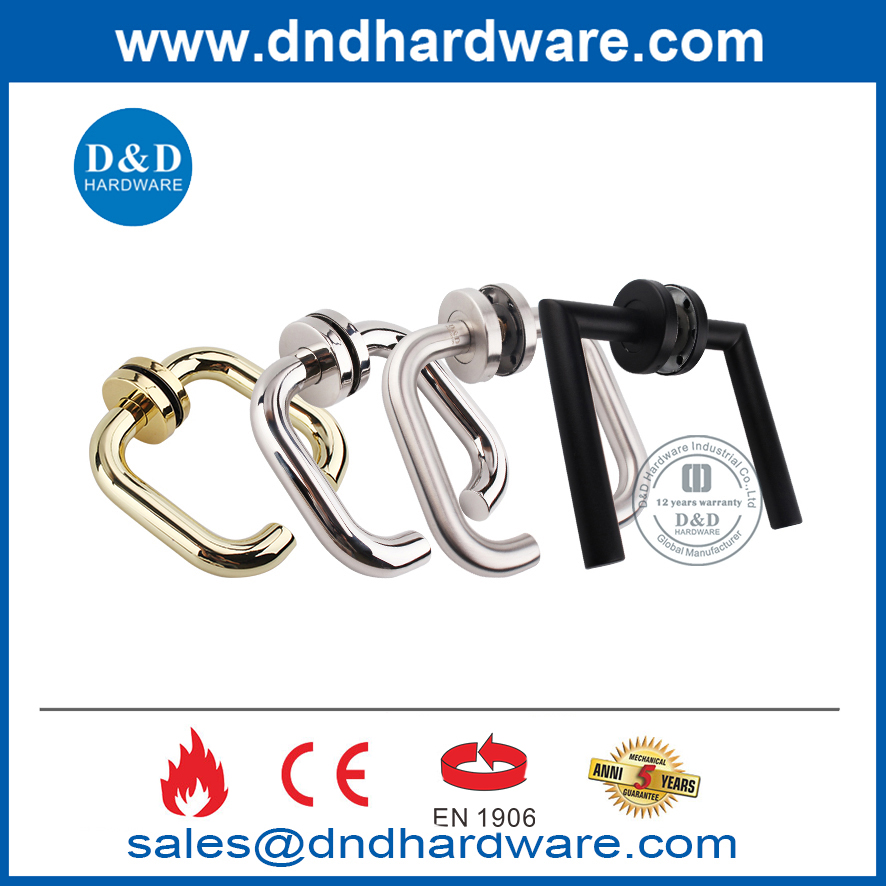
D&D Hardware supplies EN1906 door handles and complete architectural door hardware solutions for commercial, institutional and fire-rated door projects.
For distributors, contractors, door manufacturers and project buyers, our team can help review the required EN1906 classification, material, finish, fire door suitability, quantity and project schedule before recommending suitable products.
If you need EN 1906 lever handles for a commercial project, contact D&D Hardware to request a door handle catalog, classification information, technical documents or a complete door hardware solution.
What is EN 1906 for door handles?
EN 1906 is a European standard that specifies performance requirements and test methods for lever handles and knob furniture used to operate locks, latches and other door hardware.
What does the EN 1906 classification code mean?
The EN 1906 classification code uses eight digits or characters to describe key performance characteristics such as category of use, durability, fire or smoke door suitability, safety, corrosion resistance, security and type of operation.
What is the difference between EN 1906 Grade 3 and Grade 4?
Grade 3 and Grade 4 usually refer to the Category of Use. Grade 3 is suitable for high-frequency public or commercial use, while Grade 4 is intended for severe-duty applications with frequent or rough use.
Is EN 1906 required for fire doors?
EN 1906 can indicate whether lever handles or knob furniture are suitable for fire or smoke door applications, but fire door suitability also requires relevant fire performance evidence and compatibility with the complete fire door assembly.
Are EN 1906 door handles suitable for commercial buildings?
Yes. EN 1906 door handles are commonly specified for offices, hotels, hospitals, schools, public buildings and other commercial projects, especially when durability, corrosion resistance and tested performance are required.
What should I check before buying EN 1906 door handles?
Check the EN 1906 classification code, material, finish, corrosion resistance, fire door suitability, lock compatibility, project standard and supplier documentation.
Which material is best for EN 1906 lever handles?
Stainless steel 304 is suitable for many commercial projects, while stainless steel 316 is recommended for coastal, humid or harsh environments. The final choice should depend on the project environment, finish requirement and performance documentation.
Can EN 1906 handles be used with mortise locks?
Yes, many EN 1906 lever handles are designed for use with mortise locks. Buyers should confirm spindle size, fixing dimensions, lock compatibility, backset and door preparation before ordering.
Conclusion
EN1906 is an important standard for evaluating lever handles and knob furniture in commercial, institutional and architectural door hardware projects. It helps buyers understand the tested performance of door handles, including category of use, durability, corrosion resistance, safety, fire or smoke door suitability, security and type of operation.
For project buyers, the most important step is to review the full EN1906 classification code and supporting documents, not only the product appearance or material. Grade 3 and Grade 4 handles are commonly used for high-traffic commercial and public buildings, while fire-rated doors require additional verification of fire or smoke door suitability and complete assembly compatibility.
If you are selecting EN1906 door handles for offices, hotels, hospitals, schools, public buildings or fire-rated door projects, D&D Hardware can help you choose suitable lever handles and complete architectural door hardware solutions.
Contact our team to request product specifications, classification information, certification documents or a project quotation.
Contact us Now:
Contact: David Jian
Mob:0086-139 2903 7292
Email: David@dndhardware.com, sales@dndhardware.com,
Contact: Jobby Zhang
Mob:0086-137 2599 9617
Email: jobby@dndhardware.com
D&D HARDWARE INDUSTRIAL CO.,LTD
ADD:12th Floor, Building 2, No.898, KeChuang Technical Zone, Jiangmen Avenue, Pengjiang District, Jiangmen City, Guangdong, China (Postcode:529000)
https://www.dndhardware.com
Tel: +86-750-3856396
Fax: +86-750-3856395


 English