European Hardware Solution for Single-Leaf Timber Fire Doors in Stairwells
A stairwell fire door must support everyday access while helping protect the escape route during a fire. Its hardware needs to work together: hinges support the door leaf, a door closer returns it to the closed position, and the operating hardware allows users to pass through safely.
For door manufacturers, contractors and project buyers, selecting this hardware involves more than choosing individual products. The configuration must suit the timber door construction, opening direction, door dimensions, required fire performance and escape requirements.
D&D offers European-standard door hardware options for single-leaf timber fire doors, with configurations selected according to the requirements of each opening.
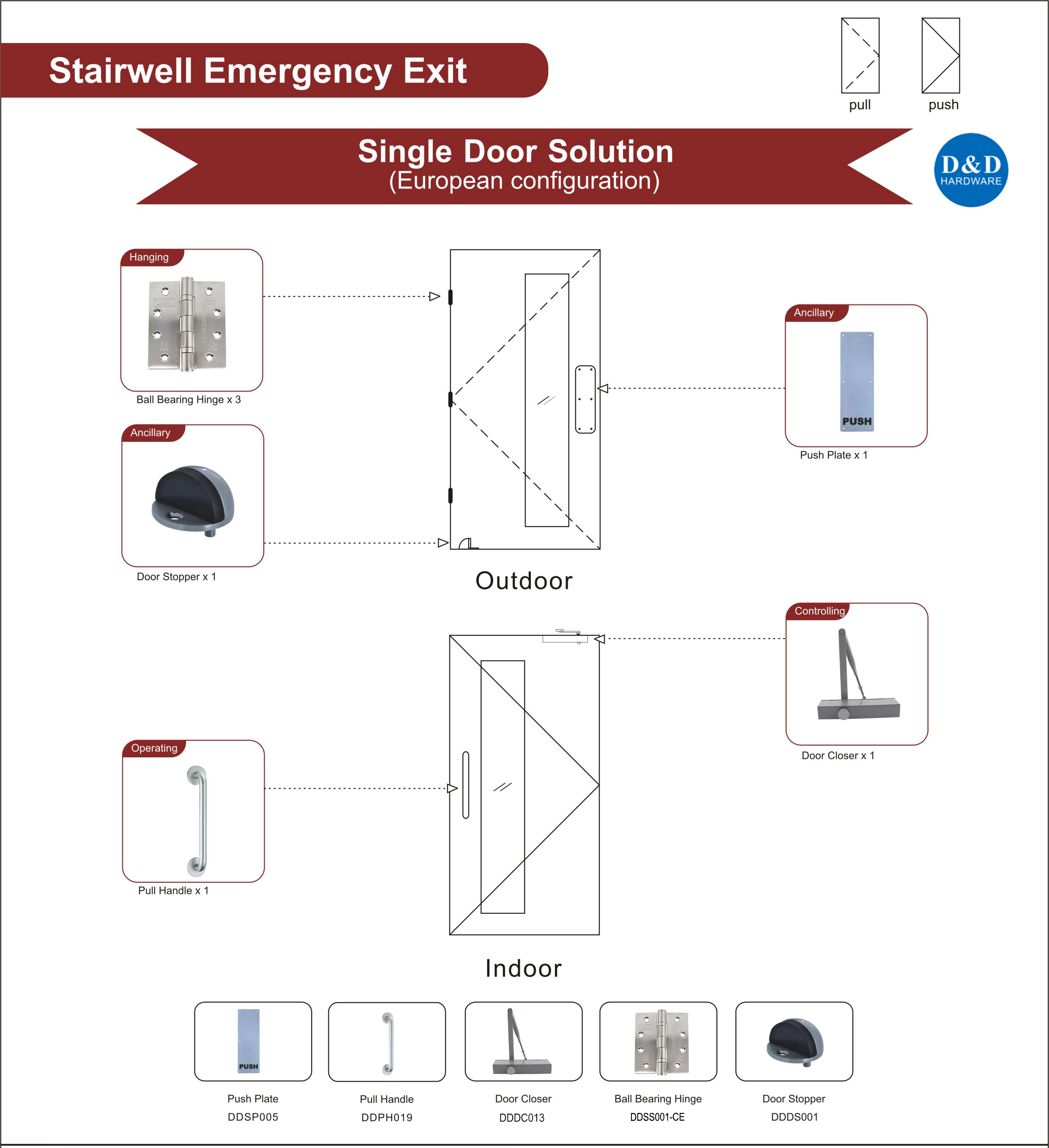
Define the Door Requirements Before Selecting Hardware
Two doors in the same stairwell may need different hardware. A door providing access from a corridor into a protected stairwell may have different operating requirements from a final exit door.
Before preparing a hardware schedule, confirm the following information:
Project Detail | Information to Confirm |
Door construction | Timber door leaf, frame construction and available fire test evidence |
Door configuration | Single leaf, door dimensions, thickness and weight |
Opening direction | Direction of escape and required handing |
Fire performance | Required fire resistance and any smoke-control requirements |
Operating function | Push/pull passage, escape release or controlled access |
Access from the opposite side | Free access, restricted access or no external operation |
Usage conditions | Traffic frequency, exposure and accessibility requirements |
The final hardware selection should remain within the scope of the door assembly’s supporting test or assessment evidence.

Typical Hardware Configuration
For a single-leaf timber fire door designed for push/pull passage without a latch, a hardware set may include the following components:
Hardware | Typical Quantity | Main Function |
Stainless steel ball bearing hinges | To suit the door specification | Support the door leaf and allow smooth movement |
Fire-door-suitable door closer | 1 | Return the door to the closed position after use |
Pull handle | 1, where required | Provide operation from the pull side |
Push plate | 1, where required | Provide a push surface and protect the door finish |
Door stop | Where required | Limit opening travel and protect adjacent surfaces |
This push/pull configuration is suitable only where an unlatched arrangement is permitted and supported by the relevant door assembly evidence. A pull handle and push plate do not release a lock or latch.
Where the opening requires latching and panic escape operation, the hardware schedule should instead include a suitable EN1125 panic exit device, together with compatible external operating hardware where required.
1. Ball Bearing Hinges: Support for the Timber Door Leaf
Hinges carry the door throughout its service life. Their size, load capacity, fixing method and quantity must suit the door’s weight, dimensions and construction.
For a timber fire door, hinge selection should also account for the door manufacturer’s installation requirements, including any specified reinforcement, fixings or intumescent protection.
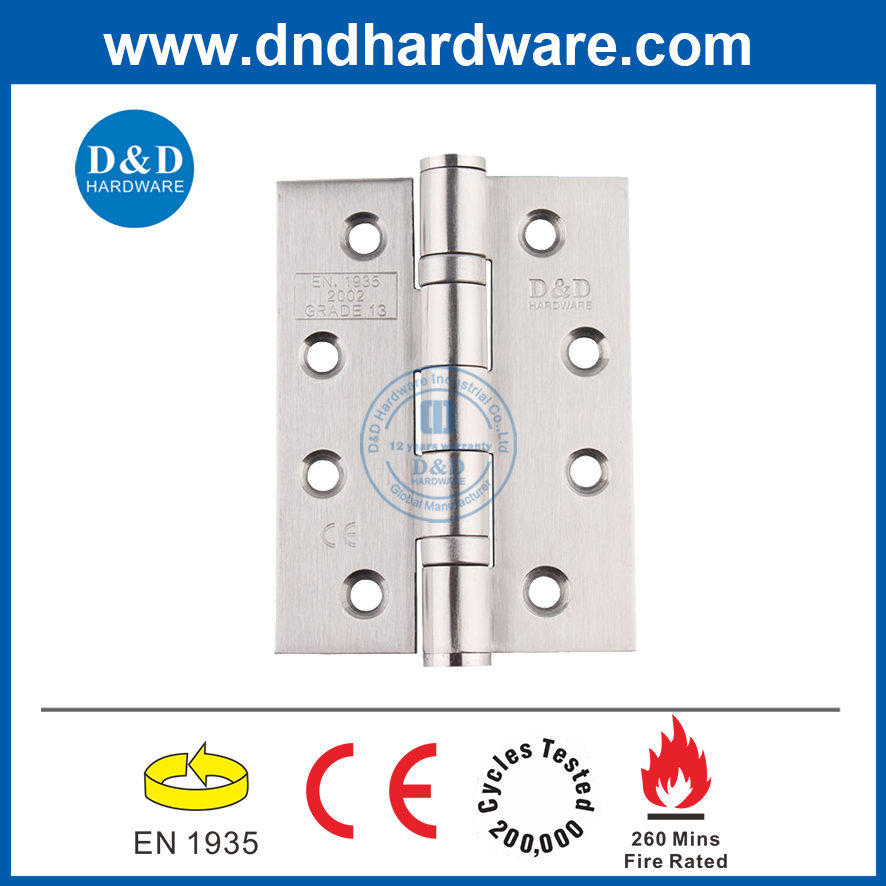
Relevant D&D door hinge test information includes:
BS EN1935: 200,000 operating cycles.
EN1634: reported fire test durations of 192 minutes for wooden door, depending on the tested configuration.
EN1670: 240 hours of corrosion-resistance testing.
These figures relate to the applicable tested products and configurations. The hinge model supplied for a project should be checked against the supporting documentation for the intended timber door assembly.
2. Door Closer: Reliable Closing After Every Use
The door closer returns the door to its closed position after people pass through. Where a latch or panic exit device is fitted, the closer must also allow the door to close and latch reliably.
Selection should consider door width and weight, mounting position, opening angle, seals and any pressure differences across the opening. Closing force and operating effort should be considered together, particularly on routes used by people with limited mobility.

Relevant D&D door closer test information includes:
BS EN1154: 500,000 operating cycles.
EN1634: reported fire test durations of 120 and 180 minutes, depending on the tested configuration.
EN1670: 96 hours of corrosion-resistance testing.
The closer should be installed using the approved mounting arrangement and adjusted on site to suit the completed door. Specifying a closer by door weight alone does not address all the conditions affecting reliable closing.
3. Pull Handle and Push Plate: Operation for Push/Pull Passage
For an approved unlatched door arrangement, a pull handle provides operation from the pull side, while a push plate provides a clear contact surface on the push side.
Stainless steel options can be selected to suit the required appearance, fixing arrangement and usage conditions. Handle dimensions and fixing positions should be coordinated with the door construction and available clearance.


These components should be selected for their intended operating function. A standard pull handle or push plate must not be treated as a panic release device.
Where a panic exit device is required, the push-side arrangement should be designed around that device. Access from the opposite side can then be specified separately.

4. Door Stop: Protecting the Door and Surrounding Surfaces
A door stop may be required to prevent the door leaf or operating hardware from striking a wall or adjacent fitting.

Its position should suit the permitted opening angle and the door closer’s operating range. Floor-mounted stops should be located carefully to avoid creating an obstruction on the escape route.
A standard door stop limits opening travel; it should not be used to wedge a self-closing fire door open.
Understanding the Test Data
Cycle testing, corrosion testing and fire testing describe different aspects of hardware performance.
Test Information | What It Helps Buyers Assess |
Operating cycles | Durability under repeated operation |
Corrosion-resistance testing | Performance under the specified laboratory exposure |
Fire testing | Performance within the particular tested assembly and installation conditions |
The figures listed above are D&D-reported results for relevant product ranges. Available results vary by model and configuration.
The fire resistance of a complete timber door assembly cannot be determined by combining the test durations of its individual hardware components. The selected door leaf, frame, hardware, seals and installation details must be supported by appropriate evidence.
For procurement, request the documentation for the exact models proposed, including applicable CE documentation, performance classifications, fire test or assessment information and installation instructions.

Request a Hardware Schedule for Your Stairwell Door
A coordinated hardware schedule helps door manufacturers and contractors confirm what is required before preparing the door leaf, frame and fixing positions.
Send D&D your door dimensions, weight, required fire resistance, project location and operating requirements. Please also confirm whether the opening needs push/pull passage, panic escape operation or restricted access from the opposite side.
D&D can help identify suitable hardware options and the supporting documentation for your project review.
Request a Stairwell Door Hardware Configuration
Frequently Asked Questions
Can a timber stairwell fire door use a pull handle and push plate?
A push/pull arrangement may be suitable where an unlatched door is permitted and supported by the door assembly’s test or assessment evidence. It should not be presented as a universal configuration for all stairwell fire doors.
When should an EN1125 panic exit device be considered?
An EN1125 panic exit device should be considered where the project requires panic escape operation using a horizontal bar. The selected model must also be suitable for the intended timber fire door application.
How many hinges does a single-leaf timber fire door need?
The quantity depends on the door’s dimensions, weight, hinge specification and supporting door assembly evidence. Use the door manufacturer’s approved requirements rather than applying one quantity to every opening.
Does a longer hardware fire test duration give the complete door the same rating?
No. Hardware test results apply to defined test configurations. The fire performance of the complete door depends on the assembly and its supporting evidence.
What information is needed to recommend a door closer?
Provide the door width, height, weight, installation arrangement, required opening angle and fire requirements. Information about seals, traffic levels and pressure differences also helps determine a suitable option.
Contact us Now:
Contact: David Jian
Mob:0086-139 2903 7292
Email: David@dndhardware.com, sales@dndhardware.com,
Contact: Jobby Zhang
Mob:0086-137 2599 9617
Email: jobby@dndhardware.com
D&D HARDWARE INDUSTRIAL CO.,LTD
ADD:12th Floor, Building 2, No.898, KeChuang Technical Zone, Jiangmen Avenue, Pengjiang District, Jiangmen City, Guangdong, China (Postcode:529000)
https://www.dndhardware.com
Tel: +86-750-3856396
Fax: +86-750-3856395


 English